
Ironically, at least this time, better than you might think!
Ironically, at least this time, better than you might think!
And this one is a big one. Heriberto Lazcano, the founder and the principal leader of the Zetas. Perhaps he’s even the big one. The real kingpin. I guess we won. Ten times is the charm.
Let’s savor our victory and bask in a new drug-free world.
Update: the body was stolen.
 Since I’m still keeping track, I thought I’d share.
A Colombian woman known as “the queen of cocaine” was murdered earlier this month. But she was murdered, not killed or captured by the good guys. (Plus technically, she would be a Queenpin, which sounds kind of funny.) So I’m not counting her. So it’s been awhile since the wheels of justice have crushed one of these evil-doer kingpins.
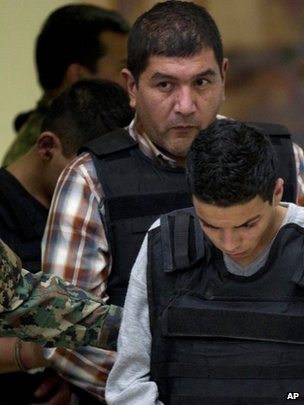
Luckily today I woke up today to see the amazing news that we’ve captured Ivan Velazquez Caballero. I mean this guy is known as El Taliban. It doesn’t get much badder than that! So by my count he’s the ninth “kingpin”we’ve put out of business in just the past two years. Of this guy, the BBC says: “He is believed to have controlled some of the most important drug routes
into the United States and ruled them with cold brutality.” Wowzahs! Mark those drug routes closed, shut, and done!
So… how’s that drug war going?
In Mexico 50,000 have been killed. But perhaps more than 100,000. With so many bad guys being eliminated by friend and foe, soon the streets will be safe!
Remember Dudas (AKA Christopher Coke), the Jamaican drug lord? He was sentenced in Manhattan (though most of his criminal acts were in Jamaica). When he was holding out in Tivoli Gardens, I did not think this he would ever be sentenced, much less by a US court.
I wonder if life today is better or worse in Tivoli Gardens without Dudas. Seriously. Seems like an important question to ask.
The Sixth Amendment states, in rather uncompromising terms: “In all criminal prosecutions, the accused shall enjoy the right to a speedy and public trial, by an impartial jury.” But the system can’t handle those rights. That’s why but a very small fraction of cases is decided by a trial, much less a jury trial (the other option is a “bench trial,” where the judge decides.
The problem is that if you choose to exercise this right, they’ll throw the book at you. Because they want you to plead guilty. From the Houston Chronicle:
“Our criminal justice system is broke; it needs to be completely revamped,” declared Terry Nelson, who was a federal agent for over 30 years and is on the executive board of Law Enforcement Against Prohibition. “They have the power, and if you don’t play the game, they’ll throw the book at you.”
Castillo maintains her innocence, saying she was tricked into unknowingly helping transport drugs and money for a big trafficker in Mexico. But she refused to plead guilty and went to trial.
In 2010, of 1,766 defendants prosecuted for federal drug offenses in the Southern District of Texas – a region that reaches from Houston to the border – 93.2 percent pleaded guilty rather than face trial, according to the U.S. government. Of the defendants who didn’t plead not guilty, 10 defendants were acquitted at trial. Also, 82 saw their cases dismissed.
The statistics are similar nationwide.
Is this case a 56-year old grandmother and first-time offender was convicted of conspiracy to smuggle a ton of cocaine from Mexico. She maintains her innocence. Had she plead guilty, she would have got a few years behind bars. But because she demanded her constitutional right to jury trial, they sentenced her to life without parole.
In a stupid way, mind you. But what I love is that if the Dutch want to regulate drugs, they can! Our illegal drugs are unregulated.
What’s ironic is that this isn’t actually about drugs. It’s much more about traffic and parking.
Also, don’t count the kips (chickens) before they hatch. I’d be shocked if this comes into effect throughout the nation and in Amsterdam.
By Cesar Gaviria, Ernesto Zedillo, and Fernando Henrique Cardoso.
Gaviria is former president of Colombia, Zedillo former president of Mexico, and Cardoso former president of Brazil. All are on the Global Commission on Drug Policy. They say:
The facts speak for themselves. The foundations of the U.S.-led war on drugs — eradication of production, interdiction of traffic, and criminalization of consumption — have not succeeded and never will. When there is established demand for a consumer product, there will be a supply. The only beneficiaries of prohibition are the drug cartels.
…
The stunning reduction in the consumption of tobacco in the Americas shows that prevention and regulation are more efficient than prohibition and punishment.
…
A paradigm shift, combining repression of the violent drug trade with increased investments in treatment and prevention, would be the best contribution that Latin America — a region that has suffered so much under drug prohibition — could make to global reform of drug policies.
[Thanks to J.B.]
Three months ago, I became president of Guatemala. And contrary to the good fortunes enjoyed by [Drug Lord “Chapo”] Guzman, I found that the justice and security systems were not what they had been 20 years earlier. Which led me to ask myself these questions: isn’t it true that we have been fighting the war on drugs these past two decades? Then, how on earth is drug consumption higher and production greater and why is trafficking so widespread?
…
Moving beyond prohibition can lead us into tricky territory. To suggest liberalisation – allowing consumption, production and trafficking of drugs without any restriction whatsoever – would be, in my opinion, profoundly irresponsible. Even more, it is an absurd proposition. If we accept regulations for alcohol and tobacco, why should we allow drugs to be consumed and produced without any restrictions?Our proposal, as the Guatemalan government, is to abandon any ideological position (whether prohibition or liberalisation) and to foster a global intergovernmental dialogue based on a realistic approach – drug regulation.
Otto Perez Molina is president of Guatemala. Read his whole article at the Guardian.
Wouldn’t it be nice if ourpresident could show such leadership?
[thanks to S.M. down under]
From the Telegraph:
Bob Carr, Australia’s foreign minister, whose brother died after a heroin overdose, has urged the decriminalisation of low-level drug use, after a report concluded the war on the scourge was lost.
His comments were at odds with Julia Gillard, the Australian prime minister, who said tough policing was the answer while the government’s chief law officer expressed a measure of scepticism about the new report.
So now we’ve got prominent leaders from Australia, the Netherlands, Mexico, Portugal, Greece, Colombia, and Brazil, not to mention the great states of New Mexico and New Jersey and UN secretary general.
Wouldn’t it be great if our federal leaders could do the same. Republicans could call off the federal war on drugs (I’m all for letting states and localities make their own laws) on the grounds of Federalism. What could be more Tea Party conservative than that?
[thanks to J.B.]
Ten beheadings in Mexico wasn’t enough to make me post…. But then killing 12 police officers who came to investigate? That’s hardcore. From the New York Times. Let me know when we start winning this war.