Justin Nix has a good article (academic, but plain English and not behind paywall) about the dangers of using cops-killing-people as a variable. He writes in response to an article by Schwartz and Jahn that maps “police violence” across U.S. metropolitan areas. Schwartz and Jahn find, as have I, that
Rates of police-related fatalities varied dramatically, with the deadliest MSAs (metropolitan statistical areas) exhibiting rates nine times those of the least deadly. Overall rates in Southwestern MSAs were highest, with lower rates in the northern Midwest and Northeast. Yet this pattern was reversed for Black-White inequities, with Northeast and Midwest MSAs exhibiting the highest inequities nationwide.
Not that I’m cited or anything — though granted this blog is not a peer-review publication — but I do believe I was the first to observe and try to raise the issue of state and city disparities in police use of lethal force back in 2015 (and everyyearsincethen). This was after the Washington Post and Fatal Encounters starting keeping a reliable count of those killed by police (starting in late 2014, after Michael Brown was killed in Ferguson). My goal has always been to have others do more thorough statistical analysis, so I’m happy it’s finally getting some attention.
What Nix does is raise some very serious and legitimate issues about what can be gained from this kind of analysis. Not to say one shouldn’t look at those killed by police, but any conclusions need to come with much larger caveats.
Nix’s first issue, however, is with Schwartz and Jahn’s term “police violence” (this and all subsequent quotes are from Nix):
Use of the term “police violence” has the potential to mislead readers who believe that police use of deadly force is rampant and usually unjustified (e.g., those who view police as “vigilantes” or “oppressors”). It also has the potential to drive away readers who understand how statistically rare police use of deadly force is, and that it usually occurs in response to violence (e.g., police officers themselves, and those who view police as “professionals”).
We in the field tend to use “police use of deadly force.” Why does this matter? Because, as Nix says, “‘police violence’ assigns all responsibility to officers, as if none of the citizens involved contributed in any way to the violence.” This contributes to a certain anti-policing narrative. But also “police violence” groups incidents in which police need to use deadly force together with incidents in which police shouldn’t have used deadly force. If cops shoot a shooter actively killing people, it seems a bit unfair to focus on the race of the shooter as causal factor.
But there is a more serious statistical problem with using police-involved killings as indicative of deadly-force situations. The problem is that “killed by police” is not a reliable and instructive variable even with regards to deadly-force encounters with police! And given that US police have literally hundreds of millions of interactions with people, fatal shootings are really rare (about 1,000 per year).
The number of times in which police might use deadly force (pointing a gun at somebody) and the number of times police do use deadly force but do not kill (more on that, later) far outweigh the times somebody is shot and killed. So we’re studying a very rare phenomenon, extreme outliers, while also missing most of the cases of exactly the phenomenon we’re trying to study.
The numerators of Schwartz and Jahn’s fatality rates are a nonrandom sample of all deadly force incidents that occurred from 2013 to 2017. To be sure, there is some degree of chance in whether a person who is shot lives or dies (e.g., whether bullets pierce a vital organ). But part of the variation across MSAs both in terms of rates of police-involved fatalities and racial disparities therein might be driven by nonrandom factors apart from police behavior. [italics added]
That’s serious, if your focus (or blame) is on police behavior. When people, myself included, compare fatal police shootings in, say, Las Vegas, Nevada, and St. Louis, Missouri, we’re assume that fatal shootings represent the number of times cops shoot people. But that’s not the case. At least in the limited cities we do know about. In some given time frame, Las Vegas police killed 47 people while St. Louis PD killed 20. So it seems like Las Vegas police shoot more than twice as often as St Louis police. But both police departments shoot just as often. The Las Vegas fatality rate (chance of dying after being shot by cops) is 41% while in St. Louis it is just 17%. And this doesn’t begin to take into account police-involved shootings where cops simply miss. (I’d guess, very roughly, based only on the NYPD concept of “object completion,” that that may be somewhere between 10% and 20% of the incidents in which police shoot.)
Similarly, based on people killed by police, Boston and Atlanta seem to shoot the name amount (not rate, just number). But in reality Atlanta police are 3 times as likely to shoot. The fatality rate after being shot by a cop in Boston is 71% while Atlanta is 24%. Why are these rates are so different? Distance to good trauma care is a proven factor, but that can’t be the only one. And we don’t have national data on this.
This is the “numerator” problem. We’re studying use of lethal force and don’t know how often it happens. Sure, being shot and killed is proxy. But how good of a proxy is it? We don’t know. Hell, only for the past 5 years do we know the number of people cops kill. So we’re forced, like it or not, to use the best data we have, the data we have rather than the data we want. Is this good enough? That’s the question. And Nix makes a good argument that the answer is “no.”
The third of three issues raised by Nix is about the “denominator.” Or, to put it another way, “Yes, the use of force is disproportionate… but compared to what?”
One can only be subjected to police force—including deadly force—conditional on interacting with a police officer in time and space. So how informative is it to calculate police-involved fatality rates for a population that is mostly never at risk? … A Venn diagram of the “at risk” and general populations would not perfectly align—instead, the “at risk” circle would be a small circle within the much larger general population circle. Perhaps some comparisons to other phenomena are in order. To estimate maternal mortality rates, researchers do not include all women in the denominator, but instead the number of live births. … To estimate the rate at which sharks bite people, researchers would need to determine who goes into the water. Studies concerned with police use of deadly force must be equally attentive to identifying a meaningful denominator.
In any given year, most people have zero chance of being killed by cops. Why? Because they don’t interact with cops in that given year. If we’re looking at individual police as a source of bias, it doesn’t make much sense to include those who don’t interact with cops. The Bureau of Justice Statistics estimates that in one year about 20% of Americans over 16 had some sort of contact with police.
We know there are racial disparities in policing based on — in addition to any active bias on the part of police — 1) people who call 911, 2) victims of crimes, 3) criminal offenders, and 4) traffic stops. And numbers 3 and 4 are related to 5) disproportionate police presence and activity in high-crime neighborhoods. We do not have reliable data on the rate at which cops interact with people. And even then, all interactions are not equal. Context matters.
The available evidence indicates that both crime reporting and proactive police stops differ systematically across racial groups. … Is the solution to ignore this mediator—which is literally a necessary precondition for being killed by a police officer—and calculate rates for the entire population (most of whom are never at risk)? If the goal is to understand and improve officer decision-making as a way to save lives, then I am not convinced. Stopping a person and using deadly force on a person are two different decision points, with different antecedents, and need to be analyzed as such.
Yes, as we like to say: it’s complicated. Comparing racial disparity to overall population figures does has its use. It describes, well, police use-of-force on a given population. But it does not explain the police part of use-of-force.
To be clear, there is nothing inherently wrong about Schwartz and Jahn’s use of population denominators in their analysis, so long as readers bear in mind there are many factors (including police behavior) that drive the disparities. I am merely pointing out that it produces rates that are not all that helpful in understanding why police-involved fatalities vary across space as they do.
If we are to move beyond shock and outrage that there are racial disparities in police use of lethal force — if we are actually going to reduce the number of people killed by police — we need to understand the “how” and “why” as much as the “what.”
Full citation: Nix J. (2020). “On the challenges associated with the study of police use of deadly force in the United States: A response to Schwartz & Jahn.” PLoS ONE 15(7): e0236158. https://doi.org/10.1371/journal.pone.0236158
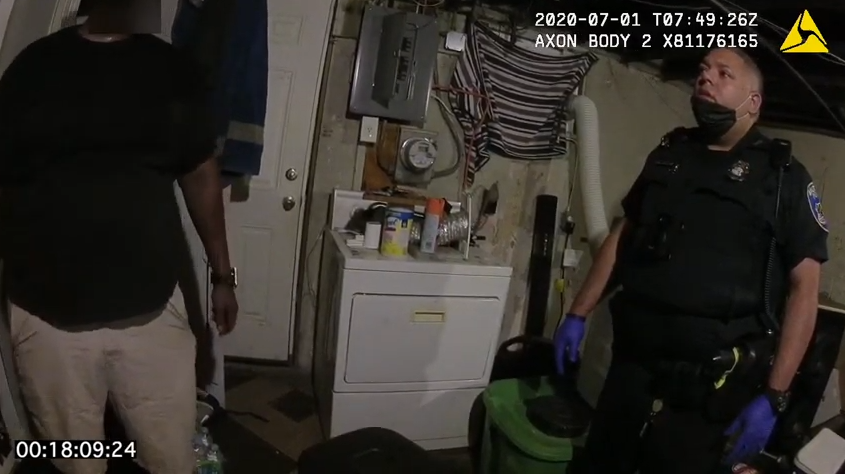
In some ways this is yet another too typical police-involved shooting (not that police-involved shootings are typical — these kind of calls get handled in the thousands “without incident”). But it’s all here: a man with a gun, mentally disturbed, confronted by police. And not for the first time. The man is black, unlike the previous one I wrote about, in Patterson, NJ, in which the man was white. Here the only white people are the paramedics. That too is not untypical.
This is not an unusual call. It’s a 3AM call for somebody in “behavior crisis.” It’s the fourth such call of the day. The previous day, June 30, there were 36 such calls. On July 1st, this is the 4,071th such call this year for Baltimore City Police. Probably (though I don’t know) this was the first to end with somebody being shot. Anyway if you don’t want cops to respond to this call, you’d need resources to handle up to maybe a half dozen of these “behavior calls” calls an hour. This is for a city of (sigh, less than) 600,000 people.
But this is worth analyzing because, well, it seems to be handled very well by police, and the mentally ill guy still gets shot. The cops do well. They treat the man as a man in crisis and not a mortal threat. they don’t dehumanize him. You don’t hear de rigueur verbal commands for the sake of “controlling the scene.” This is the midnight shift in action.The cops take their time. The cops are calm. They are caring. They try to connect with the guy. They make sure he knows they’re here to help him. They don’t have their guns out even though they strongly suspect the man is armed and turns out to be a mortal threat!
I’d like you to look at this and think, “At what point did the cops make a mistake?” “At what point would I or better yet a trained expert done something differently? Short of the guy being on his meds and/or not having a gun, how could have this turned out differently. But he wasn’t on his meds. And he does have a gun (though we don’t know that, and that’s part of the problem). And the family has tried and failed to managed the situation. So they call 911 because they help.
So we send the cops. And the handle the situation well, in my humble opinion. And a cop comes within a split-second of being killed. And the mentally ill get get shot multiple times (though lives).
When the cops enter the house, the mother-in-law warns them, “It ain’t gonna be that easy.”
The cop replies, “Nothing ever is.” Truer words have never been spoken.
The moment this becomes a lethal force situation happens so fast that I missed it more than once, trying to take notes. From police arriving on scene to shooting takes 18 minutes. But from sight of the gun to the shootings takes less than 2 seconds. Even knowing it’s coming, you’ll miss it. I guarantee it.
The other reason I’m writing a lot is to weed out the weak! But seriously, I can’t force you to watch the whole video, but if you’re still interested and willing to watch the shooting part, watch the whole damn thing. My point is not to show violence, but how to prevent it. Or, unfortunately accept that sometimes, for many reasons, it is inevitable.
After the shooting the Mayor of Baltimore says through a spokesman that the shooting was under an “active investigation.” The Maryland ACLU said: “In Maryland, this has become a disturbingly familiar pattern – where officers called to assist someone in mental distress instead trigger a crisis, failing to see the person’s humanity and shooting instead of helping. This latest incident further points out how Baltimore’s over-dependence on police is setting them up to fail, and costing unnecessary lives.” Gosh. Sounds horrible.
“This is why the ACLU of Maryland and and more than 60 other organizations across the state are demanding that the Law Enforcement Bill of Rights be repealed…. #BlackLivesMatter”
So the ACLU says this would not have happened if only LEOBOR were repealed. (Personally I’m not a big fan of LEOBOR, but that’s neither here nor there right here). The ACLU is literally taking this man’s death, a man a crisis, a black man, and using it for political gain. This needs to be pointed out. It’s a shitty thing to do. Anyway, after (hopefully) proper redactions, a few days later the BPD did release the body cam footage. As far as I know the ACLU never said anything about maybe the cops did pretty well here, all things considered.
From the Sun: The police commissioner said that after the shooting by the officers, the residence where the shooting occurred was searched and eight weapons were found, including a second weapon registered to Walker. Asked whether police should have taken steps after the first incident to determine whether Walker had additional weapons, Harrison said the investigation was “ongoing.”
The police commissioner could have should have been more laudatory about the professionalism of the officers. It’s not exactly the defense you’d like to hear from your boss after you just had to shoot someone, had your game taken away, and worry if the prosecutor will slap you with criminal charges.
Think that’s crazy? Cops fear getting in trouble not for doing wrong, but for doing right. Just one year ago Sgt. Bill Shiflett confronted an active murderer and got shot for his efforts. For his troubles, Mosby, the prosecutor, held potential criminal charges against him for 7 months. I don’t know why. You’ll have to ask her. But this is policing today.
This police-involved shooting, as is common, starts with a 911 call. It’s after 3AM on Wednesday, July 1, 2020. The call itself is very well handled. Mother in law calls and says: Last time he was drinking he had a gun. … He’s a psych mental patient. … Yelling and screaming and ranting. …Last time they give him two shots and took him to [the hospital.] …My daughter is trying to get him to come up. …My daughter’s husband is in the basement and he’s paranoid or schizophrenic. … He was diagnosed with that couple weeks ago. …He’s down in the basement and he’s like that now.
Operator: Is he having an episode or something?
Yes.
Operator: How old?
33 years.
Operator: I’m making request for an ambulance. Is he violent?
I guess. I don’t know.
Operator: Possibly or likely?
Yes.Possibly.
Operator: Does he have a weapon?
That I don’t know.
Operator: Is he thinking about suicide?
I don’t know.
Operator: Is he completely alert?
Not really. Hearing voices.
Operator: I’m going to send the paramedics and well as police. They’re going to monitor.
You should make them silent cause he’s going to go crazy when he hears.
Operator: They usually do accordingly for certain calls.
And then standard instructions are given about setting up the house and whether people have COVID. The whole call takes two minutes and thirty seconds. The cop on 414 post gets a medium-priority call for a “behavior crisis” and probably takes about 15 minutes to get there. Another officer would be assigned as backup. Usually this can of call involves standing around while paramedics do their thing.
It’s worth pointing out that all three cops parked some distance from the house, as they should… but that didn’t used to happen when I was there. Better to take a minute to approach on foot and judged the scene. Also they didn’t want to block the ambulance in. Anyway, to me it’s noteworthy. Also there were no sirens. But it’s late night/early morning. Only the ambulance has its flashing lights on. The fire department does that. Partly they just like their lights. But also it does provide a beacon to approaching vehicles, which can be life saving.
Anyway, so once the cops are there, at the front door, with paramedics, we get this additional information from the mother in law. She is on the phone with her daughter, who is in the basement with her daughter’s husband, Walker. The mother in law says the following: Running down the street acting crazy. … When the found him last time he was ranting, he had a gun. … He is a psych patient. … Down there screaming and ranting now. … He probably didn’t take his meds. “I’m doing this natural. I’m doing this natural.”He ain’t harmed nobody.… About 2 weeks ago running up and down the street. That’s him.
Paramedics know the guy from the previous week’s incident, when he was running around, maybe shooting a gun? I’m not sure. One paramedic asks the other if he is combative. The other replies, “very.” So they won’t go in. And it’s not their job. So at 5min 34sec (on Officer Gray’s bodycam, below) two police enter the house. A third joins later. This is 4 minutes after Gray got out of his police car. There’s no rush. That’s good.
Walker’s wife, the caller’s daughter, can’t get him to come upstairs. She probably been trying for hours. Eventually she concedes what she’s doing isn’t working and says cops are going to come downstairs.
When everybody gives up, cops go in. The wife can’t get her husband to come up. The paramedics won’t go down. There is no dedicated social worker cops know to call. But is that really the solution at this point? Like the paramedics, it’s hard to social workers going down without cops. And I’m not certain what they would do that the cops didn’t. The mother and father in law? God knows what they think about how they got in this situation. Pops seems to have given up. But I’m sure it’s been a very long night. Again.
So should the cops refuse to go in because it’s dangerous? They can’t. Or maybe the cops leave and say this isn’t a job for police. Except it is. Because it’s dangerous. The police are our responders. And they’re trained. Their goal is to get this guy to either calm down enough so the cops can leave and the paramedics can have a look. Or to get take the man into custody and get him safely into appropriate medical care. That’s it, right? Those are the choices.
Baltimore Police released video. This is the video from Officer Gray’s bodycam. This is the one I’m going to use. But here is the video from Officer Torand. And from Del Valle (I’m not certain why there isn’t video at the moment he’s doing most of the shooting. Could be too gory. Could be malfunction. Could be a massive cover up!… but it’s not). Here’s the the version edited by the BPD which they released for the press conference. It’s a good job and kind of covers it all. But it’s also a bit confusing since they show multiple bodycams and slow-mo and stop things down at times. But police work in real time. I like real time. Finally, here’s Justin Fenton’s article in the Baltimore Sun. (Fenton does a good job, but I don’t want that to go to his head.)
Gray asks for addition units at 5min 37sec (this is not clock time, but the time on the video, which is the after the officer started his body cam). The officer confirms the name of the man in “distress.” It’s about 4AM. Gray and another officer go to the basement at 6:15. At 6:40 they ask the wife to clear out, and they tell her that medics are there. The man’s name is Walker. The timeline below is this video. The transcript is edited and not complete. The only white people I can see are the paramedics, which isn’t that uncommon for Baltimore. I’ll leave to you to say if that matters.
This is the video that corresponds with the timeline, below.
7:30 Cops: Your family called us.
7:42 Walker: Come in front to the cameras. [This is in reference to cameras that may but probably do not exist.]
8:00 Walker: Trying to take my life. In my house illegally. And about to kill me.
For much of the time, Walker has his hands in a prayer-like position and speaks to either a non-present friend (maybe his barber?) or God.
8:25 Walker: Distorted because my wife tried to poison me.
8:48 Walker: Take your masks down.
9:23 Cops: If he takes his mask off?
9:38 Cops: Can you listen to me? I‘ll go in front of the camera if you take that knife out of your pocket.
10:10 Cops: Where are the cameras?
10:15 Walker: I know tribal tattoos when I see them.
10:17 Cops: We’re trying to help you. The medics are upstairs.
10:45 Walker: Nobody called y’all.
11:00 Walker: He’s been sleeping with my wife. Whole time.
11:20 Cops: Do you feel like you want to hurt yourself?
11:22 Walker: Hell no.
11:39 Walker: Come shake my hand like a man.
11:45 Walker: [third officer arrives about now] I don’t know him, sir. Can you take down your mask please. And if I kill you inside my house, it’s legal, yo. I’m peaceful.
At some point the specifics of the dialogue here don’t really matter. This man simply isn’t all there. Times like this were only time I was afraid as a cop. That moment when I realized that all the words I said, any empathy I had? They mean nothing. And there lots of red flags. Messianic references to rising from the dead. Threats. Paranoia. Speaking to God. None of this is a good, from the cops’ perspective. But they do their best to stay calm and get the man to comply and come upstairs.
12:14 Cops: Your family is here. If your family comes down…
12:20 Walker: I apologize come. Shake my hand. I was chastised. They poisoned me. …Take off your mask .
12:45: Cops: I took off my mask….. I can’t take off the gloves.
12:55 Walker: How’d I get to the hospital illegally.
13:12 Walker: The police are here illegally. I didn’t invite them in.
13:20 Walker: I died. I came back on the third day. On the cameras.
13:35 Walker: Every time I’m in front of cameras they still trying to kill me. The whole time they kept trying to kill me. Please they tried to kill me other day. I don’t know you. You either.
13:55 Cops: The ambulance is upstairs and we’re trying to help you.
14:10 Walker: [to the heavens] Please save my life. They’re trying to kill me in real life. On camera. I don’t know how these people got here. [yelling] Bosses only king chambers. Get out my chambers!
14:35 Walker: They’re trying to kill me in real life.
14:42 Cops: They’re the medics behind us.
14:45 Walker: How’d they get here when I didn’t invite them.
14:48: Cops: Cause your family called them.
14:50: Walker. I hate everything.
15:25 Walker: [Yelling] You can’t kill me. Everything recorded, yo.
15:55 Walker: Y’all can’t kill me in real life.
16:10 Cops: If you’re not able to go with us, then we’re going to have to put cuffs on you.
16:15 Walker: I’m on camera. You can’t kill me in real life. You gonna kill me in front of my father. It’s my real life. Can you lock them up before I die, yo?
16:47 Cops: Nobody is trying to kill you. Nobody is trying to harm you.
16:49 Walker: Everybody in my house right now. They’re moving stuff. They’re trying to kill me.
16:51 Cops: We’re trying to help you.
16:52 Walker: They’re moving stuff, you. Why y’all trying to kill me. All y’all was here the other day. Sheriffs here! Please save my life.
[Officer moves camera right to side of Walker, moves an object that we could trip over. Officer Gray silently points to two possible weapons. This is a tight team. I like that.]
17:15 Walker: Why ya’ll getting close. I died in real life. Please save my life. The sharps are here, yo. Why you moving stuff, yo?
17:30 Cops: Keep your hands out your pocket. Keep your hand out your pocket.
17:35 [officer on right move what I think is a knife from off the top of the dryer.]
17:38 Walker: I’m distorted. Everything is recorded yo. I’m distorted because these people trying to kill me. Can I get a hug, yo?
17:48 Cops: Do you want to go with the medics?
17:48 Walker: Come give me a hug in front of the camera.
17:55 Walker: I didn’t invite these people in. Quarantine and chill. I’ve been begging to chill all day.
17:56 Cops: Do you want to go upstairs with the medics?
17:58 Walker: I ain’t going nowhere. [Angry] Cause I’m all natural!
18:08 Cops: Did you take your medication.
18:11 Walker: Naw. That shit fake.
18:15. So listen. The medics are outside. Can we get you upstairs for the medics to have look at you?
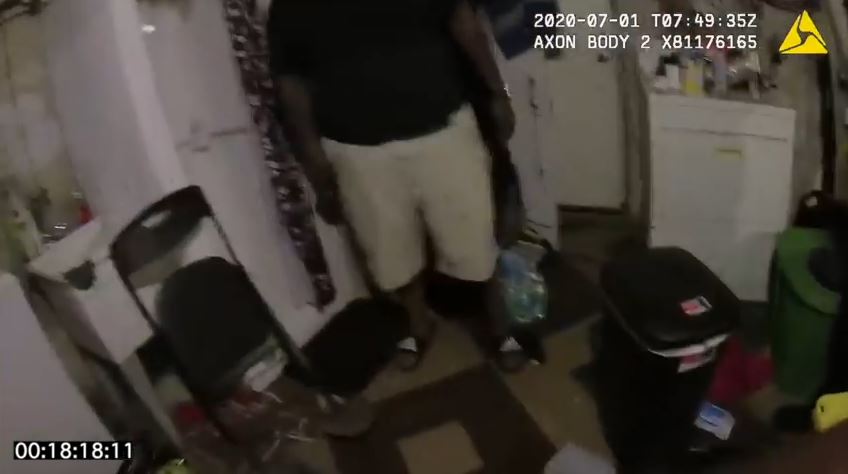
18:16:00 [Walker’s hand goes in his pocket. No visible officer has their hand on their gun. Though I would hope the third officer, Torand, the one behind Gray does have his gun in hand.]
18:17:05 [Walker’s gun is visible. And yes, here the timelines has to go into milliseconds. You’d have to watch this multiple times frame-by-frame (like I did) to see how all the cops react in sync, without saying a word, to that gun that just appeared. This is where training kicks in. There’s no hesitation. There can’t be. This whole time there, the officers were focused. Completely. And aware of their surrounds. Hyper aware.]
Oh, indeed he wasn’t just happy to see me. That was a gun in his pocket.
18:17:17 [Walker’s gun aimed right at officer’s bodycam. This image is highlighted in the BPD edited version, and for good reason. Yes, the cop is looking down the barrel of a loaded gun. In freeze frame, in hindsight, I see his finger is not yet on the trigger. The fact that Walker doesn’t have a good grip on the gun is what saves the cops’ lives. It buys them an extra second.]
18:17:29 [Cop on right starts to reach for gun. Walker’s gun is visible at 18:17:05. 1/5th of a second (00:00:20) is the standard alert human’s reaction time.]
18:18:00 [Walker lowers his arm holding the gun.]
18:18:18 [Cop on right gets to his gun holster.]
18:19:06 [Walker starts to raise gun toward cop on right.]
18:19:17 [First shot. Not clear from whom. BPD says Torent, behind Gray, fired. If so, he probably fired first. Just be happy Gray didn’t jump to his left to take cover. It’s not a good shooting position to be in. But what can you do? We see Del Valle on the right fire at least 3 rounds, the 3rd through 5th shot.]
18:19:22 [Walker is in shooting position, aimed at officer on right.
18:19:50 [A second shot is heard. I don’t from whom or exactly when.]
18:20:06 [Cop on right fires the 3rd shot.]
That little bright dot in the barrel of the gun is the muzzle flash. The recoil 1/100 of a second later
18:20:15 [Cop on right fires 4th shot.]
18:20:24 [Cop on right fires 5th shot. The cops stop shooting ends exactly 1.07 seconds after they start shooting. Why? Because in that one second the threat was no longer a threat. “Shoot to incapacitate. That’s how I was trained. They haven’t killed Walker (they could have), but they ended the threat. So they stop shooting. That’s the way it’s supposed to work. Quite often, too often, despite training, what happens in “contagion shooting.” Once one shot goes off, everybody shoots, and next you know all the cops have emptied their magazine and 1 of them somehow managed to reload and fires even more. That doesn’t happen here. It’s really impressive.]
18:26 Cops: Twenty-three [unit number], shots fired get the medics down here.
18:29 Walker: I’m still alive. You saved my life. They shot me. Please save my life.
18:45 Cop: Where’s the gun? He had a gun.
18:46 Cop: Medics!
18:46 Cop: Put him in cuffs!
Cops went from “no visible threat” to shooting in 2 seconds. In the next second cops went from 1st shot fired to 5th and last shot fired. From the first bullet, it is just 7 seconds before the cops are calling on the radio for a medic to help save Walker’s life.
In the proverbial “split second,” cops see a threat, respond, shoot, stop the threat, stop shooting, and then render aid. All this despite the fact that (presumably) none of them has ever been in this situation before.
That’s what training is about. In times of crisis it’s supposed take over, because you literally don’t have time to think. Had the officer not fired when he did, had he been just maybe 1/4 second slower on the draw. He’d likely be dead. Had Walker’s gun been just a “gun-like” object, the cops would be facing criminal charges. As I like to say, “how was your day at the office?”
I believe the gun was indeed loaded, but I don’t know that for sure. But really, does it matter? What if it had been a BB gun? Or a cell phone? It doesn’t matter. Are the cops supposed to stand there and take one in the face before returning fire? Who can watch this saying the cops shouldn’t have shot this man exactly when the did?
Anyway, these cops are tight, working together as a team. Never do they raise their voice. The communicate with each other barely saying a word. They try to connect with Walker. They say his name. Nothing works. I can’t think of what they did wrong. In hindsight, perhaps they sould have just Tazed him right off the bat. But had they done that, I would criticize them for that. Doesn’t mean I’m right. But the truth is the guy wasn’t a sure threat until he pulled out a gun. His hands were mostly in the air. He is delusional. And has worrisome fits of flexing anger. But he’s not actually a threat to cops… until he is. And the cops treat him accordingly both before and after.
In too many videos you see cops standing around after shooting somebody still shouting, “Let me see your fucking hands!” This said to somebody who may not be moving because… he’s dead or dying. But one thing BPD has been good at for decades is the first priority is always: “render aid.” [By the way, cops, at least in Baltimore, didn’t call for “medics” until veterans started coming back from Iraq and Afghanistan post 2001. Before the endless war, we just called for an “Ambo.”]
Also, does it matter that Walker was black? Did that change police behavior. The public sure thinks it does. Doesn’t seem very relevant to me here. Nor does the officers’ various skin tones seem to matter. But you know what probably didn’t help? The narrative Walker was pretty convinced of: that cops are there to kill him.
In comes down to this: this man can’t be left to his own devices, not in the state he’s in. So let’s accept that some response is needed. At 3AM. Who? Well, paramedics, of course. They respond. But they won’t go in without cops because this guy was “very” combative with them just the other week. Is a social worker or shrink going to come and calm him down? Maybe. But I doubt it. Not with the history of guns and violence. But if an unarmed social worker and psychiatrist want to go down to that basement and offer themselves up as an human shield, police will gladly stand behind them.
(Update 6/17/21: Here’s an article in the Washington Post about mental health response in Montgomery County, MD, that goes well with this post.)
So I’ve done a little work using the data from FatalEncounters.org on people shot and killed by police. Fatal Encounters is like the Washington Post database, but for adults. I combined/merged this with a city or police department’s population, number of cops, average number of murders in the jurisdiction (over 4 or 3 years), median household income, percentage Black, and percentage Latino/Hispanic. The dataset includes every city/town where cops killed somebody between 2015-2019 and also every city above 100,000 population. I end up with 2,872 cases.
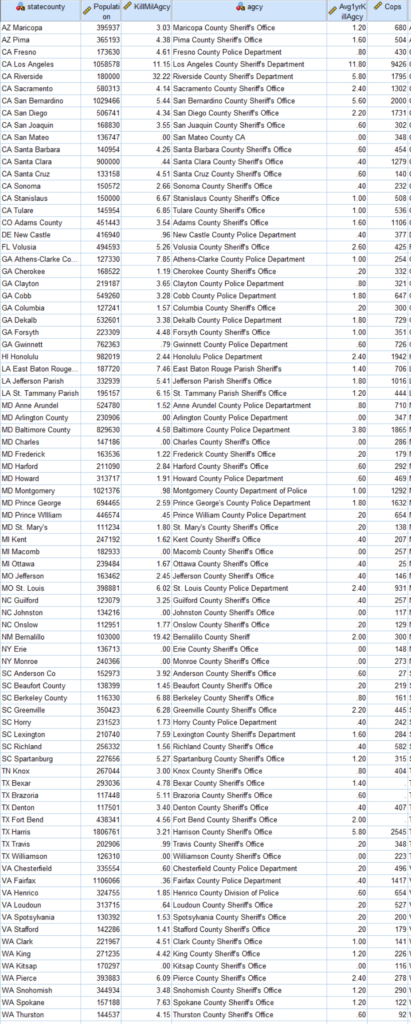
I also looked at counties, which nobody has ever seem to have done before. If you live in a state like Maryland, Texas, California or Arizona, you probably know that county police of sheriff can be the major police department. Some of the counties are huge, and their very existence is seemingly noticed by research despite the fact that there are 88 county police departments that have jurisdictions of more than 100,000 people. The police departments of 20 counties police more than 500,000 people. County data is tricky. So take this with grain of salt. Population (the denominator is the rate) is based not on the entire county but on the population policed by the department. It could be wrong (corrections welcome). And I tried to exclude jail operations from cop population (by taking only sworn officers).
LA County Sheriff’s Department kills an average of 12 people a year (2015-2019). That’s a lot. Their rate is 11 per million population (if my population figures are correct, which is tricky for county police and overlapping jurisdictions). The rate for Los Angeles City Police Department is 4.2. The national average is about 3. Riverside County and San Bernardino Counties also have very high rates. Riverside County is 32 per million, the highest in the nation. But that is only if Riverside County Sheriff’s Department polices but 180,000 people (which is the population of Riverside County minus the cities that have their own police department… but maybe that’s not a good way to figure it out; the population of Riverside County is 2.4 million). Either way, 1,795 cops killing 5.8 people a year over 5 years is a lot. That’s 1 killing for every 310 cops. In NYC, the comparable figure is 1 killing for every 4,605 cops.
The Bernalillo County Sheriff’s department (Albuquerque) has a rate of nearly 20 (per million). Three-hundred Sheriff Deputies killed 10 people over 5 years. That’s a lot. Could be bad luck. Could be unfortunate but necessary shootings in cases for which there was no less-lethal alternative. But if the NYPD killed two people for every 300 cops, it would be over 200 police-involved shooting deaths a year in NYC. Last year in NYC police shot 15 people and killed 5.
Other county sheriff departments in which there aren’t that many cops and kind of a lot of people killed are Spokane WA, Pierce WA, Clark WA, Volusia FL, and Lexington SC, King WA, and Greenville SC
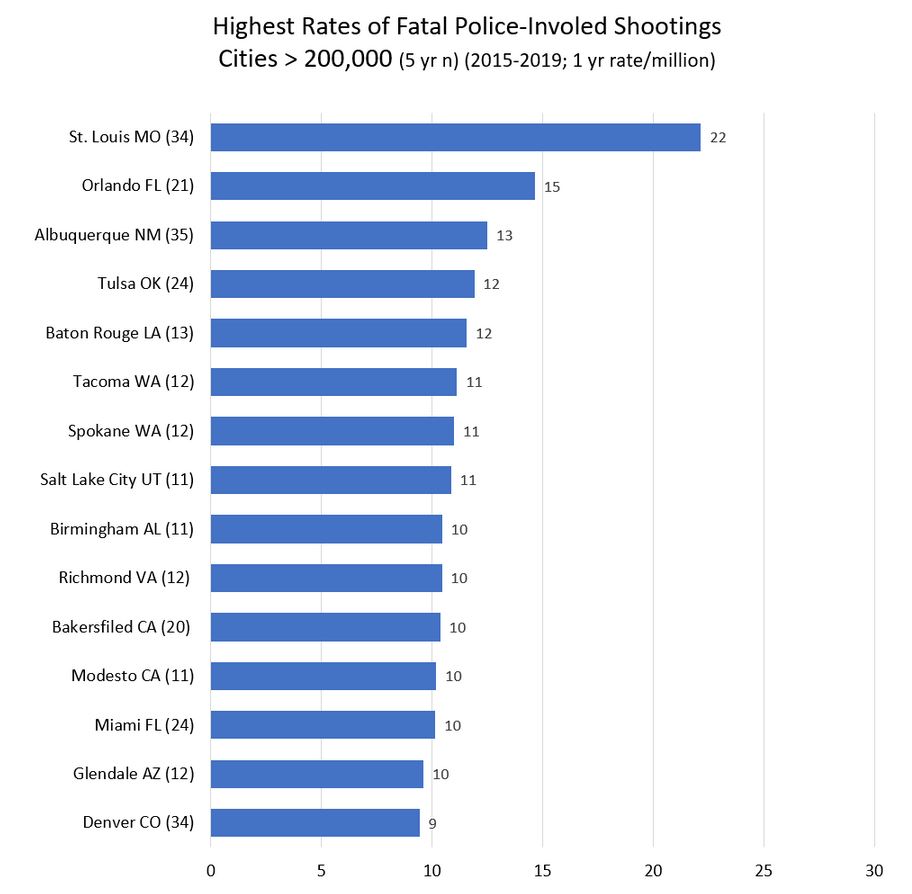
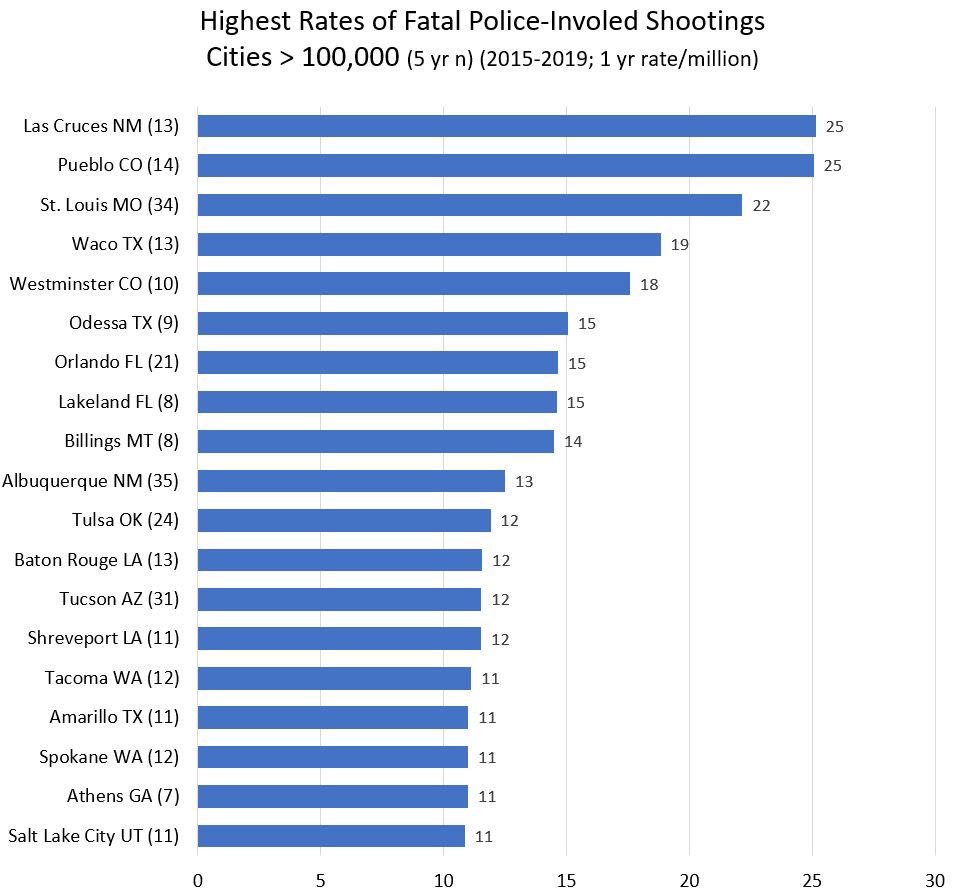
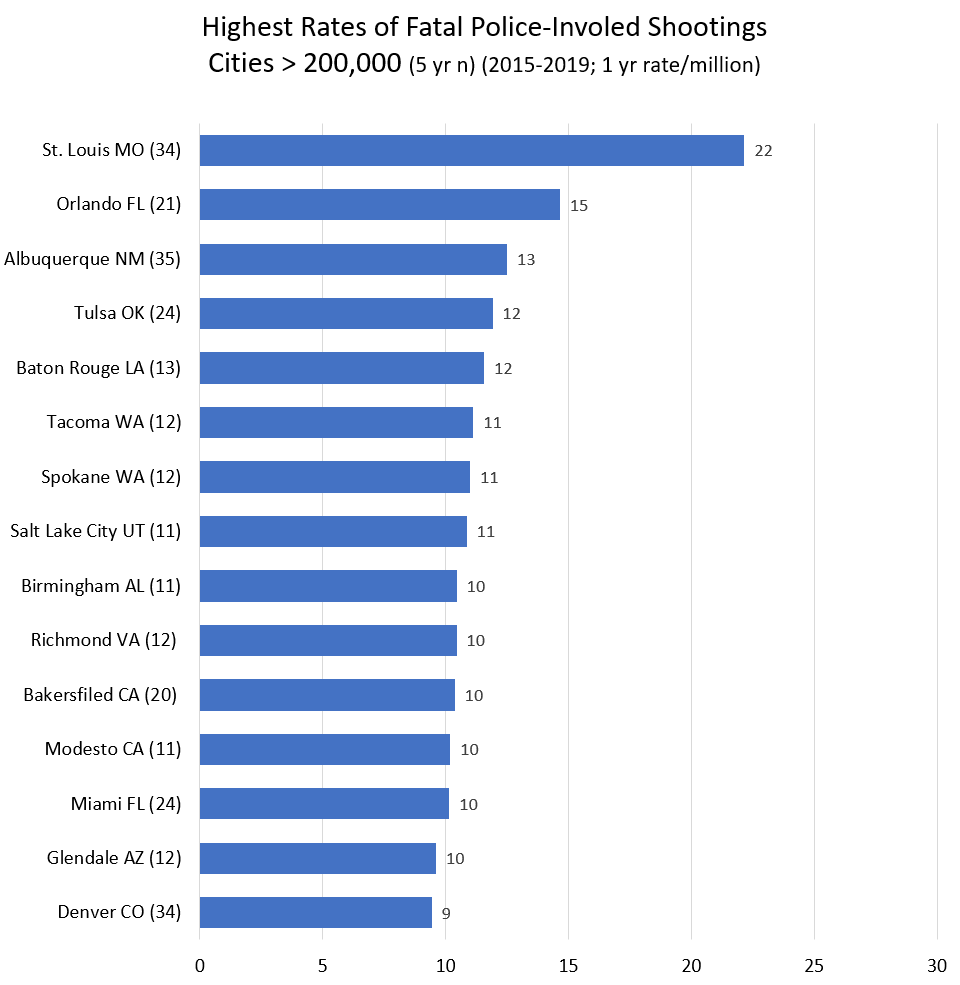
Riverside County CA and Bernalillo County NM are interesting because the largest city police departments in their county (Riverside City and Albuquerque, respectively) also shoot a lot of people (but not nearly at such a high rate). Here are the cities of over 100,000 population with the highest rate of people shot and killed by police.
Every single city on this list is west of the Mississippi (or in Florida). Every single one. The mean rate for cities in eastern states is 3.8. If you take Florida out of the east, the mean goes down to 3.5. For cities in western states, the mean rate is 5.4. That’s a big difference. (The median is 3.2 and and 4.2.) And whatever real differences account for the arbitrary geographic difference, there are many department in cities over 100,000 that shot and killed few few people from 2015-2019, or at a rate less than the national average: Plano TX, Irvine CA, Fairfield CA, Grand Prarie TX, Pasadnia CA, Mesquite TX. Were they just lucky? Or were they doing something right. Or maybe both.
Maybe population greater than 100,000 isn’t the right cut off. The top cities just make the greater than 100,000 list. The total n (for 5 years) is between 8 and 35. So a little good or bad luck can affect the rate a lot. But still, a lot of shooting goes on in cities of this size. Also, the murder rate is high in a lot of these cities… but not all of them. And the murder rate is also high in Birmingham, Baltimore, New Orleans, Jackson, and Detroit, and they’re not on the list. And a lot of cities that are on this list have very few black people (Las Cruces, Pueblo, Westminster, Billings, Albuquerque, Tucson, Spokane, Salt Lake City).
Once you start getting into larger cities, I should look not only at places where cops shoot a lot, but also at places where cops shoot very little. Sure, since shootings are rare, at might just be luck. But it might be police departments are doing something right.
Thirty-one cities have rates under 1 per million. All but 4 have fewer than 200,000 people. So maybe they’re lucky. Irvine California is on the list. But hey, Irvine is rich. But what about Hialeah FL? Or Lexington KY? Or Lubbock TX? Zero fatalities all. What about New York City? 8.5 million people. And a rate of 0.89, less than a third the national average? That’s not an accident. That’s policy, training, and leadership. Why not learn from the cities doing it right?
Βetter cities (rate < 1.5 / million, half the national average) in the 200,000 to 300,000 range (n = 52), include Lubbock, Hialeah, and Greensboro. They aren’t rich. (Irvine, Oxnard, Glendale, Plano, and Jersey City are also on the good list.) In the most-shooting category (rate > 10 / million, 3 times the national average) are Orlando, Baton Rouge, Tacoma, Spokane, Salt Lake City, Birmingham AL, Richmond VA, and Modesto CA. These are mostly middle income places with a wide variety of racial demographics.
In the 300,000 to 500,000 category (n=29), only Lexington KY and Raleigh NC stand out as better than average (rate < 2). Though Virginia Beach, Minneapolis, Pittsburgh have rates < 4. On the high end (rate > 10) are Miami, Bakersfield, Tulsa, and St. Louis. St. Louis tops the chart at a whopping rate of 22.2 / million. Though St. Louis has a terribly high murder rate of 60 (per 100,000). Though New Orleans has a high murder rate of 39,000 and a cop-involved killing rate of (just?) 4.5 per million. (The US murder rate is about 5 per 100,000.)
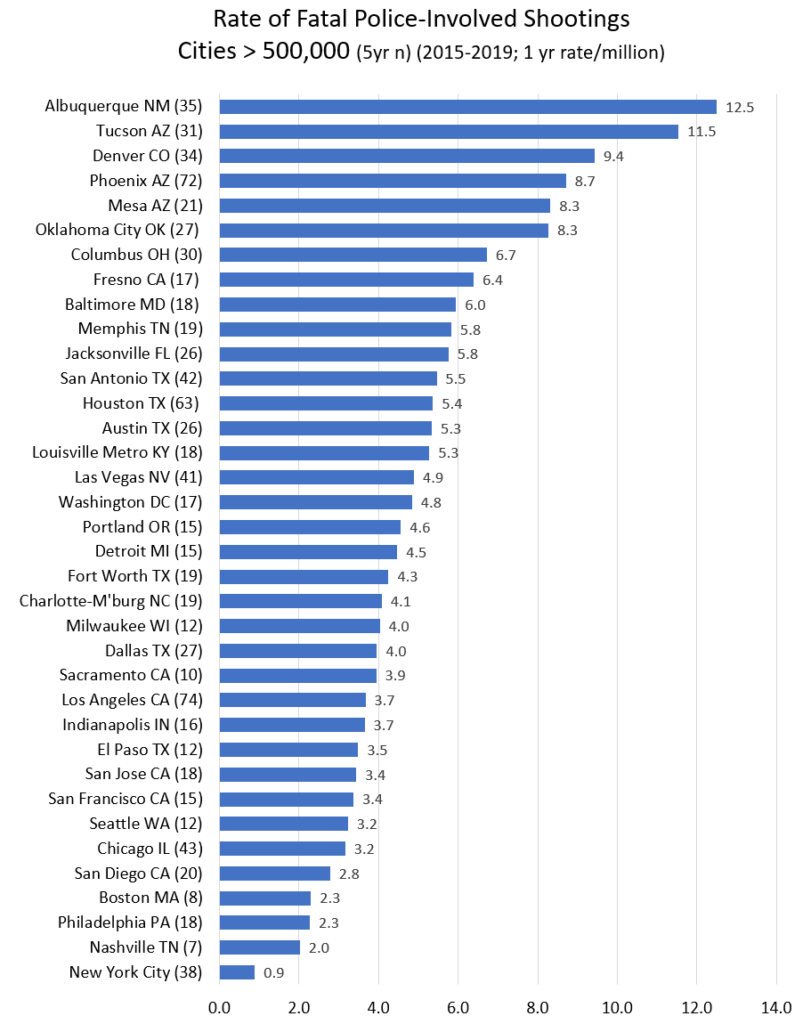
Above half a million population, the range in rates of killed by police goes from above 8 in Albuquerque, Tucson, Denver, Mesa, Oklahoma City down to New York City with a rate of 0.89. Nothing comes close. Nashville, Philadelphia, Boston and San Diego have annual rates between 2 and 3 per million.
(Note I’ve changed the scale from the above charts. The x axis went to 30. Now it’s 14.)
Keep in mind there are hundreds of smaller cities and counties between Albuquerque and New York City. But the disparity between cities at the top and bottom of the list! It’s immense. And nobody sees to be able to look up from the latest outrage and ask, why?
So let’s give credit where it is due. By my figuring these departments all have killing rates under 1 per million (and serve populations over 180,000. If my data is correct, which it may not be). Their success should be applauded and emulated:
Travis County Sheriff’s Office Montgomery County Department of Police New Castle County Police Department Gwinnett County Police Department Loudoun County Sheriff’s Office Chesterfield County Police Department Prince William County Police Department Santa Clara County Sheriff’s Office Fairfax County Police Department Monroe County Sheriff’s Office Arlington County Police Department Macomb County Sheriff’s Office Oxnard Police Department New York City Police Department Lubbock Police Department Lexington Police Department
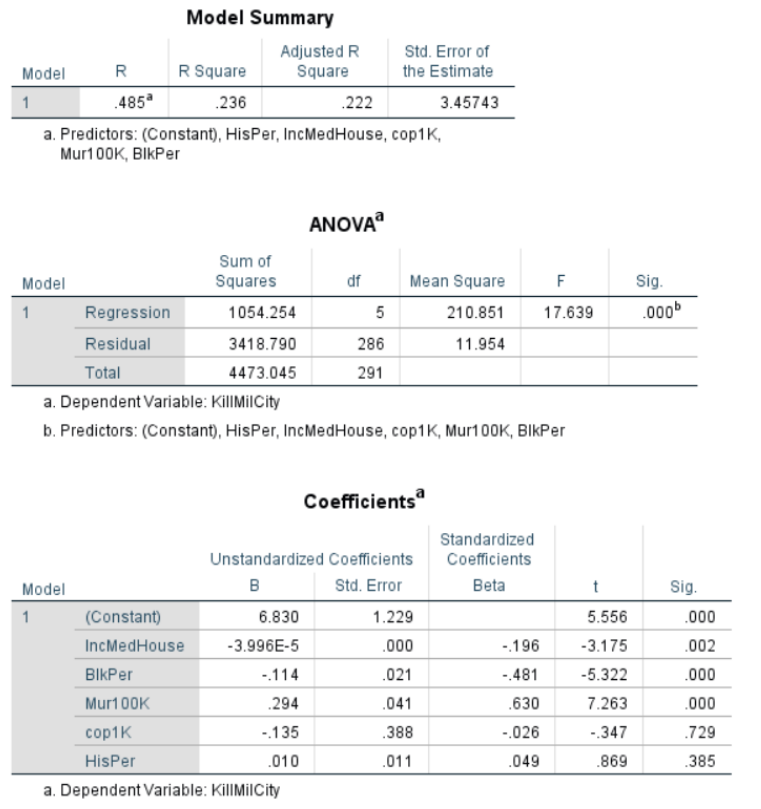
For those who understand such things, I also ran this regression for cities > 100,000. Dependent variable being the rate of police killings and independent variables being median household income, percentage black, murder rate, cops per capita and Hispanic/Latino percentage. Income matters (not a surprise). So does murder rate (obviously). But the negative correlation with Black percentage is of note. I was not expecting the lack of correlation with Hispanic/Latino percentage. My knowledge of advanced statistics doesn’t get much advanced that this, alas.
And this is all subject to errors and corrections. This a blog. Not a peer-review article. Leave a comment or better yet email me. Or twitter @petermoskos
Killed by police data is from https://fatalencounters.org/. I gave $100; you should give few bucks, too. This is really important data, and it’s all the work of one guy. Plus he puts the format of the Washington Post’s gathering of similar data to shame.
Then I filtered for intentional gun killings for each city, county, and police agency. From this I created a data set (one row) for each city, county, and/or agency. County data is tricky. Best I could, I figured out the population policed by large police agencies. But it’s not an exact science. (Basically take a county and subtract the cities and towns that have their own police.) There’s a lot of overlapping jurisdiction. There’s also the issue that a lot of sheriff department are responsible for jails, and I tried to exclude correctional officers (by leaving out non-sworn employees). But then in the end it turns out the number of cops per capita seems to not be that revealing, other than being correlated with murders per capita (yes, cities with more murders have more cops, presumable in that direction of causality).
It’s also likely that some of the counties shouldn’t be included because their work is limited to courts and jails. Some of the police in these counties probably aren’t doing active policing, and hence shoot nobody. Also, murder data is probably accurate, because it comes from county departments reporting. And departments don’t generally claim other people’s murders. And some county department just don’t report any data. So some of the rates may be wrong. Long way of saying take county data with a grain of salt. But it’s still worth looking at.
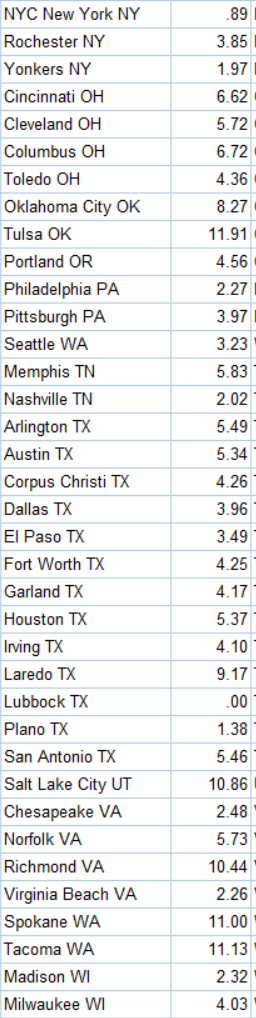
[Update] Here are the rates for every city in America with more than 200,00 people. Because somebody asked requested. This is the annual rate of people shot and killed by cops (2015-2019) in this city. Rate per million.
Here’s county data. (Sorted by state, then city). Here I am including more data because I’m not confident about these rates. What is correct is the number of people killed by the agency in 5 years (Avg1yrKillAgcy). I’m not certain about the rate (KillMilAgcy) because I’m not certain about the population policed (Or the number of cops). If you know better, let me know.
Here’s some fancier statistical regression courtesy of Professor Gabriel Rossman. This is a work in progress.
I think we get a few things from the Poisson:
The satisfaction that it’s done right, or at least that it’s less wrong.
Cops/1000 population is now significant. Given that the specification is technically better, as in the data better fit the model’s assumptions, you can probably trust this, or at least trust it at least as much as you could the OLS of rates
You no longer need to worry about small n and zeroes biasing the models which means that even with a rare event you can include small cases. You no longer need to drop Mayberry from the dataset though obviously data cleaning is a pain with a bunch of small towns.
12/7/2020 KillMilCity and KillMilAgcy are deaths as police homicides per million population.
Reasonably good match for Moskos’s 7/5/2020 blog post but numbers aren’t exact. Perhaps it’s minimum population of 100,000 (blog) vs 150,000 (this notebook). Alternately may be a counties issue.
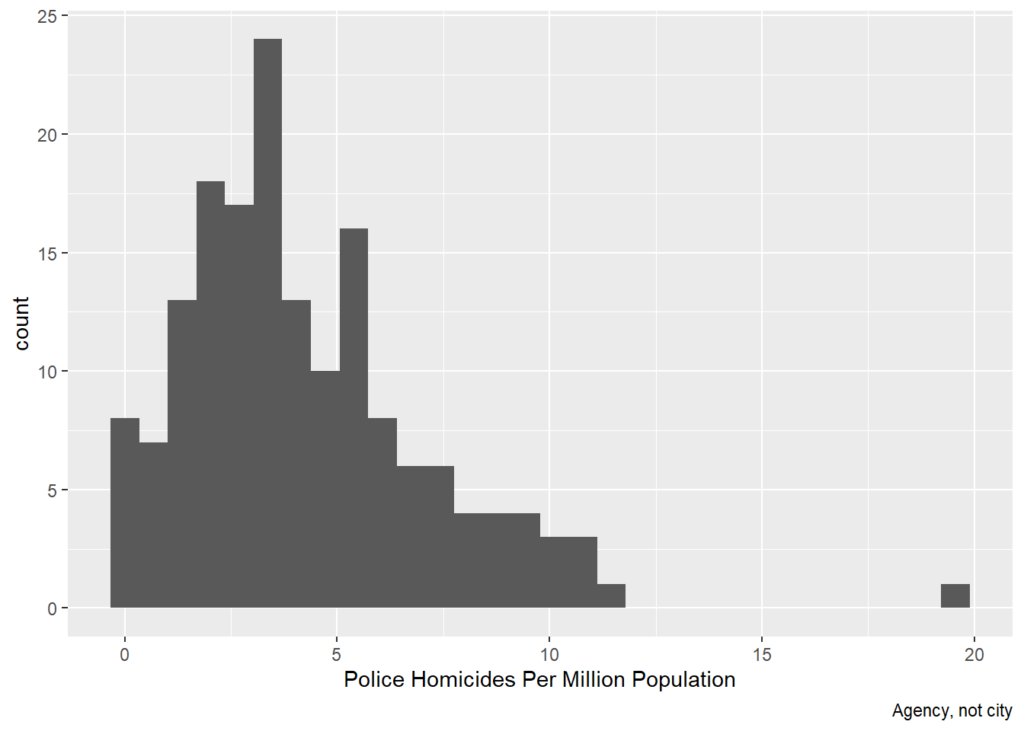
cops %>% ggplot(aes(x=KillMilAgcy)) + geom_histogram() + labs(x='Police Homicides Per Million Population', caption='Agency, not city')
## `stat_bin()` using `bins = 30`. Pick better value with `binwidth`.
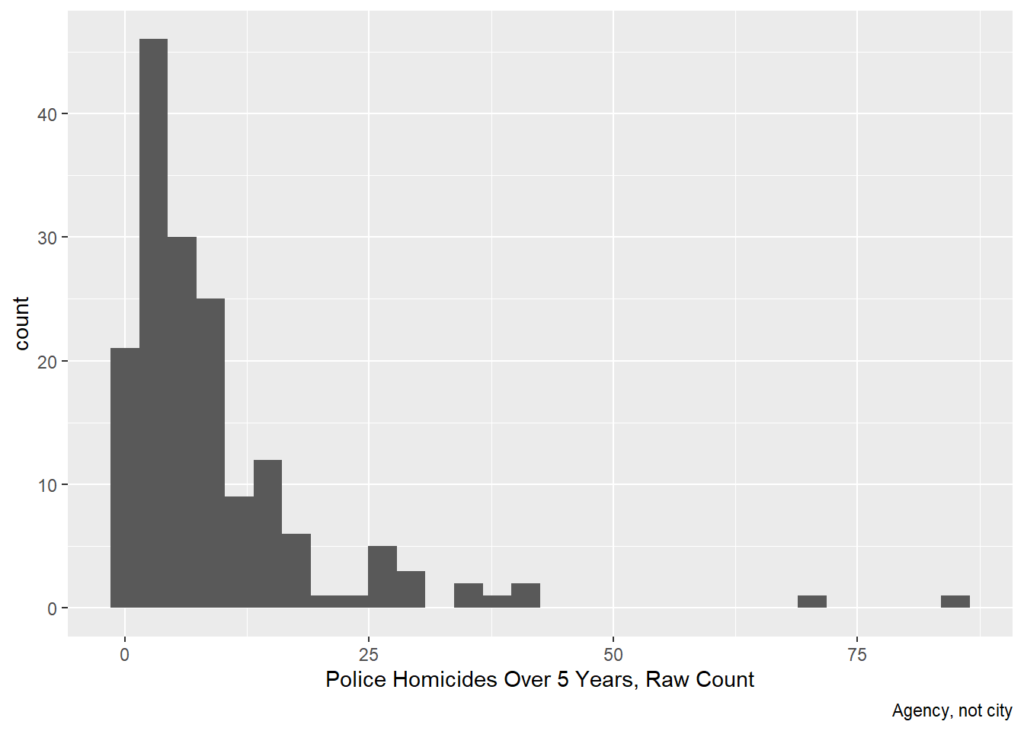
cops %>% ggplot(aes(x=killedByAgency5Yr)) + geom_histogram() + labs(x='Police Homicides Over 5 Years, Raw Count', caption='Agency, not city')
## `stat_bin()` using `bins = 30`. Pick better value with `binwidth`.
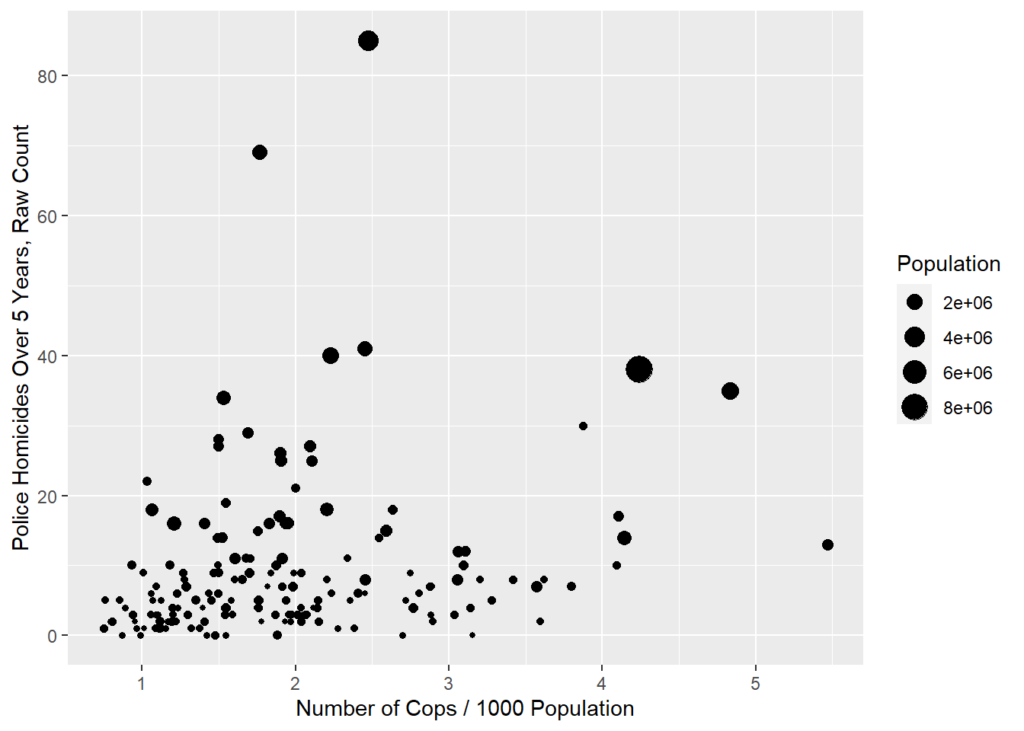
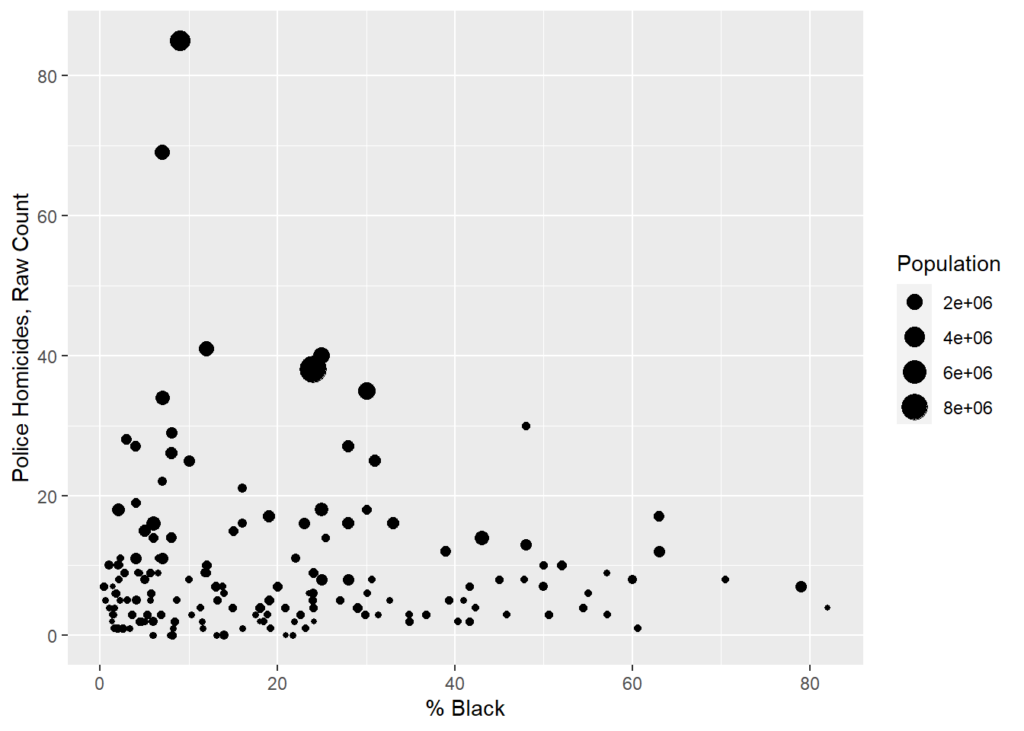
cops %>% ggplot((aes(x=cop1K,y=killedByAgency5Yr,size=Population))) +
  geom_point() +
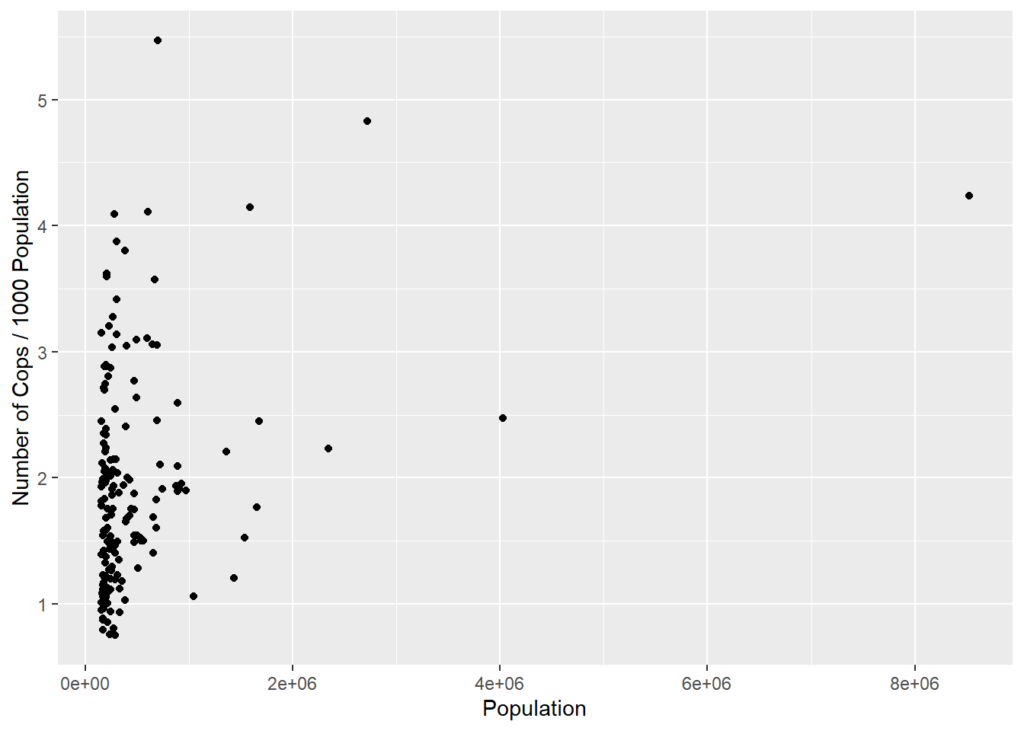
  labs(x='Number of Cops / 1000 Population',y='Police Homicides Over 5 Years, Raw Count')
Because police homicides are events, they can be modeled with a count model. Assuming the events are independent net of observables, a Poisson is appropriate. This seems consistent with the histogram. If the histogram were much more right-skewed or if there were strong theoretical reasons to think police homicides were not independent, then a negative binomial could be appropriate.
Because cities/ agency jurisdictions vary wildly in size, it’s best to include population as an offset to model the different exposure. That is, more people means more people at risk of getting shot by cops and the model accounts for that.
Compared to the OLS analysis of rates, the Poisson analysis of counts is similar but now everything is significant, including number of cops and percent Latino, both of which are negatively associated with the counts of police homicides.
##
## Call:
## glm(formula = killedByAgency5Yr ~ IncMedHouse + BlkPer + Mur100K +
##     cop1K + HisPer + offset(log(Population)), family = "poisson",
##     data = cops)
##
## Deviance Residuals:
##     Min       1Q   Median       3Q      Max
## -3.9061  -1.2174  -0.1628   0.9152   3.3863
##
## Coefficients:
##               Estimate Std. Error z value Pr(>|z|)
## (Intercept) -9.609e+00  1.748e-01 -54.973  < 2e-16 ***
## IncMedHouse -1.068e-05  2.140e-06  -4.993 5.95e-07 ***
## BlkPer      -2.789e-02  3.018e-03  -9.242  < 2e-16 ***
## Mur100K      5.070e-02  3.583e-03  14.149  < 2e-16 ***
## cop1K       -2.050e-01  3.459e-02  -5.926 3.10e-09 ***
## HisPer      -5.088e-03  1.536e-03  -3.312 0.000925 ***
## ---
## Signif. codes:  0 '***' 0.001 '**' 0.01 '*' 0.05 '.' 0.1 ' ' 1
##
## (Dispersion parameter for poisson family taken to be 1)
##
##     Null deviance: 654.06  on 164  degrees of freedom
## Residual deviance: 369.63  on 159  degrees of freedom
##   (1 observation deleted due to missingness)
## AIC: 960.63
##
## Number of Fisher Scoring iterations: 4
Percent Black vs Murder Rate
There is a 0.772 correlation between % black and the murder rate, which suggests possible collinearity. As such,
Note that the murder only version has a lower AIC so if forced to choose that’s the better model. Also note that when only one at a time is included, murder remains positive and black remains negative. Whatever is driving the murder and black effects, it is not collinearity.
cops %>% ggplot((aes(x=BlkPer,y=Mur100K,size=Population))) +
  geom_point() +
    labs(x='Percent Black',y='Murders per 100,000')