Category: Police

  • It’s the criminals, stupid. (Or why cops don’t stand for gun control)

    In reaction to this Missouri law, a friend of mine asked me “why police are not standing up to the gun lobby more vociferously and effectively? It seems to me that their jobs are made immeasurably harder and more dangerous by rollbacks in gun laws such as this.” You’d think, she said, police would want fewer guns out there that could kill them. But generally that’s not the case. My reply:

    Partly because there really isn’t any real national police organization to do the standing. And I wouldn’t want a representative national police organization talking about politics, because if such an organization existed, we wouldn’t like what they have to say. [And as if on cue, the FOP came out endorsing Trump. I was hoping they’d keep their mouth shut on that one.]

    There’s the IACP (Int’l Association of chiefs of police). But it’s not like they have a lot of Clout. And this law was opposed by Missouri’s Police Chiefs Association, says the story. I suspect they carry about 20 votes. And organizations of “chiefs” are more Left than their rank-and-file, because a lot of chiefs are appointed by politicians, and have to represent their beliefs.

    Then you’ve got the police unions (the PBA and FOP). They’re technically apolitical, though very much politically conservative. Like any union, there’s a question over how much they should venture beyond working conditions and pay and the like and speak on national issues. Far be it for me to speak for a million cops, but I think most cops do support some gun regulation — and thus oppose what Missouri did — but given the either/or choice between “all guns banned” and “no gun restrictions,” most cops would go with the latter.

    So then we just delve into the gun control debate with all the usual and predictable sides and lack of progress. Cops see danger coming from a small subset of criminals with guns, and not guns in general. Remember: police officers and all their friends are (for the most part) legal responsible gun owners. Cops want laws to focus on criminals and crimes, rather than guns. Collectively, most cops are incredibly pro-gun and equate the 2nd Amendment with freedom (just as you and I might do with the 1st Amendment). Inasmuch as gun laws are seen to infringe their rights while doing nothing to prevent criminals from shooting each other and shooting cops, cops aren’t going to support it.

    Consider this: there are (almost) no shootings in Chicago or New York or Baltimore that involves a legally possessed handgun. We’ve already “controlled” these guns and made them illegal. So what would passing *more* restrictive gun laws do to stop this violence? Are we going to double-dog-dare make them illegal? They’re already illegal. We don’t prioritize the laws we do have.

    How can we take guns out of the hands of criminals? (Or get criminals to use them less?) That’s the $64,000 question. Most gun-control laws are close to irrelevant here. Perhaps the only way to get guns out of the hands of criminals is to confiscate guns with strong gun control, Australian style. Many people, myself included, like this idea. But the majority of Americans and the current Supreme Court would not agree.

    The basic ideological divide is that liberals see guns as the problem and conservatives see criminals as the problem. And nobody on either side has a good plan to keep guns out of the hands of criminals.

    There are three-hundred million guns in America; ten-million guns are manufactured every year! And yet only about 10,000 of these gun are used to murder somebody (plus suicides, of course). How many millions of guns would we have to confiscate before we prevented a single gun homicide? And how would we go about doing this?

    Most proposed gun-control is pretty useless in actually preventing crime (as opposed to preventing a small number of gun sales.) And gun people see this as an ideological battle on gun-owners, so they won’t give in (even on so-called “common-sense” issues). The political reality is that there’s no way right now we could enact gun control so restrictive it would actually do any substantial good.

    Common ground? Maybe actual jail time for people who carry illegal guns? Would liberals support more mandatory sentences for those caught with illegal guns? Without exception? I suspect such a practice did actually contribute to the crime decline in NYC. But you try throwing the words “mandatory minimum” into a room of urban Progressives and see the response you’d get! (The key here is mandatory; the minimum doesn’t have to be long.)

    If gun-control advocates maybe first agreed that criminals with illegal guns are a bigger problem than guns, maybe some political compromise could be reached. I’m afraid gun-control has become a harmful distraction to real issues that can save lives now.

    This past Monday in Baltimore, a 64-year-old man was robbed and attacked while reading a book in a park. A group of young people placed a gun to his head, stabbed him, sprayed him with mace, took his stuff, and then, just for kicks, stabbed him again. That’s just a normal crime, right? But what makes this shocking is less the crime than the girl that was there to film the crime and post it on facebook (which she did)! And this wasn’t their only recent crime.

    I have no clue what gun-control law is going to stop this from happening. Or what law would keep the 13-year-old armed robber with a gun in Ohio (who was just killed by police) from getting his hands on the BB-gun replica he had? And yet there’s more outrage from the Left about police killing this kid armed-robber who had a gun (albeit one that turned out to be non-lethal) than about actual armed robbers.

    Here’s what scares me right now more than guns: the potential right-wing law-and-order backlash. The official 2015 crime data comes out, get this, the day of the next presidential debate. Homicides are way up in America. We know this. Black homicides in particular. It will be the largest increase in decades. And yet the Left has been in denialabout this (and/or discounts its significance). By talking about guns rather than crime, we’re virtually conceding law-and-order issues to Trump and the fascist Right. Politically and morally, this is bonkers.

    [Unrelated, I suspect the phrase “It’s the ______, stupid” is long dated and most people don’t understand it or know its Clinton-Era origin.]
  • Legal weed means 25% fewer overdoses

    This is pretty striking data, as published in JAMAand reported in Newsweek. From JAMA:

    States with medical cannabis laws had a 24.8% lower mean annual opioid overdose mortality rate compared with states without medical cannabis laws. Examination of the association between medical cannabis laws and opioid analgesic overdose mortality in each year after implementation of the law showed that such laws were associated with a lower rate of overdose mortality that generally strengthened over time.

    Medical cannabis laws are associated with significantly lower state-level opioid overdose mortality rates. Further investigation is required to determine how medical cannabis laws may interact with policies aimed at preventing opioid analgesic overdose.

    It’s not rocket science to figure out a likely cause-and-effect.

  • White-On-White Crime (lots, but without homicide)

    [This relates to my previous post]

    Years ago, like when I was 13, I was with my father, driving from NYC to Chicago, on a baseball road trip (he drove). Between Philadelphia and Pittsburgh, we spent one night in Johnstown, PA. (Remember the Johnstown Flood!). After watching the Johnston Jonnies play baseball, we had dinner in a local bar. My father, known for being gregarious and getting along with all races, religions, and education levels, looked around at the pale depressed clientele and said to me in a hushed tone, “These are not my people.” It’s the only time I ever saw him uncomfortable in a crowd.

    Based on my last post, I looked up East Liverpool, Ohio. It’s very white (93 percent) and quite poor. The median household family income of $23,138 is about half the national average. A quarter of the population (and 35 percent of children) are below the poverty line. The population of 11,000 is down from a 1950 peak of 24,000.

    East Liverpool is the biggest city in Columbiana County, which seems to straddle coal, rust, and rural. The county has a total population of just over 100,000 people and is 96 percent white. It’s also poor, with a median family income of just $34,200 (but interestingly, the poverty rate is below the national average). And it’s increasing Republican. It’s Trump country.

    What I’m saying is, kind of like Obama and Clinton, I’ve never felt much kin with this part of America (the Appalachian Scotch-Irish folk of southeast Ohio, northern W. Virginia, and southwest Pennsylvania). If they’re more worried about immigrants, gun rights, and encroaching Sharia Law than about moving forward and letting people help them get out of poverty and not overdosing in from of their grandson, I’m inclined to let them be and not give a damn.

    But here’s the thing. No matter how hopeless and messed up things might be in East Liverpool and Columbiana County, Ohio; no matter how the jobs are gone; no matter how loose the gun laws are; no matter where junkies are shooting up; no matter how much crime there is; no matter how forgotten by the government and mocked by east-coast elites they might be, the good folks of Columbiana County somehow manage not to murder each other. And there is crime in East Liverpool, Ohio. In fact, if the data is accurate (and that is a big if, coming from a small place), the violent and property crime rates of East Liverpool are twice the national average.

    Neighborhood Scout (not exactly an ideal academic source) puts it this way:

    With a crime rate of 53 per one thousand residents, East Liverpool has one of the highest crime rates in America. With a population of 10,951, East Liverpool’s [crime rate] is very high compared to other places of similar population size.

    Best I can tell, this entire county of about 100,000 has maybe one homicide a year. Some years there seems to be none. Other years maybe two. (I’m basing this on Columbiana County, East Liverpool, and Salem City police departments). This homicide rate, 1 per 100,000, is about 1/4th the national average.

    Meanwhile, Baltimore City has a poverty rate lower than East Liverpool. Baltimore’s median household income is higher than East Liverpool. Hell, the average income even in poor East and West Baltimore is higher than East Liverpool. And yet in the past 365 days (Sep 10, 2014 to Sep 10, 2015) 329 people in Baltimore have managed to put themselves in harm’s way and get killed. Now Baltimore has more than six times the population of Columbiana County. So if Baltimore were 1/6th the size, it would have 55 murders. Columbiana County has 1.

    Even whites in Baltimore managed to get murdered 17 times last year. That’s of course a fraction of the number of black homicides, but whites in Baltimore (fewer than 200,000) get murdered eight times as often as the good folks of heroin-addicted poverty-living can’t-find-work police-are-asking-for-help Columbiana County.

    What gives?

    Baltimore City has more unemployment (7.4 percent vs. 5.3 percent). Yeah, sure. And there’s more poverty and extreme poverty in Baltimore. I’m not saying that doesn’t matter. But deep down, no. Poverty is a red herring. Culture matters. Columbiana County’s unemployment could be 20 percent and the murder rate would still be lower that Baltimore City.

    There’s something else going on. The nexus of violence is not poverty and racism but public drug dealing and drug prohibition. I suspect addicts in Columbiana County buy their heroin from friends and family and coworkers. Not from Yo-Boys on the corner. Push drug dealers inside and violence plummets. But when police try and do that in Baltimore, the DOJ complains about systemic racism.

  • “We Need Help”

    “We Need Help”

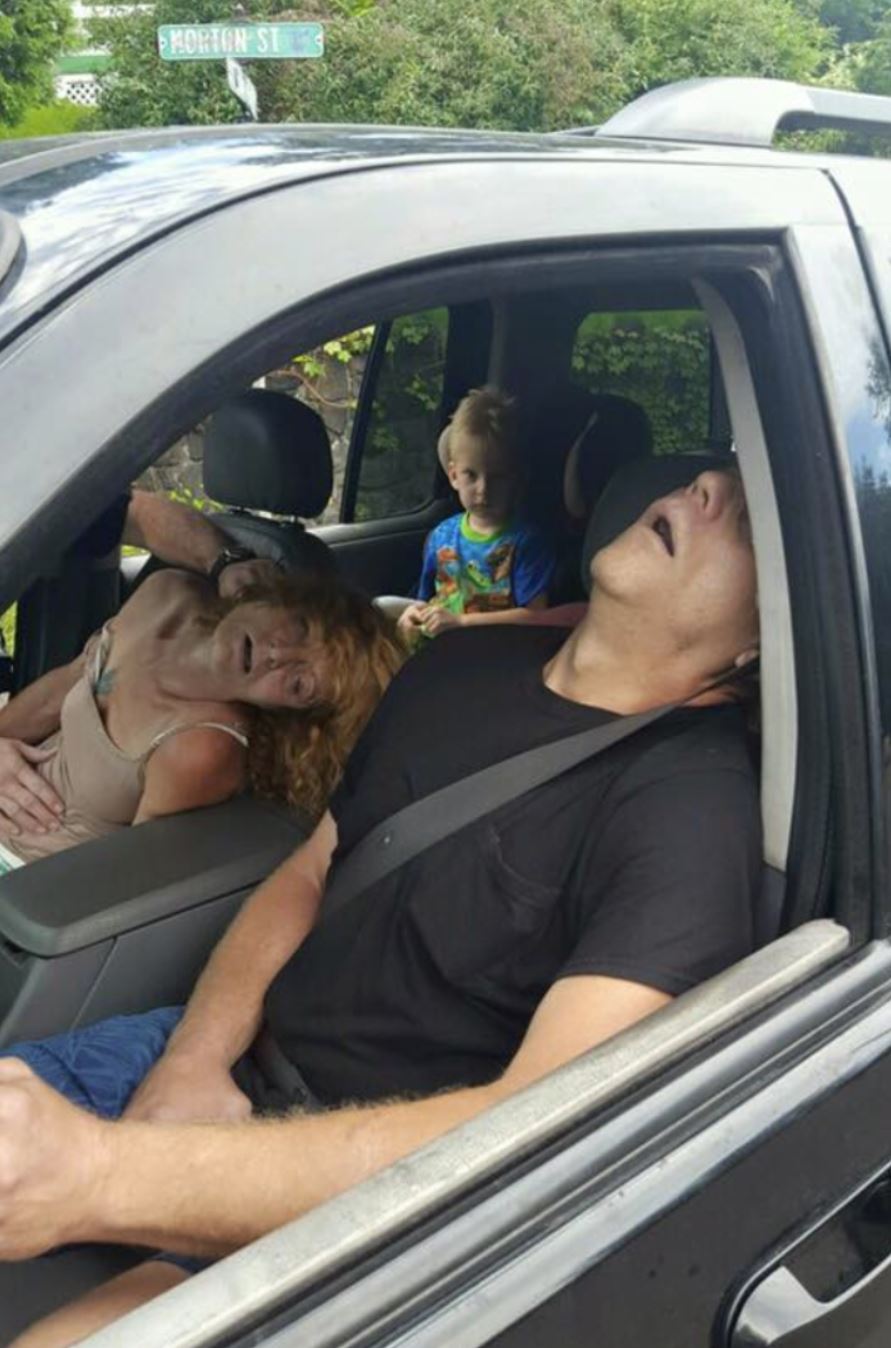
    This picture of adults overdosing when a kid in their car has been making the rounds since police in East Liverpool, Ohio, posted it on facebook.

    The police department wrote:

    We are well aware that some may be offended by these images and for that we are truly sorry, but it is time that the non-drug-using public sees what we are now dealing with on a daily basis. The poison known as heroin has taken a strong grip on many communities, not just ours. The difference is we are willing to fight this problem until it’s gone and if that means we offend a few people along the way we are prepared to deal with that.

    Normally I wouldn’t consider this event or picture blog-worthy. But I just heard an interesting interview on All Things Considered with the East Liverpool Chief of Police, John Lane. In part:

    Chief Lane: We knew the photos would be shocking… We need help. We’re strapped with resources as far as trying to handle this kind of thing. And I don’t think the public is aware of the problem…. That’s his grandmother, not his mother. And she has custody of him…. He needs to be removed from the environment he’s in. He needs to be put in a safe loving environment.

    Q: Is this about shaming?

    Chief Lane: I don’t think it’s about shaming. It’s to make people aware…. He was sentenced to 360 days. That’s part of the issue here, too. You’ve got an obvious, a person who has an addiction. If you could have some sort of treatment there while he’s in jail, so when he comes out he’s not going right back to this. Some way to work and try to get off of this addiction.

    Q: Is treatment in available if he wanted that?

    Chief Lane: Not here. We don’t have any resources. Even if somebody comes down to the station and knocks on the door and asks for help. Where do we send ’em? We have nothing here, in our county…. We need resources, is basically what it boils down to. We have an understaffed police department, we’re constantly chasing one overdose after another. He had half a dozen over the weekend. One person passed away.

    Q: What have you heard from the state or your local congressman? People who can take action here.

    Chief Lane:I’ve heard nothing. In our little community here we don’t have the resources here to deal with it.

    And in searching for the picture, lots of similar cases popped up:

    December, 2015, Pittsburgh, “A woman who had overdosed on heroin in Pittsburgh’s Morningside neighborhood Thursday afternoon was revived, after her 8-year-old daughter ran to get help.”

    February, 2016, Grand Traverse, Michigan. “The woman also had her 6-year-old son in the car.”

    July, 2016, Burlington, Vermont. “Police were called to the downtown parking lot of Pearl Street Beverage and Lakeside Pharmacy for the report of two people in a semi-conscious state in a car with a [five-year-old] child in the back seat ‘screaming for help.’”

    There’s still the basic and false belief among too many people that somehow, somewhere, there are “programs” to help people. Or that the criminal justice system is a system with so single goal in mind. Like police arrest you, you do time, and you come out better for it. It’s not true. And it never has been true. Sure, sometimes there’s a program here or a grant-funded thing there, but basically, no. There’s nothing. It doesn’t matter what the problem is — crime, drugs, mental illness, poverty (or all of the above) — when somebody calls 911, police will show up. But then what? A lot of people need help. But it’s not the kind of help police officers can give. Especially when police departments themselves need help.

    [See my next post, on crime in East Liverpool, Ohio.]

  • NYPD: “Broken Windows Is Not Broken”

    NYPD: “Broken Windows Is Not Broken”

    The NYPD released its response to the “quality-of-life policing is bad” report issued by the NYC Dept of Investigation. Guess what? Quality-of-life policing is good! (The original report, the one this responds to, is titled, and I’m not joking: “The New York City Department Of Investigation’s Office Of The Inspector General For The New York City Police Department Releases A Report And Analyses On The NYPD’s Quality-Of-Life Enforcement.”)

    Here’s what I wrote about the DOI’s report. I was bit gentle. Well Bratton and his people sure as hell are not. From Azi Paybarah in Politico describes it like this:

    Bratton, who is scheduled to step down Sept. 15, said the June 22 report from the Department of Investigation’s Inspector General for the NYPD is of “no value at all” and that the office does not have experts on staff capable of analyzing NYPD work.

    The report has an “incomplete understanding of how quality-of-life policing works and mischaracterizes Broken Windows as zero-tolerance, which it is not, and never has been,” Bratton said during an hour-long press conference at police headquarters. “Police go where people call. The vast majority of quality-of-life calls come from some of the poorer neighborhoods in our city.”

    Bratton also cast doubt on the ability of the OIG-NYPD to analyze police work.

    “I’m not sure of the quality of the researchers at the OIG,” he said. “I think we made it quite clear that if you want to delve into these types of areas, you’re going to need experts, not amateurs. Otherwise, you’re going to get the rebuttal that you’re seeing here this morning where we have a lot of experts within the NYPD [and] access to experts who are objective reviewers of the issue [that] the IG just, apparently, does not have, based on the poor quality of this report.

    Here’s the first footnote from the NYPD’s report, which actually is a very good point:

    The OIG report contains numerous modifiers and disclaimers that seem to contradict its own conclusions in many places. On the one hand, it strives to support the conclusion that there is no positive correlation between what it defines as quality-of-life enforcement and decreasing felony crime, but, on the other hand, it acknowledges that this conclusion cannot be reasonably drawn. It is as if the report’s authors wish to insulate themselves from possible criticisms by preemptively mentioning these criticisms in their report without allowing any of the criticisms to alter their conclusions. Taken together the disclaiming statements in the report form a virtual rebuttal to the report itself.

    See, the report said it wasn’t a critque of Broken Windows, but we all knew it was. And that is exactly how the media summerizedthe report.

    The NYPD response is a thorough report. I’ll highlight parts that illustrate Broken Windows. (I’m assuming you’re not going to read the whole report).

    From page 10:

    The Broken Windows Theory does not assert that 20 more misdemeanor arrests, for instance, will result in one or two fewer felony crimes. Rather, the concept holds that a general atmosphere of order and a general sense of police presence resulting from the enforcement of lesser crimes, will reduce the opportunity for more serious crime with generally positive results.

    Page 11:

    Misdemeanor arrests and summonses should not be used as simple surrogates for quality-of-life policing which has many other dimensions. Police officers can effectively respond to reports or concerns regarding quality-of-life conditions without arrests or summonses simply by dispersing groups, warning people to cease disorderly activity, establishing standards of behavior, and assisting with social service interventions.

    Page 12:

    Enforcing quality-of-life standards, without actually using misdemeanor arrests and summonses, still relies on the ability to invoke these sanctions. Telling people to move along when they know an officer can arrest or summons them is far more effective than it would be if they believe the officer cannot. Police officers require the fundamental authority to manage street situations and the option to move swiftly to criminal sanctions when necessary.

    Page 15:

    There actually is a strong statistical link between minor and felony criminals. The populations that commit both types of crime overlap to a significant degree. About half of all misdemeanor arrestees in New York City in recent years have had prior felony arrests, and nearly three quarters of felony arrestees have had prior misdemeanor arrests. [Ed note: This is surprisingly low. I would have guessed something closer to 90 percent.]

    Page 16:

    From the Broken Windows perspective, street management is a critical element in controlling street violence. It is an observable phenomenon that drunken, carousing groups may become involved in violence as an evening wears on. Summary enforcement, or police intervention prior to the violence, is one way of controlling it.

    Page 18:

    Quality-of-life enforcement should not be confused with reasonable-suspicion stops. Reasonable-suspicion stops are based on a significantly lower standard of reasonable suspicion, whereas misdemeanor arrests and summons issuance each require probable cause, the same standard required for felony arrests. The NYPD uses quality-of-life policing as a way of countering more serious crimes, but it does not make misdemeanor arrests and issue summonses without meeting the probable cause standard.

    Page 19:

    The OIG report largely ignores calls for service as a reason why quality-of-life enforcement may be pursued more intensively in one precinct than in another. As the NYPD has shown in its own report on quality-of-life policing “Broken Windows and Quality-of-Life Policing in New York City,” racial disparities in enforcement of minor laws in New York City can be largely explained by calls for service that have pulled officers to particular locations and particular offenders.

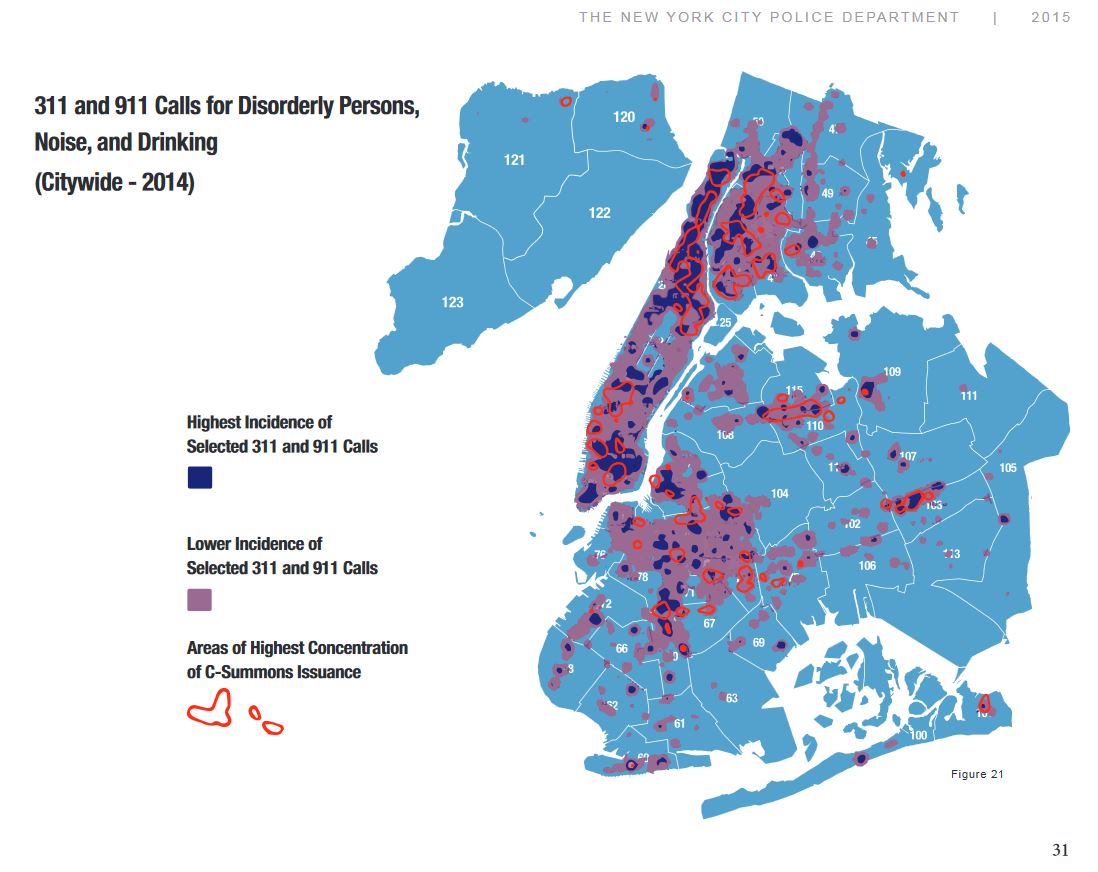
    It’s worth pausing here. This is important. Quality-of-life enforcement — which does affect minorities disproportionately — is in response to minority citizens’ calls for service. Here’s a page from that linked-to report.

    Quality of life enforcement happens because residents want it to happen. And residents in black and hispanic neighborhoods call police for quality-of-life issues most of all.

    In the name of racially non-disproportionate policing, should police ignore these calls for service? Not according to the poll data of New York blacks and hispanics (page 21). Similarly there’s a 2015 Gallup poll that showed 38 percent of blacks (nationwide, compared to just 18 percent of whites) want more police presence; just 10 percent of blacks want less police presence. Blacks want more policing more than whites want more policing. You wouldn’t sense that from the current cops-are-the-problem. Now of course more policing and better policing are not mutually exclusive, but it comes down to this: you can’t have community policing if you ignore the quality-of-life issues the community cares about.

  • “Cast-Out Police Officers Are Often Hired in Other Cities”

    It’s unclear how big of a problem this is. But even that is part of the problem. The fact that it happens at all is horrible. You’d also think police departments, even the tiny ones (much less Cleveland), would be a bit more inclined to do a more thorough background check. Maybe pick up the phone or something. You’d also think there would be a database. And there is, The National Decertification Index. But it’s not well funded, according to the New York Times. Why it can’t get a little cash from the DOJ seems to is a mystery:

    The Justice Department, which gave the association about $200,000 to start the database in 2009, no longer funds it. The department declined to explain why it had dropped its support, but a spokesman said the goal was “ensuring that our nation’s law enforcement agencies have the necessary resources to identify the best qualified candidates to protect and serve communities.”

    Thanks for nothing, spokesman.

  • It Depends What Your Definition of “Rose” Is

    What’s your definition of “rose”? Leaving aside the one that “would smell as sweet,” mine is “goes up.” I ask because the headlinein the New York Times says: “Murder Rates Rose in a Quarter of the Nation’s 100 Largest Cities.”

    When you say homicides “rose” in 25 of 100 cities, you might think it didn’t rise in 75 cities.

    Since crime rates fluctuate from year to year, we used a statistical technique to determine places where we can definitely say rates were rising.

    A “statistical technique”? What might that be? Praytell, Times, praytell. My advanced quantitative methods are rusty (and were never good), but I’d love to know what you do.

    If the data were presented in some kind of useful fashion (they’re not) you’d see something similar to Prof. Richard Rosenfeld’s solid research (pdf link). Rosenfeld looked at 56 cities and found an increase in 40.

    You can’t really tell from the Times’ crappy graphic, but in the 70 cities “Where murder rates…,” I count 27 cities where murder rates “fell slightly.” Combined with the 5 with significant decreases, that leaves 68 of the nation’s 100 largest cities where the murder rate — what’s the word? — rose. (Which is consistent with Rosenfeld’s 40 of 56.) [It’s worth mentioning that those who write the story don’t write the headlines. In the story it’s clear that murders rose “significantly” in 25 cities.]

    Now of course as a PhD, I’m supposed to use five-dollar words when fifty-cent words will do:

    Cities are obviously heterogeneous. There is tremendous variation across the largest cities in basic features such as demographic composition, the concentration of poverty, and segregation that relate to city-level differences in rates of violence.

    O.K.

    As an academic, I’m expected to endorse platitudes like:

    There is no consensus on what caused the recent spike.

    And

    Many crime experts warn against reading too much into recent statistics.

    And I should urge restraint, lest we get carried away with caring about murder. (My fear: restraint will lead to a right-wing law-and-order backlash). Also, apparently, I’m not supposed to worry about murder until more murder is up in every damn city in America. Nor should I worry about homicide because it’s been worse in the past. (An interesting argument, I note, should one apply it to poverty, racism, lead, infectious disease, or police-involved shootings. But I digress.)

    In terms of numbers (in what I would call burying the lede):

    Nationwide, nearly 6,700 homicides were reported in the 100 largest cities in 2015, about 950 more than the year before.

    That’s a 16.5 percent increase. In one year? That, my friends, is huge. Now the nationwide percentage increase will almost certainly be smaller, but the last time there was even a double-digit percentage increase in homicide was 1968. That last time the homicide numbers increased by more than 1,000 was 1991.

    Back in January, based on less data, I guessed that 2015 would see about 1,500 more murders than 2014. Gosh, am I a swamy? No, just somebody who can remove the ideological blinders long enough to use a calculator. I even offered an open $100 bet to anybody who said, “We don’t know if homicides are up.” Nobody put their money where their mouth was. Odd. It’s like they didn’t even believe what they were saying.

    If we focused on the carnage instead of arguing about reality and methodology, you see, we’d have to consider the why? And then, perhaps, we’d notice that increased violence isn’t really linked to any change in poverty or gun laws or even legitimacy. Perhaps we’d take note, as have Professor Rosenfeld and myself, that the cities where violence is most up are the cities where police have been, to put it mildly, in the news (or even charged criminally for no good reason). Perhaps crime is up because police are doing exactly what we’re asking them to do: be less proactive and have fewer interactions with the public.

  • “El Chapo and the Secret History of the Heroin Crisis”

    Damn good (5,500 word) read in Esquire by Don Winslow:

    Okay, I’m going to say it: The heroin epidemic was caused by the legalization of marijuana.

    Weed was a major profit center for [the Sinaloa Cartel], but suddenly they couldn’t compete against a superior American product that also had drastically lower transportation and security costs.

    In a single year, the cartel suffered a 40 percent drop in marijuana sales, representing billions of dollars. Mexican marijuana became an almost worthless product. They’ve basically stopped growing the shit: Once-vast fields in Durango now lie fallow.

    The Sinaloa Cartel decided to undercut the pharmaceutical companies. They increased the production of Mexican heroin by almost 70 percent, and also raised the purity level, bringing in Colombian cooks to create “cinnamon” heroin as strong as the East Asian product. They had been selling a product that was about 46 percent pure, now they improved it to 90 percent.

    Their third move was classic market economics—they dropped the price. A kilo of heroin went for as much as $200,000 in New York City a few years ago, cost $80,000 in 2013, and now has dropped to around $50,000.

    At the same time, American drug and law-enforcement officials, concerned about the dramatic surge in overdose deaths from pharmaceutical opioids (165,000 from 1999 to 2014), cracked down on both legal and illegal distribution, opening the door for Mexican heroin, which sold for five to ten bucks a dose.

    But pill users were not accustomed to the potency of this new heroin. Even heroin addicts were taken by surprise.

    As a result, overdose deaths have skyrocketed, more than doubling from 2000 to 2014. More people — 47,055 — died from drug overdoses in 2014 than in any other year in American history.

    Historically, the Sinaloa Cartel has been the least violent of the Mexican drug-trafficking organizations. Admittedly, this isn’t a high bar to clear, but it has long been axiomatic that the Mexican government felt that it could at least talk to Guzmán and his partners in ways it never could with, for instance, the Zetas.

    Many journalists and writers, myself among them, believe that the Mexican government eventually supported the Sinaloa Cartel during the worst years of the drug war in an attempt to establish some modicum of order.

    For the record, Guzmán did not go out that [prison] tunnel on a motorcycle. Steve McQueen escapes on motorcycles. My money says that Guzmán didn’t go into that tunnel at all; anyone who can afford to pay $50 million in bribes and finance the excavation of a mile-long tunnel can also afford not to use it.

    Gentle reader, the man is worth $1 billion. He was thinking about buying the Chelsea Football Club. He went out the front door.

    If Mexico has become Iraq, then the Jalisco New Generation Cartel (CJNG) is the country’s ISIS.

    What makes CJNG so ISIS-like is that they just don’t give a shit. To consolidate power, El Mencho allegedly authorized the murder of Jalisco’s tourism secretary and the assassination of a congressman.

    In March 2015, lugging assault rifles and grenade launchers, CJNG gunmen rolled into a town and killed five police officers. Two weeks later, they ambushed a police convoy and killed fifteen officers. The next day, they murdered the police chief of another town.

    In April 2016, they shot down a military helicopter with a rocket launcher

    Just as this mess was heating up, a new drug — actually an old drug — entered the scene. Fentanyl is a synthetic opioid that is thirty to fifty times as strong as heroin. It was developed in 1960 by Janssen Pharmaceuticals (now a division of Johnson & Johnson) as a treatment for the severe pain caused by terminal cancer.

    For the narcos, the advantages of fentanyl over heroin are enormous.

    First of all, it’s made in a lab, so you don’t need fields of poppies that can be raided, fumigated, or seized. You don’t need hundreds of campesinos to harvest your crop and you don’t need to take or control territory. (Well, not territory for cultivation—you still have to control access to smuggling turf, hence the renewed violence in Baja, where the murder rate has tripled.)

    But it’s the profits that will make fentanyl the new crack cocaine, which created the enormous wealth of the Mexican cartels in the eighties and nineties. A kilo of fentanyl can be stepped on sixteen to twenty-four times to create an astounding return on investment of $1.3 million per kilo, compared with $271,000 per kilo of heroin.

    We’ll no longer know where’s it coming from, and worse, what’s in it. First responders will not be able to tell if they’re dealing with pure heroin, heroin laced with fentanyl, pure fentanyl, fentanyl cut with God knows what … there will be pharmacological chaos.

    We talk about the heroin epidemic.

    Fentanyl will be the plague.

    So Guzmán is behind bars, it’s over, and we won. Just like we won when Hussein literally reached the end of his rope.

    The Los Angeles Times estimates that two thirds of Mexican drug lords have been either killed or imprisoned. And what’s the result? Drugs are more plentiful, more potent, and cheaper than ever. Deaths from overdoses are at an all-time high. Violence in Mexico, once declining, is starting to rise again

    An entire economy is based on drug prohibition and punishment, something to the tune of $50 billion a year, more than double the estimated $22 billion we spend on heroin.

    That’s a lot of money. There will inevitably be another Guzmán, but he’ll be a distraction, too…. Follow the money.

  • “Do Not Shoot Anyone”: Policing J’Ouvert and the West Indian Day Parade

    “Do Not Shoot Anyone”: Policing J’Ouvert and the West Indian Day Parade

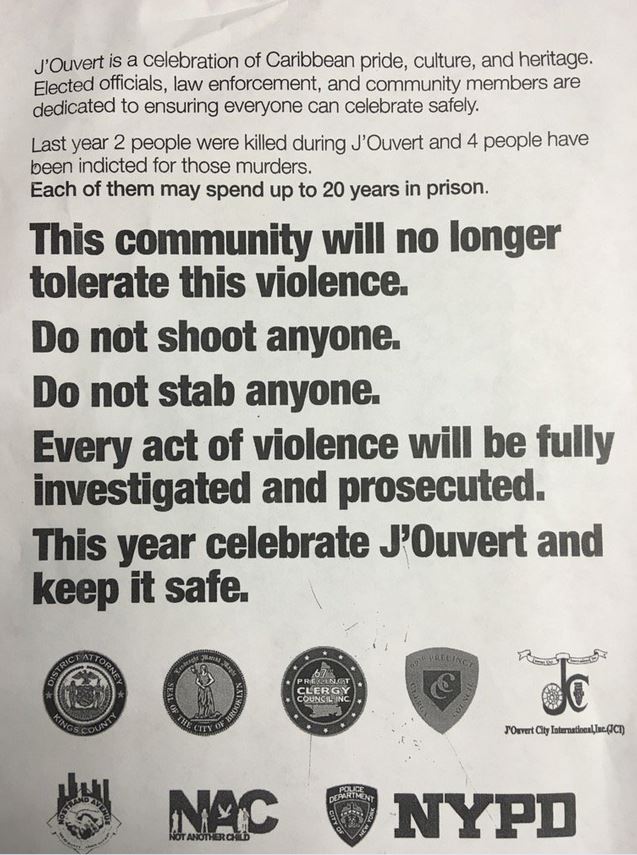
    Yes, the NYPD and others politely asked people to not shoot each other at J’Ouvert this year. The New York Postquotes a police source as saying, “I guess this is the de Blasio crime prevention program.”

    In Brooklyn, pre-lent pre-dawn J’Ouvert is followed by the massive (like one-million people massive) Caribbean Day Parade (which has also had a few unfortunate deathsover the years). The two events are organized separately and not related but by culture and heritage.

    It’s easy to mock a poster, but I don’t know if it was a bad idea. It’s never a bad idea to work collaboratively and ask politely. It’s not like the poster was the only thing police were doing. If nothing else, at least you can say, “At least we tried.”

    Last year an aide to Gov. Cuomo was shot and killedin the pre-dawn J’Ouvert hours.

    While onlyone bullet struck Gabay, some 20 or so people using some 27 firearms, mostly pistols, blasted off as many as three dozen rounds during the exchange.

    When the smoke cleared, three others were shot and two people were stabbed, one fatally.

    Last year organizers claimed the shootings happened during the parade, but not because of the parade. Just, you know, typical Brooklyn violence. Former cop and City Council Member Eric Adams saidthe reaction to the violence was “hysteria”: “We don’t stop celebrating the Fourth of July because some crazy breaks out a gun.” No, we don’t. But people don’t break out guns in most festivals.

    In 2014, “a gunman opened fire into a crowd of revelers, killing one man and wounding two others. In 2012, two people were stabbed to death and at least two were shot.”

    From the New York Times:

    Along with colorful costumes and dancing in the streets, there has been another constant: violence. Over the past decade, 21 shootings and other violent acts have been recorded at J’ouvert festivities, said Assistant Chief Steven Powers, the department’s Brooklyn South commander.

    At a news conference on Monday morning, Mayor Bill de Blasio said that the additional security measures “were exactly the right things to do,” but added, “We didn’t get the results we wanted.”

    Asked whether the parade should be moved or canceled, the mayor said only that “every option will be on the table.”

    He compared the J’ouvert festivities with other large New York City celebrations like the St. Patrick’s Day Parade and the Puerto Rican Day Parade, both of which were once far more raucous.

    “All of those previously violent events were brought under control,” Mr. de Blasio, a Democrat, said. “We will find a way to keep this one under control.”

    So yeah, you need to police J’Ouvert and the West Indian Day Parade differently than a million people listening to classical music in Central Park. And no, it’s not because the attendees at the former are mostly black and the latter mostly white.

    This year, rather than a scatter-shot police approach, for city decided to work with the organizers of J’Ouvert (the Caribbean Day Parade has always been much more legit). The city granted its first ever permit to J’Ouvert. There was a route, street closures, light towers, and an even greater police presence. The whole nine yards.

    Alas, it didn’t work. Two people were killed and last I heard at least three others were shot. A 17-year-old and 22-year-old were fatally shot a block from each other, at 4 and 4:30 AM, along the route of the official J’Ouvert parade.

    One of those shot, 73-year-old Margaraet Peters, said,

    The youths seem to want to ruin the West Indian parade. They’re smoking marijuana, carrying on, looking for fights with other groups…. The bystanders are always the ones getting hurt. It’s so sad – I could have died. I told my family the most important thing is I’m alive.

    For cops, this day is a no-win no-fun too-loud not-worth-the-mandatory-overtime hassle. I suspect Caribbean cops, and there are many in the NYPD, may beg to differ. But the few I know don’t want anything to do with policing this event either.

    Cops hate working these events because, like you, they want to be eating burgers with their families on Labor Day. Instead, they have to work a chaotic scene of literally a million people. And the 999,000 who aren’t causing trouble aren’t cops’ concern. Because at some point, especially pre-dawn, you know there will be fights and gunfire. And God forbid you actually stop somebody, cause then the New York Times will say you’re racist.

    For the often anti-cop Daily News, the story isn’t just violence but the cops complaining. Cops “crowing” over killings on “racist online message board,” screams the headline. Juicy! For example, right there in the first post, say the News:

    It’s 0644 on Mon. morning and already we have 4 SHOT with 2 DEAD (SHOT IN FACE) and we have 1 reported STABBING. Godless DeBlowsio was on his hands and knees PRAYING FOR THE STORM TO WASH OUT THE PARADE.

    Uh, actually, yeah. I bet de Blasio would have happily had the skies open up at 02:00 hours last night.

    [For the record Thee Rant often brings out the worst cops and the worst in cops. And yeah, some cops and retired cops are racist and know how to use the caps-lock key. But bitching about violence and the political sensitivities around working J’Ouvert makes you human, not racist.]

    But at least we tried. I guess you try again next year. It’s not like I’ve got the answer. I don’t think you could shut it down, even if you wanted to. And why would you want to? You really shouldn’t stop Carnival.

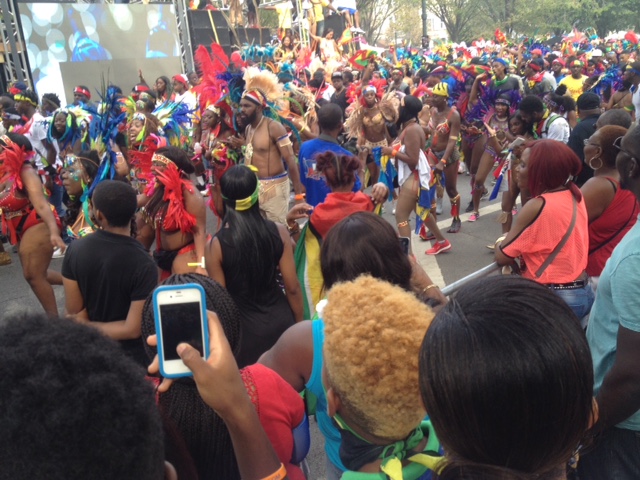
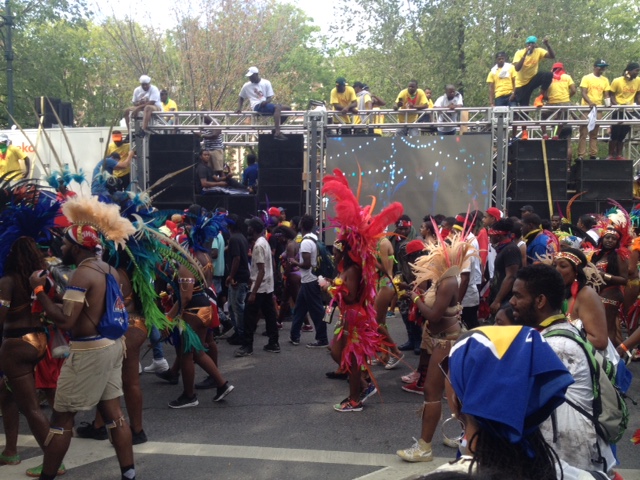
    I try and avoid massive crowds and police barriers, but my intrepid wife sent this report from the front line:

    Pretty freakin’ awesome, and made me sorry I’ve never gone before. Not terribly crowded. Insanely good fashion everywhere. Great-looking food. Only intermittently loud, as sound systems are pretty spread out in the parade. I did not find the girl I was trying to meet, but, oh well.

    Maybe next year I will go. I do look great in feathers.


    [Photos by Zora O’Neill]