Category: Police

  • Violence and the Drug Corner in Baltimore

    Too many people are getting killed! From Cop in the Hood:

    Still the risk of death is astoundingly high. For some of those “in the game,” the risk of death may be as high as 7 percent annually. Each year in Baltimore’s Eastern District approximately one in every 160 men aged fifteen to thirty- four is murdered. At this rate, more than 10 percent of men in Baltimore’s Eastern District are murdered before the age of thirty- five. As shocking as this is, the percentage would be drastically higher if it excluded those who aren’t “in the game” and at risk because of their association with the drug trade. Yet if everybody you know has been shot, killed, or locked up, perhaps such is life.

    Linked to the recent increase in homicides:

    Police don’t find many guns when frisking suspects. The threat of arrest may outweigh the risk of being robbed or attacked. For others, a reputation for violence may be enough of a deterrent. Yet there is no doubt that guns are accessible to many. After all, gunfire is a daily reality and pacifist corner drug dealers don’t last long.

  • Corruption in the Baltimore Police Department

    When I hear people, Commissioner Batts including, talk about the horrible institutional problem of Baltimore police corruption, I know they have never spent any time working on the streets of Baltimore. Batts certainly hasn’t. He’s the chief. He’s separated by five thick layers of chain of command from the rank-and-file. And he didn’t work his way up through that chain of command.

    Here’s what I saw. If you have no first-hand experience, please don’t try and convince me otherwise. It’s the old line about “Who are you going to believe? Me or your lying eyes?”

    This comes from Cop in the Hood:

    Temptation is everywhere. Given the prevalence of drug dealing and the fact that drug dealers hold hundreds and sometimes thousands of dollars in cash, police officers routinely face the opportunity for quick and illegal personal gain. Police could get away with stealing drugs or money, at least for a while. But robbed drug dealers can and will call Internal Affairs. And officers with criminal dealings will usually be ratted out by another criminal. Putting a dirty cop behind bars is as good a get-out-of-jail card as exists.

    I policed what is arguably the worst shift in the worst district in Baltimore and saw no police corruption. I know there are corrupt police officers. After three years on the street, one Eastern District officer stopped a man who drove his motorized scooter through a red light. The man had $6,300 in his pocket. The officer counted the money and allegedly returned $4,900 of it. The man called police to report the missing money and the officer was arrested and indicted on felony theft charges. One year later, these charges were dropped on condition that the officer resign from the police department and agree not to work in law enforcement again. When a cop is dirty, there is inevitably a drugs connection. Over a few beers after work, the subject of the drug squad came up. An older cop warned me to “stay away from drugs [in your dealings as a cop]. They’ll just get you in trouble in the long run.”

    Incidents do happen, but the police culture is not corrupt. Though overall police integrity is very high, some will never be convinced. But out of personal virtue, internal investigation stings, or monetary calculations, the majority— the vast majority—of police officers are clean. A greater problem is that high- arrest officers push the boundaries of consent searches and turn pockets inside- out. Illegal (and legal) searches are almost always motivated by a desire to find drugs. In the academy, an officer warned the class, “Corruption starts six months to a year after you’re out of the academy. When you’re on the streets and you start shaking down drug dealers because they’re worthless shits.” Similarly a sergeant explained:

    You’ll get out there, thinking you can make a difference. Then you get frustrated: a dealer caught with less than twenty- five pieces will be considered personal use. . . . Or you go to court and they take his word over yours. You’re a cop and you’re saying you saw something! . . . After it happens to you, you don’t care. It’s your job to bring him there [to court]. What happens after that is their problem. You can’t take this job personal! Drugs were here before you were. And they’ll be here long after you’re gone. Don’t think you can change that. I don’t want you leaving here thinking everybody living in this neighborhood is bad, does drugs. Many [cops] start beating people, thinking they deserve it.

    Police officers are often in a position to hold various amounts of drugs and money. Legally seized drugs and money are kept in one’s pockets (carefully separated from personal belongings) before being taken to the station house and submitted in the proper fashion. Officers have to be careful not to make honest mistakes. They could put something in the wrong pocket. Something could fall out of a pocket. The night gets busy and they might forget to submit. Before each shift, police officers search the squad car for anything left behind.

    Many residents, after repeated calls to police about drug dealers, assume that officers are either incorrigibly corrupt or completely apathetic:

    I understand what you [police] deal with. But you got to understand. People see police drive right by the dealers, don’t even get out of the car. Or they [police] got them [dealers] with their legs spread [being searched]. Who’s to say you ain’t taking a little something on the side? You can’t have drugs on this scale without somebody letting it happen.

    Police discount such accusations:

    People get bad ideas from the media or from criminals that we’re corrupt or brutal. But we’re not. Or they refuse to think that their son could be involved with drugs. They want the corner cleared, but if we pick up their son it must be the racist cops picking on him because he’s black. And with the amount of drugs you’ve got in this area, of course they aren’t going to like police because we’re trying to lock them up. Too many people here are pro-criminal.

    Even financially, it pays to be straight. A New York City police officer explained:

    My pension is worth between one and two million dollars. I’d have to be a fool to risk that for $100, even $1,000. I’ll tell you when I’ll be corrupt: the day I walk into a room piled with drugs, five million dollars in cash, and everybody dead. For five million, I’d do it. I’d leave the drugs and take the cash.

    Some officers enter the police department corrupt. Others fall of their own free will. Still others may have an isolated instance of corruption in an otherwise honest career. But there is no natural force pulling officers from a free cup of coffee toward shaking down drug dealers. Police can omit superfluous facts from a police report without later perjuring themselves in court. Working unapproved security overtime does not lead to a life in the Mob. Officers can take a catnap at 4 am and never abuse medical leave. There is no slope. If anything, corruption is more like a Slip ’N Slide. You can usually keep your footing, but it’s the drugs that make everything so damn slippery.

  • “Police earn court overtime pay while residents get rap sheets. It’s a horrible equilibrium, and police are the fulcrum”

    I hear a lot of people with very strong opinions try and tell me and others about a place they’ve never been and a job they’ve never worked. I wrote about police the drug corner, places like where Freddie Gray was arrested and died in police custody. The next few posts will be exerts from the chapter in Cop in the Hood called “The Corner: Life on the Streets.” It starts with this quote from a Baltimore City police officer:

    It’s a different culture. You know, what is normal for us–like going to work, getting married–they don’t understand that. Drugs are normal. Mommy did it. Daddy did it, not that he’s around. But if people want to take drugs, there’s nothing we can do. All we can do is lock them up. But even that is normal.

    On “clearing the corner”:

    [It’s] what separates those who have policed from those who haven’t. Some officers want to be feared; others, respected; still others, simply obeyed. An officer explained: “You don’t have to [hit anybody]. Show up to them. Tell them to leave the corner, and then take a walk. Come back, and if they’re still there, don’t ask questions, just call for additional units and a wagon. You can always lock them up for something. You just have to know your laws. There’s loitering, obstruction of a sidewalk, loitering in front of the liquor store, disruptive behavior.” Police assume that if the suspects are dirty, they will walk away rather than risk being stopped and frisked. You can always lock them up for something, but when a police officer pulls up on a known drug corner, legal options are limited.

    If a shop is run efficiently, the boss, himself working for or with a midlevel dealer, should be able to sit and observe the operation. By not handling drugs or money, he faces little risk of arrest from uniformed patrol officers. The boss may be sitting on a stoop of a nearby vacant and boarded-up building posted with a “no loitering” sign. Because of the sign, he could be arrested for the very minor charge of loitering, the catch-all arrest charge. But how often can that be done? Repeated arrests for loitering, especially if no drugs are found, could easily result in a complaint about police racism and harassment to Internal Affairs.

    Don’t worry. It gets better.

  • Batts says he’d reform the police department if only it weren’t for all those pesky police officers.

    Batts doubles down against the rank and file.

    I’m not quite certain whom Batts is trying to win over with his op-ed in the Sun. It seems like maybe he should have thought twice before pressing the send button.

    The first half of Batts’ article is spent recounting how bad the police department used to be, before Batts showed up to save the day:

    The decade before I arrived saw more than 50 officers arrested, according to news reports. The public consciousness is filled with names like William King and Antonio Murray, who were sentenced to hundreds of years in federal prison for robbing drug suspects…. The cycle of scandal, corruption and malfeasance seemed to be continuing without abatement.

    Now I was already gone a decade before he arrived. So maybe the department went to hell the second I left, but I doubt it. Now King and Murray were criminal cops caught up in the war on drugs. They were arrested (thanks to the Stop Snitching video) and convicted after taking the stand in their own defense.

    The tow-truck scandal was less serious but more odd. It was like a throwback to low-level corruption from the 19 friggin’ 60s. But since it involved more officers, it is worth looking at. This scandal was also very much linked to a 2006 effort to hired Spanish speakers officers: “Baltimore can also lure Puerto Rican applicants with higher pay: The department’s starting salary is $37,000, compared with $25,000 for a starting job in a Puerto Rican police agency.”

    Well perhaps it would have been better to simply offer Spanish classes in Baltimore.

    Because in 2008 it seemes like the whole damn Puerto Rican police department got busted. (And the Puerto Rico PD apparently still hasn’t cleaned up their act.) So apparently some high-ranking genius went down to Puerto Rico and poached a dirty police department of some of its dirty police officers. But hey, you want US citizen Spanish speakers and only have $37 grand to pay? I got a deal for you! (To be clear, many but not all of the officers caught in that scandal were linked to that hire. Likewise, not all the officers hired were dirty.)

    Anyway, Batts is right about this:

    Many officers will be unhappy reading these words. Many want me to outright defend the department and say nothing is wrong with the way this organization engages in police work. For the overwhelming majority that is true. However, when people go on television wearing masks, allege themselves to be police officers and are cloaked in the shadows espousing their own indifference to violence as children are shot, I am troubled. This is not the Baltimore Police Department that I know.

    One problem is that Batts has never known the Baltimore Police Department. Or Baltimore.

    Then Batts takes on black officers:

    I challenge the leadership of The Vanguard Justice Society, an African American advocacy group for police officers, to stand and project their voice in this African American city, where people who look like them feel treatment is unfair. Speak out against the beating of a resident at a bus stop or the selling of narcotics on the back porch of a police station. Where is the concern over scores of African Americans arrested and college scholarships lost? Don’t allow yourself to be used as a tool of a bygone strategy from times long since past.

    Did the police commissioner just call his black officers a bunch of Uncle Toms? Well, that’s not going to go over well. Now the Vanguard Society has never been an advocate for business as usual in the policing world. In some ways black police organizations exist as opposition to the older, whiter, more conservative FOP/PBA world. And to the credit of the Vanguard Society, they’ve also called out Batts for his job poorly done.

    Batts continues, taking credit where none is due:

    I will not apologize for bringing professionalism and integrity to the forefront while eliminating greed, corruption and intolerance from the rank and file. Policing in any environment is difficult on a good day. That does not mean we have, or should ever have, a blank check to treat the public with callous disregard.

    Continuing these reforms also means that organizations and individuals, who have profited, either materially or through position, will continue to fight against the reforms we are enacting. It means that people will throw mud, call into question my leadership, or lament days gone by. They will attack with innuendo, rumor and supposition. We will respond with fact, with evidence, with the things we have done.

    Reform is not easy. It comes with a cost. It is a cost we should be willing to pay for the future of our city.

    So what exactly are Batts’ reform accomplishments? Because I honestly do not know. Or is his vague call for “reform” simply be a cover for incompetence, a riot, a demoralized police department, and a homicide rate that has more than doubled? Because I think it’s the latter. So let me be the first to nominate Paddy Bauler for commissioner. He’s the Chicago politician famous for one line: “This city ain’t ready for reform!”

    [Batts, known for his fuzzy math (though he may be basically right about the number of officers terminated), comes out with these stats:

    We have seen the lowest police involved shootings since 2004, a 54 percent decrease in discourtesy complaints, a 45 percent decrease in excessive force complaints and lawsuits at the lowest levels in years.

    If true, that’s interested. Especially when combined with arrests being down 65 percent from their peak. It sure seems to go against the idea that the “uprising” was some inevitable rebellion against bad and over-aggressive policing.]
  • The math of American racism: blacks are outnumbered by racists

    This is one of the few things that really stuck with me from my grad-school days. A simple mathematical analysis of racism in America. It was in a class with Professor Orlando Patterson.

    I think of this math when people say we should be post-racial. Or say that we need to condemn anti-white racists as strongly as we do anti-black racists. To be clear, we should condemn all racism. But no, anti-white racism isn’t the same problem as anti-black racism. It’s not just about the hate. It’s also about the demographics and the math and the very essence of what it means to be a minority.

    Here’s the math. There are roughly 320 million Americans. Of those, roughly 41.7 million are black. About 280 million Americans are not black.

    Now ask yourself: what percent of Americans are racist? Of course it depends on how you define racism. But can we use 15 percent as a working figure? Maybe that’s too high; maybe that’s too low. I don’t know. You can pick whatever percent you want. But let’s do the math for 15 percent.

    If 15 percent of all Americans are racists, that means about 6 million blacks who hate whites (or Asians, or whomever). Since there are 280 million Americans who are white or another non-black race, the odds that you, a non-black, would come across somebody who hates you because of your skin color are pretty slim. If you’re not black, and you come across 100 Americans at random in a given week, maybe 2 of those 100 people will be blacks who hate you for the color of your skin. Also, and this matters, there are 46 of you for every one of them. So if there were some gigantic street brawl between all 6 million black racists and all 280 million targets of their racism, the racists would get crushed. When you are part of the majority, there is safety in numbers.

    Now let’s flip it around. If 15 percent of all Americans are racist, that means there are about 42 million anti-black racists walking around. There are more racist Americans than black Americans. Blacks are outnumbered by racists. Think about that. If you’re black and come across 100 Americans at random in a given week, 13 of those 100 people will hate you for the color of your skin. When you are part of the minority, there is danger in the numbers.

    Every time a black person leaves the house, there’s one racist sonofabitch out there potentially waiting for him or her. If there was a big street brawl between racists and blacks, the racists would probably win. That’s why we — our society, any society — need to be more concerned about minority rights. An attack on a minority group, any minority, is more dangerous because the group is a minority.

    So even if you and your white friends aren’t racist, that’s nice. But it doesn’t really matter. And it certainly doesn’t mean that racism doesn’t happen simply because you don’t see it. It’s like pointing out to police that a lot of people in their post aren’t criminals. That’s nice… but the good people are not the ones you need to focus on. It’s the people out to cause harm that get your attention. And if there are more of them than there are you, then you’ve got a real problem.

  • In memory of those killed at the New Hope A.M.E. Church

    A few times, if I was working late enough or some church started extra early enough, I would go to church to say hello. Personally I’m a non-believing Greek Orthodox. But there’s something about a good black church that can’t be matched. Some Sunday mornings I would just sit outside, just to provide a little security. (And also to enjoy the passing parade of hats.)

    Sometimes I would go inside. I liked to remind myself that the people on the corner didn’t represent everybody in the Eastern District. Going into church at 8AM I saw a different world, literally sharing the same block, than the one I had just policed for 8 hours. Inside, I was always immediately embraced (something I’ve never felt from my own church, to be honest) by the love and warmth of honest, love-filled, church-going Christians:

    Went to church this morning [February 12, 2001] at Bond and Eager. They were very warm and welcoming and immediately formed a little prayer circle, about 8 or 9 people in all. A good black-preacher-man prayer, I’d have to say. Nice voice, especially for so early in the morning. Said a prayer for us getting up today, and also for all the police working all night. I felt very warm…. I was happy I didn’t get a call during the prayer, but I did get one right after that.

    Never have I felt more welcome and love than I felt walking into a black church on duty, as a white cop in Baltimore. And after a long night working in the Eastern District, it was a nice feeling.

    Checking now, I see the church at Bond and Eager is the New Cornerstone Baptist Church. I was probably also attracted to the fact that it may be the only entirely Formstone-sided church in the world.

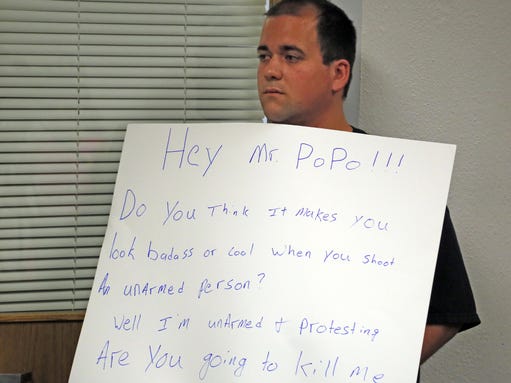
  • Cops shoot and kill unarmed man

    No real point here. Except it happens. And you won’t hear this (except in Des Moines) because there’s no racial element to the story. Does that make the shooting any better or worse? I don’t think so.

    Apparently there was a protest of one.

  • Race, drugs, arrests, and hospital admissions

    Race, drugs, arrests, and hospital admissions

    I recently got some interesting data over the email transom.

    Here’s the thing: It’s largely assumed that white and black illegal drug use is about the same. And that’s based on legit sources. The kind of drug people take varies by race. For instance crack is still disproportionately black. Meth and LSD still mostly white. Generally.

    But those who point to the racism of the drug war, myself included, start with the assumption that illegal drug use overall is not disproportionately black. Quick random links: 1, 2, 3, and 4. I did find one opposing view (but even that only questions a 20 percent difference).

    Now the link between drugs and violence is disproportionately black thanks to the prohibition and the nature of illegal drug distribution. Public drug dealing equals violence. Buying from friends and family and coworkers? Much more copacetic.

    Blacks are 32 percent of those arrested for drugs, which is roughly twice what would expect to find based on the number of blacks in America.

    But the nature of drug dealing (and police presence and reaction to violence rates) does explain some of the disproportionate arrest and incarceration rate. You don’t get arrested for drugs unless A) police find them. And that sometimes often relates to B) people complain about it. (Street corner drug dealing in particular.)

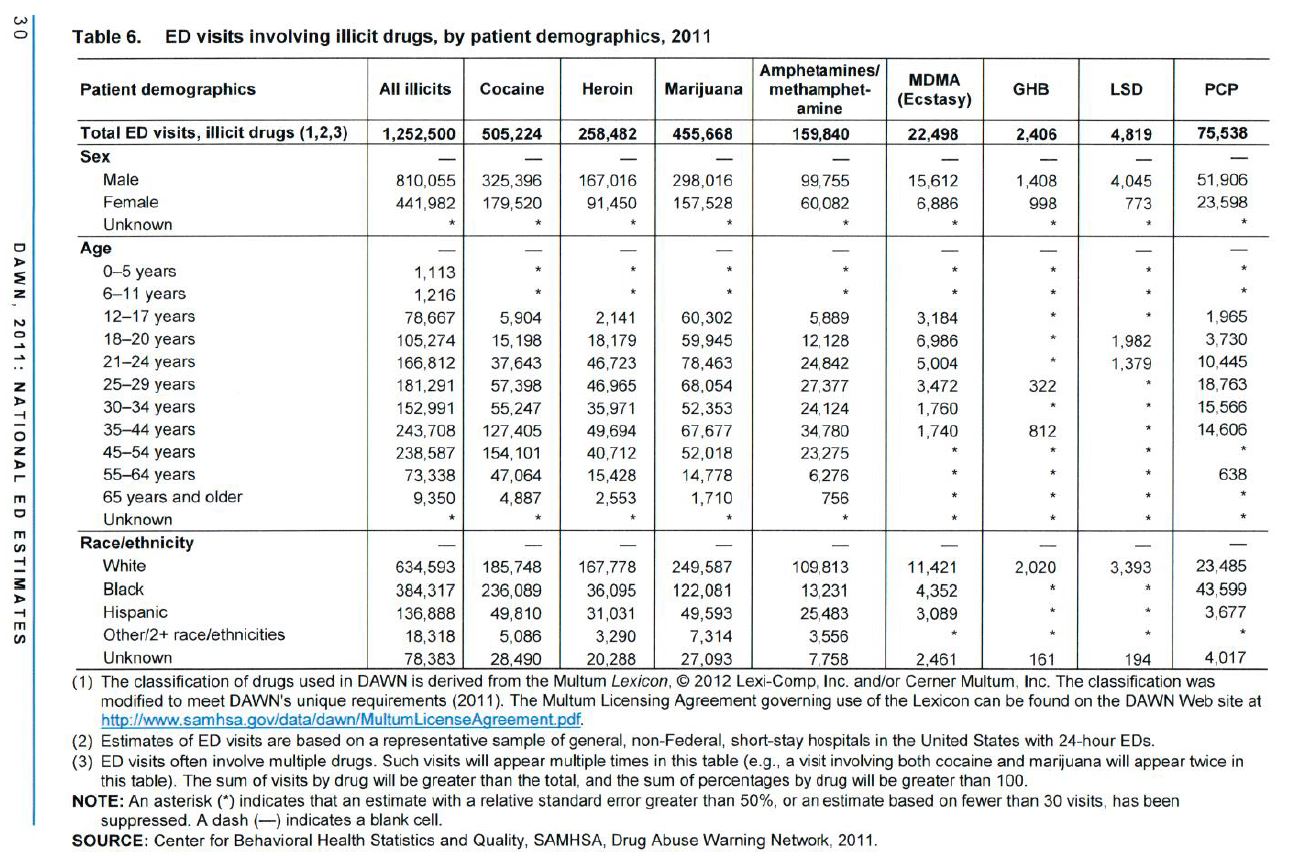
    So explain this: Why are blacks roughly one-third of those admitted to the ED (formerly known as the ER) for illicit drugs? This is rate 2.5 times greater than one would expect, based on 13 percent of Americans being black.

    click to embiggen.

    Leaving out when race in unknown, 60 percent of PCP patients going in to the ED are black, 50 percent of cocaine admittances, 15 percent for heroin, 28 percent marijuana, 9 percent meth, and less 1 percent for GHB and LSD. All in all it’s 33 percent. The ED admissions percentage, by race, is the exact same as the percentage of those arrested for drugs.

    What gives? Perhaps the hospital data is bad. But I’m more likely to suspect that surveys on illegal drugs use are bad. Are blacks are 2.5 times more likely to buy bad drugs? Are blacks are 2.5 times more likely to go to the hospital if they have a bad trip? Maybe. I don’t know.

    I can’t figure out how to reconcile these hospital admissions data with the long-established belief that illegal drug use rates are consistent across race. Any ideas?

    [Update: A lot of people have good ideas. But I think it comes down to the fact that blacks are twice as likely (per capita) to go the ED (and there are a bunch of reasons for that). That could explain away 80% of the 2.5X disparity right there. The rest could be measurement error or anything. That’s close enough for me. I consider that a good honest answer to a good honest question.]

  • Yeah, but they’re foreigners!

    What can we learn from them? I know. Nothing. Because this is America. Exceptionalism and all that. I’m not saying we could go to this model overnight, damnit! But we could still learn from it. We could learn a lot from other countries, if we got around to looking. If we start looking at police in other countries, next thing you know we’ll have socialism and universal health care.

    Man… that’s a lot of disclaimers for a thought provoking piece in the Washington Post about Britain’s police and their tendency to not shoot people.

    Of course there are differences — big differences, mostly with guns and gun laws — between the US and UK. No need to point this out. I know. But it’s not like England doesn’t have guns. There are about 1.8 million legally owned guns in England and Wales.

    The stats are amazing. In all of England and Wales, with 56 million people, only about 5 officers discharge their firearm in any given year. (Killing about 3 people per year. There are about 550 homicides over there in all. About 44 or so with guns.)

    About 1 in 13 gun killings in the US are committed by law enforcement. That probably means something like 1 in 20 of all homicides (I have not done the math. But 5 percent is probably a good ballpark figure). That figure kind of shocks me. In England and UK, it’s about 0.5 percent. (For what it’s worth, police over there are still responsible for about 1 in 13 gun killings. It’s just the numbers for both are a lot lower.)

  • “Daily Measurables”

    My long-standing question related to Freddie Gray — no doubt tops on everyone’s list — has always been, “Why the hell were officers doing much of anything at 8:45 on a Sunday morning?!” The Baltimore Sun reports:

    About three weeks before Freddie Gray was chased … the office of prosecutor Marilyn Mosby asked police to target the intersection with “enhanced” drug enforcement efforts.

    “It must be understood that Mrs. Mosby was directing these officers to one of the highest crime intersections in Baltimore City and asking them to make arrests, conduct surveillance, and stop crime,” the defense attorneys wrote. “Now, the State is apparently making the unimaginable argument that the police officers are not allowed to use handcuffs to protect their safety and prevent flight in an investigatory detention where the suspect fled in a high crime area and actually had a weapon on him.”

    [Western District commander Maj.] Robinson told [Lt.] Rice and the other officers to begin a “daily narcotics initiative” focused on North Avenue and Mount Street, according to the email, and said he would be collecting “daily measurables” from them on their progress.

    “This is effective immediately,” Robinson wrote, noting that the officers should use cameras, informants and other covert policing tactics to get the job done.

    “They want increased productivity, whether it be car stops, field interviews, arrests — that’s what they mean by measurables,”

    Butler said that he has never seen such orders come from the state’s attorney’s office but that they come at the request of politicians and community leaders all the time.

    “Once you’re given an order, you have to carry it out. It’s just that simple,” he said.

    Defense attorneys want Mosby removed from the case because of her involvement in the police initiative.