Category: Police

  • I am Ahmed Merabet

    Let’s not forget the French police officers who were killed. Particularly Ahmed Merabet, who died protecting other people’s right to make fun of his religion.

    David Brooks has an interesting take on the matter. While deliberate provocation is best left at the kids’ table, let’s not get too on our high-horse about our own dedication to free speech:

    Let’s face it: If they had tried to publish their satirical newspaper on any American university campus over the last two decades it wouldn’t have lasted 30 seconds. Student and faculty groups would have accused them of hate speech. The administration would have cut financing and shut them down.

    Americans may laud Charlie Hebdo for being brave enough to publish cartoons ridiculing the Prophet Muhammad, but, if Ayaan Hirsi Ali is invited to campus, there are often calls to deny her a podium.

    It’s a good time to come up with a less hypocritical approach to our own controversial figures, provocateurs and satirists.

    In most societies, there’s the adults’ table and there’s the kids’ table. The people who read Le Monde or the establishment organs are at the adults’ table. The jesters, the holy fools and people like Ann Coulter and Bill Maher are at the kids’ table. They’re not granted complete respectability, but they are heard because in their unguided missile manner, they sometimes say necessary things that no one else is saying.

    Healthy societies, in other words, don’t suppress speech, but they do grant different standing to different sorts of people. Wise and considerate scholars are heard with high respect. Satirists are heard with bemused semirespect. Racists and anti-Semites are heard through a filter of opprobrium and disrespect. People who want to be heard attentively have to earn it through their conduct.

    The massacre at Charlie Hebdo should be an occasion to end speech codes. And it should remind us to be legally tolerant toward offensive voices, even as we are socially discriminating.
  • Draw Mohammed Day (II)

    Draw Mohammed Day (II)

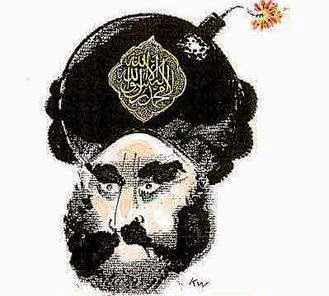
    I suppose today is just as good as any day to link to my post from 2010: Draw Mohammed Day. This is the cartoon that started it all (though this was Norway, I think, and not France). But click through for more.

    Meanwhile it’s worth posting this article from the Onion in 2012: “No One Murdered Because Of This Image”

    WASHINGTON—Following the publication of the image above, in which the most cherished figures from multiple religious faiths were depicted engaging in a lascivious sex act of considerable depravity, no one was murdered, beaten, or had their lives threatened, sources reported Thursday. The image of the Hebrew prophet Moses high-fiving Jesus Christ as both are having their erect penises vigorously masturbated by Ganesha, all while the Hindu deity anally penetrates Buddha with his fist, reportedly went online at 6:45 p.m. EDT, after which not a single bomb threat was made against the organization responsible, nor did the person who created the cartoon go home fearing for his life in any way. Though some members of the Jewish, Christian, Hindu, and Buddhist faiths were reportedly offended by the image, sources confirmed that upon seeing it, they simply shook their heads, rolled their eyes, and continued on with their day.

  • George Kelling on Broken Windows

    In the LA Times:

    Q: Do people confuse and conflate broken windows with “zero-tolerance policing” or “stop, question and frisk” practices?

    A: Yes. The other day I read that a Delaware police chief said his department was going to do broken windows with steroids. I find that pretty scary because that smacks of zealotry.

    Broken windows is a tactic, an essential part of community policing that works with the community to identify problems and set priorities. It doesn’t matter what problems police are up against, they need partners to resolve them, whether it’s squeegee men or homeless in the subway. Broken windows is a tactic within community policing strategy.

  • Broken Windows in question

    This article in the Times is worth reading. Of note: the most discretionary arrest in NYC, Dis Con, down 91 percent. Meanwhile the courts are close to empty.

    “This proves to us is what we all knew as defenders: You can end broken-windows policing without ending public safety,” said Justine M. Luongo, the deputy attorney-in-charge of criminal practice for the Legal Aid Society.

    I love how it took the police union and police (in)action for police officers to prove what Legal Aid lawyers have been saying along. But are they correct?

    Stupid arrests are not part of Broken Windows. And they have been part of NYC policing. And by “stupid” I mean giving tickets or summonses to non-criminals using a park at night, riding the subway, riding a bike on a bike path/sidewalk, and walking through a park at night to get home (p 207 of Cop in the Hood). Now I don’t think those BS things were the majority of arrests and summonses, but they did happen. And they happened because pressure from compstat and community meetings got passed down through the chain of command. And there didn’t seem to be any way to stop these abuses from happening. Until now!

    Any time discretionary arrests go down 90 percent without crime going up, it’s noteworthy. First it was stop and frisk going down and now it is arrests. Maybe this is good. There have always been too many arrests in American policing because policing in American has for too long been defined by making arrests. And that’s a shame (see p 144 of Cop in the Hood). You don’t need to arrest people to use Broken Windows. Indeed, you shouldn’t need to. That’s been the disconnect here in NYC. This takes a major shift in police mentality. One that is hopefully happening right now. The optimist in me likes to think of this as a clean slate, where a police department and can get its priorities in order and police officers can be left to use discretion and do their job. The realist in me knows better.

  • Stop lying! (and free Doug Williams)

    “You’re a fool if you go into a lie detector test thinking that telling the truth is good enough.”

    – Peter Moskos, John Jay College of Criminal Justice.

    I’ve written about this before. Here I am saying much of the same… but this time it’s on NPR.

    What I find crazy is that the defenders of the test, the American Polygraph Association, is thrilled simply to find a study that says the test is “better than chance.” Well, I should hope so!

    But tell that to the 20 percent of applicants who get rejected while telling the truth.

  • It’s a Dirty Job…

    I’ve always been a big fan of Mike Rowe and his TV show, “Dirty Jobs” (now on a different channel and called, “Somebody’s Gotta Do It”).

    Here Rowe talks about recent police events. As always, he approaches issues with a certain degree of kindness and empathy. Also, he’s nobody’s fool. (I suspect he would make a very good police officer.) Read the full version. But here’s a part:

    Within moments, everyone was talking about Garner and Brown, and the conversation got very political very quickly. A liberal guest said, ‘Look, I wasn’t there, but it seems pretty clear that both men would still be alive had they been white.’ A conservative guest replied, ‘I wasn’t there either, but it seems pretty clear that both men would still be alive if they hadn’t resisted arrest.’

    This annoyed the liberal, who asked the conservative why Republicans wanted a ‘police state.’ This annoyed the conservative, who asked the liberal why Democrats wanted ‘total anarchy.’ Things continued to escalate, and within moments, fingers were pointing, veins were bulging, and logical fallacies were filling the air. Ho! ho! ho!

    For once, I kept my mouth shut and listened as a roomful of decent people tore each others throats out. It was remarkable, because no one disagreed on the big points. No one disagreed that black lives mattered just as much as white lives. No one disputed that racial bias in law enforcement should be exposed and eliminated. In fact, no one disagreed about the basic facts surrounding each case. The breakdown happened over relevance and context.

    The one thing I’ll add is that I do think there’s great disagreement about the basic facts. Either Michael Brown was fighting to get Officer Wilson’s gun and then charged the cop or Brown had his hands up in surrender and was executed in cold blood. Either Eric Garner was murdered by a cop using a chokehold while Garner was trying to surrender or Garner resisting arrest and died after after physical struggle.

    And the other one thing I’ll add is that I’m often in situations where everybody wants to talk to me about recent events. I’ve been forced to say, “Can we please talk about something else?” Maybe I can just hand out Rowe’s article and get another drink.

    And the final one thing I have to say is that it’s actually not often that I or you will be in room with divergent views. Holiday parties are one of the few events that bring together people of different political persuasions.

    Happy New Year!

  • What’s your C.O.P. score?

    You know, “Crimes prevented Over rePlacement.” (Or maybe just “C-POR.”) Like WAR, wins above replacement, but for cops.

    The idea is to break crime down by beat/post and looking at it over time (a long time, like years). Wouldn’t it be nice to know if there actually was less crime on your post while you were policing. Of course would give incentive to under report crime. Still, it would be nice to know. And it’s not like we have anything better.

  • Policing protests

    There’s never a guarantee in policing that a tactic will always work, but if the goal is to let people protest, not have people hurt, and end things peacefully, two cities serve as useful case studies.

    In Hong Kong, protesters blocked major roadways for months (OMG, traffic was blocked!). Rather than cracking down and perhaps igniting a major revolt, the government waited it out. Police torn down the last camps a few weeks ago. In the end: “The Hong Kong government gave no substantial concessions, and the protest movement increasingly succumbed to exhaustion and internal fractures.” This is actually somewhat similar to how the NYPD dealt with Occupy in 2011.

    Had the law-and-order police come in and busted heads, who knows? We might have democracy in Hong Kong (and angry people in America). But my point isn’t whether the protests are for a good cause or not, my point is there’s a right way to handle protests if you don’t want people to get hurt (or hand political capital over to the protesters).

    Meanwhile in Nashville, Tennessee, the chief turned over a highway to Ferguson protesters and served hot chocolate. Of course a lot of people got pissed off at such treatment when he could have used tear gas and arrests. (And the freeway! What about the free flow of vehicle traffic?!)

    In the end nobody got hurt and everybody went home. Chief Anderson wrote a nice letter in response to one complainer. Worth reading. Good on ‘im! Chief Anderson seems to understand that protesters are not an existential threat to American values as much as heavy handed policing of protesters.

    Happy 2015!

  • Choose your own adventure! The sick prisoner. (page 9)

    You’re back on the way to booking when the prisoner starts to act like he’s sick. Again! He moans and says he’s not well.

    What do you do?

    Ignore him. Good God. You just came from the hospital! Now he must be faking it. If you keep driving, turn to page 8.

    You took this job to help people. Sure he might be faking it, but what if he really needs help? If you stop immediately to check on his well being, turn to page 26.

    Don’t ask any questions. Maybe he fine 30 minutes ago. But right now this man is in need of aid! Best to see a real doctor. If you change course, put on the lights and siren, and head straight to the hospital, turn to page 4.