Category: Police

  • NYC Shootings and Homicides

    NYC Shootings and Homicides

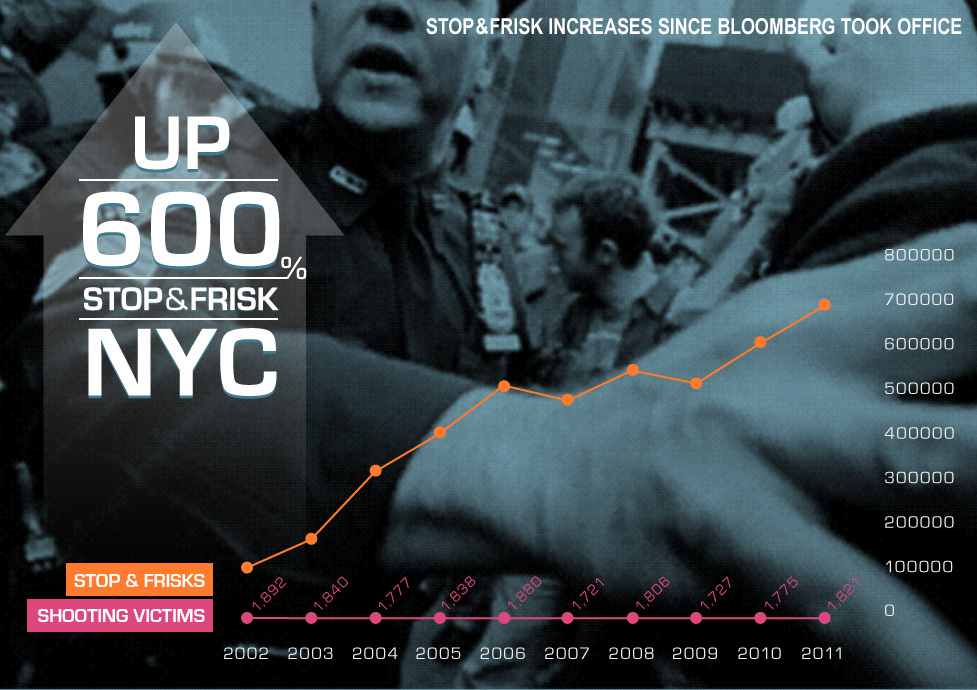
    A short while back I was hit with this little picture:

    You may look at the stop-and-frisk trend. But what I found more interesting are the shooting numbers. You don’t often see those numbers. Homicides are well tallied by police departments and the Uniform Crime Reports. Shootings less so. I’ve always used homicides as my standard indicator for crime. Homicides are reliable and valid, right?

    But here’s what threw me for a loop: are shootings in NYC really not down? 1,892 in 2002 and 1,821 in 2011. During that time, homicides went from 587 to 515.

    So here’s the problem: using homicides as a bellwether indicator for crime rests on the assumption that 1) there is a direct and consistent correlation between violent crime and shootings and 2) between shootings and homicides. So if homicides are down and shootings are not, it doesn’t work. Something else other than police work is probably responsible for the drop in homicide. Paramedics, nurses, and doctors jump to mind. The Wall Street Journal reported on this a few months ago (but the story is behind a paywall).

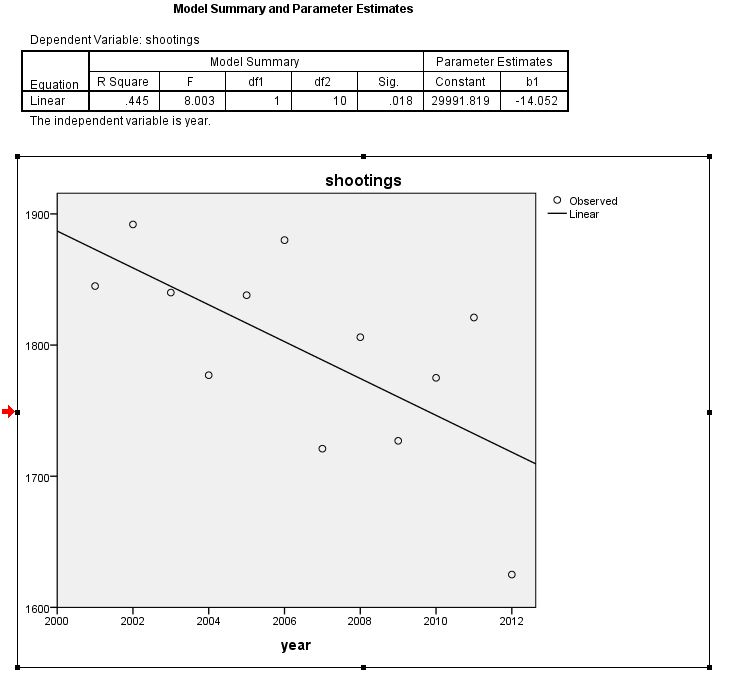
    The problem with the chart on shooting victims from dnainfo (which is a horrible name for a great news source) is that it draws a flat line. And 2012 was a good year for the NYPD: shootings dropped to 1,625 and homicides to 419. So if you punch the numbers into SPSS and get a trendline, you get this:

    It’s an average reduction of about 12 shootings per year over the past 13 years. It’s not huge, but it’s not insubstantial (and it is statistically significant). Shootings are down about 12 percent since 2001; homicides are down one-third (I haven’t broken down the homicides by weapon, but roughly 70 percent of homicides in NYC are shootings).

    One could reasonable infer that about 2/3 of the decline in homicides in NYC has nothing to do with police (because shootings are a better indicator of crime than are homicides). But still, a long-term (since 2001) 10-to-15 percent decline in New York City shootings (and, I would infer, crime) is noteworthy, if not exactly headline grabbing.

    Last year, 2012, recorded stop and frisks were down 22 percent, to 533,000 (compared with 685,700 in 2011. Homicides and shootings in 2012 were also down. (So clearly, if nothing else, last year tells us there’s no direct inverse linear relation between stop-and-frisks and homicides.)

    I’ve long argued that some some stop-and-frisks are necessary. You know, the ones based on reasonable suspicion that a suspect is armed. It’s the ones that are nothing more than stat fluffers that bother me.

  • “A system that is dishonest and fundamentally flawed”

    I often (and sincerely) defend Vice Magazine as (on a good day, mind you) the best source of journalism in our fine republic.

    Last night a friend sent me this link called, “Testilying: Cops Are Liars Who Get Away with Perjury.” OK… so I’m not expecting this to be pro-police. But before I read it, I wrote back saying: “I predict this will be much more informative (and accurate) than Michelle Alexander’s op-ed the other day in the Times on the same subject.”

    Now don’t get me wrong, I support Michelle Alexander. I like her book (even if I am a bit peeved it sold so much more than In Defense of Flogging). And I think the corrupting nature of the war on drugs is horrible for society and police. I think American incarceration is a racist gulag we need to be ashamed of. But Alexander loses me when she says, “Are police officers necessarily more trustworthy than alleged criminals? I think not… Police shouldn’t be trusted any more than any other witness, perhaps less so.” Really?! This shows a worldview based on outliers all to common to people who haven’t been in the courtroom (or the streets) for far too long. People lie in courts all the time. In court, cops lie least of all.

    Now compare that op-ed to Nick Malinowski’s article in Vice:

    By not acknowledging rampant police misconduct, by not demanding that criminal justice is meted out in a fair way, what are we giving up? Are we sacrificing a moral claim to justice by sanctioning the police–and thus the state–the freedom to circumvent the rule of law in the pursuit of a particular type of social order?

    “That is assuming that the justice system ever had any moral claim, which I would not assume,” former NYPD officer and Queens county prosecutor [and my colleague at John Jay College] Eugene O’Donnell says. “There is dishonesty in court, prosecutorial dishonesty. It’s legislative dishonesty that sets up this system and by no means are cops exempt from a system that is dishonest and fundamentally flawed.”

    Damn, Gene, you did it again!

    Here’s the thing: the courts in this country are literally a game. Cops know how to play that game pretty well. And cops want to win. Personally, I think a Continental system based on “discovering the truth” would be better, at least on a moral level, than our “adversarial system.” But such is the system we have. So be it. And what this means is that prosecutors want to convict and defense attorneys want to acquit regardless of what the suspect actually did. See, that’s the game. A defense attorney never throws up his or hands and says, “damnit, my client is guilty.” They’re not allowed to! Because the point of the system is not to determine what is right and just. Let me repeat that: the point of the criminal justice system is not to determine what is right and just. The point is for all the players to play their role. And you do this, at least in theory, because you hope and assume the greater system is right and just.

    Now prosecutors are supposed to admit when they’re wrong. Too often they don’t. More often this doesn’t come into play because the accused is guilty as sin. But if you want to find abuse in the criminal justice system, you could do a lot worse than starting with a look into proprietorial discretion and the plea bargain system. That is where the shit everybody is covered in is actually manufactured and distributed wholesale.

    So if you’ve never been to criminal court, why don’t you stop watching TV and spend a day in your local neighborhood court. Pick the lowest level and see what passes for justice for thousands of people every day.

    Cops are placed in this fucked-up game, but usually police not really key players in that game. If somebody beats the crap out of you, and you’re willing to testify, nobody needs the cops. Police just come along for the overtime. But when it comes to drugs and other “victimless” crimes, police suddenly are major players. And what drives police, usually in this order, is a desire to make overtime, please their bosses, and do good (usually seen as getting the guilty off the streets).

    There are rules that cops follow on the street that come not directly from laws and constitutions but from what prosecutors say are the rules of the game based on laws and the state and federal constitutions. Prosecutors tell police what police need to say and do to get a conviction. These rules can be very frustrating to police (see the Oreo Cookie example from Cop in the Hood, for instance; or me wrestling with a suspect and trying to keep a purse in view when I should have been spending 100 percent of my energy on the battle at hand). Often, if police feel the urge to lie, it’s not a matter convicting the innocent but convicting the guilty exactly as charged. Because prosecutors won’t prosecute unless a certain and somewhat arbitrary checklist of standards is followed. You’re bending the rules not of the Constitution but of a prosecutorial game that is rigged and with rules that seem to make no sense.

    The most common example I came across is that drugs can’t leave an officer’s sight. So you chase somebody down an alley, you see the person throw drugs down. You catch the person around the next bend. Twenty seconds later you go back to where you saw the drugs thrown and find those very drugs. This would probably hold up in a trial, but it will never get there because (well, leaving aside that fact that almost nothing ever ends up in a trial) the prosecutor won’t prosecute unless you say those drugs never left your sight. It would be an easy lie to make. All you would have to say is that the drugs were on the person when you took them into custody. And yet still, most cops won’t make that lie. Why? Because it’s not worth it. One person with a video camera means you get called out for perjury and get fired. To be fired is to lose your pension. Now why would want to do that? You get paid whether or not the guy walks. Let the bastard go.

    Then Vice digs deeper and makes the link between the rise of police lies and Mapp v. Ohio and Terry v. Ohio. Deep. Insightful.

    OK… Vice does indeed go a bit off the deep end. In Malonowski’s words, “police are indoctrinated into something akin to genocidal project: the forced removal of a class of people from their homes.” Sure. Whatever. And a bit of ignorance shines through as well: “If we started taking police lies more seriously — prosecuting them as we would civilian perjurers….” Tee-hee. See that’s funny, not because it’s true, but because it makes the assumption that civilians get prosecuted for lying in court. Ha ha.

    OK, maybe Vice doesn’t like police. But hell, I don’t expect Vice to be pro-police. Hell, even more, I don’t want Vice to be pro-police! And yet it’s still a great article.

    Once again, for the record, I did not see an officer lie in court. Maybe Baltimore officers are simply more honest than cops in other cities? Maybe. I kind of doubt it, but maybe.

    But I write this not to defend cops. Do some cops lie? Yes. We’ve seen it. Is the harm they do somehow mitigated by putting some schmuck away for some time? No, not even close. But you could end 90 percent of police corruption if you ended the drug war. And in the meantime, if you’re looking to find out why the system is rotten, you’re barking up the wrong tree if you focus on police testimony. The lying cops that are out there are symptom of the drug-war problem, not the cause. Not even close.
  • Jackpot!

    Alan Suderman of the Washington City Paper has a good article about police department discipline and some recent happenings in DC. Here’s the main story. And an extra.

    I don’t know why, but I always get a kick about being quoted using naughty words. In truth, I don’t actually think Iswear that much. And yet the blue just seem to roll out when I talk to a journalist about, well, the blue

    To wit:

    As Peter Moskos, the former Baltimore cop with a PhD from Harvard said in LL’s cover story: “It’s the worst of both worlds, because they have all these rules, but then it comes down to whether they want to fuck you or not.”

    Good thing he didn’t say that while on the force. He might have gotten fired.

  • Flogging Gains Steam

    There’s a bill to bring back corporal punishment(seemingly in lieu of incarceration) in Montana. It ain’t gonna happen, but still…

    Speaking of which, did I mention — gosh, no, I didn’t think I did — that In Defense of Flogging is out in paperback? Already? Where does time go? You might be thinking, “So light. So tidy. So cheap. Such a pretty orange cover. It actually fits in my pocket!”

    So why don’t you go and buy a copy? It got rave reviews, and yet you didn’t buy it. Because you were waiting for the paperback. So now is your chance!

    It’s only $12.59!

  • Earl Weaver, RIP

    “In five years, who’s going to be in the Hall in Fame?!”

    You, Earl, you gonna be in the Hall of Fame.

    “Little did I know 15 years ago, how deeply attached I’d become to this city. I came here in 1968 when urban areas were being demolished by riots and fires … but, after the turmoil subsided, it didn’t take me long to find out I was in a baseball town.”

    Here’s the obitin the Sun.

  • Stop and Frisk

    A federal judge ruled that some of the ways the NYPD conducts their “Trespass Affidavit Program” are unconstitutional. The NYT reports, “The judge ordered the police ‘to cease performing trespass stops’ outside the private buildings in the program unless officers have reasonable suspicion, a legal standard that requires officers to be acting on more than just a hunch.”

    So the judge basically ordered the NYPD to follow the law and the constitution. You’d think that would go without saying, but apparently somebody had to say it. The ruling is well stated and actually pretty mild. It doesn’t ban the program or stop and frisks. It bans illegal stop and frisks (which, of course, were already technically illegal).

    Of particular note, the judge criticized the check-the-box system in which officers tic, “furtive movements” as a basis for the stop. The NYPD set up this system to make the forms idiot proof. But most cops aren’t idiots. And maybe those that are shouldn’t be on the street.

    It is likely that the NYPD will have to go back to what is generally accepted standard practice everywhere else: articulating in words their reasonable suspicion for a stop. That’s the way it should be.

    I find it curious that the NYPD defends the system by saying this is what landlords want. It would be a lot better of the program was conducted at the behest of the residents. I don’t think most tenants, particularly poor tenants, see their landlords as looking out for the best interests. Landlords own buildings to make money, not to serve the best interests of their tenants.

    As a side note, and quite worrisome assuming it’s true:

    The judge expressed concern over a department training video that she said incorrectly characterized what constituted an actual police stop. In the video, a uniformed narrator states “Usually just verbal commands such as ‘Stop! Police!’ will not constitute a seizure.”

    The narrator explains that the encounter usually qualifies as an actual stop only if the officer takes further steps such as physically subduing a suspect, pointing a gun at him, or blocking his path. “This misstates the law,” Judge Scheindlin said of the video, which has been shown to most of the patrol force.

    To say only that this “misstates the law” is quite generous. That the NYPD would incorrectly educate its officers on such a basic issue… well I’d like to think it simply ain’t so, Joe.

    A “stop” (for which reasonable suspicion of crime is needed) occurs when a person cannot or reasonably believes he or she cannot leave. Because it is illegal to disobey a lawful order, reasonable suspicion kicks in the second a cop says “stop” or “come here.”

    This decision could be a win-win for the police and the community if the NYPD rises to the challenge by discouraging illegal quota-based stops based on “hunches” while continuing to encourages and support officers who perform legal stops. The risk (I think it’s a small risk) is that NYPD will know throw up its hands and stop policing. But nothing in this decision bans legal and effective policing.

  • Ah, the good ol’ days

    Some of my old police friends my recognize these stories from Slate.com, which are taken from Ray Fisman and Tim Sullivan’s soon-to-be bestselling The Org: The Underlying Logic of the Office. Tim knows my story well, since his help and editorial vision made Cop in the Hood the rip-roaring success it is.

  • Bang Bang, My Baby Shot Me Down

    More murders in Chicago. Fewer in NYC. Clearly something is going on. But generally you’ll hear nothing but crickets (or winter winds) blow through the ivory towers. It’s a real shame. These days, most academics will (almost reluctantly) concede that effective policing may play a roll in reducing homicide. And yet still very few academics would dare consider the hypothesis that aggressive — yes sometimes even unpleasant — policing may actually prevent homicides. (And, yes, you can and should be polite and respect the law and state and federal Constitutions at the same time as policing effectively and aggressively. Police work is harder and more dangerous when police go out of the their way to piss off people).

    As some academics may be afraid of digging deeper because they’re afraid of what they’ll uncover. Better to round up the usual suspects of poverty, gangs, racism, drugs, etc. But the NYPD does itself no favors by not giving a damn what people think: “Everything is under control. No need to look here. Keep moving.” But academics and the NYPD need each other. Certainly they do if any lessons are to be learned from the NYPD and applied elsewhere.

    You can’t just “do it like they do in New York” because we don’t know what about what they do in New York works. Is it Compstat? Stop and frisk? Broken Windows? Foot patrol? Zero Tolerance? College-educated police officers? Community policing (whatever that means)? Hot spots (actually, we do know that this works)? Better public housing? Mandatory prison time for illegal gun possession? Decreased incarceration? More immigrants? More eyes on the street? Getting rid of lead? Who knows? But let’s say that one thing the NYPD does pretty well these days in keep homicide numbers low. Well one thing academics do pretty very well is test theories and break things down into parts. There’s a lot going on here. It would be nice to systematically figure out what works. We need to understand these parts so that effective police tactics and strategies can spread to other cities.

    In the meantime, it’s like we’re swinging at a piñata, blindfolded. We took a few swings and feel some contact. But in the end all we see is candy in the floor. So we scoop some up and forget about what we actually did.

  • Bang Bang, That Awful Sound

    Chicago’s 2012 murder total was 532. NYC’s total number for 2012 was 417. Even in absolute numbers this is significantly lower than Chicago! Amazing. The comparable homicide rates for NYC and Chicago are 5 and 20 per 100,000.

    Homicides in New York City declined 19 percent from 2011 (just to remember: in 1990 2,245 people were killed in NYC). To get such a substantial drop on such a low (by US standards) homicide number needs some explaining. Chicago saw a 23 percent increase from 2011.

    Had the New York numbers gone up and the Chicago numbers gone down, you’d hear sage mumblings from chin stroking academics about regression to the mean (which, of course, assumes there is a mean (average) homicide rate toward which to regress… but I digress). I’ll tell you what the answer isn’t: people in New York just loved each other more; while clearly hate was on the rise in Chicago.

    [More tomorrow]

  • Bang Bang, I Hit the Ground

    Remember that fear mongering from last year?

    “Which one?” you might say.

    The one about more police officer getting killed? Forty officers were shot and killed in 2008. In 2011 that number increased to 67! Even the New York Times go in the act: “72 officers were killed by perpetrators in 2011, a 25 percent increase from the previous year and a 75 percent increase from 2008.” There was lots of talk about a new environment in which criminals felt more “emboldened” to assault law enforcement officers.

    I was asked about this a few times last year and said bullshit (I wasn’t quoted). It was probably just a statistical spike (albeit one with a lot of dead police officers on the end of it). Part of the reason I didn’t think this was a trend was that in 2007, 66 officers were shot and killed. Maybe 2008 was the aberration.

    Well the good news is that the number of officers shot and killed went down from 67 in 2011 to 47 in 2012. Sometimes it’s best to just be lucky.

    Update: Three offices were shotand injured last night in NYC.