Copinthehood.com has moved to qualitypolicing.com

  • 2015 UCR is out

    The 2015 UCRis finally out. This means we have real numbers on last year. And the numbers are not good. Homicide is up 10.8 percent. That’s biggest increase in 45 years. Don’t downplay it.

    I’ll talk about that in my next post, but first the boring roundup:

    Firearms were used in 71.5 percent, which is up from last year’s 67.9 percent. That’s 1,500 more murders by firearm.

    52.3 percent of all victims are black. (Up ever-so-slightly from 51 percent in 2014.) 906 more black men were killed in 2015compared to 2014 (6,115 vs. 5,209). That’s a very big 17.4 percent increase (murder among white men when up 9.2 percent). To put those numbers in perspecdtive, police shot and killed 248 black menlast year (and 10 black women). Most of those were justified.

    21 percentof homicide victims are women, same as last year. And women are 7 percent of known offenders.

    And though I don’t like looking at other crime stats (because I don’t trust their reliability) rape, robbery, and aggravated assult are all up as well. Reported property crimes are down a bit, but I suspect that’s more due to people’s decreasing desire to call the police or waiting for them to show up.

  • Spin This: The biggest murder increase in 45 years

    Murder is up. Who knew? (I’ve been saying so since last October.) Eventually, we’re all going to have to accept this (not in a moral sense but in a statistical sense). The accepted liberal reaction to this increase seems to be “it’s not a big deal” and “Don’t freak out.” Let’s not get “hysterical.” Let’s talk about “gun control.” (In the early 1990s, by the way, it was all about “drug treatment.” That didn’t happen either. And crime went down.)

    What I really do not understand is why the Left is willing to concede crime prevention to the Right. (I bet Trump won’t be downplaying this in tonight’s debate.)

    False argument #1: The best violence-reduction strategy is a job-production strategy.

    It sounds nice, but I say bullsh*t. As if unemployed people just can’t help but shoot each other.

    Do not get me wrong: Poverty is bad. But it just so happens that 2015, the year with the big murder increase, also saw the biggest decrease in poverty since 1991. 3.5 million people rose out of poverty last year. That’s great news. It really is. (Full report & summary in the NYT.)

    But we still hear this from people like this St. Louis alderman:

    How do we use that [crime] data to elevate the consciousness of our community? How do we use that data to provide the opportunity for people to get meaningful jobs, with livable wages?

    No. I mean, yes! Please, work on that, too. But the question from these data is how the hell we get police back into policing and crime prevention. Sure, it sucks when dad loses his job, but consider how much worse it is for dad to get killed coming home from work. (I would even say that you can’t have a real job-production strategy until you achieve violence reduction. Who the hell is going to open a business where you will get robbed and workers get mugged walking to their car?)

    The Guardian goes on to summarize the Brennan Center’s position:

    Last year’s national murder increase was not a uniform trend, but a sum of contradictory changes in cities across the country. Early analyses of the 2015 murder increase suggested much of it might be driven by murder spikes in just 10 large cities.

    (Now I see how clever the Brennan Center was to put out their paper last week, so it becomes cited immediately to put things “in context.”)

    False argument #2: It’s just happening a few cities.

    No. It’s not.

    Homicide (and almost all violent crime) is up in every grouping of towns and cities (such as “under 10,000” and “over 1,000,000”). Period. Now that doesn’t mean it’s up in every city. But what a weird and nonsensical standard. Sure, if we remove all the places where crime is up, crime wouldn’t be up. But that’s we have fancy statistical concepts like “overall,” “in general,” and “trend.”

    Even if we were to remove the 6 cities with the largest increase — and I don’t know why we would — but just to see if the problem is isolated in a few cities, let’s take out Baltimore, Chicago, Milwaukee, Washington, Cleveland, and Houston (collectively those cities saw about 420 more murders in 2015) — even without these cities the rest of America would still have 600 more murders and the biggest homicide increase in 25 years. That’s how bad these just released numbers are.

    Now we can say that violence in concentrated in certain neighborhoods. That’s true. But we’ve long known this. Indeed, as you can tell from looking out your window, there aren’t armed marauders outside your castle gates. What matters, or at least should matter, is that more American are being murdered. I find it distasteful (particularly when it comes from the Left) to say “most people” don’t have to worry about crime because the “average person” is still safe. The fact that violence disproportionately affects a subset of Americans may indeed mean it’s not a “national crime wave,” but it is all the more reason to care.

    False argument #3: It might just be a statistical blip.

    But it’s not. I mean, it could be a statistical blip…. If it were just one or two percent. But it’s up 11 percent. The last time we saw an 11 percent one-year increase in murder was 1971. That’s exactly my entire lifetime. And that was in the middle of eight-year run when homicides doubled from ten to twenty thousand. This “blip” was literally the deaths of 1,600 more Americans. The number of people killed went up from 14,164 in 2014 to 15,696 in 2015. That one-year increase negated 5 years of homicide decline.

    If you think this increase in murder “no cause for alarm” and people who care are “overreacting,” to you, I respectfully say “go to hell.” We worked too hard to get to where we are (or were) with lower crime. And a “don’t-overreact” reaction does not help. And it may lead exactly to the right-wing law-and-order backlash you so fear. (But on the flipside, to those who don’t really care but will use these deaths to make some racist point about “black-on-black” crime and “those people,” I say with all my heart, “no really, to hell with you, too!”)

    Why I care (and why you should, too):

    Among academics, it’s quite uncool to blame criminals for crime or give police credit for crime prevention. But then how many statisticians who use the UCR Homicide Supplement can point to a specific row and say, “Yeah, I handled that one.”

    Too many who say they’re for “justice” never really have to think about the injustice of just even one real murder victim (one not shot by police). But then maybe I care because I was a Baltimore cop. Every single cop can tell you a story about a dead person. Why? Because they care. Granted, some cops do care more than others, but you can’t police and not care.

    I wasn’t a cop for long (less than 2 years in total), and even I lost track of how many victims I dealt with. But a few do stand out. And this isn’t even getting into my cop friends who were shot, killed, nearly killed, had to kill somebody, or carry physical and emotional wounds for life.

    I remember the stare of a young black man at the same track we ran around while in the academy. His backpack made me think he was a good kid, on his way home from school. He was shot, perhaps after being robbed. We made long eye contact, even though he was dead.

    I remember the guy with a gunshot to the head one 321 Post. He was still alive when I got to him. But he clearly a goner, with blood and brain dripping from the hole in his head. His sisters were wailing while he died.

    How many Harvard PhD students have the intimate experience of sorted through a victims’ clothes? Clothes that are literally dripping with blood and yet still reeking of body odor. You’re trying to go through everything, looking for pockets, for any sign of identification of the life that used to be. And then there are the death notifications.

    Think of all those deaths. Last year there were 133 more murders in Baltimore than there were in 2014. [This year the numbers are down slightly compared to 2015, and the chutzpah of some people to herald Baltimore’s “crime drop” is shocking.] Take a moment and picture all those dead bodies, almost all shot young black men and teenagers. Visually stack them up like cordwood if you wish, or lay them all head-to-toe. It’s real human carnage.

    If you took all the Baltimore murder victims from just last year and laid them head-to-toe where the Ravens play football, that line of dead bloody bodies could score six endzone-to-endzone touchdowns. And the increase in violence last year happened all after April 27th. All it took was one man’s in-custody death coupled with anti-police protests, bad leadership, a riot, and a politician’s horrible choice to press criminal charges against six police officers in the matter of Freddie Gray’s death. (All charges ended up being dropped after multiple trials without a single conviction on any charge.)

    This is actually one time I don’t care about the historical perspective. Less than the 1990’s crack-crazy murder rate is not good enough. We got down to a homicide rate like Canada (about 1/4 of ours), and maybe I’ll be satisfied. We can start caring now. Or we can start caring after a few more thousand people are needless killed. And if you think I’m over-reacting, consider that you might be under-reacting.

    [Posts in this series: 1, 2, 3, 4, 5, 6]
  • “Book Em Danno”

    “Book Em Danno”

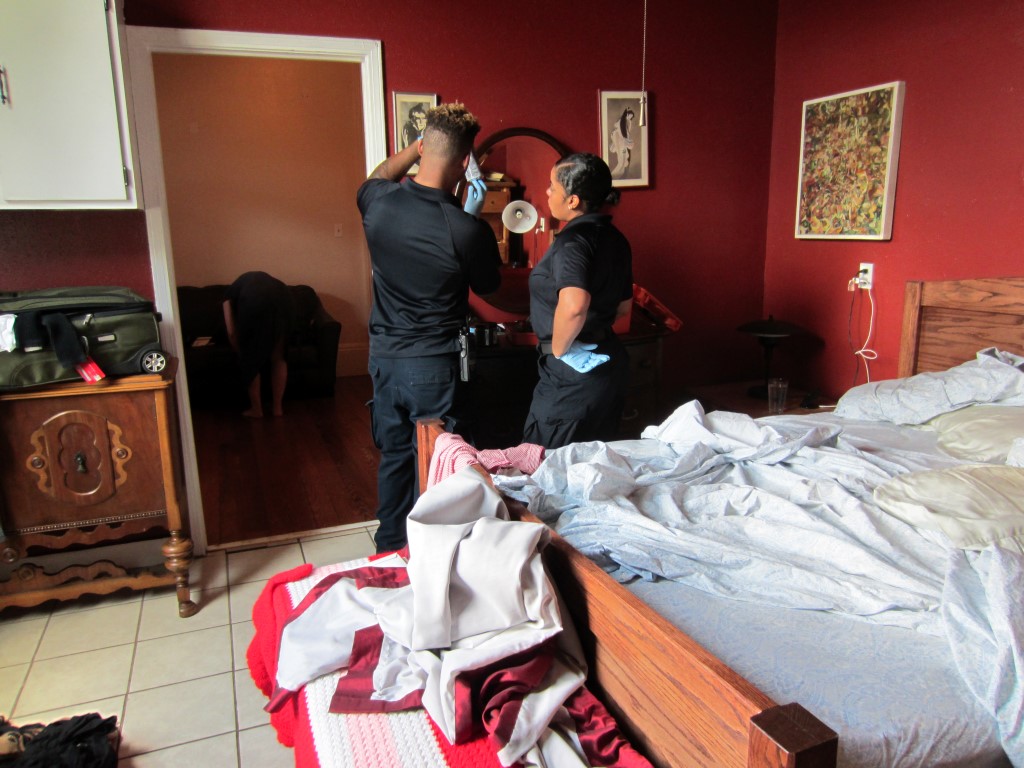
    In minor but fun news, I got a call from the New Orleans Police Department regarding the burglary that happened to us in New Orleans in May. They IDd and arrested the guy who did it!

    Turns out this very moment — when crime lab took swabbed the energy drink the crook drunk half of and left on a counter — was just the break needed to bust this case wide open.

    Needless to say, the guy was in the system. The detective called me to make sure I hadn’t invited said burglar over for an invigorating refreshment. Good work, ladies and gents of the New Orleans Police Department.

  • Brennan Center: No need for “most Americans” to worry about more murders

    The good people at the Brennan Center for Justice at NYU School of Law have assured us (pdf link to report):

    Reports of a national crime wave were premature and unfounded, and that “the average person in a large urban area is safer walking on the street today than he or she would have been at almost any time in the past 30 years.”

    The authors conclude there is no evidence of a national murder wave…. Most Americans will continue to experience low rates of crime…. There is not a nationwide crime wave, or rising violence across American cities.

    Ah, yes.

    Cause for a moment there, I was kinda worried that more people were getting killed. But it turns out, I guess, that it was illiberal of me to care about people who are particularly at risk of being killed. Also, did you know:

    Homicides are concentrated in the most segregated and poorest areas of the city.

    I hadn’t thought of that. And since that’s not where the “average person” lives, I guess we don’t need to worry.

    Maybe I should just jump on this illogic ideological bandwagon of denial to see where it goes:

    By “historic standards,” racism is pretty low in America. QED: Not a problem.

    #BlackLivesMatter can close up shop because “most Americans” don’t have to worry about being shot by police.

    Enough with all those new letters, the “average American” doesn’t face any LGBTQ discrimination.

    Check, check, and check. Problems solved!

    Oh, but while you’re here. Not that it’s any cause for concern. But there is this little issue…:

    The murder rate is projected to rise 13.1 percent this year…. [and] 31.5 percent from 2014 to 2016.

    Say what?!

    [Update: 2015 stats are out. The rate, based on recorded homicide, increased from 4.26 to 4.75 per 100,000. The rate, based on estimated homicides, increased from 4.44 to 4.90. Recorded 13,594 homicides in 2014 (estimated 14,164). 15,192 in 2015 (estimated 15,696). 2014 estimated population 318,857,056. 2015: 320,090,857.]

    If these numbers are correct — and they may not be (there is some odd math in this report*; and keep in mind 2015’s national UCR stats haven’t yet come out) — but if these Brennen Centers estimates are correct, that would mean 2015 saw a 16.3 percent increase in the homicide rate.

    So all we’ve got is just your average 16.3 percent annual increase in murder. I mean, we had one of those, well, uh, actually, never. This would be the largest increase since the government has been keeping track. (An increase in 1921 might have been greater, but we don’t really know.) The last time the UCR recorded a 31.5 percent increase in two years was, oh, never.

    [In raw numbers the homicide increase is the greatest in 25 years. But it’s standard industry practice to use rates and percentages.]

    [Update: I’ve been informed over in the twitter world that when they say “nationwide” they don’t mean “nationwide” but “in the top cities.” I would expect the national increase to be less than what is found in the top cities. But I don’t know. Anyway… the 2015 UCR data will be out this week. And then, at least when it comes to last year, we can all stop speculating and know how big the increase in homicide was.]

    As to their overall point that homicide may be up but “crime” is little changed? I just call bullshit. Not on their analysis, per se. It’s just that crime numbers are not as reliable as homicide numbers. Trust homicide. Crime numbers are heavily influenced A) by proactive police and arrests (which are both down) and B) non-reporting (probably up). I trust the strength of the correlation between homicide and other violent crimes more than I trust the data on other violent crimes. If homicide is up, violent crime is up. Trust me on that one.

    *They’ve got some weird math here I can’t figure out:

    The national murder rate is projected to increase by 13.1 percent. Nearly half of the increase (234 out of 496 new homicides) will occur in Chicago. (page 1)

    But if the national rate goes up 13 percent this year, we’d see something closer to 1,500 more homicides. (Based on 2014 rate of 4.5 and 13,472 homicides.) And Chicago’s numbers will be up by about 200 this year. This is closer to 15 percent. What gives?

    Baltimore, Chicago, and Houston are projected to account for 50 percent (517 of 1041) of new homicides between 2014 and 2016. (page 8)

    But if the murder rate is up 30 percent, we’ll have closer to 2,500 new murders. I do not understand.

    Also, these semi-annual “crime isn’t up” reports from the Brennan Center have this odd habit of saying, “if we remove the cities where the increase is the greatest, the increase really isn’t so great. (An odd statistical proposition, to say the least.) But let’s play along and “pull a Brennan.” Let’s remove Chicago, Houston, and Baltimore because (I think) in terms of raw numbers, those cities have the greatest increase in homicides, 2014 – 2016 (roughly 240, 165 and 115, respectively). After we “pull a Brennan” we lose about 520 murders. That’s a lot, but we’d still have close to 17,000 homicides in 2016, which would be a 2-year increase of 20 percent. And even that should be cause for alarm.

    [Posts in this series: 1, 2, 3, 4, 5, 6]
  • State Variance in Police Use of Lethal Force

    State Variance in Police Use of Lethal Force

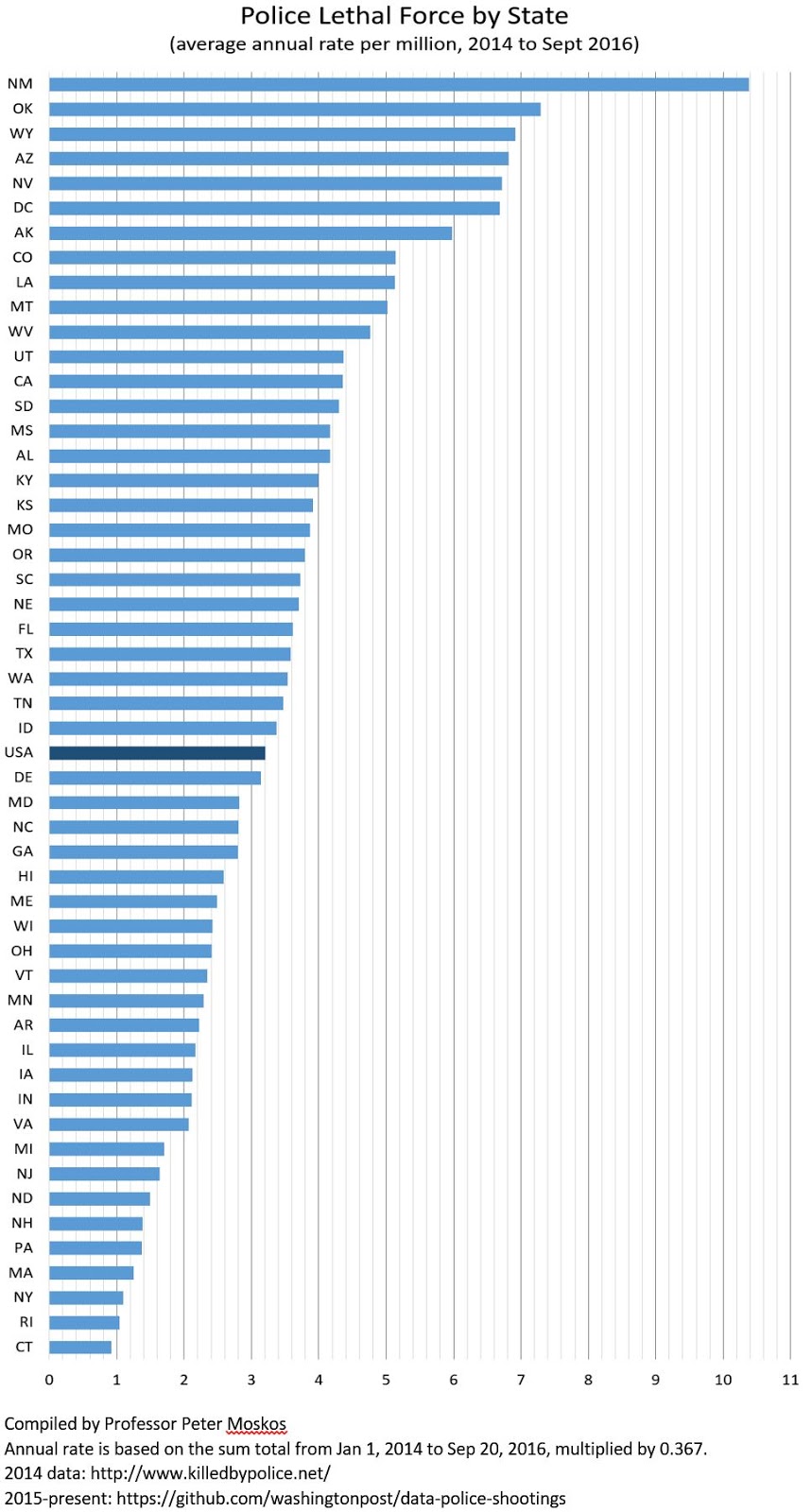
    If we want to reduce police-involved shootings— and we do — why not focus on states where cops shoot the most and learn from states where cops shoot the least? These differences are huge. What is New Mexico doing wrong? What is New York doing right? The top twenty states (ignoring D.C.) are all west of the Mississippi. Arkansas is also noteworthy. I would expect it to be toward the top, but its rate of 2.2 is below the national average.

    Take this chart with a grain of salt.

    [See 2020 caveat.]

    The data are uncorrected and I can’t promise it’s error free. And the absolute number (n) for many states is low (18 have n < 20, for instance), so the data for a lot of these states are statistically dodgy. But the greater regional trends are pretty pronounced.

    Here are the raw numbers, sorted small to large: RhodeIsland 3, NorthDakota 3, Vermont 4, NewHampshire 5, Delaware 8, Connecticut 9, Maine 9, Hawaii 10, SouthDakota 10, Wyoming 11, Alaska 12, DistrictofColumbia 12, Montana 14, Idaho 15, Iowa 18, Arkansas 18, Nebraska 19, Massachusetts 23, WestVirginia 24, Kansas 31, Minnesota 34, Mississippi 34, Utah 35, Indiana 38, Wisconsin 38, NewJersey 40, Oregon 41, Michigan 46, Maryland 46, Virginia 47, Pennsylvania 48, Kentucky 48, SouthCarolina 49, Nevada 52, Alabama 55, NewYork 59, NewMexico 59, Tennessee 62, Missouri 64, Louisiana 65, Washington 68, Colorado 75, Illinois 76, Ohio 76, NorthCarolina 76, Georgia 77, Oklahoma 77, Arizona 125, Florida 196, Texas 263, California 460, USA 2787

  • Trends in NYPD police-involved shootings

    Trends in NYPD police-involved shootings

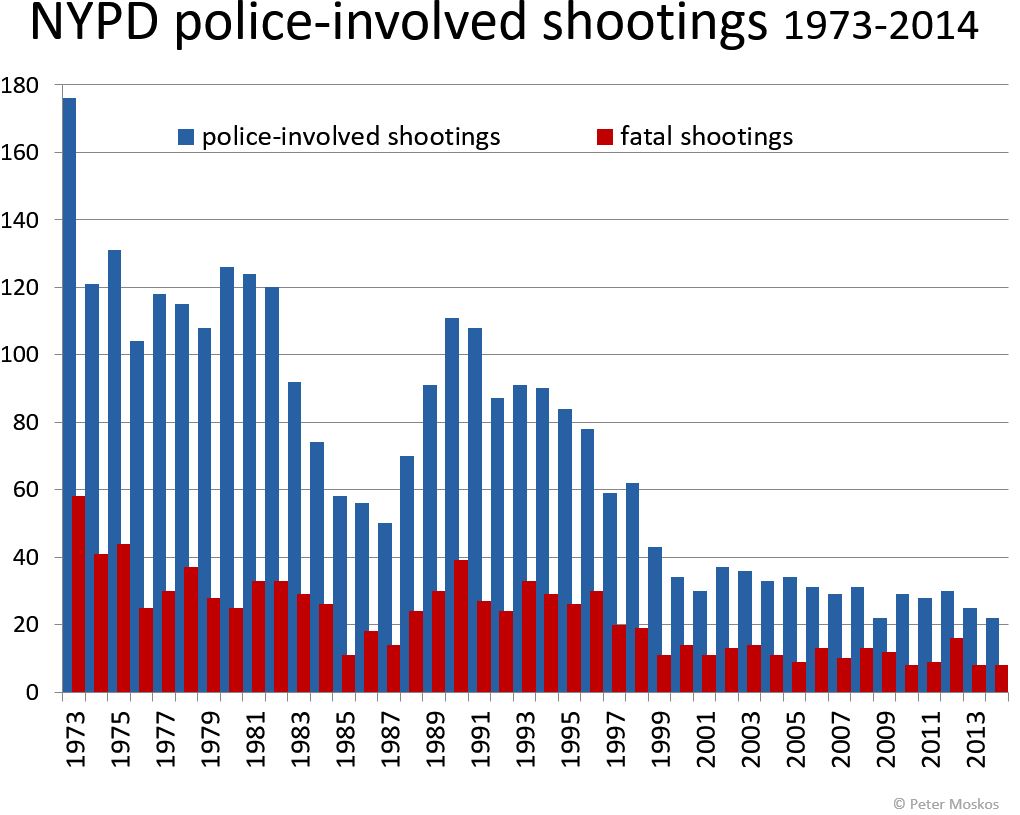
    In relation to my previous post, it’s not like the NYPD didn’t used to shoot a lot of people.

    There are two trends going on here. Police-involved shootings always reflect homicide numbers. (Cops are more likely to shoot a murder with a gun.) So there’s a spike in 1990 the then a big drop after that, which reflects crime in NYC. But even taking that into account, there’s a long-term downward trend. I have no idea what the long-terms trends in Oklahoma have been.

    Source: NYPD

  • They’re just Sooner to Shoot in Oklahoma

    They’re just Sooner to Shoot in Oklahoma

    Updated: November 15, 2017

    Also see this 2020 update. And an important caveat.

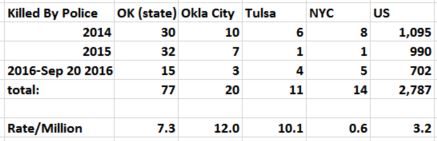
    Using data from 2014 through mid November 2017 (killedbypolice.net for 2014 and the Washington Post thereafter) Oklahoma City Police kill an average of 6.3 per year; NYPD 0.57 a year. The rate in Oklahoma City is 11 times as high. The rate per officer is 27 times higher in Oklahoma City. That means a person is Oklahoma City is 11 times more likely to be killed by police and a police officer is 27 times more likely to kill.

    Original Post:

    I’ve said for a while that when it comes to police use of lethal-force, an exclusive laser-like focus on race is misguided. It’s is a red herring. If one actually wants to reduce police-involved shootings — as opposed to simply being outraged at the latest incident — there are easier ways to do this than eliminating racism and racial disparity in America. There are low-hanging fruits to reduce the overall level at which cops shoot people.

    There will be the next police-incident worthy of outrage. We can go from incident to incident, outrage to outrage, and pretend it’s just about race. But it’s not.

    I’m not saying race doesn’t play a factor. This is American. And indeed, blacks make up a greater percent of unarmed people killed by police. The disparity could be racial bias; it could be related to violence in segregated America; it could be something else. Honestly, we’re never going to settle the debate, and I don’t know if we need to. Police misconduct doesn’t only happen to blacks. And the numbers of innocent unarmed people killed by police is simply not that large. Nor is it increasing.

    Police have shot and killed 706 people this year. Forty-one were unarmed. Fifteen of those were black. (Keep in mind “unarmed” does not mean no threat, and conversely somebody could be armed and not be an imminent threat.) I get the argument that murder is worse at the hands of the state. I even agree with it. I understand police need to be held accountable. But at some point the numbers matter, at least to put things in perspective.

    This is a country of 320 million people. There are 765,000 sworn police officers. There are 15,000 murders (and murderers). What’s an acceptable level of police-involved shooting? What’s the goal? And if you’re not happy addressing that question, or if you think the only acceptable answer is zero, than you’re not a productive part of the solution.

    Look, I know some cops do shitty things. And others make honest mistakes. But there are more cops in America than residents of Baltimore. We can and should criticize individual incidents. But we don’t harp on every crime in Baltimore — and there are a lot — to show how the whole city is filled with evil. (And I do wish we cared a bit more about victims like Michael “Chef Mike” Bates who was just shot and killed even after he complied with the three men who robbed him.)

    Does a bomb in Chelsea mean we should ban Muslims from America? (No, is the answer.) There will be the next horrific crime and the next terrorist attack just as sure as there will be the next bad police-involved shooting. Instead we’re seeing something close to a moral panic, with police as the Folk Devils, we need to reduce how often they happen.

    There are probably a few dozen bad (as in criminally bad) police-involved shootings a year. That’s a couple a month, keep in mind. And if they’re all recorded, that’s one every other week. But far more numerous are shootings which may be legally justifiable but did not have to happen. They’re justifiable but not necessary. We’re talking perhaps something in the rage of a few hundred a year. And the bulk of these happens west of the Mississippi (see a future post). The best way to reduce bad shootings is to reduce the overall level of police lethal force.

    Twenty-five percent of those who are shot and killed by police are black. Since blacks are only 13 percent of the general population, some claim this represents an “epidemic” of police violence against African Americans. But using the overall population as the denominator for interactions with police makes no sense.

    America is filled with racial disparities in poverty, violent crime, calls for police service, and those who felonious kill police officers. I mean, 96 percent of those killed by police are men, and men make up less than half the population. Is there an epidemic of misandric cops gunning for other men? I don’t think so. It’s more likely that men are more likely to pose lethal threats to police officers.

    And this brings me back to Oklahoma, where Terence Crutcher was shot and killed by a police officer even though he wasn’t an imminent threat. A while back I red-flagged Tulsa and Oklahoma because I couldn’t help but notice: they sure do seem to be a hell of a lot of police-involved shootings in Oklahoma. And now we have more data than we did a year ago.

    We’re not seeing an epidemic of police killing black people in particular in Oklahoma. The Sooner State is pretty white (72 percent, 8.6 percent Native American, and 7.4 percent black). The racial disparity in Oklahoma is pretty much in line with the rest of the nation. Since 2014, nationwide, the average annual rate of being shot and killed by police is 3.2 per million. It’s higher for blacks (6.93) and lower for whites (2.37). That’s a 3:1 ratio.

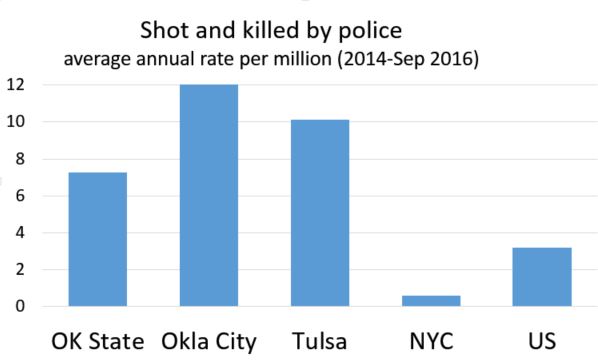
    What we see is that more white people get killed by cops in Oklahoma than all people killed by cops in majority minority New York City. Simply put, police in Oklahoma are shooting a lot of people and the NYPD isn’t. In Oklahoma, cops shoot and kill 28 people per year. In New York City, which has more than twice as many people as the entire state of Oklahoma, police kill about 5 people a year. What gives?

    People in the state of Oklahoma are 12 times as likely as New Yorkers to be killed by police.

    People in Oklahoma City are 20 times [11 times, see update, above] as likely as people in New York City to be shot and killed by police! New York City has about 2.5 times more police officers per capita. That means an officer in Oklahoma City is about 50 times more likely than an NYPD officer to shoot and kill somebody. [27 times, see update above]

    These differences are huge! Shocking! Unbelievable!

    And yet nobody seems to notice or care. [See all the states in this post.]

    I assume most of the police-involved shooting even in Oklahoma are legally justifiable. I’m not saying these cops are committing crimes, but I am saying a large percentage of these shootings aren’t necessary. They don’t need to happen. I mean, it’s likely cops in Oklahoma will always shoot more people than cops in New York City. Sometimes police have no choice but to shoot somebody. And Oklahoma isn’t New York. But it doesn’t have to be 12 or 20 times more. I can’t conceive of how a per-capita disparity this large could be justified or explained away by any variables except police training.

    So I look at the Terence Crutcher being shot, and I think: maybe that really is how police in Tulsa roll. I don’t know. And I wonder what it is about NYPD training and policy that so reduces use of lethal force. Whatever it is, and I’m sure it’s a combination of things, it shouldn’t be that hard for somebody to copy best practices. Instead of asking what individual police officers are doing wrong (though we can ask that, too), why don’t we figure out what the NYPD is doing right? We have models that work. The solution involves some combination of better hiring standards, better policy, better training, and more accountability.

    Just reducing Oklahoma’s use of lethal force to the national average would save 14 lives a year. That seems doable. And good. It’s good for the people not to get shot. And it’s good for social and racial justice. And it’s also good for police officers who get to go home without killing somebody. Cops don’t want to shoot people. You think Officer Betty Shelby wouldn’t like to go back in time and not shoot?

    And let me mention I’m only picking on Oklahoma because of the recent Tulsa shooting. Oklahoma isn’t even the worst state when it comes to high levels of police-involved shootings. Currently, in 2016, it doesn’t even crack the top five.

    [I did some brief computations on crime (some 2015 UCR data is already out!) because police violence is best predicted by public violence. In 2014 and 2015, Oklahoma has an annual murder rate of 5.4 per 100,000. This is 30 percent higher than New York City’s 4.1. Aggravated assaults and total violent crime, however, are 35 percent higher in New York City. So it seems that Oklahoma does have a violent murder problem separate from any crime problem. But nothing here would even get close to accounting for twelve- and twenty-fold differences in police use of lethal force.]

    Notes: Annual rate is based on the sum total of Jan 1, 2014 to Sep 20, 2016, multiplied by 0.367.

    2014 data: http://www.killedbypolice.net/

    2015-present: https://github.com/washingtonpost/data-police-shootings

    Oklahoma crime stats: https://www.ok.gov/osbi/documents/Crime%20in%20Oklahoma%2C%202015.pdf

    Crime stats: http://www.criminaljustice.ny.gov/crimnet/ojsa/indexcrimes/Regions.pdf

    Race data is from the Washington Post, so it starts in 2015. Annual rate is the sum from 2015 to Sep 20, 2016, multiplied by 0.58. National rates based on 318.9 million with a white population of 200 million and a black population 36 million. Feel free to double check my math. Corrections and comments always welcome.

  • Terence Crutcher shooting

    Terence Crutcher shooting

    I’ll cut right to the chase, I think this is a bad shooting; but not as bad as many people seem to think. (In my very first sentence, I probably just pissed everybody off.)

    Terence Crutcher wasn’t armed. And I don’t think he was an imminent threat when he was shot. Therefore it wasn’t reasonable. And that’s the legal standard for a justifiable shooting.

    One very troubling thing here is why nobody renders aid. It probably wouldn’t have helped (with a bullet going through a body from one side to the other). But you can’t just shoot somebody and not render aid. You can’t. And they did. What they hell were they doing backing up in formation? What weird part of training was that?

    Nor do I like the helicopter guy saying, “he looks like a bad dude.” Would the guy have said that about a white guy? I don’t know. I first thought it was a contributing factor, but from what I’ve read their broadcast was not being transmitted to the officers.

    But what was Crutcher doing? False narratives are unfair. And dangerous, as we just saw in Charlotte. (Keith Lamont Scott seems to have approached officers with a gun, not a book.)

    Despite what I keep reading, Crutcher was not complying. Crutcher was going to his SUV against the orders of cops. This is odd, worrisome even. But it doesn’t elevate somebody to a lethal threat. And Crutcher’s hands were not in the air when he was shot.

    But I still don’t understand why the cop shot at that moment. I like to think, had I been there, I would have taken Crutcher out with my straight baton and a blow to a leg. Tasing would be justified. I don’t want him getting in that car when my partner is telling him not to. Perhaps, if you have the muscle, you just tackle the guy.

    It seems to me Crutcher wanted to get back in his car. And cops are not going to let that happen, because we don’t to be killed like Officer Dinkheller died. What I’m saying is this isn’t Walter Scottbad. It wasn’t Charles Kinseybad. It wasn’t Levan Jonesbad. It wasn’t James Boydbad. It wasn’t Bobby Canipebad. It wasn’t Jonathan Ayersbad.

    Bad is bad, and there’s no reason that every police-involved shooting has to be as bad as the worst shootings to warrant criticism. But I mention those names in part because many of these names are not African American. If people don’t know that cops shoot white people, too, they should. And sometimes these shootings aren’t justified. Too many police are too quick to pull the trigger. And this problem is not evenly spread throughout policing (more on that in my next post).

    Back to Crutcher: As a cop you’re also aware that gunfire deaths of cops are up 50 percentthis year. But you can’t just shoot people because they’re non-compliant and drop their hands. You can’t be a police officer and be that afraid. Damn that Dinkheller video from 18 years ago. Before you shot, you need to wait till you see an imminent threat, like a gun or movement towards what you know is a gun. Look, people should be compliant, but as a cop you know people aren’t going to be compliant. It’s why we have police. People do not act rationally and police officers have to deal with them.

    That said, this wasn’t just a motorist with a stalled car. From the 911 call:

    Caller: There was a guy running from it. He, like ‘somebody was going to blow up.’ I think he’s smoking something.

    Dispatch: Ohh (laughing).

    Caller: I was rude to him too because I got out and was like, ‘do you need help’? And he was like, ‘come here, come here.’ I said ‘well, what’s going on’ and he’s like, ‘come here come here. I think it’s going to blow up.’ I’m like, ‘nah I’m out.’

    Dispatch: OK.

    Caller: He started freaking out and he took off running.

    Crutcher was not acting reasonably. He’s talking about something blowing up. He’s roaming the street in what was probably a drug-induced high (we don’t know for sure, but PCP was found in the car). None of this justifies the shooting. But it does all matter.

    Let’s imagine that Crutcher was going to blow up his SUV or had guns in there. It’s possible (though it wasn’t the case). Then would the shooting be justified? Still, no. (But it sure would be a better narrative.) Even then the shooting would not have been reasonable because at the moment the shot was fired, I don’t think a reasonable police officer would see an imminent threat. At least I don’t. As a cop, you don’t have to wait till a gun is pointed at you before you shoot. You shouldn’t wait till a gun is pointed at you before you shoot. But there’s got to be a gun! I mean, people should be compliant, but as a cop you know people aren’t going to be compliant. It’s why we have cops.

    So now we’ll see how justice plays out. I suspect the officer will be criminally charged, as does happen in many bad shootings.

    So here we have another “incident.” One of many, certainly. And don’t ignore the historical context. But there will be another bad policing shooting. I guarantee it. We can’t base reform on anecdote. Cops kill roughly three people a day. They’re not all good shootings, but most of them are.

    What is the goal? The goal could be fewer bad shootings. The goal could be more accountability for tax-payer funded agents of state. Fine. But we’re never going to have zero bad shootings. Not only is that impossible, it’s not even a good goal. When cops save a life by killing a criminal, it is not an example of “global and national hatred.” Policing is not a pacifist occupation. We give cops guns because sometimes, at certain moments, we want them to shoot somebody. That is the reality. The way forward cannot be continued outrage, incident by incident.

    That said, we can reduce bad and unnecessary police-involve shootings. I’ll get to that in my next post.

  • It’s the criminals, stupid. (Or why cops don’t stand for gun control)

    In reaction to this Missouri law, a friend of mine asked me “why police are not standing up to the gun lobby more vociferously and effectively? It seems to me that their jobs are made immeasurably harder and more dangerous by rollbacks in gun laws such as this.” You’d think, she said, police would want fewer guns out there that could kill them. But generally that’s not the case. My reply:

    Partly because there really isn’t any real national police organization to do the standing. And I wouldn’t want a representative national police organization talking about politics, because if such an organization existed, we wouldn’t like what they have to say. [And as if on cue, the FOP came out endorsing Trump. I was hoping they’d keep their mouth shut on that one.]

    There’s the IACP (Int’l Association of chiefs of police). But it’s not like they have a lot of Clout. And this law was opposed by Missouri’s Police Chiefs Association, says the story. I suspect they carry about 20 votes. And organizations of “chiefs” are more Left than their rank-and-file, because a lot of chiefs are appointed by politicians, and have to represent their beliefs.

    Then you’ve got the police unions (the PBA and FOP). They’re technically apolitical, though very much politically conservative. Like any union, there’s a question over how much they should venture beyond working conditions and pay and the like and speak on national issues. Far be it for me to speak for a million cops, but I think most cops do support some gun regulation — and thus oppose what Missouri did — but given the either/or choice between “all guns banned” and “no gun restrictions,” most cops would go with the latter.

    So then we just delve into the gun control debate with all the usual and predictable sides and lack of progress. Cops see danger coming from a small subset of criminals with guns, and not guns in general. Remember: police officers and all their friends are (for the most part) legal responsible gun owners. Cops want laws to focus on criminals and crimes, rather than guns. Collectively, most cops are incredibly pro-gun and equate the 2nd Amendment with freedom (just as you and I might do with the 1st Amendment). Inasmuch as gun laws are seen to infringe their rights while doing nothing to prevent criminals from shooting each other and shooting cops, cops aren’t going to support it.

    Consider this: there are (almost) no shootings in Chicago or New York or Baltimore that involves a legally possessed handgun. We’ve already “controlled” these guns and made them illegal. So what would passing *more* restrictive gun laws do to stop this violence? Are we going to double-dog-dare make them illegal? They’re already illegal. We don’t prioritize the laws we do have.

    How can we take guns out of the hands of criminals? (Or get criminals to use them less?) That’s the $64,000 question. Most gun-control laws are close to irrelevant here. Perhaps the only way to get guns out of the hands of criminals is to confiscate guns with strong gun control, Australian style. Many people, myself included, like this idea. But the majority of Americans and the current Supreme Court would not agree.

    The basic ideological divide is that liberals see guns as the problem and conservatives see criminals as the problem. And nobody on either side has a good plan to keep guns out of the hands of criminals.

    There are three-hundred million guns in America; ten-million guns are manufactured every year! And yet only about 10,000 of these gun are used to murder somebody (plus suicides, of course). How many millions of guns would we have to confiscate before we prevented a single gun homicide? And how would we go about doing this?

    Most proposed gun-control is pretty useless in actually preventing crime (as opposed to preventing a small number of gun sales.) And gun people see this as an ideological battle on gun-owners, so they won’t give in (even on so-called “common-sense” issues). The political reality is that there’s no way right now we could enact gun control so restrictive it would actually do any substantial good.

    Common ground? Maybe actual jail time for people who carry illegal guns? Would liberals support more mandatory sentences for those caught with illegal guns? Without exception? I suspect such a practice did actually contribute to the crime decline in NYC. But you try throwing the words “mandatory minimum” into a room of urban Progressives and see the response you’d get! (The key here is mandatory; the minimum doesn’t have to be long.)

    If gun-control advocates maybe first agreed that criminals with illegal guns are a bigger problem than guns, maybe some political compromise could be reached. I’m afraid gun-control has become a harmful distraction to real issues that can save lives now.

    This past Monday in Baltimore, a 64-year-old man was robbed and attacked while reading a book in a park. A group of young people placed a gun to his head, stabbed him, sprayed him with mace, took his stuff, and then, just for kicks, stabbed him again. That’s just a normal crime, right? But what makes this shocking is less the crime than the girl that was there to film the crime and post it on facebook (which she did)! And this wasn’t their only recent crime.

    I have no clue what gun-control law is going to stop this from happening. Or what law would keep the 13-year-old armed robber with a gun in Ohio (who was just killed by police) from getting his hands on the BB-gun replica he had? And yet there’s more outrage from the Left about police killing this kid armed-robber who had a gun (albeit one that turned out to be non-lethal) than about actual armed robbers.

    Here’s what scares me right now more than guns: the potential right-wing law-and-order backlash. The official 2015 crime data comes out, get this, the day of the next presidential debate. Homicides are way up in America. We know this. Black homicides in particular. It will be the largest increase in decades. And yet the Left has been in denialabout this (and/or discounts its significance). By talking about guns rather than crime, we’re virtually conceding law-and-order issues to Trump and the fascist Right. Politically and morally, this is bonkers.

    [Unrelated, I suspect the phrase “It’s the ______, stupid” is long dated and most people don’t understand it or know its Clinton-Era origin.]

  • Legal weed means 25% fewer overdoses

    This is pretty striking data, as published in JAMAand reported in Newsweek. From JAMA:

    States with medical cannabis laws had a 24.8% lower mean annual opioid overdose mortality rate compared with states without medical cannabis laws. Examination of the association between medical cannabis laws and opioid analgesic overdose mortality in each year after implementation of the law showed that such laws were associated with a lower rate of overdose mortality that generally strengthened over time.

    Medical cannabis laws are associated with significantly lower state-level opioid overdose mortality rates. Further investigation is required to determine how medical cannabis laws may interact with policies aimed at preventing opioid analgesic overdose.

    It’s not rocket science to figure out a likely cause-and-effect.