Copinthehood.com has moved to qualitypolicing.com

  • Too far a gap to bridge?

    I lose hope when, on one hand, the South Carolina F.O.P uses the term, “professional race agitators” in a press release. As a former dues-paying member, I will gladly offer my editing service gratis to any FOP newsletter. Seriously. If your goal is P.R. and you’re talking about “the recent tragedy.” Do not use the term “professional race agitators” in the same press release. Just don’t. Trust me on this one. (Al Baker’s story in the Times.)

    On the other hand, people in Baltimore are protesting a man who remains in a coma after being injured during an arrest. Meanwhile, Baltimore being Baltimore, police shot somebody near the protest who had a loaded gun (the fourth BPD-involved shooting in 2015). And one group of anti-police protesters is idiotic enough to ask in a tweet, “how could [police] know it was loaded?”

    See, when police have to explain why they shot a criminal with a loaded gun, it doesn’t make you want to engage. It makes you want to go to local F.O.P. bar, drink too much, and talk about “professional race agitators.”

    [Meanwhile, just FYI, 11 people were shot in the last 24 hours in NYC.]

  • Occupy the Corner

    Protests in Baltimore against violence. From the Baltimore Sun:

    “Occupy the Corner,” as it was called, was the opening salvo in another year of community outreach arranged by the anti-violence group known as 300 Men March. As they have for the past two years, members plan to gather every Friday evening into the fall to walk the streets as a group and engage residents young and old in an effort to make neighborhoods safer.

    “There are a lot of people who want to do something about the violence but don’t necessarily have the outlet,” Bahar said before Friday’s event. “That’s why we created ‘Occupy the Corner’ — to give people an outlet, not against police violence but more specifically the day-to-day violence happening in the communities, of young folks gunning other folks down.”

    City Councilman Brandon Scott joined the sign-wavers, saying he hopes it will help reclaim the Penn North neighborhood from drug dealing.

    “When we are engaged in our communities, we have less violence,” Scott said. Last year, the group focused its efforts in the Belair-Edison community in Northeast Baltimore, Scott said, because there had been a spate of homicides there. During the months of activity there, he added, the number of killings dropped.

    Scott also drew a distinction between the anti-violence efforts of 300 Men March and the protests against police violence.

    “Both issues are valid,” he said, adding that he may very well join the rally Saturday, too. But complaints about police misconduct are no excuse, he added, for failing to take personal responsibility for what goes on in the community.

    “This is very good, but it’s only symbolic,” said Field, 63, who leads African-American heritage tours. “As soon as the 300 crowd came, the evil folk left,” he said. But he added that “five minutes after they leave, it’s going to be a drug corner.”

    If you really think that people (black people in particular) only care about violence when it comes from police, you’re either woefully uninformed or willfully ignorant.

  • Here’s what’s up in Oklahoma

    This is an email I received from (someone I believe is) an Oklahoma Police officer. He answered my question — why does Oklahoma lead the nation in people killed by police? — very well. It’s knowledge I don’t have, and I can’t say it better myself. He agreed to let me reprint it here, anonymously:

    To clarify, the reserve academy is 240 hours (nights and weekends), the full time academy is 600 hours (increased to 600 4-5 years ago). Reserves are limited to the number of hours they may work. When I started in ____ the reserve academy was 168 (min hours, most add additional training to it) and I think full time was 320. A few years before that it was less and less.

    They have increased training greatly over the last 15-20 years. The main reason it has taken so long to increase the hours and why it isn’t as high as the national average is that most departments can’t afford to have an officer tied up at the academy for more time. Most have a difficult time making it while they are gone as it is, due to a lack of manpower. The only area where the standards in OK exceed standards is firearms. They made the qualification course easier 3-4 years ago, but it’s still difficult. (Before they used to start at 50 yards, now they have eliminated those and added more at 25 yards).

    As for the reason for more shootings by officers and other issues in general, there are many things that contribute.

    1) OK is a “conservative” state. They continually increase penalties while at the same time cutting budgets, causing less personnel, less continuing education opportunities, increased early release of inmates (I think the last news article I read on our prisons stated at they are only about 60% staffed). In my opinion, the ones on parole are far from adequately supervised. There is also, in my opinion, a lack of mental health services.

    2) Pay. No one wants to say it, but low pay contributes to they quality of officers. You get some that do it for the right reasons, then some that never should be officers. It’s hard for most agencies to find suitable officers. With the exception of a handful of agencies in the metro areas and the OK Highway Patrol, I would estimate the average salary as 30K. Some smaller agencies in our area start at just above minimum wage. Some small towns have one full time and actually pay one or two reserves (many end up going to the full time academy and becoming full time at some point).

    3) Low number of officers per square mile outside of OKC, Tulsa, Norman, and Lawton. There are no agencies outside of the metro areas that I know of they have more than one officer per unit. In many areas, the nearest backup may be 15-20 miles away. (More likely to fight or attack a solo officer.) It’s not that these areas are not populated, just not as densely populated. The tax bases do not generate enough to hire additional officers.

    4) Meth and prescription drugs, abused everywhere, but sadly more so in OK. Leads to increases crime and violence in general

    5) Suicide by cop. This seems to be happening more in OK. A few weeks ago I was involved in a pursuit and shootout with a man who had murdered his brother and told some people he wouldn’t be taken alive. As a result of his actions, a state trooper was injured by glass flying into his eye when a bullet from the suspect struck his windshield. The suspect was shot and killed. The same night one of the troopers that came to assist with that stopped a car and the driver pulled a pistol and started shooting at him, causing the trooper to retreat to his car and return fire. The suspect then exited his vehicle and shot himself in the head. The last I heard no one was able to determine why the man did it.

    6) Change in our society. I used to think my elders didn’t know what they were talking about when they spoke of changes, but I have noticed them myself over my 35 years of life, especially the last 10. With newer generations, ethics and personal responsibility seems to have declined. Children are doing things in school now that we would have never done or even thought about doing. Some (sadly some of my own family) have no respect for themselves or anything else. (I’m not sure if this is everywhere or just in our region.). We also have a high percentage of our population on various forms of welfare and large economically depressed areas (not that this makes someone a criminal).

    7) Broken juvenile justice system and some parent that just don’t care. In OK, they can do nearly anything without consequences, and they know it. By the time they turn 18 is too late and they continue to be criminals.

    8) Drug trafficking and cartels. I-35 , I-40, and I-44. Besides local drug manufactures, large amounts are brought through our state. (Same is true for AZ, NM, and TX).

    9) EVERYONE in OK is armed. I personally do not have an issue with it. I purchased my first firearm, a Colt single action .22, from an elderly neighbor when I was 9 years old. I have collected and enjoyed shooting ever since, both competitively and recreational. In OK, I would estimate that over 50% of the population have weapons and many hunt. It is legal for citizens to own suppressors, machine guns, and short barreled rifles (with appropriate paperwork and ATF tax stamp). The vast majority of gun owners are very responsible, however, with increased gun ownership, there is naturally going to be increased issues involving firearms. Same is true with alcohol (our state had a huge problem with DUI), fattening foods, and smoking.

    All of this sounds bad, but Oklahoma is actually a good state to live in, it just had some issues like anywhere else.

  • Well done, NYPD. What’s your secret?

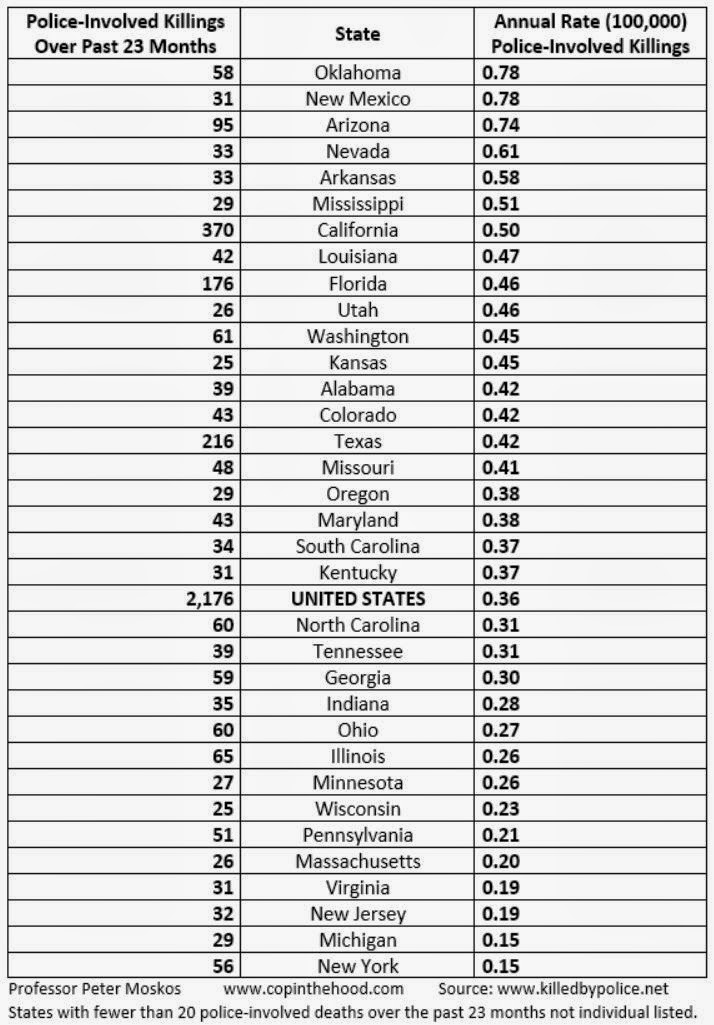
    The national average, the rate of people killed by police (as they define it, which is pretty loose, but OK) is 0.36 per 100,000. This is over the past 23 months. That’s roughly 1,135 killed per year.

    This is based on these data from May 2013 to April 2014. I believe it’s similar to (but a bit messier than) killedbypolice.net. But it’s got city and county data, which isn’t at killedbypolice.net.

    Now we already knowthat the rate of being killed by police is a hell of a lot higher in Oklahoma, New Mexico, and Arizona (0.8) — five times higher — than it is in New Jersey, Michigan, and New York (0.15).

    But states are big and have hundreds of police departments. I want to break it down by city. The rate in California is twice the national average. I don’t think San Francisco police are shooting a lot of people. So who is?

    Well, Bakersfield (rate = 2.1, which includes killing in the city killings both by the Bakersfield PD and the Kern County Sheriff Dept.), Salinas (2.0), Stockton (1.4), Fresno (1.1), and Santa Ana (0.9) come to mind. These are crazy high rates.

    Super high seem to be Kansas City, MO (rate = 2.0), Oklahoma City (1.7), St Louis (1.5), Tulsa (1.4), Phoenix (1.2), and Albuquerque (1.1). Remember all these figures are rough. So I don’t mean to rank order, but I do mean to group these cities together.

    Bakersfield? Salinas? Maybe it’s been a bad two years, but there are only 363,000 people who live in Bakersfield. Between 2012 and 2013, the NYPD killed 21 people. And in the past 23 months 15(!) people have bit the dust in Bakersfield? Do correct me if I’m wrong. The stats may be a fluke. Or maybe it was a bad two years. Or maybe the numbers are wrong. But it’s still a hell of a red flag!

    The rate in Los Angeles 0.5. That’s not quite twice the national average… but it’s one-forth of Bakersfield and Salinas. Baltimore’s rate is 0.9. Chicago comes in at 0.6.

    The NYPD? The big bad NYPD? The killers of Diallo, Gurley, Bell, Garner, and so many other?

    Zero-point-one-three. New York City’s rate is 0.13. The rate of people killed by police in one-third the national average. This is amazing.

    Put another way, Chicagoans are 5 times as likely to be killed by police. Baltimoreans 7 times as likely. And Bakersfield? Lovely Bakersfield? In the streets of Bakersfield you’re 16 times more likely to be killed by police than you are in New York City. [Update 2017: This is no longer true. The number of people killed by police in Bakersfield has declined greatly. But the overall numbers for small- to medium-sized cities west of the Mississippi are still very large.]

    [Update: See Nick Selby’s description of those shot and killed by police in Bakersfield. Maybe the streets just really are meaner.]

    Think of this, too, as my NYPD friends do. Shootings by NYPD may be tragic, but compared to the rest of the nation, they really do seem to fall in the category of isolated incidents. Whatever the NYPD is doing to shoot so few people seems to be a case of best practices. Maybe the focus should be not to criticize the NYPD but to learn from it. The systemic problems seem to be out west. And maybe people who want to protest police shootings should protest police who really are shooting too many people.

    Go west, young man, go west. There is health in the country, and room away from our crowds of idlers and imbeciles.

    [I want to emphasize these results are primarily, not double-checked, and based on unverified data. But the even as just ballpark figures, the differences are too dramatic to ignore.]
  • “If I had a hammer… I’d hammer out justice.”

    This is the second paragraph of an article by Ta-Nehisi Coates:

    When Walter Scott fled from the North Charleston police, he was not merely fleeing Thomas Slager, he was attempting to flee incarceration. He was doing this because we have decided that the criminal-justice system is the best tool for dealing with men who can’t, or won’t, support their children at a level that we deem satisfactory. Peel back the layers of most of the recent police shootings that have captured attention and you will find a broad societal problem that we have looked at, thrown our hands up, and said to the criminal-justice system, “You deal with this.”

    Nothing against women’s rights advocates, but I haven’t heard anybody question the logic of passing laws that lock people up for failure to pay child support. (And while I’m at it, can I just mention that mandatory domestic violence laws are racist, do not work, and have have hurt countless men and women.)

    This is the first paragraph. It’s just as good:

    There is a tendency, when examining police shootings, to focus on tactics at the expense of strategy. One interrogates the actions of the officer in the moment trying to discern their mind-state. We ask ourselves, “Were they justified in shooting?” But, in this time of heightened concern around the policing, a more essential question might be, “Were we justified in sending them?” At some point, Americans decided that the best answer to every social ill lay in the power of the criminal-justice system. Vexing social problems–homelessness, drug use, the inability to support one’s children, mental illness–are presently solved by sending in men and women who specialize in inspiring fear and ensuring compliance. Fear and compliance have their place, but it can’t be every place.

    And this if from the end:

    Police officers fight crime. Police officers are neither case-workers, nor teachers, nor mental-health professionals, nor drug counselors.

    I’m pretty sure Ta-Nehisi Coates isn’t trying to be pro-cop, but that’s the kind of line that will get carried off on cops’ shoulders at a police convention!

    That last paragraph goes on:

    The problem of restoring police authority is not really a problem of police authority, but a problem of democratic authority. It is what happens when you decide to solve all your problems with a hammer. To ask, at this late date, why the police seem to have lost their minds is to ask why our hammers are so bad at installing air-conditioners. More it is to ignore the state of the house all around us. A reform that begins with the officer on the beat is not reform at all. It’s avoidance. It’s a continuance of the American preference for considering the actions of bad individuals, as opposed to the function and intention of systems.

    There’s more. And you should read the whole thing. But that is my good-parts version.

  • Why are Christians so violent?

    I know that headline is unfair clickbait, but there are many things that could be said about this video. Here’s a Daily News story.

    I think it’s interesting primarily to show what can happen when officers fail to gain control of a situation: a mess. A lethal mess. A cop gets shot. Two of the fighting Graver family get shot, one fatally.

    Tactically, clearly mistakes were made, but it’s hard to second guess. It’s rare to find a group that is so willing and able to fight cops. Still, in terms of “things that could have gone better,” one place to look is that fight only started after the cops arrived on scene. That could be a place for improvement. Once the brawl is on, well this is why you always want a fight to be two, three, or four police to one. What a mess. What part of “get on the ground” don’t they understand.

  • Killed by Police (3 of 3): Cutting the number in half

    Killed by Police (3 of 3): Cutting the number in half

    [See my previous posts 1 and 2 and about NYC.]

    It’s not unreasonable to believe — even when one knows the vast majority of police-involved shootings to be justified — that three police-involved homicides per day is perhaps two too many. Can the number of police-involved killings be reduced without placing officer’s lives in danger? Of course. We know this because some departments shoot a hell of lot more people than other departments.

    If California could reduce their rate of police-involved shootings down to the rate that already exists in the state of New York? 135 people a year would by killed by police. And that’s just in California alone.

    Police in some states are much more likely to pull the trigger than in other states. Now this does not take crime and violence against police into account, which would in an ideal world. But the differences are still incredibly stark. And since we’re looked it states rather than cities, I mean, it’s not like cities in New York, New Jersey, and Michigan normally come to mind as epitomizing peace, love, and non-violence.

    [It’s worth warning and repeating that all this assumes the data is valid enough. I am assuming that. But I may be wrong.]

    Oklahoma has a police-involved homicide rate of 0.78. That’s higher than the overall homicide rate in Sweden. Oklahoma, New Mexico, and Arizona all have rates of police-involved killings that are twice the national average (0.36) and four to five times higher than Pennsylvania, Massachusetts, Virginia, New Jersey, Michigan, and New York.

    My guess is the differences have to do with better training, more police officers per capita, less public tolerance of police-involved killings, higher police standards and pay, and differences in police culture.

    But really, in terms of police training and standards, there’s no reason to think we couldn’t bring all states in line with the best states. And if police across the nation killed just as often as police in those least trigger-happy six states currently do? That would cut the national rate of police-involved killings by half and save 500 lives a year. This would also save 500 cops a year from having to shoot and kill somebody. Police lives matter, too.

    2020 Update. And 2020 caveat.

  • “Who gave this reserve cop a gun?”

    Uh, it’s his own gun. But headline aside (writers don’t write the headline), I like to think I make some good points in this CNN piece about Robert Bates, the Tulsa County “reserve deputy” who thought his gun was a Taser and shot and killed a criminal.

  • “You’re doin’ fine, Oklahoma!” Not.

    A 73-year old man, Robert C. Bates, liked to play cops and robbers. He thought he was going to get to Tase a bad guy. But instead of holding his Taser, Bob was holding his personal gun. Bang. You’re dead. Oops.

    Bates wasn’t a real cop. He was a “reserve deputy sheriff,” which isn’t necessarily a bad concept, within reason. But this isn’t reasonable. Bates paid to play. He gave money to the Tulsa County sheriff’s election campaign. Maybe he could have been a deputy sheriff without donating money. But he gave cars to the undercover unit to which he had access. And now, irony of ironies, Bates might be convicted based on the evidence provided by the very eye-glass cameras he perhaps gave to the department!

    Bates didn’t even have good reason to even Tase Eric Harris. Cops were on scene. Harris wasn’t getting the upper hand. He wasn’t going anywhere. Despite what Bates later said, I do not think Bates thought Harris was armed. I say this because Harris was flying. Booking. Like a man who does not have a gun in his waistband. His arms were pumping, not going to his dip. Not in what I saw. And this is very much contrary to what supposedly “independent consultant” Sgt. Jim Clark claimed while defending Bates after being paid to investigate the shooting.

    [And Kudos to the cop who tackled Bates. Good job. He was a fast runner and knew exactly where to tell the driver to stop the car, though the driver was a bit slow in doing so.]

    “This horrible situation is going to be about what a corrupt sheriff’s office does after a bad shooting,” said Daniel Smolen, said a lawyer for the SOB who was shot.

    I think Smolen may be right…. wait. Did I just speak bad of the dead? Yeah. And I say this without at all saying the shooting was justified. And I’m certainly not defending an elected sheriff who allowed the guy to be on the scene with a gun. But what a bastard Harris was: Violence. Drugs. Guns. Robbery. Assault on cops. Escape from prison(?!). The whole nine yards. A real life of crime.

    I mention this in relation to my Washington Post article in which I describe how cops were so bothered about the shooting of Walter Scott. That one was different. This was a tragedy. A fuck up. And blame can and should be placed. But if you want cops to shed a tear over the death of Eric Harris, you’re going to be waiting a long time. Harris was a harbinger of violence and doom.

    [Having watched the whole unedited video in the CNN office today, it’s unfair to just air the part where cops say bad things to Harris. One line — “fuck your breath” — out of context is just a gotcha moment. The media should also show Harris yelling at the cops. Now granted, Harris has just been shot. Maybe you wouldn’t like the line even in context, but the context matters. Harris, on the ground after a dangerous chase, is yelling about how he “didn’t do shit.” This is a man who had just ran from police after selling an illegal gun to an undercover cop. My actual thought when I heard his protests of innocence was, “fuck you!” Though I did manage to just think this and not blurt it out in the middle of a newsroom. I also didn’t just have to chase, catch, and restrain this jerk. This situation, to paraphrase Jay-Z, has 99 problems, but the cops’ words ain’t one.]

    Maybe it’s because as a police officer you’re around of lot of death and even a lot of people murdered. So perhaps it’s inevitable to rank order the value of life. It’s one way you cope with dealing with a lot of death. An innocent kid is worth more than a guilty adult. A robbery victim’s life is worth more than the robber’s life. Somebody who could have prevented his own death by complying with lawful orders deserves less sympathy than somebody who didn’t run. The death of a guy killed after some minor vehicle violation is more tragic than a long-time felon who dies after running and selling undercover cops a gun. Somebody killed with intent is different than somebody killed in an accident. And both of those deaths would be different than somebody who happens to die as a result of less-lethal force.

    So Bates had a Taser. And I think Bates wanted to use his toy. Oh, boy! I suspect moments like this were exactly why Bates had given so much to the Tulsa County Sheriff. He wanted to play cop. Bates and the Tulsa County Sheriff’s Department have made a mockery out of professional policing. Clearly Bates should not have have had a gun and a Taser.

    Let us not start to consider “slip and capture” (a term I had forgotten before today) justification for using a gun instead of a Taser. Yeah, apparently it is possible to hold and fire a gun that you think is a Taser. “Slip and capture” reminds me of the invented concept “excited delirium,” which to some people means it’s OK when people die after getting tased. Just because you give something a name doesn’t make it real, or defensible. At best, “slip an capture” is a description. Bates, from everything he said before and after firing one round, obviously did not intend to shoot and kill Harris. But that doesn’t make it OK. And with proper training you don’t do it.

    And it’s interesting to note that both in this case and the shooting of Walter Scott in South Carolina (and the shooting of Oscar Grant on the Fruitvale BART platform), that these victims would be alive if the cops (or, “cop” in the Oklahoma case) had not been armed with a Taser. I’ve never been a big Taser fan. I wonder if this is something to consider. There’s particularly irony in people being killed because officers have less-lethal weaponry. (Not running from cops is also a wise preservation strategy, though that didn’t help Grant.)

    Finally, let me observe that I don’t know much about Oklahoma except a song (and the history and meaning of “Sooner”). But maybe Oklahoma is not “doin’ fine.”

    Oklahoma (together with fair New Mexico) has the highest rate of police-involved killing in the nation! The rate at which people are being killed by police in Oklahoma is twice the national average and five times the rate in New York or Michigan. Five times higher? That’s a big difference. It’s also the subject of my next post.

  • Bad Taser Judgement from Officer Slager

    This is from back in 2014. This is not a good use of a Taser. It actually makes cuffing him harder. The two really hard parts — getting a guy out of a car and getting hands out from under a resisting person — are done.

    This the guy is still resisting, so it’s probably legal and departmentally justified. But it’s morally and tactically wrong. He was seconds away from being cuffed.

    I also just heard some rumor regarding the S.C. shooting (and I don’t know if it’s true) that Slager somehow ended up with a taser dart in himself. I only this mention because even if Scott had Tased Officer Slager, it doesn’t matter. And I don’t think that did happened Based on the video, if a dart did end up in Slager’s leg, it seem more he somehow tased himself. But it’s irrelevant because it doesn’t change the issue about pulling the trigger on a man who was not a threat at the time you pulled the trigger. I’m curious about what led up to the shooting, naturally, but it doesn’t matter. Slager was dead wrong.