Tag: Baltimore

  • Police-Involved Shooting, Baltimore July 1, 2020

    Police-Involved Shooting, Baltimore July 1, 2020

    In some ways this is yet another too typical police-involved shooting (not that police-involved shootings are typical — these kind of calls get handled in the thousands “without incident”). But it’s all here: a man with a gun, mentally disturbed, confronted by police. And not for the first time. The man is black, unlike the previous one I wrote about, in Patterson, NJ, in which the man was white. Here the only white people are the paramedics. That too is not untypical.

    This is not an unusual call. It’s a 3AM call for somebody in “behavior crisis.” It’s the fourth such call of the day. The previous day, June 30, there were 36 such calls. On July 1st, this is the 4,071th such call this year for Baltimore City Police. Probably (though I don’t know) this was the first to end with somebody being shot. Anyway if you don’t want cops to respond to this call, you’d need resources to handle up to maybe a half dozen of these “behavior calls” calls an hour. This is for a city of (sigh, less than) 600,000 people.

    But this is worth analyzing because, well, it seems to be handled very well by police, and the mentally ill guy still gets shot. The cops do well. They treat the man as a man in crisis and not a mortal threat. they don’t dehumanize him. You don’t hear de rigueur verbal commands for the sake of “controlling the scene.” This is the midnight shift in action.The cops take their time. The cops are calm. They are caring. They try to connect with the guy. They make sure he knows they’re here to help him. They don’t have their guns out even though they strongly suspect the man is armed and turns out to be a mortal threat!

    I’d like you to look at this and think, “At what point did the cops make a mistake?” “At what point would I or better yet a trained expert done something differently? Short of the guy being on his meds and/or not having a gun, how could have this turned out differently. But he wasn’t on his meds. And he does have a gun (though we don’t know that, and that’s part of the problem). And the family has tried and failed to managed the situation. So they call 911 because they help.

    So we send the cops. And the handle the situation well, in my humble opinion. And a cop comes within a split-second of being killed. And the mentally ill get get shot multiple times (though lives).

    When the cops enter the house, the mother-in-law warns them, “It ain’t gonna be that easy.”

    The cop replies, “Nothing ever is.” Truer words have never been spoken.

    The moment this becomes a lethal force situation happens so fast that I missed it more than once, trying to take notes. From police arriving on scene to shooting takes 18 minutes. But from sight of the gun to the shootings takes less than 2 seconds. Even knowing it’s coming, you’ll miss it. I guarantee it.

    The other reason I’m writing a lot is to weed out the weak! But seriously, I can’t force you to watch the whole video, but if you’re still interested and willing to watch the shooting part, watch the whole damn thing. My point is not to show violence, but how to prevent it. Or, unfortunately accept that sometimes, for many reasons, it is inevitable.

    After the shooting the Mayor of Baltimore says through a spokesman that the shooting was under an “active investigation.” The Maryland ACLU said: “In Maryland, this has become a disturbingly familiar pattern – where officers called to assist someone in mental distress instead trigger a crisis, failing to see the person’s humanity and shooting instead of helping. This latest incident further points out how Baltimore’s over-dependence on police is setting them up to fail, and costing unnecessary lives.” Gosh. Sounds horrible.

    “This is why the ACLU of Maryland and and more than 60 other organizations across the state are demanding that the Law Enforcement Bill of Rights be repealed…. #BlackLivesMatter”

    So the ACLU says this would not have happened if only LEOBOR were repealed. (Personally I’m not a big fan of LEOBOR, but that’s neither here nor there right here). The ACLU is literally taking this man’s death, a man a crisis, a black man, and using it for political gain. This needs to be pointed out. It’s a shitty thing to do. Anyway, after (hopefully) proper redactions, a few days later the BPD did release the body cam footage. As far as I know the ACLU never said anything about maybe the cops did pretty well here, all things considered.

    From the Sun: The police commissioner said that after the shooting by the officers, the residence where the shooting occurred was searched and eight weapons were found, including a second weapon registered to Walker. Asked whether police should have taken steps after the first incident to determine whether Walker had additional weapons, Harrison said the investigation was “ongoing.”

    The police commissioner could have should have been more laudatory about the professionalism of the officers. It’s not exactly the defense you’d like to hear from your boss after you just had to shoot someone, had your game taken away, and worry if the prosecutor will slap you with criminal charges.

    Think that’s crazy? Cops fear getting in trouble not for doing wrong, but for doing right. Just one year ago Sgt. Bill Shiflett confronted an active murderer and got shot for his efforts. For his troubles, Mosby, the prosecutor, held potential criminal charges against him for 7 months. I don’t know why. You’ll have to ask her. But this is policing today.

    This police-involved shooting, as is common, starts with a 911 call. It’s after 3AM on Wednesday, July 1, 2020. The call itself is very well handled. Mother in law calls and says: Last time he was drinking he had a gun. … He’s a psych mental patient. Yelling and screaming and ranting. Last time they give him two shots and took him to [the hospital.] My daughter is trying to get him to come up. My daughter’s husband is in the basement and he’s paranoid or schizophrenic. He was diagnosed with that couple weeks ago. He’s down in the basement and he’s like that now.

    Operator: Is he having an episode or something?

    Yes.

    Operator: How old?

    33 years.

    Operator: I’m making request for an ambulance. Is he violent?

    I guess. I don’t know.

    Operator: Possibly or likely?

    Yes. Possibly.

    Operator: Does he have a weapon?

    That I don’t know.

    Operator: Is he thinking about suicide?

    I don’t know.

    Operator: Is he completely alert?

    Not really. Hearing voices.

    Operator: I’m going to send the paramedics and well as police. They’re going to monitor.

    You should make them silent cause he’s going to go crazy when he hears.

    Operator: They usually do accordingly for certain calls.

    And then standard instructions are given about setting up the house and whether people have COVID. The whole call takes two minutes and thirty seconds. The cop on 414 post gets a medium-priority call for a “behavior crisis” and probably takes about 15 minutes to get there. Another officer would be assigned as backup. Usually this can of call involves standing around while paramedics do their thing.

    It’s worth pointing out that all three cops parked some distance from the house, as they should… but that didn’t used to happen when I was there. Better to take a minute to approach on foot and judged the scene. Also they didn’t want to block the ambulance in. Anyway, to me it’s noteworthy. Also there were no sirens. But it’s late night/early morning. Only the ambulance has its flashing lights on. The fire department does that. Partly they just like their lights. But also it does provide a beacon to approaching vehicles, which can be life saving.

    Anyway, so once the cops are there, at the front door, with paramedics, we get this additional information from the mother in law. She is on the phone with her daughter, who is in the basement with her daughter’s husband, Walker. The mother in law says the following: Running down the street acting crazy.When the found him last time he was ranting, he had a gun.He is a psych patient. … Down there screaming and ranting now.He probably didn’t take his meds. “I’m doing this natural. I’m doing this natural.” He ain’t harmed nobody.About 2 weeks ago running up and down the street. That’s him.

    Paramedics know the guy from the previous week’s incident, when he was running around, maybe shooting a gun? I’m not sure. One paramedic asks the other if he is combative. The other replies, “very.” So they won’t go in. And it’s not their job. So at 5min 34sec (on Officer Gray’s bodycam, below) two police enter the house. A third joins later. This is 4 minutes after Gray got out of his police car. There’s no rush. That’s good.

    Walker’s wife, the caller’s daughter, can’t get him to come upstairs. She probably been trying for hours. Eventually she concedes what she’s doing isn’t working and says cops are going to come downstairs.

    When everybody gives up, cops go in. The wife can’t get her husband to come up. The paramedics won’t go down. There is no dedicated social worker cops know to call. But is that really the solution at this point? Like the paramedics, it’s hard to social workers going down without cops. And I’m not certain what they would do that the cops didn’t. The mother and father in law? God knows what they think about how they got in this situation. Pops seems to have given up. But I’m sure it’s been a very long night. Again.

    So should the cops refuse to go in because it’s dangerous? They can’t. Or maybe the cops leave and say this isn’t a job for police. Except it is. Because it’s dangerous. The police are our responders. And they’re trained. Their goal is to get this guy to either calm down enough so the cops can leave and the paramedics can have a look. Or to get take the man into custody and get him safely into appropriate medical care. That’s it, right? Those are the choices.

    Baltimore Police released video. This is the video from Officer Gray’s bodycam. This is the one I’m going to use. But here is the video from Officer Torand. And from Del Valle (I’m not certain why there isn’t video at the moment he’s doing most of the shooting. Could be too gory. Could be malfunction. Could be a massive cover up!… but it’s not). Here’s the the version edited by the BPD which they released for the press conference. It’s a good job and kind of covers it all. But it’s also a bit confusing since they show multiple bodycams and slow-mo and stop things down at times. But police work in real time. I like real time. Finally, here’s Justin Fenton’s article in the Baltimore Sun. (Fenton does a good job, but I don’t want that to go to his head.)

    Gray asks for addition units at 5min 37sec (this is not clock time, but the time on the video, which is the after the officer started his body cam). The officer confirms the name of the man in “distress.” It’s about 4AM. Gray and another officer go to the basement at 6:15. At 6:40 they ask the wife to clear out, and they tell her that medics are there. The man’s name is Walker. The timeline below is this video. The transcript is edited and not complete. The only white people I can see are the paramedics, which isn’t that uncommon for Baltimore. I’ll leave to you to say if that matters.

    This is the video that corresponds with the timeline, below.

    7:30 Cops: Your family called us.

    7:42 Walker: Come in front to the cameras. [This is in reference to cameras that may but probably do not exist.]

    8:00 Walker: Trying to take my life. In my house illegally. And about to kill me.

    For much of the time, Walker has his hands in a prayer-like position and speaks to either a non-present friend (maybe his barber?) or God.

    8:25 Walker: Distorted because my wife tried to poison me.  

    8:48 Walker: Take your masks down.

    9:23 Cops: If he takes his mask off?

    9:38 Cops: Can you listen to me? I‘ll go in front of the camera if you take that knife out of your pocket.

    10:10 Cops: Where are the cameras?

    10:15 Walker: I know tribal tattoos when I see them.

    10:17 Cops: We’re trying to help you. The medics are upstairs.

    10:45 Walker: Nobody called y’all.

    11:00 Walker: He’s been sleeping with my wife. Whole time.

    11:20 Cops: Do you feel like you want to hurt yourself?

    11:22 Walker: Hell no.

    11:39 Walker: Come shake my hand like a man.

    11:45 Walker: [third officer arrives about now] I don’t know him, sir. Can you take down your mask please. And if I kill you inside my house, it’s legal, yo. I’m peaceful.

    At some point the specifics of the dialogue here don’t really matter. This man simply isn’t all there. Times like this were only time I was afraid as a cop. That moment when I realized that all the words I said, any empathy I had? They mean nothing. And there lots of red flags. Messianic references to rising from the dead. Threats. Paranoia. Speaking to God. None of this is a good, from the cops’ perspective. But they do their best to stay calm and get the man to comply and come upstairs.

    12:14 Cops: Your family is here. If your family comes down…

    12:20 Walker: I apologize come. Shake my hand. I was chastised. They poisoned me. …Take off your mask .

    12:45: Cops: I took off my mask….. I can’t take off the gloves.

    12:55 Walker: How’d I get to the hospital illegally.

    13:12 Walker: The police are here illegally. I didn’t invite them in.

    13:20 Walker: I died. I came back on the third day. On the cameras.

    13:35 Walker: Every time I’m in front of cameras they still trying to kill me. The whole time they kept trying to kill me. Please they tried to kill me other day. I don’t know you. You either.  

    13:55 Cops: The ambulance is upstairs and we’re trying to help you.

    14:10 Walker: [to the heavens] Please save my life. They’re trying to kill me in real life. On camera. I don’t know how these people got here. [yelling] Bosses only king chambers. Get out my chambers!  

    14:35 Walker: They’re trying to kill me in real life.

    14:42 Cops: They’re the medics behind us.

    14:45 Walker: How’d they get here when I didn’t invite them.

    14:48: Cops: Cause your family called them.

    14:50: Walker. I hate everything.

    15:25 Walker: [Yelling] You can’t kill me. Everything recorded, yo.

    15:55 Walker: Y’all can’t kill me in real life.

    16:10 Cops: If you’re not able to go with us, then we’re going to have to put cuffs on you.

    16:15 Walker: I’m on camera. You can’t kill me in real life. You gonna kill me in front of my father. It’s my real life. Can you lock them up before I die, yo?

    16:47 Cops: Nobody is trying to kill you. Nobody is trying to harm you.

    16:49 Walker: Everybody in my house right now. They’re moving stuff. They’re trying to kill me.

    16:51 Cops: We’re trying to help you.

    16:52 Walker: They’re moving stuff, you. Why y’all trying to kill me. All y’all was here the other day. Sheriffs here! Please save my life.

    [Officer moves camera right to side of Walker, moves an object that we could trip over. Officer Gray silently points to two possible weapons. This is a tight team. I like that.]

    17:15 Walker: Why ya’ll getting close. I died in real life. Please save my life. The sharps are here, yo. Why you moving stuff, yo?

    17:30 Cops: Keep your hands out your pocket. Keep your hand out your pocket.

    17:35 [officer on right move what I think is a knife from off the top of the dryer.]

    17:38 Walker: I’m distorted. Everything is recorded yo. I’m distorted because these people trying to kill me. Can I get a hug, yo?

    17:48 Cops: Do you want to go with the medics?

    17:48 Walker: Come give me a hug in front of the camera.

    17:55 Walker: I didn’t invite these people in. Quarantine and chill. I’ve been begging to chill all day.

    17:56 Cops: Do you want to go upstairs with the medics?

    17:58 Walker: I ain’t going nowhere. [Angry] Cause I’m all natural!

    18:08 Cops: Did you take your medication.

    18:11 Walker: Naw. That shit fake.

    18:15. So listen. The medics are outside. Can we get you upstairs for the medics to have look at you?

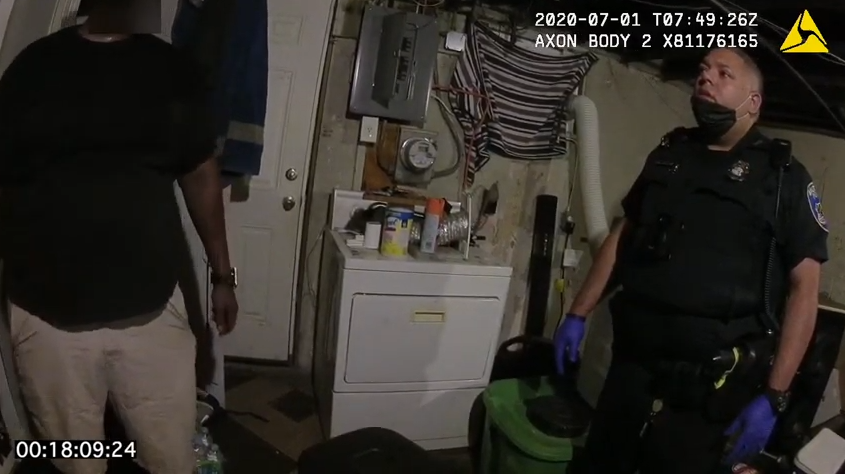
    18:16:00 [Walker’s hand goes in his pocket. No visible officer has their hand on their gun. Though I would hope the third officer, Torand, the one behind Gray does have his gun in hand.]

    18:17:05 [Walker’s gun is visible. And yes, here the timelines has to go into milliseconds. You’d have to watch this multiple times frame-by-frame (like I did) to see how all the cops react in sync, without saying a word, to that gun that just appeared. This is where training kicks in. There’s no hesitation. There can’t be. This whole time there, the officers were focused. Completely. And aware of their surrounds. Hyper aware.]

    Oh, indeed he wasn’t just happy to see me. That was a gun in his pocket.

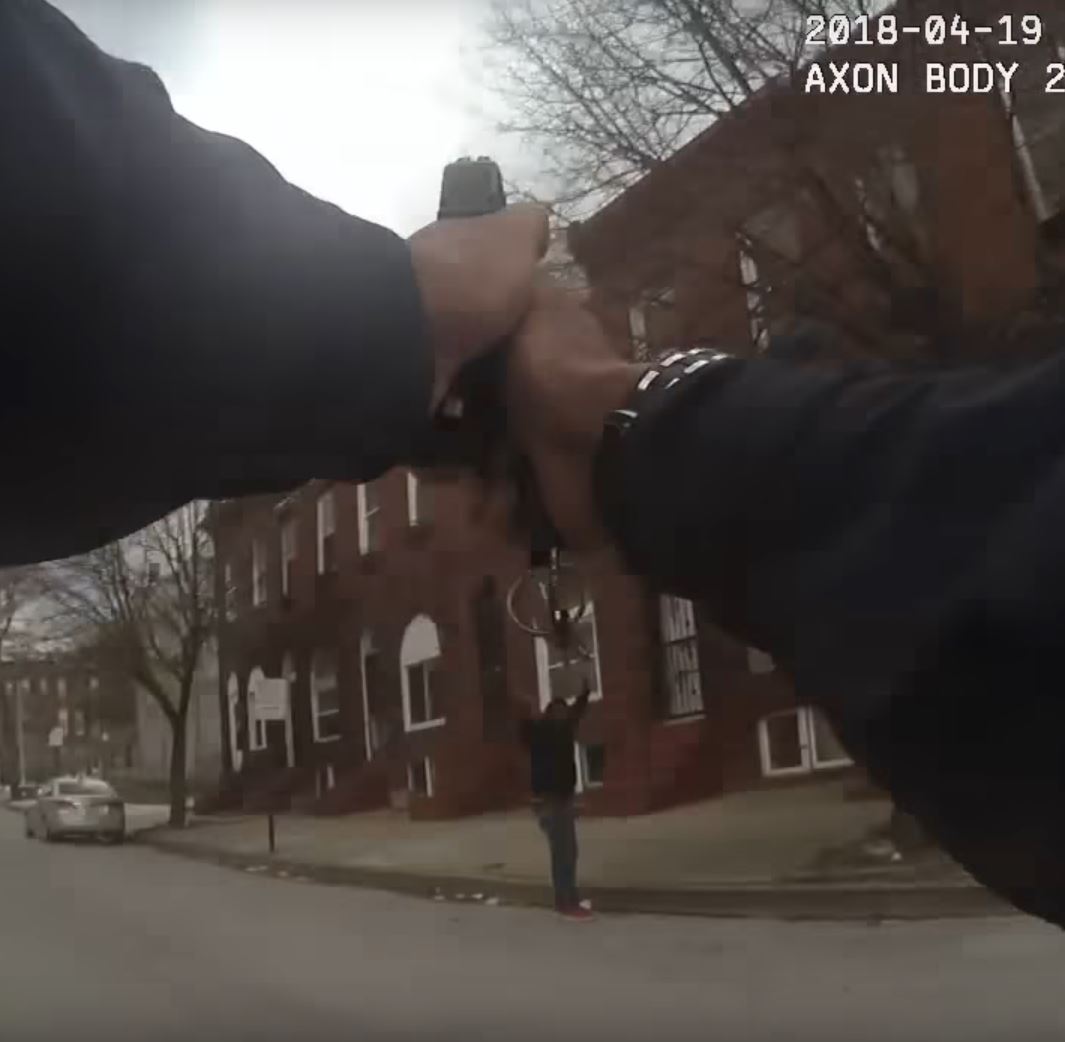
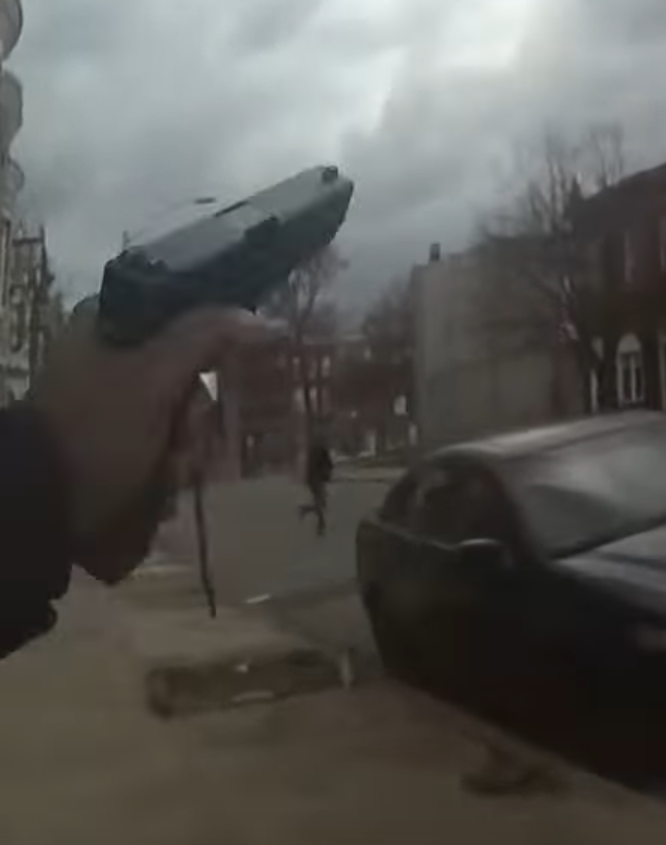
    18:17:17 [Walker’s gun aimed right at officer’s bodycam. This image is highlighted in the BPD edited version, and for good reason. Yes, the cop is looking down the barrel of a loaded gun. In freeze frame, in hindsight, I see his finger is not yet on the trigger. The fact that Walker doesn’t have a good grip on the gun is what saves the cops’ lives. It buys them an extra second.]

    18:17:29 [Cop on right starts to reach for gun. Walker’s gun is visible at 18:17:05. 1/5th of a second (00:00:20) is the standard alert human’s reaction time.]

    18:18:00 [Walker lowers his arm holding the gun.]
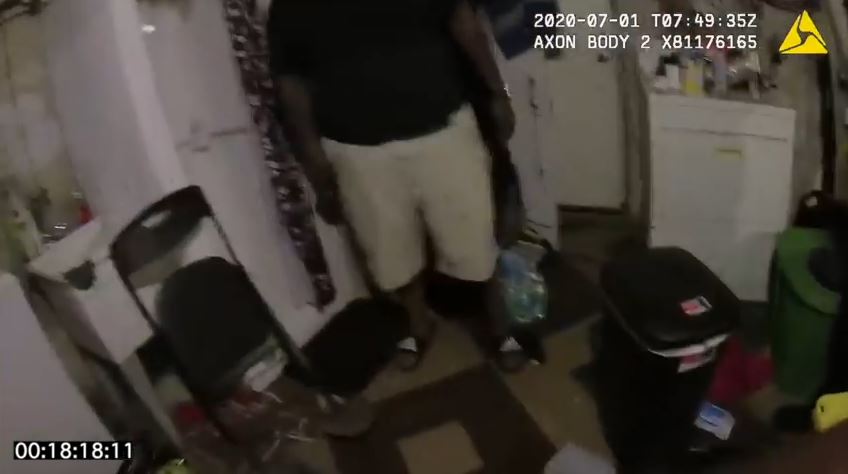
    18:18:18 [Cop on right gets to his gun holster.]

    18:19:06 [Walker starts to raise gun toward cop on right.]

    18:19:17 [First shot. Not clear from whom. BPD says Torent, behind Gray, fired. If so, he probably fired first. Just be happy Gray didn’t jump to his left to take cover. It’s not a good shooting position to be in. But what can you do? We see Del Valle on the right fire at least 3 rounds, the 3rd through 5th shot.]

    18:19:22 [Walker is in shooting position, aimed at officer on right.

    18:19:50 [A second shot is heard. I don’t from whom or exactly when.]

    18:20:06 [Cop on right fires the 3rd shot.]

    That little bright dot in the barrel of the gun is the muzzle flash.
    The recoil 1/100 of a second later

    18:20:15 [Cop on right fires 4th shot.]

    18:20:24 [Cop on right fires 5th shot. The cops stop shooting ends exactly 1.07 seconds after they start shooting. Why? Because in that one second the threat was no longer a threat. “Shoot to incapacitate. That’s how I was trained. They haven’t killed Walker (they could have), but they ended the threat. So they stop shooting. That’s the way it’s supposed to work. Quite often, too often, despite training, what happens in “contagion shooting.” Once one shot goes off, everybody shoots, and next you know all the cops have emptied their magazine and 1 of them somehow managed to reload and fires even more. That doesn’t happen here. It’s really impressive.]

    18:26 Cops: Twenty-three [unit number], shots fired get the medics down here.

    18:29 Walker: I’m still alive. You saved my life. They shot me. Please save my life.  

    18:45 Cop: Where’s the gun? He had a gun.

    18:46 Cop: Medics!

    18:46 Cop: Put him in cuffs!

    Cops went from “no visible threat” to shooting in 2 seconds. In the next second cops went from 1st shot fired to 5th and last shot fired. From the first bullet, it is just 7 seconds before the cops are calling on the radio for a medic to help save Walker’s life.

    In the proverbial “split second,” cops see a threat, respond, shoot, stop the threat, stop shooting, and then render aid. All this despite the fact that (presumably) none of them has ever been in this situation before.

    That’s what training is about. In times of crisis it’s supposed take over, because you literally don’t have time to think. Had the officer not fired when he did, had he been just maybe 1/4 second slower on the draw. He’d likely be dead. Had Walker’s gun been just a “gun-like” object, the cops would be facing criminal charges. As I like to say, “how was your day at the office?”

    I believe the gun was indeed loaded, but I don’t know that for sure. But really, does it matter? What if it had been a BB gun? Or a cell phone? It doesn’t matter. Are the cops supposed to stand there and take one in the face before returning fire? Who can watch this saying the cops shouldn’t have shot this man exactly when the did?

    Anyway, these cops are tight, working together as a team. Never do they raise their voice. The communicate with each other barely saying a word. They try to connect with Walker. They say his name. Nothing works. I can’t think of what they did wrong. In hindsight, perhaps they sould have just Tazed him right off the bat. But had they done that, I would criticize them for that. Doesn’t mean I’m right. But the truth is the guy wasn’t a sure threat until he pulled out a gun. His hands were mostly in the air. He is delusional. And has worrisome fits of flexing anger. But he’s not actually a threat to cops… until he is. And the cops treat him accordingly both before and after.

    In too many videos you see cops standing around after shooting somebody still shouting, “Let me see your fucking hands!” This said to somebody who may not be moving because… he’s dead or dying. But one thing BPD has been good at for decades is the first priority is always: “render aid.” [By the way, cops, at least in Baltimore, didn’t call for “medics” until veterans started coming back from Iraq and Afghanistan post 2001. Before the endless war, we just called for an “Ambo.”]

    Also, does it matter that Walker was black? Did that change police behavior. The public sure thinks it does. Doesn’t seem very relevant to me here. Nor does the officers’ various skin tones seem to matter. But you know what probably didn’t help? The narrative Walker was pretty convinced of: that cops are there to kill him.

    In comes down to this: this man can’t be left to his own devices, not in the state he’s in. So let’s accept that some response is needed. At 3AM. Who? Well, paramedics, of course. They respond. But they won’t go in without cops because this guy was “very” combative with them just the other week. Is a social worker or shrink going to come and calm him down? Maybe. But I doubt it. Not with the history of guns and violence. But if an unarmed social worker and psychiatrist want to go down to that basement and offer themselves up as an human shield, police will gladly stand behind them.

    (Update 6/17/21: Here’s an article in the Washington Post about mental health response in Montgomery County, MD, that goes well with this post.)
  • FOP Report: “Mismanagement of the BPD and its Impact on Public Safety”

    I’ve read this so you don’t have to. But you should. This is
    put out by Baltimore City FOP #3. So sure, take it with a grain of salt. But FOP #3
    isn’t like some other unions that tweet ill-advised statements that hurt the
    image of policing and their members. [cough NYPD’s PBA SBA!]

    In 2012 FOP #3 released “Blueprint for Improving
    Policing.” It was far more right than wrong. It was ignored. Had it been
    followed, perhaps the 2015 riots wouldn’t have happened. Then Baltimore would
    still be seeing declining crime and an influx of people.

    In 2015 FOP #3 released an “After Action
    Review” of the riots that, again, was basically correct. As the Baltimore
    Sun put it: “If what the FOP reported is wrong, the Mayor and Commissioner
    need to prove it.” Needless to say, they didn‘t. 

    So in the context that this is not an ideological screeds
    but a union perspective put together by a consulting team (that’s OK, even
    encouraged) consider some of the points in the FOP #3 report about the
    Mismanagement of the Baltimore City Police Department.

    This is not a crime plan. (But it least it doesn’t pretend
    to be.) The consent decree isn’t a crime plan nor are reformers’ proposals to
    reduce police violence crime plans. We need a crime plan. But this is about
    fixing the organization. The first step.

    There is still a leadership problem: Officers fear proactive
    policing because of unjustified criminal prosecution by the state’s attorney. This isn’t just “we don’t want to be held accountable” griping. See, eg, this.

    As to the consent decree, “police have not been informed or
    training in following the consent decree.” But the major issue right now is
    probably staffing, and that results in overtime which costs money and, when
    mandatory, low morale.

    Hire people to fill vacancies instead of paying overtime. As
    to recruitment: train recruiters in how to recruit, conduct exit interviews,
    recognize exemplary employees, and pay past due recruitment bonus. Seems like
    common decency, much less common sense.

    There is currently budgeted funding for 470 more police
    officer positions, plus 100 civilians. Standards should be higher. And pay and
    benefits at a level to attract good candidates.

    There are currently only 634 officers assigned to patrol.
    That is just 70 officers for each of 9 districts! (And may include sergeants,
    light duty, medical, etc.) This is probably less than half of what it used to
    be. I read this and said, “can it be?” It can.

    Back in 2001, just one district (of nine total)–my
    district, the Eastern District–had 265 total assigned sworn police officers.
    We had 130(!) working patrol officers for 3 shifts. And I’m just talking
    officers (not sgt’s and LTs or light duty or medical). Violence went down.

    Officer numbers are down because BPD has replaced only 80%
    of losses since 2001, for a decline of 850 police officers (to 2,480). This is
    25%(!) reduction in numbers. And the trend has worsened since 2014.

    And when numbers are down, you can’t take officers from HQ
    or consent decree compliance or specialized units or the mayor’s detail or the
    academy. So you pillage patrol, the so-called “backbone” of any
    police department. And that is what has happened. BPD needs a
    backbone.

  • Suddenly It Became His Job

    Suddenly It Became His Job

    Well done, Officer Rogers!

    “An officer was actually on this block on another call and actually heard the shots being fired, said T.J. Smith, Baltimore City Police Spokesman. “That officer gave pursuit.” How often does that happen? And what exactly happened? An edited and shortened version of the bodycam footage had been acquired by WMAR, which made me go, “damn!” I asked T.J. Smith if I could view the entire footage, and he was kind enough to post it publicly.

    Here’s what happened. [There’s a timeline, below.] On April 19, 2018, at approximately 15:00 hours, Officer Rogers responded to a 311 call for a landlord-tenant dispute at 1704 N Regester. Probably something like, “landlord says tenant refusing access to her building. Please see Miss Whomever.” The 1700 block is a small block in my old sector. Six homes are boarded up.

    Many calls are for disputes that are not or should not be a police matter. It’s not his job. In civil matters, there’s very little the police can or should do. In Baltimore, as in many places, the sheriff’s office handles law enforcement related to housing issues. [This actually takes a great burden off police, who otherwise would have to be seen as taking take sides in evictions and like.]

    The landlord tries to make it Officer Roger’s matter by saying she has been threatened by the tenant. There’s some debate about “street talk” at if “going all gangster” is a threat. But the officer wisely won’t play this game. Presumably he’s got other calls to answer. It appears he’s already out of sector handling this kind of nonsense.

    [My take: Apparently the furnace broke. That’s a housing violation that needs fixing. Now there is something about hot water, too. The tenant reports this to the city so that he would have legal reason to stop paying rent. But, and here’s the catch, the tenant doesn’t want the violation fixed because as long as the status quo can be maintained, he’s living rent free! So the tenant decides he won’t let the landlord in. The tenant also says he’s moving anyway, which is news to the landlord and no doubt will coincide with the problem being fixed. The landlord says he owes her money. She isn’t going to get it. Yes, this is why people don’t want to be landlords. And basically as a cop you just want to make sure everything is just calm enough — basically that they won’t start fighting — so you can get out of there. Often the show to which police officers have a “front-row seat” is something not worth the price of admission. Again, this isn’t his job.]

    It’s all very boring and typical. And it lasts for 7 minutes. Just as the officer is looking for a way out, boy does he find one. Gunshots ring out (7min:48sec). There are 15(?) shots in five seconds. Less than two seconds after the first shot rings out (and three seconds before the last shot) Officer Rogers takes off running, toward where the bullets are coming from. Yes, that is what most cops do.

    Walter Baynes, a 30-year-old black male, had just been shot and killed, and George Evans, 69-years-old, reported to be Baynes grandfather, was shot and wounded. One of them, I presume Baynes, had a gun on him when he was shot (13:23). The gunshots sound like they come from one gun, at least to my ears. But given the number of shots fired, it’s possible that Baynes also emptied his revolver at the man who shot and killed him with a semi-automatic. If so, Baynes missed.

    In the video, notice how the people, except for the officer, barely react to gunshots. And just a minute later it’s like things are back to normal. Traffic doesn’t stop. People walk by like nothing happened. Not even a reason to interrupt your dog walk (9:44). People act like it’s routine, because, unfortunately, it is. Sixteen of Baltimore 122 murders this year (to date) have been in the Eastern District. Many more get shot and live.

    Such brave, good police work is also routine. An officer runs toward gunshots and single-handedly confronts a man whom he believes to be armed, a man who just killed a man. He does this by instinct and training. He does this not necessarily because he wants to, but because it is the right thing to do. Because running toward danger is his job. He did good, Officer Rogers did. Very good.

    And then, after all this, all he wants to do is check his bodycam footage to see if the suspect is on it. If it were up to the ACLU and the police-are-the-problem set, police wouldn’t be allowed to do so. That’s crazy. Also, it takes 15 long minutes before somebody will watch the suspect so he can do so.

    Good police work doesn’t go viral like a video of bad policing or a cop doing something stupid. And if all people see are videos of cops shooting black men, they start believing that shooting black men is all cops do. So let’s play the counterfactual game and imagine this went down differently. Let’s say at 8:10 in the video the suspect made a move toward his waistband. Or maybe he didn’t. Either way, let’s say the officer shoots and kills the suspect. Would this be legally justifiable? Probably. Would it be correct? Well that depends if the suspect is armed. Can you tell if the suspect is? I cannot.

    It turns out the suspect isn’t armed, at least not at this moment when he’s caught by police. So now you would have a scenario in which a bad cop has shot and killed an unarmed black man. In Baltimore, no less. Oh, that would go viral. Doesn’t matter if the guy just killed somebody. The gun used to murder Mr. Baynes? Probably ditched in the alley and picked up by somebody else before it even bounced. Doesn’t matter if the cop is African American (implicit bias and all). There would be protests and perhaps worse.

    No matter what would happen now, the officer’s life is ruined. Career over. Thrown under the bus by the department. He and his family will receive death threats. Perhaps they will have to go into hiding. A criminal prosecution would likely occur. Mosby has tried to convict cops for a lot less. All because this officer ran toward gunshots and misperceived a lethal threat. Harsh.

    Should any single split-second decision really be the difference between a narrative of brave hero police officer and protests over an evil criminal cop who is now the only person from this incident on trial for murder? Perhaps we demand too much. We all make mistakes. What was the officer’s intention? Well, to apprehend a shooter. It was not to kill the suspect, though he was prepared to do so.

    Watch the video in real time, between 7:48 and 8:10. We’re talking a total of 22 seconds. How would you react? Of course you might reasonably say, “I don’t know. It’s not my job to react. I’m not a cop.” Ok. So let me ask this: how do you want police to react? Just as this cop did, right? Run towards gunshots, chase a suspect, and not shoot anybody, not even a bad guy. Job well done, right?

    Nope. Not so fast.

    See, the DOJ report on Baltimore Police, the one that opened the door to the consent decree, the one written by “progressive reformers” who have never let lack of police experience get in the way of telling police how to do their job, that report? Well it says Officer Rogers did it wrong. I mean, what if somebody got hurt?

    If circumstances require that the suspect be immediately apprehended, officers should contain the suspect and establish a perimeter rather than engaging in a foot pursuit, particularly if officers believe the suspect may be armed.

    You’re kidding me, right? I don’t even know what “containing” a suspect means, much less how you would go about setting up a “perimeter” to do so. This isn’t idle talk. Last month in Seattle, because of a consent decree, an officer faced discipline for successfully subduing a man with a axe. If police get in trouble for making decisions and acting in the face of danger, there’s really no point to having police at all. And that, of course, might be the “progressive” vision.

    Luckily, back in the real world, we’re left with the happy narrative of a brave officer who risked his life to apprehend a murder suspect. And luckily, in this case, no person-of-color was shot or killed at the hands of police. (Which seems to be just about the only thing reformers care about. The fact that two African-American men were shot, one fatally, doesn’t seem to register much with the “woke” set.)

    We have this happy narrative because, as is common, the officer did not shoot the suspect when he might have. We have a happy narrative because the suspect complied with the officer’s orders. (The manner in which the suspect complied — quickly and completely — makes me seriously consider that the suspect isn’t the actual shooter. But I don’t know. He has been charged. Presumably gunshot residue on his hands answered this question.) But mostly we have a happy narrative because, despite all the haters, police in Baltimore and elsewhere are still out there, putting themselves in danger, trying to do the best they can in spite of it all.

    As to the original call, the landlord-tenant dispute? It ain’t going to close itself. At some point the dispatcher is going to need Officer Rogers to give it a code. I’m guessing it got a David-No, for “no police services needed.”

    Timeline:

    0:34— Officer is on-scene at 1704 N Regester for a civil dispute.

    7:48— 1st shot fired.

    7:50— Officer starts running toward gunfire.

    7:53— 15th shot is fired. shooting at 7:48-53 15 shots in 5 seconds

    7:54— Officer gets on radio to report shots fired

    8:00— Officer sees man in alley off to the left

    8:08— Tell man to get drop the gun and get on the ground.

    8:10— Suspect complies

    8:18— Suspect is on ground in prone position

    8:27— Officer: “My location…”

    8:28— In all the excitement, the officer forgets his location. In his defense, he does appear to be out of sector (331 officer on 321 post). But still. Always know your 20. During the next 20 seconds, given he’s out of breath and already said “shots fired,” the dispatcher should be sending officers in the direction of 1700 N Regester, the location of his call. Little things like that matter. A good dispatcher can save an officer’s life.

    8:50— Officer gives his location.

    9:26— Finally, the sweet savory sound of clicking handcuffs.

    9:44— Man with dog walks by and says good job or something.

    9:49— Backup arrives, one minute after location is announced.

    10:35— Officer: “Check that alley…. This dude, I’m up there handling a landlord-tenant dispute. Then all the sudden people start shooting. Shooter’s down right here. This dude I believe is the shooter. He just took his hoodie down. He might have dropped the gun in alley cause that’s where he ran.

    13:23— Radio: “One of the victims has a firearm in his waistband.” We later learn (at 18:34) that this gun is a revolver. It’s not clear if the revolver was fired at all. Either way, that leaves a semi-automatic belonging to the shooter who didn’t get shot, and fired somewhere between 9 and 15 rounds.

    13:30— Officer: “Why was you in the alley? And you just happened up here when the shooter came out, right?” Suspect: “Bro, I was walking up the alley to walk up North Avenue, bro, and I heard some shit. That’s why I started running.”

    14:41— Officer tries to get somebody to watch the suspect so he can review his bodycam footage.

    16:28— Shift commander: “What hundred block of Lafayette is Register at?” Uh, in the 1700 block, Baker-09. Where it’s always been.

    30:08— The suspect assures officer he wasn’t doing nothing.

    30:18— Finally, a kindly homicide detective agrees to watch the suspect the officer can return to his car to check his bodycam footage. “I’m not leaving till you do,” she says.

    30:20— Officer: “I swear. One simple thing. Ask one person to watch him so I can review the bodycam footage so we can close this. But nobody is listening to me. I’m only the one that chased the goddamn dude.”

  • Baltimore police trial: guilty

    Yesterday the verdict came out. I wrote this op-ed for the Washington Post:

    This current scandal is more than a case of a few bad apples, though bad apples they were. These officers acted with impunity until the FBI caught wind of their actions through an unrelated criminal investigation in Pennsylvania. A specialized police unit cannot survive for years as a criminal enterprise without the implicit — or overt — acquiescence of higher-ups. Effective leadership could have prevented this. Bad leadership has consequences.

    Corrupt units tend to be specialized and selective. Once murky rumors begin about a unit or officer, good cops stay away for fear of trouble. The corrupt and brutal cops work together, as I once heard, as if pulled together by some magnetic force. You don’t just randomly get assigned to a plainclothes “gun trace task force.” This unit segregation removes officers from the otherwise corrective influence of the honest rank and file. There is no formal colleague review in policing; perhaps there should be.

    Honest cops — still the vast majority — avoid trouble, as any citizen should hope. The rank and file cannot be blamed for keeping their noses clean, especially when unresolved questions remain about the integrity of internal affairs and the prosecutor’s office. These officers in Baltimore were guilty, but the systemic problems represent a failure of leadership, the same leadership that absolved itself of responsibility by inviting the Justice Department to investigate after Freddie Gray’s death.

    Until 2015, policing and Baltimore had been getting better. After an excess of zero-tolerance policing in the early 2000s, Baltimore saw a sustained decline in both murder and arrests. From 2004 to 2011, murders declined from 278 to 197 while arrests dropped from 42 percent. People even began to move back to the city. After six decades of decline, the population increased. These civic and public safety gains reversed in 2015. Last year 343 people were murdered in Baltimore City, and the population and tax base is falling once again.

    This year the police scandal is yet another black eye for a bruised city. Mayor Catherine Pugh, in a statement she later walked back, said she was too busy to follow the trial. The acting and presumed next police commissioner, Darryl De Sousa, is well-respected but will have his hands full. Corrupt police officers deserve special blame for committing crimes while in the public’s trust. But for a wounded Baltimore to rise again, city leaders, both elected and appointed, must accept their responsibility and get things done.

    Go on, click through for the whole article.

  • Cops and Robbers in Baltimore

    Justin Fenton of the Baltimore Sun has tweeted a crazy accountof testimony in today’s trial of corrupt Baltimore cops.

    Crazy testimony in federal court just now by former Detective Maurice Ward, outlining illegal tactics used by Gun Trace Task Force Officers …

    They’d regularly drive fast at a larger group of people, slam brakes and pop their doors to see who ran, then detain and search them. They had no reason other than trying to provoke someone. 10-20 times on slow nights, as many as 50 times others, he said.

    Ward said Sgt Jenkins profiled vehicles – “dope boy cars” such as Honda Accords, Acuras, Honda Odysseys – for car stops and would falsely claim he saw people not wearing seat belts or their windows were too darkly tinted.

    Jenkins also had a thing about men over age of 18 carrying a book bag – probably drugs, he guessed, so they would stop them, Ward said.

    More outrageous testimony from Det Ward: they kept BB guns on hand in case they hit someone or got into a shootout and needed to plant it on someone.

    When they stopped someone suspected of being in the drug game, Jenkins would ask, “If you could put your own crew together and rob the biggest drug dealer you know of, who would it be?” And then they’d go after the person they named, to rob them.

    Prosecutors dumped out a giant black bag, like a hockey equipment bag, onto the floor that apparently belonged to Jenkins that had masks, black clothes, shoes, and tools such as a rope with a grappling hook.

    One of the craziest stories involved a man who they stole $100,000 from. Ward says Jenkins listened to the man’s jail calls after he was arrested, and heard him talking about the officers stealing money from him. /1

    The man said he was going to hire a good lawyer and try to go after them. Jenkins learned that the man’s wife was handling things for him on the outside, and he wanted to extract her so he’d have to hire a public defender and plead out, Ward said /2

    So on one of the calls, Jenkins heard the man talking to another woman. Jenkins, Ward said, had an officer with good handwriting write up a note purporting to be from the other woman saying she was pregnant, and dropped it in the wife’s front door /3

    This is just the first of four officers who will testify during this trial, and he hasn’t even been cross-examined yet.

    The story in the Sun.

    This scandal is big. And it starts just as a new commissioner takes over the BPD. And that transition, from Davis to De Sousa, is just about the first good bit of policing news coming from Charm City in three years. Davis, you may remember, took over from Batts in 2015. Batts was the so called “progressive” who led the department into a riot and saw murder nearly double overnight in May, 2015. But rumor has it that Batts, to his credit, wouldn’t go along with the futile (and failed) criminal prosecution of the six cops involved in the arrest and subsequent death in police custody of Freddie Gray. Davis, they say, got the job in part because he had so such qualms.

    I don’t know De Sousa, but I’ve only heard good things. At least now the possibility of change for the better.

    I still can’t get over the fact that the DOJ was investigating the Baltimore Police Department at the same time that all this was going on. What did they find? Poorly filled out “statements of probable cause,” a few petty gray-area scandals from a decade ago, and, get this, black cops in Baltimore use the “n word.” And yet they were totally clueless about all this happening under their nose. But we can’t blame the investigators because, well, we don’t know who they were since the report was anonymous and with the only the vaguest of “methods” section. But then the purpose of the DOJ report was not to find the truth, but rather show problem to legally trigger a consent decree.

    Speaking of which… Keven Rector reports in the Sun:

    The two highest-ranking Baltimore police officials in charge of instituting reforms, overhauling policies and ensuring compliance with the city’s consent decree with the U.S. Department of Justice have both resigned following Mayor Catherine Pugh’s firing of Police Commissioner Kevin Davis last week.

    Well, there you have it.

  • RIP Sean Suiter

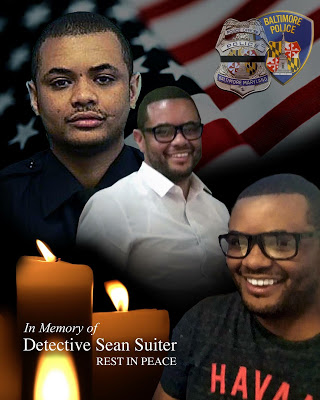
    Detective Suiter’s funeral was today.

    I was fine. Until I clicked on this audio.

    At least in New York City it’s OK to cry in public.

    An NYPD friend just told me they don’t have do this in New York. It’s a BPD thing. And I’m proud of it.

    I don’t know how the dispatcher manages to do this. It’s not like she practices. It’s all in the delivery. The slight annoyance as she can’t raise an officer. The mundane tone because this happens every day. Going to the sequence number? That’s a bit extreme. But why isn’t 6443 answering the radio? Because, of course, 6443 is 10-7. Out of service. In this case, dead.

    From this I learned that I was the 72nd officer hired after Sean Suiter, which means (since I was the last person hired in my class) Sean was in the class before me, 99-4. Our paths crossed many times, though I have no memory of him.

    Here’s what I wrote about this radio ritual in Cop in the Hood:

    Twenty months in Baltimore wasn’t very long, but it was long enough to see five police officers killed in the line of duty. And there were other cops, friends of mine, who were hurt, shot, and lucky to live. A year after I quit the force, my friend and academy classmate became the first Baltimore policewoman killed in the line of duty, dying in a car crash on the way to back up another police officer.

    Crystal Sheffield patrolled opposite me in the Western District. Occasionally I would switch my radio over to the Western District channel to see what she was up to. When she died, I returned to Baltimore, hitched a ride in a police car from the train station to the funeral, and stood in the cold rain at attention in my civilian clothes with my uniformed fellow officers. Police funerals are one of the few events that bring together law enforcement personnel. Funerals give meaning to that often clichéd concept of Blue Brotherhood. At an officer’s funeral, police-car lights flash as far as the eye can see. Thousands of police officers wearing white gloves and black bands on their badges stand at attention. Guns are fired in salute. Bagpipes are played. A flag is folded. The coffin is lowered into the ground.

    At the end of a Baltimore police funeral, a dispatcher from headquarters calls for the fallen officer over all radio channels. The response, of course, is silence. After the third attempt the dispatcher states the officer is “10- 7.” Ten-seven is the rather unsentimental radio code for “out of service.” Ten-seven usually refers to a car, an officer handling a call, or an anonymous murder victim on the street. To hear your friend and colleague described as 10-7 is heartbreaking. In this way the few officers left working the streets know the burial is complete.

    A few seconds later a routine drug call is dispatched or one bold officer reclaims the radio airwaves for some mundane police matter. A car stop. A warrant check. A request for a case number. The show goes on. Sometimes it just don’t make sense.

    A few hours after today’s funeral another Baltimore cop was shot. In the hand. Non fatal. But very possibly career ending. As I wipe the tears from my eyes, it doesn’t make sense.

  • RIP Sean Suiter

    RIP Sean Suiter


    Baltimore City Detective Sean Suiter was shot and killed two days ago while doing his job.

    I didn’t know Sean, but he also came up in 1999. He had 18 years on. Were I still a Baltimore Police Officer, that could be me. His killer has not been arrested.

    After his shooting I glued online to KGA, Baltimore police radio dispatch. The sadness in the voices of the dispatchers and officers was palpable. But the show goes on. The calls kept coming. There is no time-out in policing. And the routine bullshit calls keep coming. Kids were fighting in the downtown Starbucks. A man named Precious Romeo wanted his a woman removed from his house (I’m not making that up). An officer in the Eastern was at the front door of a caller but his bodycam wouldn’t activate. He was told to 10-18 (return to the district) to fill out related paperwork (thanks, federal consent decree). I wonder what the caller thought about that. And there were two other unrelated shooting victims within a few hours. One victim walked himself into Shock Trauma, adding to the chaotic scene there. There weren’t enough crime labs available for all the crime scenes. Another man was shot in the Eastern District. The Central and Western Districts were all but shut down by police activity. Officers and dispatchers were snapping at other (which is rare).

    After a few hours of crazy chaos, things returned to the usual choas. Detective Suiter would live another day, but we knew it was futile, with the gunshot wound to his brain.

    Rest in peace, Detective Suiter. My heart goes to his wife, his five children, and all who loved him. Rest in peace.

  • Quality Policing Episode 6

    A new episode of Quality Policing is out. Check it out. We talk about many things including the DC body cam study that seems to show body cams don’t change anything. We beg to differ. Body cams just don’t change what people think they do.

    We don’t, however, talk about the details of the dirty gun squad in the Baltimore Police Department. You can read about that in the Sun. The details are salacious.

    Nor do we talk about the Feds busting a drug crewin East Baltimore. Arrested a dozen or so, including “Rat” and “Juicy” and recovered, get this hundreds of, er, grams of drugs.

    The shop opened at 6:30AM and continued into the early evening. with about 10 drug transactions per hour. Let’s say 100 transaction a day at $10 profit per. That’s a good living. But divided by 13 plus people, it’s not that much money. One of the dealers worked “at the Sheraton Inner Harbor Hotel downtown and sold drugs to hotel guests in addition to working with the East Baltimore gang.” He remarked on a wiretap:

    That it was “more stressful to have a job” than to “just be out here hustlin’.”

    Ain’t that the truth.

    Meanwhile in Baltimore, a supervisor in the Department of Transportation was charged by the Feds. Shoplifting turns violent. And the killing continues unabated, 23 people killed to date, this monthalone.

    All this, and you’d think some city leader would take blame for something. But no, it’s never the fault of the leaders. Not as long they say they’re for “reform.” What are they reforming? Perhaps, in a city without accountability, they’re part of the problem.

    On the plus side, lead is down. Maybe homicides will drop similarly in the 2030s.

  • Data presentation and the crime rise in Baltimore

    Data presentation and the crime rise in Baltimore

    Data presentation fascinates me because it’s both art and science. There’s no right way to do it; it depends on both hard data, good intentions, and interpretive ability. Data can be manipulated and misinterpreted, both honestly and dishonestly. And any chart is potentially yet another step removed from whatever “truth” the hard data has.

    Where I’m going isn’t exactly technical, but there’s no point here other than data presentation and honest graph making (and also crime being f*cking up in Baltimore after the riots, but that’s not my main point). If that doesn’t interest you, stop here. [Update: Or jump to the next post.]

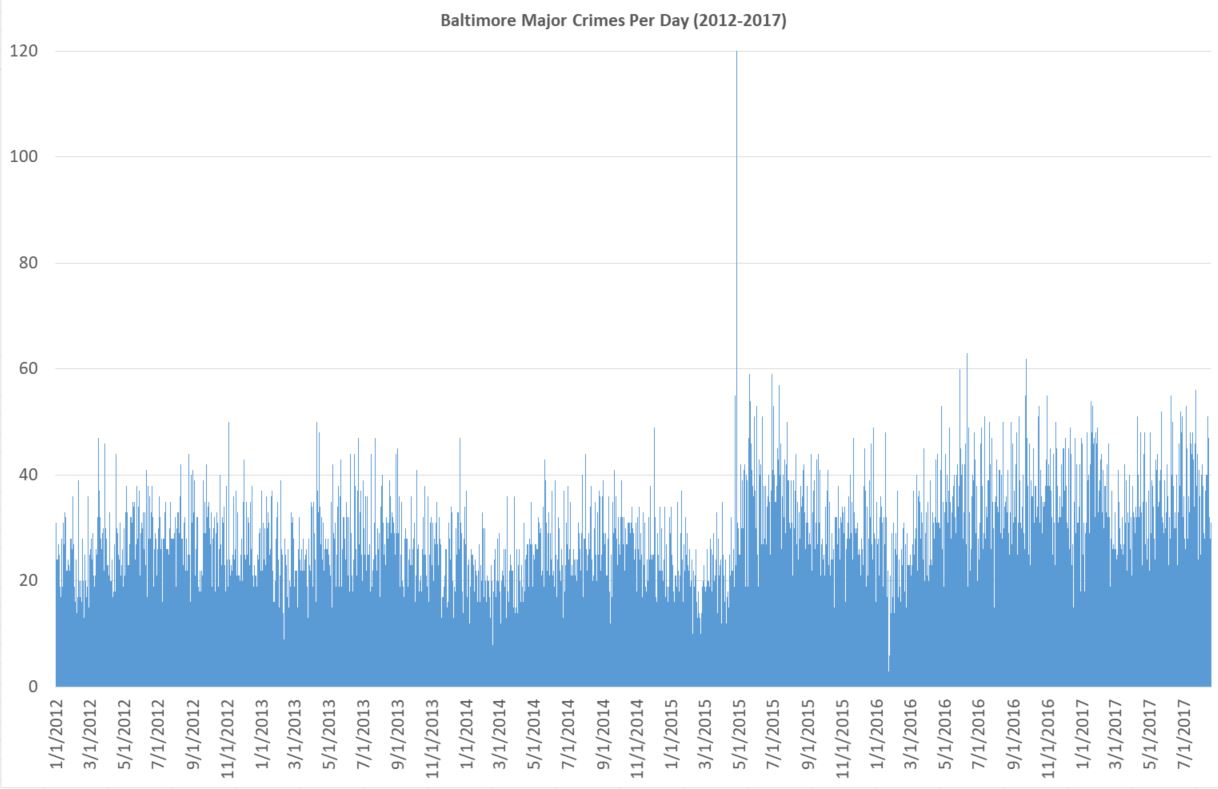
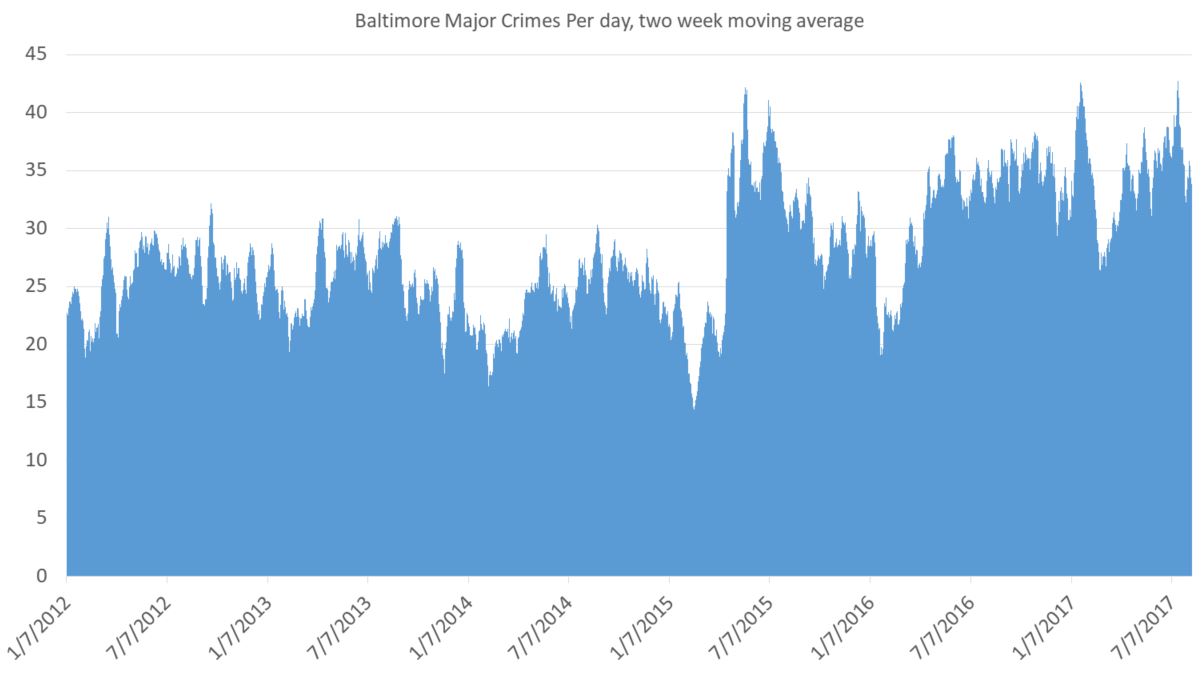
    I took reported robberies (all), aggravated assaults, homicides, and shootings from open data from 2012 to last month. I then took a simple count of how many happen per day (which is strangely not simple to simple to analyze, at least with my knowledge of SPSS and excel). You get this.

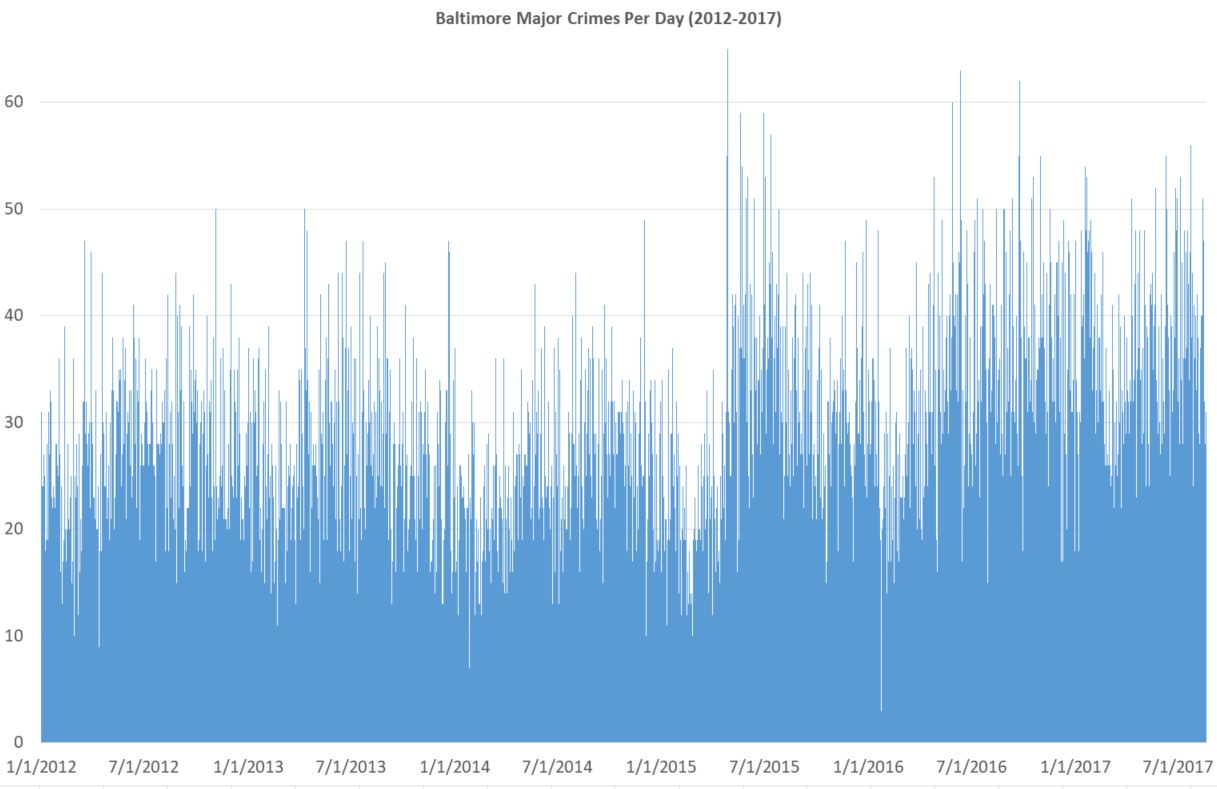
    It takes a somewhat skilled eye to see what is going on. Also, since the day of riot is so high (120), the y axis is too large. With some rejiggering and simply letting that one day go off the scale unnoticed, you get this.

    It’s still messy, but is the kind of thing you might see on some horrible powerpoint. Things bounce up and down too much day-to-day. And there are too many individual data points. Nobody really cares that there were more than 60 one day in July 2016 and less than 5 in early 2016 (I’m guessing blizzard). It’s true and accurate, but it’s a bad chart because it does poor job of what it’s supposed to do: present data. Again, a skilled eye might see there’s a big rise in crime in 2015, but the chart certainly doesn’t make it easy.

    Here’s crimes per day, with a two-week moving average. A moving average means that for, say September 7, you take Sep 1 through Sep 14 and divide by 14. Why take an average at all? Because it smooths out the chart in a good way. It’s a little less accurate literally but much more accurate in terms of what you, the reader, can understand. One downside is that the number of crimes listed for September 7th isn’t actually that number of major crimes that happened on that day. You can see why that might be a big deal in another context. But here it isn’t.

    For a general audience it’s not clear what exactly the point is. You still have lots of little ups and downs, and the seasonal changes are an issue. (Crimes always go up in summer and down in winter. And it’s not because of anything police do. And it’s nothing do to with the non-fiction story I’m trying to tell.) On the plus side, you do see a big spike in late April, 2015, after the riots and the absurd criminal prosecutionof innocent Baltimore cops. But it needs explaining.

    Also, you need some buffer for the data. The bigger the average, the more of a buffer you need. But for this I think this is one perfectly fine way to present these data, at least for an academic crowd used to charts and tables.

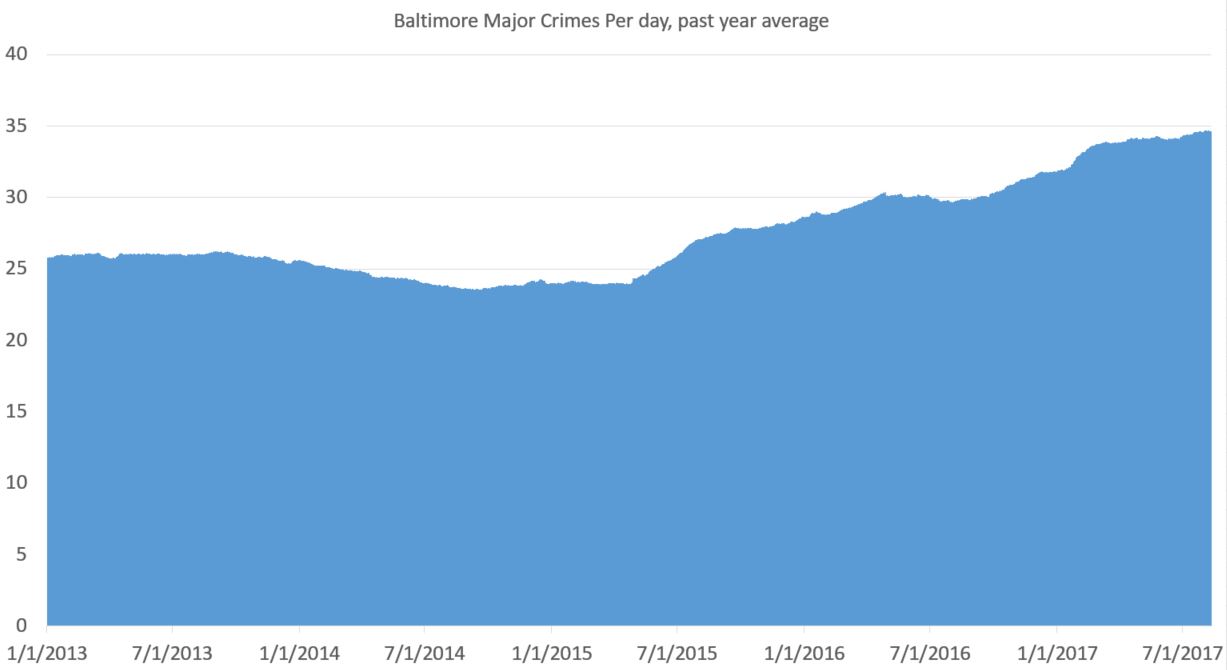
    Another tactic is to take the average for the past year. Jeff Asher on twitterover at 538.comdoes good work with NOLA crime and is a fan of this. It totally eliminates seasonal issues (that’s huge) and gives you a smooth line of information (and that’s nice).

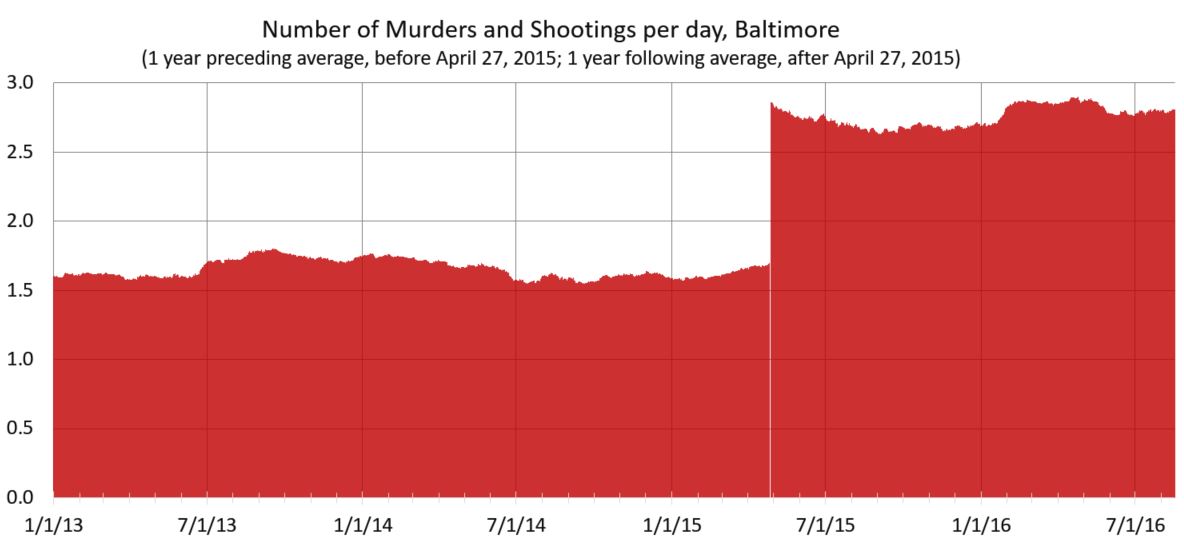
    You can see a drop in crime pre-riot (true) and a rise in crime post-riot (also true). That’s important. Baltimore saw a drop in crime pre-2015 that wasn’t seasonal. It was real. And the rise afterward is very real. But there are two problems with this approach: 1) you need a year of data before you get going and 2) everything is muted. What looks like a steady rise (the slope since 2015) is actually a huge rise. But it looks less severe than it is because it takes an average from the previous year. But that’s not exactly true. Crime went up on April 27, 2015. And basically stayed up, with a slight increase over time.

    Here’s my problem. I want to show the rise in crime post-riot. But I want to do so honestly and without deception. But yes, for the purpose of this data presentation, I have a goal. (My previous attempts were pretty shitty.)

    Also, you need at least a year of data before you can graph anything. That’s a downside.

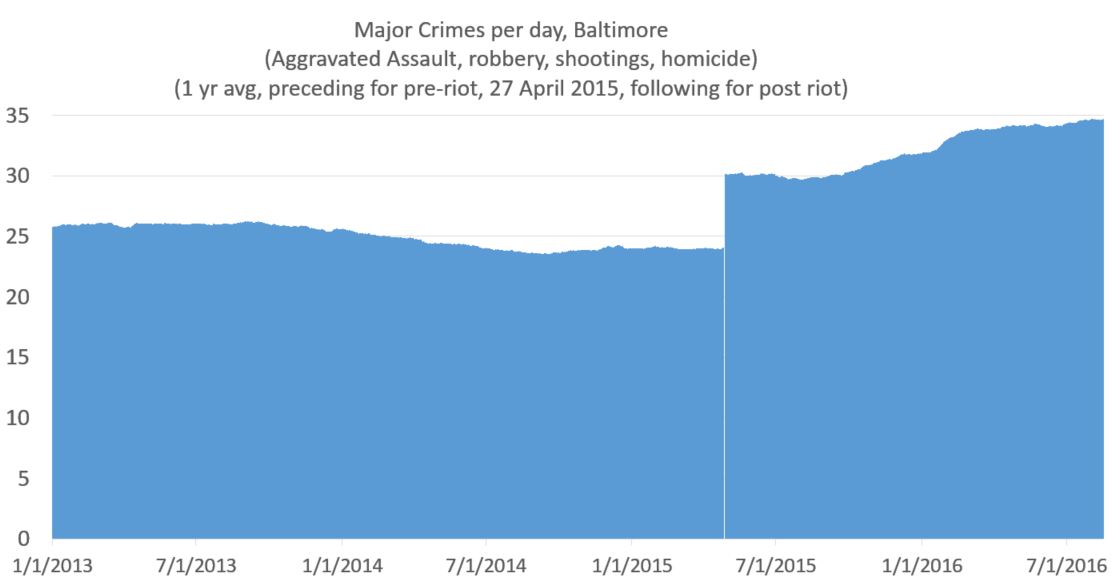
    Here’s my latest idea. If one is looking at a specific date at which something happened — in this case the April 27, 2015 — and trying to eliminate seasonal fluctuations, why not take the yearly average for the previous year before that time and the yearly average after that date for dates after that time? I think it’s kosher, but I’m not certain.

    Here’s how that works out:

    This shows the the increase that was real and immediate. And as minor point I like the white line on the day of the riot, which I got from removing April 27 from the data (because it was an outlier).

    Now if I wanted to show the increase in more stark form, I would move the y axis to start at 20. But being the guy I am, I always like to have the y-axis cross the x-axis at 0. That said, if the numbers were higher and it helped the presentation of data, I have no problem with a y-axis starting at some arbitrary point.

    Take into account that graphs are like maps. While very much based on truth, they exist to simplify and present selected data. I mean, you can have my data file, if you want it. But I do the grunt work so you don’t have to. But of course my reputation as an academic depends on presenting the data honestly, even though there’s always interpretation (e.g.: in the case of a map, the world, say scientists, isn’t flat). The point, rather, is if the interpretation honest and/or does the distortion serve a useful purpose (In the case of the Mercator Projection it was sea navigation; captains didn’t gave a shit about the comparative size of the landmass of Greenland and Africa.)

    So taking an average smooths out the line of a chart, which is a small step removed from the “truth,” but a good stop toward a better chart. It’s not a bad approach. But it tends to mask quick changes in a slow slope, since each data point in the average for a lot of days. A change in slope in the graph actually indicates a rather large change in day-to-day crime. There are always pluses and minuses.

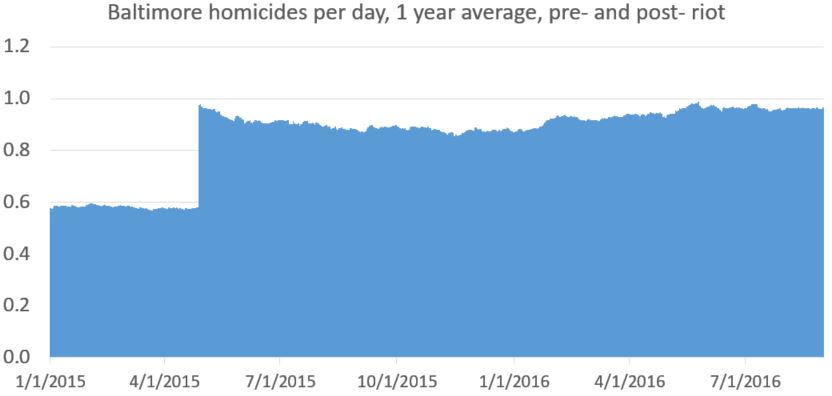
    If you’re still with me, here’s what you get when just looking at murder. Keep in mind everything up to this point has been the same data on the same time frame. This is different. But homicides matter because, well, along with people being killed, it’s gone up much more than reported crime.

    [My data set for daily homicides (which is a file I keep up rather than from Baltimore Open Data) only goes back to January, 2015. So I don’t have the daily homicide count pre-2015. 2014 is averaged the same for every day (0.5781). This makes the first part of the line (pre April 27, 2015) straighter than it should be. This matters, and I would do better for publication, but it doesn’t change anything fundamentally, I would argue. At least not in the context of the greater change in homicide. Even this quick and imperfect methods gets the major point across honestly. ]

    Update and spoiler alert: Here’s a better version of that chart, from my next post.

  • The Consequences of Bad Leadership: the Baltimore Riots of 2015

    Last postI talked about what didn’t cause the 2015 riots in Baltimore. Well, what did? Macro theory too often assumes happenings and history are per-ordained, that leadership decisions don’t have consequences, and that individuals have no free will. But what if the buses kept running? What if police continued to disperse crowds in the street instead of retreating? What if Gregory Lee Butler hadn’t cut (or been able to cut) a fire hose outside the burning CVS? What if police had arrested him on the spot? These things matter. If they don’t, I don’t know why we bother to try at all.

    The riots were not inevitable. Systemic problems matter, but they’re a constant. As important as they are, poverty and segregation and drug addiction and broken families and violence are nothing new in Baltimore. And they certain were not worse in 2015 than they were in the preceding decade. Why on April 27, 2017 and not on April 25 or 26? Or why not in 2003, when police arrested 312 people a day, many for minor zero-tolerance bullshit reasons? By 2014, the arrest rate had dropped by two-thirds and violence was down. God did not ordain Baltimore would burn a week after the death of Freddie Gray. It didn’t have to happen.

    Bad leadership caused the Baltimore riot of April 27, 2015. Effective leadership and tactics can be the difference between a protest or even a violent disturbance and a riot. The latter happens not just because people are pissed off. People are always pissed off, sometimes for good reason. Now this is a weird point to make, but Freddie Gray wasn’t the first guy to die in the back of a police van; sadly, since the city still hasn’t procured safe transport vehicles, he probably won’t be the last. Angry people are a necessary but insufficient cause of rioting. Poor decisions in planning, message, and tactics let a bad situation spiral out of control.

    Bad leadership has consequences. If not, why seek good leadership? Actions and inaction matter. Only on April 26, 2015, for instance, did the mayor, Stephanie Rawlings-Blake, defended a “measured” police response to protests by saying: “We also gave those who wish to destroy space to do that as well.” The riots started the next day.

    At the time, in 2015, many said the mayor’s words didn’t matter. And also that she didn’t mean what she said, which may be true, but those were the words she said and the words people repeated. Also, now it’s 2017. Does anybody still believe that the words from a chief elected executive have no impact? That they can’t incite violence?

    But it took many more bad decisions before the riots started. Somebody (and oddly, we still don’t know who) made horrible transit and crowd control decisions at Mondawmin Mall on April 27. School kids were stranded en masse because the transit system was stupidly shut down. Kids couldn’t get home. It was bad, but the city still wasn’t in riot mode.

    Ultimately the riots started because when things got rough, and cops received orders to pull back. The fear at the top, the mayor and Commissioner Batts, was that was police would be criticized for over-reacting. (And truth be told, they probably would have been.) But good leadership is willing to face criticism.

    This video shows where and when the riot started, at the corner or North and Pennsylvania Avenues. (And just a block from the aptly named Retreat St). The looting began at 4:37pm. A line of cops was present near the CVS at 4:41pm. Even after looting began, cops didn’t act. For more than hour cops stood by while the store was set on fire. A fire hose was cutwithin steps of officers who followed orders and did not engage. Police didn’t move till 6pm, and even then it took 50 minutes to regain control of the corner. By then it was too late. “Hold the line,” police officers were ordered, and they did. And while waiting for orders to act, the “Thin Blue Line” (that ever-trite but here apt cliché) broke down, and the city burned out of control.