Tag: Baltimore

  • “Dear Sir or Ma’am…”

    In late May Rolling Stone had a poorly conceived article about Baltimore police and riots. On May 30th I wrote this letter to the editor:

    I applaud Matt Taibbi (“Why Baltimore Blew Up”) for keeping the focus on Baltimore after the nation’s attention seems to have shifted elsewhere. But Taibbi seems more intent on attacking police and Broken Windows – something never tried in Baltimore – than the crime and police issues that uniquely affect Baltimore.

    If Baltimore police were to blame for the riots — if overpolicing and too many arrests caused the violence — why didn’t the “uprising” happen back in 2003, when Baltimore arrests peaked? (Tiabbi is in error when he says Baltimore arrests peaked in 2005.) It seems worth mentioning, at least in passing, that arrests have dropped every year since then, 65 percent in total.

    If one were to put facts before anti-police ideology, one might blame the riots and subsequent increase in homicides on incompetent political leadership and the underpolicing of criminals. Baltimore’s mayor and police commissioner, in particular, stand out for their incompetent handling of events after Freddie Gray’s death in police custody. Regardless, I find it odd that an article about policing and riots in Baltimore omits any mention of criminals and fails to quote a single Baltimore City police officer. I suppose it’s easier to simply blame Baltimore cops, but the next time I urge Taibbi to perhaps speak to a few.

    They didn’t publish it.

  • How was your weekend?

    300 Men marched against violence In Baltimore. I guess since was no looting or violence associated with the march, it did not make national news.

    But apparently the criminals weren’t listening. “At least 21 people were shot since Friday,” reports the Sun. To put it in perspective, as Justin Fenton did, that rate of violence would be 92 shot in Chicago. Or 279 people shot in New York City. Now that would be a story.

    The level of carnage, the lost and broken lives, is almost impossible to comprehend if you’re not there. That doesn’t mean we shouldn’t try.

  • “The Rise and Fall of Anthony Batts”

    Great piece by Simone Weichselbaum in the Marshall Project about Batts and his problems in Baltimore.

    Good piece in Vice about the problem of “superstar” police chiefs.

  • Post-Riot Baltimore: Arrests Down and Gun Crimes Up

    Post-Riot Baltimore: Arrests Down and Gun Crimes Up

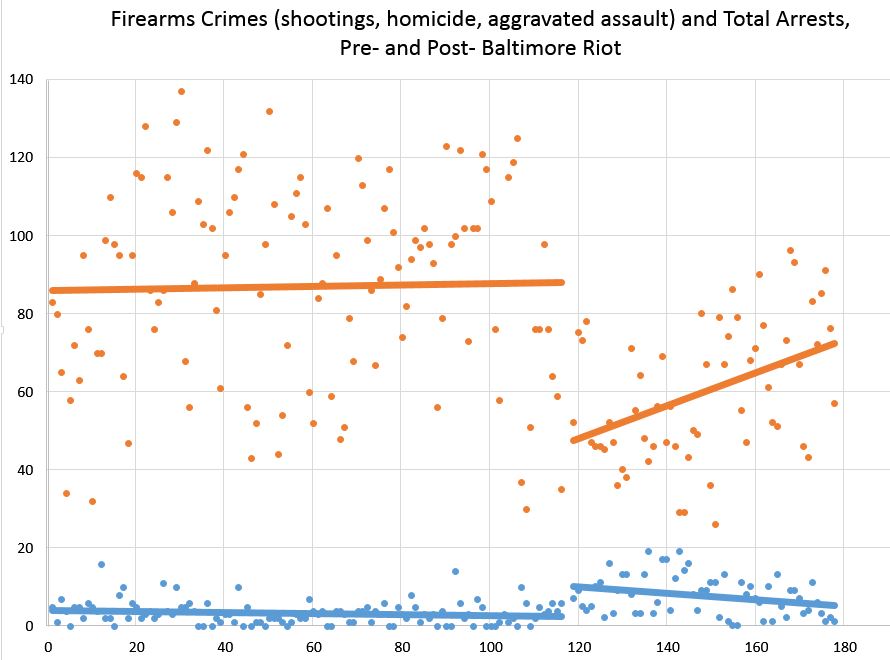
    Total arrests per day are in orange. Firearms crimes per day are the lower lines, in blue.

    (Click to embiggen)

    The bottom axis represents the numbered day of year. 1 is Jan 1. 178 is June 27th. The riot was on April 27, day 117.

    This was partly inspired by a frustrating discussion on the radio yesterday in which one person was trying to assert that Baltimore hasn’t seen any increase in violent crime related to the riot and its aftermath. What world is he living in?”It was up before the riots.” Yeah, a bit. “It’s seasonal. Shootings go up in warmer weather.” Not this much, they don’t! (And shootings were actually down in June compared to cooler May). But then the same guy also insisted there was no riot. (It was, of course, a “rebellion.”) Methinks his ideology may be trumping reason.

    I like to think that facts matter, especially when lives are ending. So here we ago again….

    I’ve already looked at the massive increase in homicides (one more person each day is being killed in Baltimore post-April 27). This time I thought I’d look at gun crimes, which correlate very well with homicides, just to get a bigger N (more cases). And I excluded outlier arrests numbers from April 27 and 28 (which were 178 and 143, respectively).

    These data go up to June 27, 2015. Before the riots, there were 3.4 recorded gun crimes per day (those classified as shootings, homicides, and aggravated assault with firearms) and 87 arrests. (Back in in the 2000s, there were roughly 275 arrests per day, which is worth noting.)

    After the riots, there were 7.7 daily gun crimes and 60 arrests. That actually less of a decline in arrests than I suspected. But it’s still a one-third decrease. Gun crimes are up 118% post riot.

    The good news, limited though it is, is the current trend. Arrests are inching up back up to “normal” and gun crimes are declining. While of course correlation doesn’t automatically mean causation, I beg anybody to offer an alternative hypothesis here. This social scientist is willing to assert cause and effect.

    Here are the number this year compared to last year:

    2014 pre-April 27: 3.4 gun crimes per day and 114 arrests.

    2014 post-April 27: 4.9 gun crimes per day and 117 arrests.

    2015 pre-April 27: 3.4 gun crimes/day (identical to 2014), 87 arrests.

    2015 post-April 27: 7.7 gun crimes per day and 60 arrests.

    So we might have expected a 40 percent increase in gun crimes after April 27 as a seasonal factor. We saw a 126 percent increase.

    (It’s worth pointing out that I’m not saying arrests are good just for their own sake, but they can be a good indicator — a proxy — for more general discretionary crime-preventative proactive policing.)

    [see future post: The Freddie Gray Effect in Baltimore]

    Source: Baltimore Open Crime data.

  • “My own private Baltimore”

    This piece by Tim Kreider is pretty fabulous.

    It includes John Waters’ great line: “NYC is full of normal people who think they’re crazy; Baltimore is full of crazy people who think they’re normal.”

    And “Bananas & hardware for sale at the bar” actually only narrows things down to a half-dozen locations. I still use the hair clippers I bought at a bar on Eastern Ave 15 years ago. But I realized that bars sold hardware because there were no hardware stores selling hardware.

    And: “White Baltimore, which, if mapped, would look like a tenuous network of interconnected nodes laid over the terra incognita where the majority of the city’s inhabitants lived their lives. That other Baltimore, hungry and disenfranchised and heavily armed, written off by politicians, pushed around by the cops and called animals on the Internet, was always a block away.”

    And finally: “Even though NYC is where I belong now, I still feel at home in Baltimore in a way I will never feel anywhere else.”

  • “If what the FOP reported is wrong… prove it.”

    That’s from the Sun. The FOP riot report is good. Well done. And based on everything I’ve heard from police officers, true. It’s proofread and a surprisingly well put together package (the whole “issue” and “recommendation” and “references” thing).

    Keep in mind this is coming from a local FOP chapter that misspelled my name on my membership card…

    It’s actually rare I find myself agreeing wholeheartedly with police unions. (See, for instance, here and here and here.) But this isn’t the first time I’ve been impressed with the minds and writing ability of Baltimore’s FOP Lodge 3.

    I’m not going to summarize their report. (If you care enough, just read it.) Overall, it’s a very damning report of poor police leadership and a police organization that let down both its workers and the citizens of Baltimore. But I will say this: if you instinctively don’t believe anything coming from a police officers’ union, just pretend the report was written by the local chapter of the ACLU or something. You’d be surprised how much of this report can pass that test.

    Here’s what the Sun has to say [I’ve added selective bolding]:

    The FOP has had a legacy of tension with Mayor Rawlings-Blake…. It is in that sense not necessarily the ideal entity to take on the task of analyzing how she and her police commissioner, Anthony Batts, handled an event that left many officers literally and figuratively wounded. The mayor pounced on that history to discredit the report as “a trumped up political document full of baseless allegations, finger pointing and personal attacks.” (Speaking of personal attacks, the statement accuses the FOP of “choosing to be their lesser selves.”) But the assertions the union makes about what instructions officers were given and how they were trained and equipped are too specific and detailed to be dismissed so easily.

    And this (keep in mind this is from the Sun and not the FOP):

    The FOP’s report is based on interviews with police who were on the front lines, focus groups and surveys…. But it is rich for the mayor’s spokesman to tut-tut that “the FOP continues to issue baseless and false information instead of working with us to find solutions that will protect our officers.” The FOP filed a Public Information Act request for reams of information that could have shed some objective light on the situation — tapes of radio transmissions, emails, text messages and the like — but the city has handed over very little of it.

    This report has its limitations and biases, but more than two months after the fact, it’s the only report we’ve got. Neither the police nor the mayor’s administration have issued anything like a comprehensive assessment of what happened on those nights of violence, and a third-party review by the Police Executive Research Forum is only slated to begin today. If what the FOP reported is wrong, Mayor Rawlings-Blake and Commissioner Batts need to prove it.

    Oh…. did I hear the Sun just go “snap”?

    But seriously, bad leadership has consequences. There are problems with the whole Rawlings-Blake administration. She is not up to the job of running Baltimore.

    It’s also worth reading this Baltimore Sun editorial in its entirety. (Note the story of the stolen bike and the closed station. In covering all these events, kudos to the Sun and their soon-to-be Pulitzer-winning ace reporters for living up to the paper’s “Light For All” motto.)

    [Update: I just learned the FOP report was put together by a consultant firm. That makes sense. Still though, kudos to the FOP for knowing their limitations and not trying to do it in-house.]

  • The next boss

    The next Baltimore police commissioner really needs to be home-grown. Why not Lt. Col. Melvin Russell?

  • “Conservator of the peace”

    “Conservator of the peace,” you say. I was skeptical about how/if Mayor Rawlings-Blake could legally declare a curfew in Baltimore. Turns out she can:

    Circuit Judge Paul Alpert determined that a curfew was within Rawlings-Blake’s powers as a “conservator of the peace.”

    The powers of that title are not clearly defined in the city charter or state law, but City Solicitor George Nilson has said there was “substantial supportive authority” for a conservator of the peace to impose a curfew.

    While the curfew could be imposed, the judge dismissed the charge because he found that there was no established penalty for a curfew violation.

    Baltimore Deputy Public Defender Natalie Finegar argued that only Gov. Larry Hogan had the authority to impose a curfew, and the mayor needed City Council approval.

    During the riots that followed the assassination of Martin Luther King Jr. in 1968, Gov. Spiro Agnew imposed a citywide curfew at the request of Mayor Thomas D’Alesandro III. The Maryland Court of Appeals, the state’s highest court, later ruled that once the governor declared a state of emergency, “control over the citizens of Baltimore, in our opinion, lay in the hands of the governor of the state.”

    But a curfew imposed in 1979 by Mayor William Donald Schaefer after a massive snowstorm was upheld by a district judge, who found it was part of his powers as a “conservator of the peace.” People arrested for violating that curfew were sent to jail.

    Legally and substantively, is a curfew the same as martial law?

  • “Stay Out of Downtown For Now”

    Remember when Batts and the mayor said nobody ever told the cops to “stand down” during the riots? Well people who were there know they were lying.

    Well here is at least one order telling officer not to engage.

  • What if the messenger actually is a bit to blame?
    The BBC has a story about Michael Wood and his reporting of police wrong doing.

    I still don’t doubt the truth of what he says he say and participated in. That’s important. As to his character or motives, nobody outside of policing really gives a damn what they are or if Wood was a good police officer or not.

    Wood makes some very good points. Points that need to be made. So good on him for making them! These are all from his twitter feed:

    Guess what will happen if police act super courteous while being filmed? Would get boring huh? Kill em w/ kindness, duh.

    Of importance is that, because of the culture, nearly any BPD officer could have been involved in Freddie Gray, that’s the shock they have.

    PC Batts has been feeding you BS from day one, research what he says. Is it true? Does he carry out?

    7pm-3am shifts with 9am court, destroy your sanity, your family, your life.

    [It’s wrong to place] people in a situation where they can choose either a 6 month guilty plea or face 20+years in prison.

    These things need to be heard more. And right now people are listening to Wood.

    But people are most interested in the bad and illegal things Wood saw and did.

    It’s one thing, as a young cop, to go along with the flow or not report on bad behavior. I’m not saying it’s good. But it’s understandable. It’s one thing to decide six years after your last arrest that something needs to be said. That’s even understandable.

    But at some point you can’t just admit that bad things you did and hold your head high. Wood says this in the BBC story:

    I was a shift commander [VCID, I would guess, known as “Impact” in my days] and I told the shift that when you go out there doing car stops: “I don’t want to see you stopping an old lady – this is Baltimore! You stop 16-24 year old black males.” Why? Because 16-24 black males are the ones who commit all the crime.

    Seriously? What the fuck?!

    You’re not some great whistleblower if you blow the whistle against yourself. That’s called confessing to your crimes. Look, I’m glad Wood if has matured and no longer says racist or anti-semetic comments. But as Chris Rock once said, you don’t get credit for shit you’re supposed to do!

    To be clear, I don’t mean this as a personal attack on Wood. If Wood is using himself as Exhibit A for a messed-up system, more power to him. There is a problem not just with individual people but with a system that allows a supervisor to issue such racist illegal commands. There’s a problem with a system that allows people to get through the academy no matter what they do. There’s a problem in a system that thinks their way is the only way. But when you want to change and improve that system, attack the system. Attack those who do wrong. But you shouldn’t besmirch others by thinking your own malfeasance is typical.

    My shift supervisors never told us to stop black men. I was never encouraged to conduct an illegal search. I didn’t conduct illegal searches. Though like Wood, I saw many cops’ hands unconstitutionally empty pockets. Also like Wood, I wrote about this (in Cop in the Hood) and mentioned it whenever I could. (“But do they call me Pierre the Great Whistleblower? Non.”)

    Now I and those in my squad were not angels. But I never heard of a cop taking a dump in a home. Nor did I witness cops slapping anybody. I didn’t see a handcuffed man get beat by police (I did see that happen once in CBIF, but that’s another story). There is a pretty hard and fast rule that once the cuffs are on, the fight is over. That said, if you are going to criminally assault a prisoner, you would certainly want to assault somebody else’s prisoner!)

    So what’s different about Wood? Best I can tell:

    1) Wood was a cop longer than I was;

    2) Wood was in a specialized drug squad that did more bad stuff;

    3) Wood actually did more bad stuff. And like attracts like.

    Kind of related, and this is one of the few good things I’ve heard Batts has done as chief, but the worst offenders were demoted from specialized units. Rumor has it that complaints against police dropped 40 percent. Of course what happened to these obnoxious cops? Most were just sent back to patrol to be bitter and pissed off at even less criminal citizens.

    My sergeant (who never went to college) could articulate the legal distinctions between a stop and an arrest, between a frisk and search, and between reasonable suspicion and probable cause. Why can’t others? Also, he never took a day of medical.

    Update here:

    What if the messenger actually is a bit to blame?