Tag: corruption

  • NYPD prostitution scandal

    When ever corruption scandals breaks, I always notice two things:

    1) The “blue was of silence” is more fiction than fact. Sure, cops in collusion won’t talk, at first. But that’s hardly a blue wall. I mean, given people’s natural inclination not to snitch on their friends and family, cops snitch on other cops quite regularly. Probably more so than other occupations. Why? A) cops don’t like bad cops, B) when push comes to shove, people CYA and say “I’m not going to risk my pension for that dirty cop I never liked anyway.”

    2) The dollar amount some cops are willing to screw up their lives, their reputations, and their valuable pension. It’s chump change. Lazy cops retire. Bad cops retire. But dirty cops rarely retire because being able to rat out a dirty cop is a great get-out-of-jail-free card. And that card is something other crooks find very useful. I mean, just put in 20 to 25 years and they pay you for the rest of life! And you screw it all for $100 here and $200 there?

    But here we go, as reported in the Times: “One detective was allowed to pay $20 for an encounter with a prostitute that would normally cost $40.” A cop gave his all for $20 off a blow job.

    This was a “multi-year NYPD investigation” started by a top from a cop. But a multi-year NYPD investigation means there are a lot of well crossed T’s and beautifully dotted I’s.

    Last I heard, 7 cops and about 20 civilians were arrested.

    It’s also interesting when internal PD investigation brings down dirty cops. Cops are like, “Great, system finally worked! Stupid dirty cops got what they had coming.” Cop-sceptics are like, “Blue Wall of Silence is proof police are irrevocable corrupt!”

    Also, for police and sex-workers alike, prostitution should be regulated and legal.

  • Michael Wood Jr. took money from veterans

    Michael Wood Jr. took money from veterans

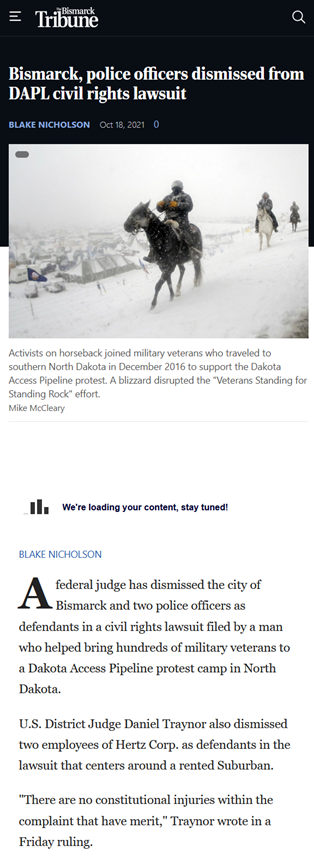
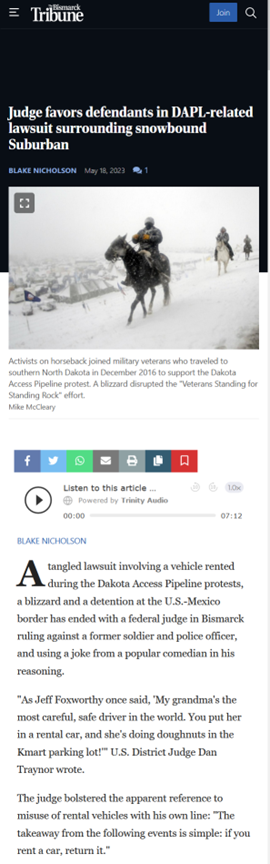
    Michael Wood Jr, a former Baltimore cop, confessed many of his sins a few year ago. Because of that, he became a darling of the anti-cop left who mistook his confessing for whistle blowing. Pretty much everybody who ever worked with the guy has stories about him, and not favorable ones. I never met the guy, but I think he saw me as his nemesis. Anyway, he got his when he was shut down by the #MeToo movement and also by the fact he took a bunch of money from veterans. And pocketed the cash. He’s not a force for good, no matter how much he says about how horrible police are. Mostly he just looks in the mirror.

    I’ve written about him before. Pulled a few punches, honestly.

    Update…. How it started:

    How it went:

    How it went some more:

    And in the Lakota Times.

    How it’s going:

  • Baltimore police trial: guilty

    Yesterday the verdict came out. I wrote this op-ed for the Washington Post:

    This current scandal is more than a case of a few bad apples, though bad apples they were. These officers acted with impunity until the FBI caught wind of their actions through an unrelated criminal investigation in Pennsylvania. A specialized police unit cannot survive for years as a criminal enterprise without the implicit — or overt — acquiescence of higher-ups. Effective leadership could have prevented this. Bad leadership has consequences.

    Corrupt units tend to be specialized and selective. Once murky rumors begin about a unit or officer, good cops stay away for fear of trouble. The corrupt and brutal cops work together, as I once heard, as if pulled together by some magnetic force. You don’t just randomly get assigned to a plainclothes “gun trace task force.” This unit segregation removes officers from the otherwise corrective influence of the honest rank and file. There is no formal colleague review in policing; perhaps there should be.

    Honest cops — still the vast majority — avoid trouble, as any citizen should hope. The rank and file cannot be blamed for keeping their noses clean, especially when unresolved questions remain about the integrity of internal affairs and the prosecutor’s office. These officers in Baltimore were guilty, but the systemic problems represent a failure of leadership, the same leadership that absolved itself of responsibility by inviting the Justice Department to investigate after Freddie Gray’s death.

    Until 2015, policing and Baltimore had been getting better. After an excess of zero-tolerance policing in the early 2000s, Baltimore saw a sustained decline in both murder and arrests. From 2004 to 2011, murders declined from 278 to 197 while arrests dropped from 42 percent. People even began to move back to the city. After six decades of decline, the population increased. These civic and public safety gains reversed in 2015. Last year 343 people were murdered in Baltimore City, and the population and tax base is falling once again.

    This year the police scandal is yet another black eye for a bruised city. Mayor Catherine Pugh, in a statement she later walked back, said she was too busy to follow the trial. The acting and presumed next police commissioner, Darryl De Sousa, is well-respected but will have his hands full. Corrupt police officers deserve special blame for committing crimes while in the public’s trust. But for a wounded Baltimore to rise again, city leaders, both elected and appointed, must accept their responsibility and get things done.

    Go on, click through for the whole article.

  • Cops and Robbers in Baltimore

    Justin Fenton of the Baltimore Sun has tweeted a crazy accountof testimony in today’s trial of corrupt Baltimore cops.

    Crazy testimony in federal court just now by former Detective Maurice Ward, outlining illegal tactics used by Gun Trace Task Force Officers …

    They’d regularly drive fast at a larger group of people, slam brakes and pop their doors to see who ran, then detain and search them. They had no reason other than trying to provoke someone. 10-20 times on slow nights, as many as 50 times others, he said.

    Ward said Sgt Jenkins profiled vehicles – “dope boy cars” such as Honda Accords, Acuras, Honda Odysseys – for car stops and would falsely claim he saw people not wearing seat belts or their windows were too darkly tinted.

    Jenkins also had a thing about men over age of 18 carrying a book bag – probably drugs, he guessed, so they would stop them, Ward said.

    More outrageous testimony from Det Ward: they kept BB guns on hand in case they hit someone or got into a shootout and needed to plant it on someone.

    When they stopped someone suspected of being in the drug game, Jenkins would ask, “If you could put your own crew together and rob the biggest drug dealer you know of, who would it be?” And then they’d go after the person they named, to rob them.

    Prosecutors dumped out a giant black bag, like a hockey equipment bag, onto the floor that apparently belonged to Jenkins that had masks, black clothes, shoes, and tools such as a rope with a grappling hook.

    One of the craziest stories involved a man who they stole $100,000 from. Ward says Jenkins listened to the man’s jail calls after he was arrested, and heard him talking about the officers stealing money from him. /1

    The man said he was going to hire a good lawyer and try to go after them. Jenkins learned that the man’s wife was handling things for him on the outside, and he wanted to extract her so he’d have to hire a public defender and plead out, Ward said /2

    So on one of the calls, Jenkins heard the man talking to another woman. Jenkins, Ward said, had an officer with good handwriting write up a note purporting to be from the other woman saying she was pregnant, and dropped it in the wife’s front door /3

    This is just the first of four officers who will testify during this trial, and he hasn’t even been cross-examined yet.

    The story in the Sun.

    This scandal is big. And it starts just as a new commissioner takes over the BPD. And that transition, from Davis to De Sousa, is just about the first good bit of policing news coming from Charm City in three years. Davis, you may remember, took over from Batts in 2015. Batts was the so called “progressive” who led the department into a riot and saw murder nearly double overnight in May, 2015. But rumor has it that Batts, to his credit, wouldn’t go along with the futile (and failed) criminal prosecution of the six cops involved in the arrest and subsequent death in police custody of Freddie Gray. Davis, they say, got the job in part because he had so such qualms.

    I don’t know De Sousa, but I’ve only heard good things. At least now the possibility of change for the better.

    I still can’t get over the fact that the DOJ was investigating the Baltimore Police Department at the same time that all this was going on. What did they find? Poorly filled out “statements of probable cause,” a few petty gray-area scandals from a decade ago, and, get this, black cops in Baltimore use the “n word.” And yet they were totally clueless about all this happening under their nose. But we can’t blame the investigators because, well, we don’t know who they were since the report was anonymous and with the only the vaguest of “methods” section. But then the purpose of the DOJ report was not to find the truth, but rather show problem to legally trigger a consent decree.

    Speaking of which… Keven Rector reports in the Sun:

    The two highest-ranking Baltimore police officials in charge of instituting reforms, overhauling policies and ensuring compliance with the city’s consent decree with the U.S. Department of Justice have both resigned following Mayor Catherine Pugh’s firing of Police Commissioner Kevin Davis last week.

    Well, there you have it.

  • “That’s quite a day’s work.”

    “That’s quite a day’s work.”

    Yesterday this video came outof Baltimore officer putting gel caps of heroin in a can, placing the can in trash in an alley, leaving the alley, and then “starting” his body cam and going to discover the heroin where he put it. Problem is, for the cops, the camera records video for 30 seconds preceding the press of the on button.

    A man was arrested related to this and held on $50,000 bail. Nobody put up the 10 percent needed to get out, so he had been in jail for the past 7 months. He was released yesterday (eventually) after the video came out.

    These seem to be possibilities, based on the video:

    Option A: Dirty cops planted drugs on an innocent person.

    Option B: Dirty cops planted drugs on a guilty person.

    Option C: Dirty cops realized they forgot to turn on their body cameras, and decided to recreate the discovery, based on a true story.

    Option D: Well-intentioned but stupid cops forgot to turn on their body cameras when the did find the drugs, and decided to recreate the discovery, inspired by a true story.

    Option E: It’s all some great misunderstanding and somehow this is acceptable police work.

    I’m going to dismiss Option E, as has every cop I’ve spoken to.

    Here’s what makes this video so odd. Not exactly the “what,” but the “why?” If you were planting drugs to frame an innocent (or guilty of something else) person, you’d plant the drugs on the person. It doesn’t make sense to plant drugs in a stash because (absent other evidence) people in Baltimore City don’t get prosecuted for a stash of drugs. This is why drug dealers use a stash (it also provides loss protection against robbery). You can’t prove possession without a direct eyes-on chain-of-custody from person to stash. And even then you can’t prove the stash belongs to a person who just happens to be reached into it.

    I wrote about this kind of scenario in Cop in the Hood.
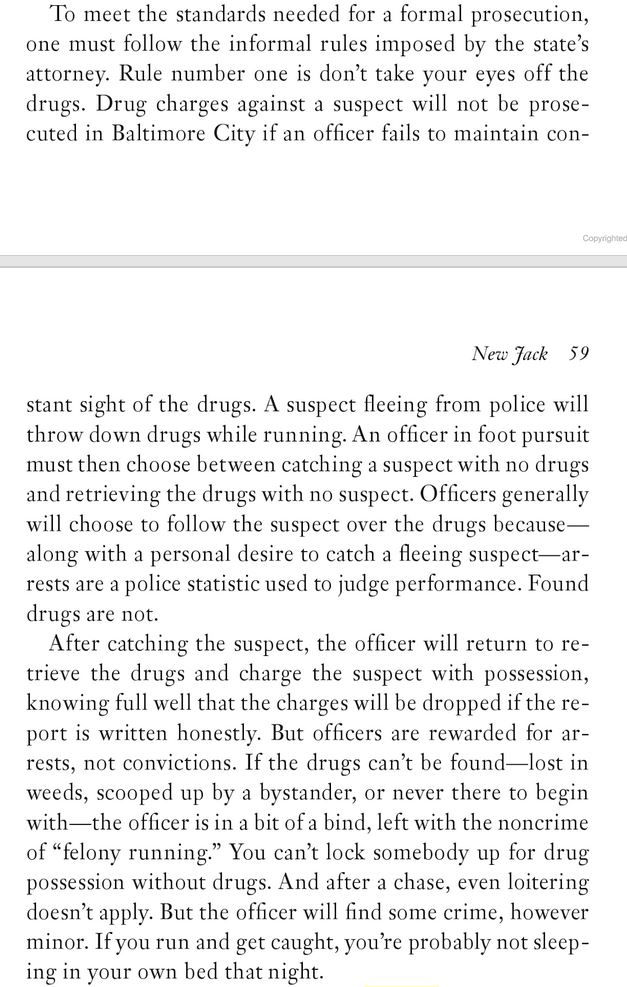
    Could there be a chase of an innocent person, with drugs planted to provide probable cause for arrest? Could be in theory, but I don’t think so here because the drugs were not planted in a place where somebody would throw them while running from cops. No, the drugs were placed in a can, in a drug stash. So maybe this was a reenactment based on a true story. This scenario, which is where I would place my money, is also the saddest. I mean, it was stupid, damaging to police, and harmful to the prosecution of criminals. It was also career ending directorial choice. And for what? That’s what gets me about so-called “noble cause” corruption. Why? (See #3, below.)

    Other issues:

    1) $50,000 bail is a lot of bail, especially for a drug arrest in Baltimore.

    2) Even after watching the video, the State’s Attorney’s office (the public prosecutor) at first only offered time-served. What the hell? It can’t be said often enough what a disaster Marilyn Mosby, Baltimore City’s elected State’s Attorney, has been. Baltimore is a city without effective leadership at the top. One quality of leadership is to take responsibility for what happens under your watch. This does not happen in Baltimore. Bad leadership has consequences.

    3) And it’s always a good time to periodically repeat that almost all police corruption stems from drug prohibition. How’s that war working out? You think the fifth decade will be charm? I don’t. The war on drugs will not be won. And the damage from the fight — to families, communities, incarceration, police — is immense and entirely self-inflicted. Society could better deal with the problems of drug use without police.

    And it’s not that all drug cops are dirty. That’s important to say not to defend cops, but to not excuse the dirty ones. Being involved in narcotics is not an excuse to be a dirty cop; that’s on the cop. But if we want to get rid of police corruption on a systemic level, you need to get police out of the drug game. Just like we did with gambling: regulate and control the supply and distribution. Voila! Cops are no longer on the take with the numbers’ racket.

    But back to the issue at hand. In some ways this is all academic. (But hell, I am an academic.) I’d really like to read the arrest report and statement of probable cause. But there is no scenario where this video is good or defensible. Whether it’s planting drugs or a dramatic re-enactment, it’s bad. David Rocah is 100 percent correct. From Justin Fenton’s and Kevin Rector’s story in the Sun (well worth reading):

    David Rocah, senior staff attorney with the ACLU of Maryland, said that even “a faked recreation of officers finding the untied bag of drugs” would still be “potentially criminal” and should be a violation of police rules.

    Rocah criticized the state’s attorney’s office for “the total lack of any apparent systemic response” to the incident, including putting the officer on the stand in another case after the video was flagged.

    Rocah said it was “insane” that state laws that bar the disclosure of disciplinary records for police officers would prevent the public from seeing the results of the Police Department’s investigation or knowing how it punished the officers internally.

    Rocah also said “there is zero reason to trust any video or any statement from any of these officers” given what was clearly observable in the video flagged by the public defender’s office.

    “So even if it is indeed true that they simply staged a re-creation of finding the drugs, these officers have not only destroyed their own credibility, they have single-handedly destroyed the credibility of every piece of video where BPD officers find contraband without a clear lead-in that negates the possibility of it being staged,” Rocah said. “That’s quite a day’s work.”

    Update: Indeed, this officer forgot to turn on his body-cam when he went and found the stash. So he decided to recreate the scene as it actually happened, potentially a firing offense. Counterfactually, had he simply fessed up (or been caught) failing to turn on his body camera, the departmental punishment would have been verbal counseling.


  • Seven Baltimore cops indicted

    The Feds arrested seven Baltimore City cops today. I don’t know all the details yet, but the robbery charges seem major. “Robberies while wearing a police uniform,” I just heard. But you know what? Even without knowing the details I can go out on a very short limb and predict a few things. Why? Because it’s always the same. And that’s what makes it so frustrating. It’s like we never learn.

    Articles in the Wall Street Journal and the Baltimore Sun. And an unrelated scandal in Chicago. Though I will read these stories thoroughly. It bothers me that I don’t have to. Some things are always the same. Always:

    • Drugs. Always drugs. I’m not one for “root causes” theories in the abstract, but if you want to end police corruption, you’ve got to end drug prohibition. That’s it. Until then, this will happen. This only question is when, where, and how often. The drug game is dirty. And it is a game with arbitrary rules. It taints all involved, even the honest cops.

    • A specialized unit, removed from the generally non-corrupt culture of most police officers.

    • A selective unit, in that people don’t just get assigned there. Officers need to self-select. And the more aggressive cowboys do. And this aggressive hot-headed police sub-culture can feed on itself. Here’s something you may not know: most officers have no desire to work with those cops. Why? Because most cops don’t like they way they operate. Do cops know they’re dirty? No. But they certainly suspect things aren’t kosher. So the good cops stay away. You stay away because there’s guilt by association in the police department, and when the shit hits the fan, and it always does, you don’t want to find yourself in the jackpot.

    • Red flags galore. Let me guess, the officers involved had tons of overtime (this seems to be one of the charges). Too much legal (or illegal) overtime is a red flag. But usually what now happens is the department cracks down on all overtime. Collective punishment, in essence. And that will only piss off the honest cops who are trying to do their job.

    I bet a few of these cops are “highly decorated.” Yes, too many awards is a flag.

    I’m also going to guess there were a lot of complaints against these officers over the years. Now of course if you do aggressive work you’ll get more complaints than some lazy hump who never gets out of their car. And you need to be careful not to see every complaint as legit, because most are BS. But still, when you get a dozen complaints — use of force, discourtesy, the whole nine yards — in a year or two? I think of the line from the Wire:

    “…which for Herc will make an even four in the last two years.”

    “None sustained.”

    “But all of them true.”

    On the flip side, you can’t treat every complaint as a career hold. That’s how you get the maxim, “If you don’t work you can’t get in trouble.” Flags aren’t guilt. That’s why they call them “flags.” You notice them. You investigate. And maybe there’s nothing to them. But sometimes there is. Somebody up top needs to notice these flags. And somebody with authority, you know, a “leader,” needs to put their neck on the line and take action.

    • High “productivity.” You want guns and drugs and cash on the table? You reward officers for arrests? Then you get this. (Not always, mind you. Not immediately. Not all officers. But yes, eventually it is inevitable). It’s not easy to balance “productivity” on one hand with “laziness” on the other. But I’m telling you, there’s a huge middle ground into which fall 80 percent of cops.

    • Bad supervision. The sergeant got arrested, and this implies the squad was rotten to its core. So, I can’t help but wonder, who was the Lieutenant? Go on up the chain of command, for a change. Not just to punish and blame, but to inquire, reform, and figure out how this happened. Did the LT close his or her eyes because of pressure from higher up? I don’t know. Where exactly was the communication breakdown? Because this is about bad apples. But it’s not just about bad apples. There’s the barrel that allows these apples to rot.

    The military-like chain-of-command does nothing more efficiently than suppress open communication. In a police department, it’s too easy to put on blinders and not know what is happening around you. In fact, you’d be a fool to do otherwise. This is not the same as a “blue wall of silence,” mind you. But it is a problem. But even if those higher up don’t know about the crimes happening under them, it’s still a failure of leadership.

    Anyway, I’m just writing about scandals in general. But if these facts are true in this case — and I bet they are — isn’t that, as they say in the police world, a clue?

  • “Cast-Out Police Officers Are Often Hired in Other Cities”

    It’s unclear how big of a problem this is. But even that is part of the problem. The fact that it happens at all is horrible. You’d also think police departments, even the tiny ones (much less Cleveland), would be a bit more inclined to do a more thorough background check. Maybe pick up the phone or something. You’d also think there would be a database. And there is, The National Decertification Index. But it’s not well funded, according to the New York Times. Why it can’t get a little cash from the DOJ seems to is a mystery:

    The Justice Department, which gave the association about $200,000 to start the database in 2009, no longer funds it. The department declined to explain why it had dropped its support, but a spokesman said the goal was “ensuring that our nation’s law enforcement agencies have the necessary resources to identify the best qualified candidates to protect and serve communities.”

    Thanks for nothing, spokesman.

  • Chicago Police Report

    It’s kind of hilarious that Chicago Mayor Rahm Emanuel is trying to present his cover-up-and-dictate style of management as concern for police misconduct. But leaving that aside, a task-force he appointed has released its report.

    Some of what it says needs to be said: “From 2011-2015, 40% of complaints filed were not investigated by IPRA.” And: “These events and others mark a long, sad history of death, false imprisonment, physical and verbal abuse and general discontent about police actions in neighborhoods of color.”

    And let’s not forget the false (and consistently false) police reports and (mayoral?) cover-up related to the killing of Laquan McDonald:

    Not until thirteen months later — after a pitched legal battle doggedly pursued by local investigative journalists resulted in the court-ordered release of the dash-cam video of the shooting — did the public learn the truth: McDonald made no movements toward any officers at the time Van Dyke fired the first shot, and McDonald certainly did not lunge or otherwise make any threatening movements. The truth is that at the time Van Dyke fired the first of 16 shots, Laquan McDonald posed no immediate threat to anyone.

    They really should have added that McDonald didn’t pose any threat when the last shots were fired.

    There are the ignored red flags:

    The enduring issue of CPD officers acquiring a large number of Complaint Registers (“CRs”) remains a problem that must be addressed immediately. From 2007-2015, over 1,500 CPD officers acquired 10 or more CRs, 65 of whom accumulated 30 or more CRs. It is important to note that these numbers do not reflect the entire disciplinary history (e.g., pre-2007) of these officers.

    The inability to act on red flags:

    Sadly, CPD collects a significant amount of data that it could readily use to address these very troubling trends. Unfortunately, there is no systemic approach to addressing these issues, data collection is siloed and individual stakeholders do virtually nothing with the data they possess.

    And the perennial problem with “community policing”:

    Historically, CPD has relied on the Community Alternative Policing Strategy (“CAPS”) to fulfill its community-policing function. The CAPS brand is significantly damaged after years of neglect. Ultimately, community policing cannot be relegated to a small, underfunded program; it must be treated as a core philosophy infused

    But here’s where ideology begins to trump common sense. It’s claptrap to advocate for “community policing” without defining community policing or offering any evidence to its effectiveness. Yes, police right now need better relations with the non-criminal public in minority neighborhoods. But the main job of police, lest we forget, is to deal with the criminal public.

    And then there’s the absurdity — the dangerous and even racist absurdity — of promoting racial balance in police activity and use of force.

    Police Officers Shoot African-Americans At Alarming Rates: Of the 404 shootings between 2008-2015:

    • 74% or 299 African Americans were hit or killed by police officers, as compared with

    • 14% or 55 Hispanics;

    • 8% or 33 Whites; and

    • 0.25% Asians.

    For perspective, citywide, Chicago is almost evenly split by race among whites (31.7%), blacks (32.9%) and Hispanics (28.9%).

    Really? That’s your perspective?

    The idea that police should stop, arrest, and even shoot and Tase people in proportion to population demographics is nutty. For real perspective, consider that of 3,021 Chicagoans shot last year, just 25 were shot by police. 79 percent of murder victims were black; 4 percent were white. For known assailants (which is known just a shamefully low 26 percent of the time) the figures are comparable.

    With this perspective, the use-of-force stats seem quite reasonable. To say this is not to deny a historically troubling legacy or even current problems. But if the benchmark for success in policing is racial parity in use of force, then Chicago and Chicagoans are in for more bloody years.

    Chicago is 5.5 percent Asian. As a benchmark of success, will we not rest till more than 5 percent of those shot by police are Asian?

    Overall, use of lethal force by the Chicago Police Department is on par with the national average (0.33 per 100,000 for the CPD, compared with 0.31 for the nation). Chicago is below LA, Houston, Atlanta, San Francisco, and most cities. The Chicago Police Department may have 99 problems, but an excessive use of lethal force and a racial disparity in that use of force doesn’t seem to be one of them.

    Still, there is a room for improvement. The NYPD kills people at an outlyingly-low rate of 0.08. Maybe, instead of suing police departments into institutional paralysis, folks could determine what the NYPD is doing right and advocate better — rather than less – policing based on best practices. (But who on the Left wants to talk about what the NYPD is doing right?)

    But I’ll finish on a positive note:

    The findings and recommendations in this report are not meant to disregard or undervalue the efforts of the many dedicated CPD officers who show up to work every day to serve and protect the community. The challenge is creating a partnership between the police and the community that is premised upon respect and recognizes that our collective fates are very much intertwined.

  • Scandal in the NYPD

    It’s still hard to figure out what exactly is going on. But Banks seems to be toast. Banks never had money problems. Maybe the IRS is interested. Overall, the best summary to date is by Lenny Levitt in NYPD Confidential.

    Along with connections to Da Mayor, the white elephant in the room is the “special consideration” given to the Hasidic community. It’s an open secret in the NYPD that Hasids and some of the Orthodox community are treated very kindly. Why? Because they got, as they say in Chicago, clout.

    In 2013 DeBlasio won the Democratic primary (and hence the general election) by 101,503 votes. He avoided a runoff by 5,623 votes. Fewer than 700,000 votes were cast. Yes, in a city of 8.5 million, local elections are decided in an off-year with less than 10 percent of total residents voting. Meanwhile, there are 15,000 Satmars whose leaders offer their votes as a block. Most voted for deBlasio.

  • A Toddlin’ Town

    From AP:

    In all, Chicago has paid a staggering sum — about $662 million — on police misconduct since 2004, including judgments, settlements and outside legal fees, according to city records. The payouts, for everything from petty harassment to police torture, have brought more financial misery to a city already drowning in billions of dollars of pension debt.

    The Chicago police said there were 45 firings and 28 suspensions from 2011 through 2015 in a department of about 12,000. Some cases remain open.

    The city’s top lawyer, Stephen Patton, says his office has reduced costs with new strategies: It has cut the number of outside lawyers by more than 80 percent, taken more cases to trial (the corporation counsel’s office won 21 of 28 last year), whittled down a backlog and spread the word it will no longer settle small cases routinely.

    Burge cases — including settlements and outside lawyers — have cost the city more than $92 million (about $109 million, if county and state expenses are included), according to Taylor, who keeps his own tally.

    And I’m just going to beat Pirate to the punch.