Tag: crime prevention

  • Police just “perpetuating an already vicious cycle”

    Sometimes the police-are-bad set can be so casual in their negative assumptions about police you just might miss it. But it’s worth calling out, because accepting these lies is damaging, potentially lethal if you’re in a high-crime neighborhood. This is buried in Kate Crawford’s article in the New York Timesabout artificial intelligence:

    Police departments across the United States are also deploying data-driven risk-assessment tools in “predictive policing” crime prevention efforts. In many cities, including New York, Los Angeles, Chicago and Miami, software analyses of large sets of historical crime data are used to forecast where crime hot spots are most likely to emerge; the police are then directed to those areas.

    That’s good, right?

    Nope:

    At the very least, this software risks perpetuating an already vicious cycle, in which the police increase their presence in the same places they are already policing (or overpolicing), thus ensuring that more arrests come from those areas. In the United States, this could result in more surveillance in traditionally poorer, nonwhite neighborhoods, while wealthy, whiter neighborhoods are scrutinized even less.

    And to think, that is “the very least” harm predictive and data-driven policing policing could do. What is the worst-case scenario?

    See, the problem according to this piece — just thrown in there, asserted like God’s truth — is that people in high-crime neighborhoods suffer from police presence. Nothing about preventing crime or the criminals police are paid to confront. Police just “scrutinize” and arrest. To break this “vicious cycle”, should we have fewer police in high-crime neighborhoods? I can’t help but notice that cities that have inadvertently put this strategy to test — less policing, less scrutiny in high-crime areas, fewer arrests — cities like Baltimore and Chicago? They’re not doing so well with the crime fighting.

    [hat tip to my brother]

  • Why did New Yorkers stop shooting each other?

    In New York City not only has the number of homicides being going down, but the percentage of homicides committed with a gun has been decreasing.

    Put another way, there were about 309 people shot and killed in 2011 in NYC (for UCR reasons we’re talking incidents, so this is a bit of an undercount). In 2013: 188. That’s a huge decrease. (2014 saw 184.)

    If you look at all other city homicides (ie: non-gun), they’re down a little. But the decrease in NYC is all about fewer people shot. Did New Yorkers get together in 2011 and decide to stop shooting each other? I missed that meeting. Was it because of Occupy? Or because Occupy was broken up? Did anti-police protests somehow reduce gun violence? I doubt it. But something happened, and I don’t know what it is.

    Oddly, the NYPD didn’t take credit for this crime drop because it coincided with anti-police protests and the end of stop and frisk. Cops and Kelly and those on the right were certain — hoping even — that crime was going to skyrocket. They’ve been saying that since at least 2012. Well, it’s 2016.

    Here is some UCR homicide data from 2014 (if you hold your breath for 2015, you’ll turn blue and pass out):

    New York City: 56 percent of homicides are by gun, 26 percent by knife (“or cutting instrument”). Nationwide is 68% gun, 13% knife.

    A few other cities:

    Baltimore: 75% gun, 18% knife.

    Chicago: 87% gun, 7%knife.

    Los Angeles: 73% gun, 13% knife.

    Here’s the percentage of NYC homicides that were gun-related at various years (UCR data):

    1990: 74% of homicides by gun

    1997: 61%

    1998: 60%

    1999: 59%

    2000: 66%

    2002: 61%

    2005: 61%

    2009: 63%

    2010: 61%

    2011: 61%

    2012: 57%

    2013: 59%

    2014: 56%

    So maybe that’s not the issue. Honestly? A five-percent decrease since 1997 ain’t such a big deal. But my gut tells me a 5-percent slow but steady drop since 2011 does mean something.

    Of course it *is* related to gun control. But as any 2nd-Amendment-loving Trump-loving patriot will tell you (often in all caps) “CHICAGO HAS GUN CONTROL!!!!” And Chicago, if this is too subtle for you, has a lot of killings.

    So maybe, at least this is what I think, gun control isn’t about gun laws as much as actual prosecution and deterrence. New York is the only city where people believe — mostly correctly I might add — that illegal gun possession will bring you real time.

    What if it were that simple?

  • Swamy Pete says…

    Swamy Pete says…

    Swamy Pete, the gypsy scryer, looks into his crystal ball.

    With eerie music in the background and an echoey voice, Swamie Pete makes a bold prediction:

    In the future, in fact tomorrow at exactly 19:00 hours eastern time, crime will not happen. The crystal ball says that for maybe three hours, somehow people will manage to have fewer problems. The root causes will remain constant, and yet fewer people will dial 911. Yes, I can see it now… for a few hours Sunday night, triggers on guns will be harder to pull and knives will be so dull they will not cut human skin….

    But… at around 10:30pm everything will be back to normal.

    I never liked that Swamie Pete and his voodoo nonsense, even if back in October he was right about the homicide increase of 2015. How did he know that? Witchcraft, I say!

    But by the way, if we accept that blizzards reduce homicide. And the Super Bowl reduces homicide. Why is it so controversial that aggressive police presence focusing on maintaining order in high-crime communities can reduce homicide? I don’t know. I’ll ask Swamie Pete if I ever see him again.

    Update (Feb 10): Surprisingly, call volume was only down a little during the Super Bowl. Not the huge dropoff I expected. Crime data isn’t out yet.

  • Cause 911 is cheaper than a shrink

    Here’s a report with some numbers on the problem of untreated mental illness and police response.

    Bottom line, according to these numbers:

    About two percent of Americans have untreated severe mental illness.

    Those two percent of people account for 10 percent of police responses, 20 percent of those behind bars, and 25 percent of fatal police encounters.

    I was going to joke how it’s easier to blame the police than treat mental illness. But I don’t even know if that’s true. We just choose to treat mental illness with police and incarceration. That’s messed up.

    [Thanks to a reader]

  • ShotSpotter

    Anybody know if ShotSpotter is good? From an NYPD press release:

    This is one of more than 30 firearms that have been recovered since the inception of the ShotSpotter program, back in March of this year.

    Three guns a month doesn’t seem like so many. But then to get 30 guns off the streets, back in the old stop-and-frisk would have meant stopping 26,370 people!

    How does ShotSpotter work in practice? Is a response mandatory or discretionary? What about false positives?

  • “I do think people underplay the poverty in [Baltimore]. They really don’t understand it.”

    There’s an interview with Justin George in The Trace. He was a Baltimore Sun reporter who recently moved on to Milwaukee. I like that he’s willing to consider the possibility there might be some trade-off between aggressive policing, which causes community resentment, and getting illegal guns off the streets, which saves lives:

    Which of the citywide initiatives to help cut the homicide rate has been the most successful?

    What everyone talks about most is these plainclothes cops, which are very controversial. These are detectives who are working in unmarked cars. They gather intelligence. When Baltimore’s homicides dipped below 200, in 2011, for first time in decades, one of the things pointed to were these units. They were chasing down leads, looking for guns and getting info on who has them. But a lot of black residents were being unfairly harassed. At the John Hopkins gun policy center they say that some units that are specifically trained to spot guns have shown effectiveness in other cities. But these units also run the risk of alienating the neighborhood.

    So what can be done to turn things around in Baltimore?

    I can only speak to what the residents tell me. And they tell me repeatedly that there aren’t enough things for you to do on the streets. They say that they want more recreation centers; they miss the different athletic leagues and getting youths involved with good influences. And there’s certainly that notion that a lot of these kids need people who are rooting for them. And when I say kids, I’m talking about teens here. I think if there’s a boost in the economy, you’ll see a change. But I want to express, I’m not an expert in any of this — I’m just a humble journalist. But I do think people underplay the poverty in the city. They really don’t understand it.

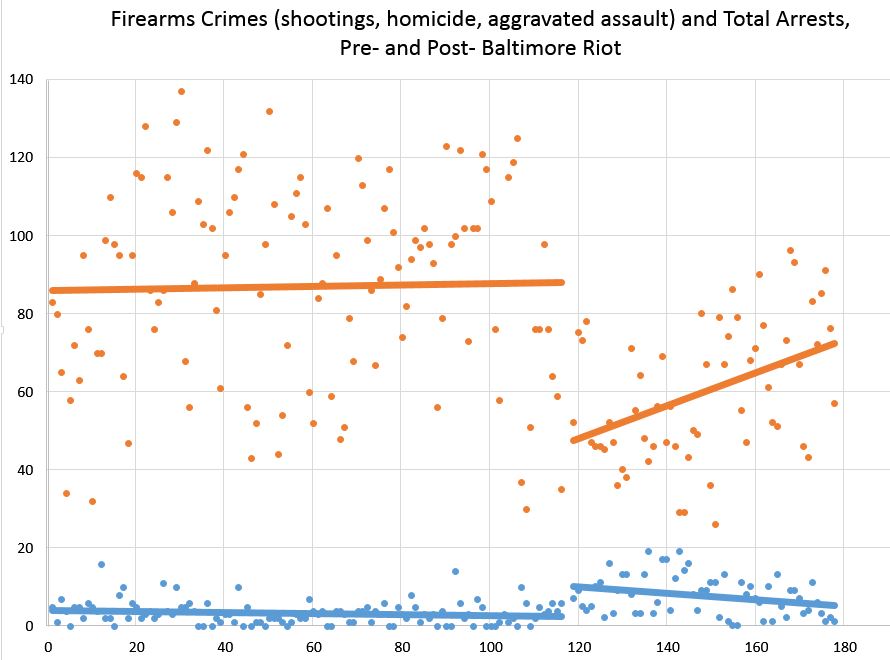
  • Post-Riot Baltimore: Arrests Down and Gun Crimes Up

    Post-Riot Baltimore: Arrests Down and Gun Crimes Up

    Total arrests per day are in orange. Firearms crimes per day are the lower lines, in blue.

    (Click to embiggen)

    The bottom axis represents the numbered day of year. 1 is Jan 1. 178 is June 27th. The riot was on April 27, day 117.

    This was partly inspired by a frustrating discussion on the radio yesterday in which one person was trying to assert that Baltimore hasn’t seen any increase in violent crime related to the riot and its aftermath. What world is he living in?”It was up before the riots.” Yeah, a bit. “It’s seasonal. Shootings go up in warmer weather.” Not this much, they don’t! (And shootings were actually down in June compared to cooler May). But then the same guy also insisted there was no riot. (It was, of course, a “rebellion.”) Methinks his ideology may be trumping reason.

    I like to think that facts matter, especially when lives are ending. So here we ago again….

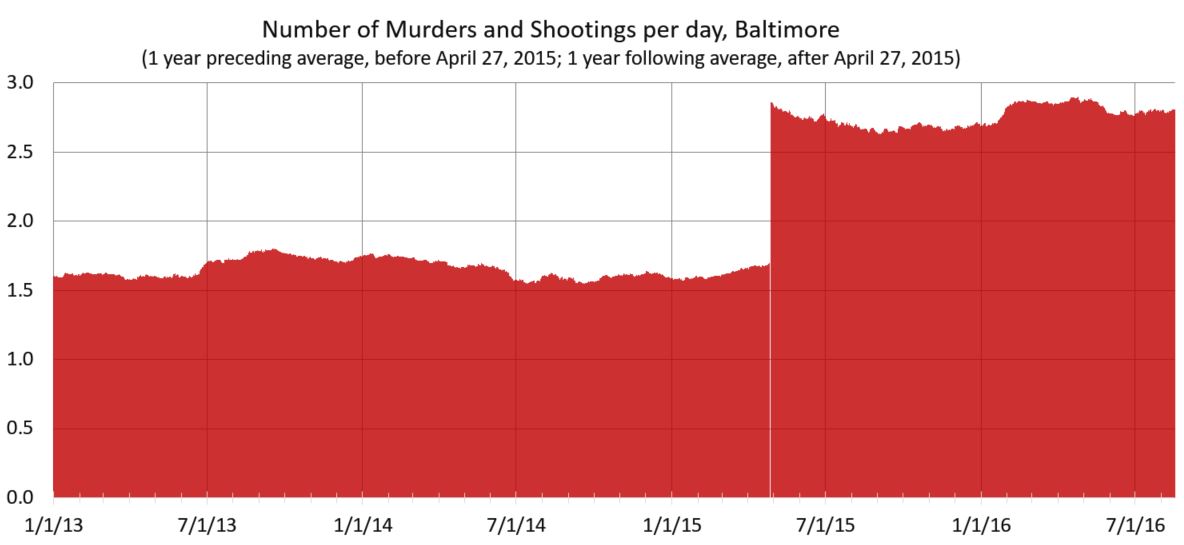
    I’ve already looked at the massive increase in homicides (one more person each day is being killed in Baltimore post-April 27). This time I thought I’d look at gun crimes, which correlate very well with homicides, just to get a bigger N (more cases). And I excluded outlier arrests numbers from April 27 and 28 (which were 178 and 143, respectively).

    These data go up to June 27, 2015. Before the riots, there were 3.4 recorded gun crimes per day (those classified as shootings, homicides, and aggravated assault with firearms) and 87 arrests. (Back in in the 2000s, there were roughly 275 arrests per day, which is worth noting.)

    After the riots, there were 7.7 daily gun crimes and 60 arrests. That actually less of a decline in arrests than I suspected. But it’s still a one-third decrease. Gun crimes are up 118% post riot.

    The good news, limited though it is, is the current trend. Arrests are inching up back up to “normal” and gun crimes are declining. While of course correlation doesn’t automatically mean causation, I beg anybody to offer an alternative hypothesis here. This social scientist is willing to assert cause and effect.

    Here are the number this year compared to last year:

    2014 pre-April 27: 3.4 gun crimes per day and 114 arrests.

    2014 post-April 27: 4.9 gun crimes per day and 117 arrests.

    2015 pre-April 27: 3.4 gun crimes/day (identical to 2014), 87 arrests.

    2015 post-April 27: 7.7 gun crimes per day and 60 arrests.

    So we might have expected a 40 percent increase in gun crimes after April 27 as a seasonal factor. We saw a 126 percent increase.

    (It’s worth pointing out that I’m not saying arrests are good just for their own sake, but they can be a good indicator — a proxy — for more general discretionary crime-preventative proactive policing.)

    [see future post: The Freddie Gray Effect in Baltimore]

    Source: Baltimore Open Crime data.

  • Let’s Rethink Patrol

    Here’s another piece of mine in CNN, also out today. I hope this gets a bit of attention because I was able to move past the headlines (thanks to my wonderful editor at CNN for her encouragement and mad editing skillz) to question the very concept police patrol. That’s the type of moderately deep-thinking that is hard to get published in op-ed form.

    But at this moment there might be a small window of opportunity to make substantive changes in policing. Why do have a system where, for instance, the first responder to a mentally ill person is a police officer? It doesn’t make sense. Not for the cops. Not for the mentally ill. So why not rethink a reactive model of undervalued and understaffed police patrol. The status quo swallows up resources and — by design — limits the discretion and problem-solving ability of police officers.

    Many people who call 911 do need help, but it’s not help that a very young police officer barely out of high school — armed and with the power of arrest — can provide. These calls for service would often be better addressed by doctors, social workers, teachers and parents.

    Over the past 40 years, with the advent of call-and-response policing, the mentality of policing changed. Consider the portrayal in the 1980s TV show “Hill Street Blues” (it’s pop culture, but it contains truth): The first sergeant, played by Michael Conrad, finished roll call with the sage advice: “Let’s be careful out there.” After his death, the new sergeant was played by Robert Prosky. His motto? “Let’s do it to them before they do it to us.”

    There are benefits to old-fashioned beat policing that we need to reclaim, but we can’t as long as most police resources are controlled by civilian dispatchers, officers have too little discretion, and the war on drugs dominates urban policing by criminalizing too many people.

    For a cop bouncing from call to call constantly dealing with criminals or people who have lost control of their lives, it’s too easy to believe that nobody in the area is in control. From the window of a patrol car, every face on the corner starts looking the same. By walking on foot and engaging with the noncriminal public, police officers, especially those without any prior knowledge of the area they police, could begin to understand both how communities function and how they fail.

    Read the rest here.

  • How about telling cops what they should do rather than what they shouldn’t do?

    Here’s my piece in today’s New York Times:

    Critics of police — and there have been a lot this past year — are too focused on what we don’t want police to do: don’t make so many arrests; don’t stop, question and frisk innocent people; don’t harass people; don’t shoot so many people, and for God’s sake don’t do any of it in a racially biased way.

    Those are worthy goals all, but none of this tells police what they *should* do. Some critics of police seem to forget that the job of police and crime prevention involves dealing with actual criminals.

    It’s a perfectly fine short piece. I do want to move the discussion away from what police shouldn’t do to what police should do. But I find the whole New York Times “room for debate” concept a bit disingenuous. Because there’s no debate. As a writer, I don’t know who else is writing or what they are going to say. It really would be nice to respond to other points and flesh out the issues. Instead “room for debate” is a collection of 300-400 word op-eds. Perhaps that is what it should called: “Room for too-short opinion pieces from people willing to write for free just to get a Times byline.” Doesn’t really roll of the tongue, admittedly.

    (On principle, in solidarity with free-lance writers everywhere, I try not to write for free, especially to for-profit businesses. Writing is work. And workers should be paid. A proper 800-1,000 word op-ed published in the print edition of the Times or the Washington Post or the Daily News or with CNN.com generally pays $200 – $300. A dollar figure that has actually decreased for some publication. Now the $300 I get from CNN is not a lot of money, mind you. But it really is the principle… and the money. And yet once again I wrote for the Times for free because it’s the Times. So much for principles. Or money. But it is pretty easy for me to hammer out 300 words.)

  • Shootings up in NYC

    The recent crime numbers in NYC will soon come out, and they’re not good. Homicides this week are way up compared to last year. Of course that’s just one week… till it’s not. Shootings are up in NYC. Not Baltimore up. But up. People are dying. It is time to ring the alarm. Maybe not the crazy 5-alarm fire for Baltimore. Maybe a simple 1-alarm would do NYC. But more people are dying.

    So what might be the cause? A lot of things of course. One factor may be people’s willingness to carry heat. Word on the street is that guns are back in town. As I was told: “People are now shooting into crowds more often, doing drivebys, more often, and shootings as teams more often. The risk for carrying a gun in nearly zilch. Bottom line: cops aren’t stopping people, and young black men are paying for it with their lives.”

    Stop and frisks are down roughly 95%. Now we could debate whether certain police tactics are legal, constitutional, or moral. We should debate these things. Maybe it’s OK to have 50 more dead bodies in NYC if hundreds of thousands of other young black men aren’t stopped by police for no good reason. So let’s have that debate. What bothers me is the disingenuousness of those who refuse to grant criminals any agency in crime. Like Broken Windows is the root of all evil. Like it is inevitable that 2015 would see a 10 to 20 increase in shootings in Brooklyn. And it must have been written by the Almighty that some in Baltimore would riot on April 27, and then the homicide rate would skyrocket.

    Criminals don’t leave their guns at home because they’re asked politely by community leaders. It is possible that force and coercion might, in some cases, keep people alive. Remember (before we forget) that the arguments against stop, question, and frisk weren’t only that it was illegal, unconstitutional, and morally reprehensible. It was that it didn’t work — that stop, question, and frisk was actually counterproductive with regards to crime prevention. (I never quite understood that argument, but it was said.)

    The role of guns in NYC homicides is surprisingly varied. It wasn’t that long ago (well, the 1970s) that guns were used in less than half of all murders in NYC. In 1960, at least according to one source, guns were used in just 20 percent of homicides. But that changed in late 1960s and 1970s.

    By 1990, guns in NYC out of control. 1,650 killed by guns, 75% of all murders, higher than the national average (not including NYC) of 67%. (All these percentage may be a bit low based on “other and unknown”.)

    So along with all murder going down in NYC, gun murders went down in particular.

    In 2000 65% of murders in NYC involved guns. (Compared to 66% in the rest of the nation. UCR data, all.)

    In 2005 61% in NYC. (Rest of nation: 68%.)

    In 2010 60% in NYC. (Rest of nation: 68%.)

    In 2013 59% in NYC. (Rest of nation: 70%.)

    Meanwhile, the percentages of gun homicides in other cities is much higher: 84% in Chicago; 79% in Los Angeles; 81% in Baltimore. So New York looks all the more impressive.

    This was a little heralded victory against gun crime in NYC. While the rest of the country saw a small increase in the percentage of homicides involving guns, NYC saw a decrease.

    I asked my friend, Dan Baum, who insisted on being identified as “a liberal Democrat Jewish gun owner who wrote Gun Guys: A Road Trip“. Baum can write. (Too bad you didn’t buy his book.)

    Anyway, I asked Baum about what changed in the 1960s. Gun violence increased 50% in the 1960s (five times more than other/non-gun violence). He said:

    What changed in the early 1960s? JFK was shot, and the liberals began their long love affair with gun control. Until 1968, you could buy guns through the mail. Guns were things that people owned, but they weren’t a cultural marker, a badge of belonging to a particular subculture.

    The liberals changed all that, by relentlessly pushing the bubbas into a corner. Suddenly, people were in a panic to buy all the guns they could, because they never knew when the liberals were going to ban their sale altogether. The NRA, taken over by the loonies in 1977, pushed that narrative. The number of guns circulating in private hands exploded exponentially, with predictable results. Not only that, a tremendous amount of anger was injected into the national discussion around guns — also not a good thing.

    So I’d argue that we have the liberals, and gun control, to thank for the huge increase in gun murders. Guns are way more prevalent than they used to be, because the liberals made them a thing. Had they not done that, we’d be back in 1960 America — guns being a thing that some people own, that have no cultural/political/spiritual significance.