Tag: crime prevention

  • Five charts Ray Kelly Doesn’t want you to see!

    Five charts Ray Kelly Doesn’t want you to see!

    (Can you guess I was just on buzzfeed? A better headline would be “Murders way down in NYC. And so are stop and frisks. And nobody seems to care.” But what kind of clickbaite would that be?)

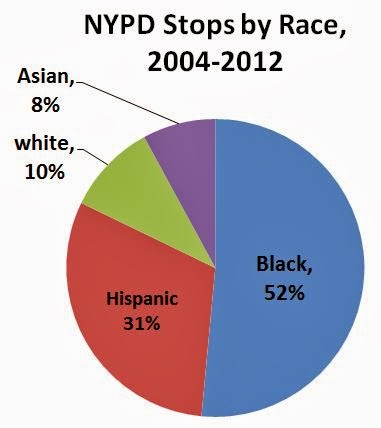
    1) Breakdown of NYC stops by race.

    Indeed, as often reported, 83% of stops have happened to black and hispanic people.

    2) Breakdown of NYC homicide victims by race.

    But ninety-one percent of homicide victims were black or hispanic. Wow. Actually, this is the chart Ray Kelly wants you to see. Critics of stop and frisk generally don’t like talking about this issue (as if the racial disparity in violent crime will just go away if we ignore it). But it is relevant. It may not excuse the racial bias of stop and frisk, but it goes a long to explaining it. Cops are where the violent crime is. Cops stop people where cops are assigned. Ergo cops stop black and hispanics disproportionately. “Racism without racists,” it’s sometimes called. It’s not that individual cops are racists in their day-to-day work, but the end result of a stop-and-frisk policy can still racist.

    3) Hit rate for stops of black people.

    (this and then next figure are taken from Mother Jonesand the data from the Center for Constitutional Rights)

    One in 143 stops of blacks yields guns, drugs, or other contraband. Compare this to the rate for whites who are stopped.

    4) Hit rate for tops of white people.

    One in 27 stops of white people yields guns, drugs, or other contraband. Same yield with 19 percent of the stops.

    Wow.

    One way to interpret these data is that white people must be 5.4 times as likely as blacks to be packing heat or drugs! Of course that’s unlikely. So why is contraband 5.4 times as likely to be found on white people? Because white people are more likely to be stopped based on actual suspicion (there is much less pressure to produce stats in low-crime neighborhoods). Black people are being stopped because Compstat and “productivity” pressure in high-crime neighborhoods mean some officers stop people simply because the feel they need to stop people to fill out the UF-250s (the stop, questions, and frisk form).

    So how about this for a goal: get the “hit rate” for blacks up to the same level for whites. Not only would this be fair, it would be good policing. It would also go a long way to mitigating the problem of excessive stop and frisks. And it’s not hard to do. Make smart stops, not more stops.

    5) Stops and homicides are both down!

    For years Bloomberg and Kelly were basically saying that every one of the five, six, and seven-hundred-thousand stops was necessary to keep the city from exploding in crime. An inevitable part of the crime drop in New York City.

    And yet stops have plummeting in the past two years (2013 figures are estimated year-end totals based on latest available data). In part this is from pressure from the top and in more recent part instructions from the PBA.

    And homicide? Must be way up, right? Because Bloomberg and Kelly have insisted we need all these stops to keep homicide down. And yet we’re on track from just over 300 homicides for the year in NYC. (Again, estimated year end total).

    What did I just say New York City is on track to have just 318 homicides this year?! That’s amazing. Why is this not front-page news? This 22 percent reduction is not from a crack-fueled high of the late 1980s but from the record low year of 2012! The 2013 homicide numbers are an amazing accomplished. (I mean Baltimore City used to top 300 homicides with just 650,000 residents.)

    Homicides in New York City are down 22 percent this year and nobody seems to want to take credit! Attackers of stop and frisk never like to highlight any evidence that might be used to imply stop and frisks are effective. But defenders of stop and frisk can’t reconcile a huge crime drop that correlates with an even larger decline in stop and frisks. In two years stops have been cut in half and homicides are down by one-third. (Of course there might be a delayed link between the end of stop and frisk and a rise in crime, but I think the past year or two should be enough time to see such a lag effect).

    So for crying out loud, give the NYPD some credit! Just last year academics, once again, were saying crime had bottomed out; crime won’t go down; crime can’t go down any more. And yet, once again, it did. This was not inevitable. This is not irreversible. But as Bill Bratton likes to say, “Cops count and police matter.”

    So give the NYPD credit for a record low number of murders, but remind them that this amazing reduction in homicide has happened without unnecessarily stopping and bothering another 350,000 innocent black and hispanic New Yorkers this year. That matters.

    We now know that all these stops were not needed. Throw out that bathwater! But be careful, because there is baby somewhere in that murky water. Surely some of these stop are needed. You know, the stops based on officers’ reasonable and honest suspicion.

    The crime reduction can continue at the same time unnecessary stop and frisks and ended. One goal should be to raise the hit rate for blacks stopped to the same level as found for whites who are stopped. This alone could reduce the total number of stops (and misdemeanor marijuana possession arrests) more than 80% from the 2011 high. The good news is we’re already half way there.
  • “Police work is a thinking person’s game”

    It’s worth highlighting this excellent comment to a previous post, from a anonymous police officer. You can file this under “if you don’t work, you can’t get in trouble.”

    What I’ve learned over my career, and what has frustrated me as a life-long progressively inclined citizen, is that despite all common sense and evidence to the contrary, well-meaning liberal types are stubbornly attached to this outdated narrative of white officers maliciously and illegally harassing innocent black men “doing nothing.” As you just articulated, police work is a thinking person’s game. Unfortunately the critics are often so blinded by ideology that to educate themselves on very basic police procedures which may illustrate, like you stated, that for professionals it’s not all about race.

    The real harm from this refusal to engage maturely with the subject matter is the effect this political pressure has on departments, and by extension the most vulnerable communities. I see officers putting blinders on and avoiding perfectly justified stops (not even grey area sophisticated, I’m talking straight probably cause) for fear of allegations of racism. It’s more trouble to deal with the subsequent complaints that now accompanies meaningful proactive police work than to do the bare minimum. And of course, the crime rate sky rockets because the suspects are emboldened by de-policing and ideological cover. So once again, it’s folks in the poor and predominately black neighborhoods, where the well-meaning liberal types don’t have to live, that suffer.

    It’s too easy to be for “police accountability,” whatever that means. Good intentions aren’t enough. Hell, even I’m for police accountability at some very large level. But any “accountability” needs to result in better, not worse, policing. That may sound obvious, but it’s not.

    I’m curious to see how things are going to work out in NYC with potentially two new levels of “accountability” that will just happen to coincide with a new mayor and new police chief who will have to reap what Bloomberg and Kelly sowed. It is not inevitable that crime will go up! But next year the NYPD will have to choose to do right and continue to improve and police (and stop stops for stops’ sake!) or curl-up into a ball and disengage.

    If you create a system where an officer can get banged or sued for doing his or her job, don’t be surprised when officers say, “I want to get promoted. I want to keep my pension. I’m not getting out of this car unless someone calls 911.” Individual actors still act rationally in irrational systems. So-called accountability can all too easily lead to bureaucratic paralysis (for exactly how, see “the Anticorruption Project and the Pathologies of Bureaucracy” in Chapters 10 and 11 of Anechiarico and Jacobs’s The Pursuit of Absolute Integrity.)

  • Sorry about the shooting, Brian, but it’s not profiling if it’s the totality of the circumstances

    A few posts ago I linked to nice article by Brian Beutler. He explains very well how he didn’t succumb to the “ecological fallacy” (of assuming what is true for the individual is true for the group, or vice versa) even after being held up and shot. I particularly like the line, “Everyone who’s ever shot me was black and wearing a hoodie. There just aren’t any reasonable inferences to draw from that fact.”

    But I’ve since heard Beutler on the radio (On Point with Tom Ashbrook, but I can’t find the link to the segment). What I heard makes me think Beutler doesn’t understand policing. And to say (I’m paraphrasing here) “I’ve been shot by two blacks guy and still don’t think police should have stopped my shooters” is like a left-wing equivalent to the right-wing mindlessness of wrapping yourself in the flag and saying “September 11th!” whenever somebody considers that it may not be right for the US to kill or capture and imprison and/or torture some innocent person.

    Beutler said that these two guys, the ones who shot him, were doing nothing that he and his friend weren’t doing that night. So police had no reason to stop them. And if they had, it would have been racial profiling. But of course the two criminals were doing something that Beutler and his friend were not doing. The two black guys wearing hoodies were carrying a loaded gun and looking for people to mug. This intention matters because, as any street cop can tell you, it changes your behavior.

    Cops are trained and have experience noticing things. I’m not talking about some vague “leave crime to the professionals” bullshit. I’m talking about concrete behavior that would give observant police officers reasonable suspicion to suspect and stop these thugs before Beutler got shot. That really is what we train and pay police to do.

    Beutler, I assume, was going from point A to B. The criminals may have walking around the block, or back and forth on one block. The cops might have known of previous armed robberies in the area the past few days and been looking for two young black men who actually did match the description… or were the actually criminals pictures in a previous robbery.

    A cop could have noticed the walking that is characteristic of a man carrying a gun in his pants: a sheltering hand, a favoring gait, a possessive pat, or a heavy weight in the pocket. A good police officer would also notice that the two criminals were very alert to their surroundings, their heads jerking in all directions while they walked with a practiced nonchalance that doesn’t coincide with said hyper-vigilance. Or maybe the cop just know these two from a previous arrest.

    Now none of these reasons alone may give police reason to stop a person (though a few of them would). But my point is a good cop could see many suspicious aspects of criminal behavior that a dumb-ass politically correct liberal would be oblivious to.

    At some point the “totality of the circumstances” (Illinois v. Gates) allows a cop to build a case for the reasonable suspicion needed to make a legal stop. Had a good cop been there and done this, he could have preventing the the shooting of Beutler. The only thanks he may have received from Beutler was being called racist: “Why didn’t you stop us, the white guys. I was doing the same thing they were.”

    But no, Brian, you weren’t. And this is key: The criminals weren’t (hypothetically) stopped because they were black. They were stopped because their behavior was suspicious in a way that would lead a reasonable police officer to suspect that they were about to mug somebody. Just because all you see is race may say more about you than it does about police.

  • We are shocked…

    As usual David Simon makes a lot of sense. But what I don’t understand, and what bothers me most about the whole deal, is why it had to be a secret. If this were really a “healthy” discussion we should be having, then why did it take a whistleblower to start it? hard to imagine we’re less safe because it’s not a secret (there might even be a greater deterrent effect now).

    I also don’t like such intelligence being subcontracted to private companies. The last thing we need is an intelligence-industrial complex giving money to congress and getting laws passed similar to the military- and prison-industrial complexes.

  • Gun Guys, by Dan Baum

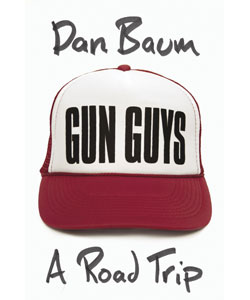
    Gun Guys, by Dan Baum

    I finished reading Gun Guys, and it’s very good.

    Here’s Dan Baum talking about his book on the BBC. And here he a more in-depth interview with Dan Baum on KMO’s C-Realm Podcast (which just happens to have been recorded in my basement). [Update: and here is Baum in the New York Times.]

    Baum makes the point that nothing productive with gun policy unless anti-gun people actually listen to gun guys. And he presents his case from a “liberal Jewish gun-loving” perspective. This book isn’t a defense of the NRA, since the NRA represent but a small minority of gun owners (something like 4 million of 100 million gun owners). But rather an attack on the gut-level reaction so many liberals have against gun, without considering (or worse, mindlessly dismissing) the thoughts, feelings, and needs of hundreds of million of non-criminal gun owners.

    A take-away point is that guns are here, like them or not. We can pass all the pointless laws we want, but if we want a safer and less violent America, we need to have an engaging, serious, and rational conversation about guns. Gun Guys does that. How does it make sense to advocate restricting something when the people advocating such restrictions have no idea what they’re talking about? For instance, if the goal is fewer guns, how does it make sense to push for laws that result in a boom in gun sales?

    I do think Baum places a bit too much of the onus on people who don’t like guns. It doesn’t seem to much to ask for a less violent America. Even an America with fewer guns (not that those two are necessarily related–the past two decades have seen less restrictive gun laws, more guns, and a reduction in violence). But to say something isn’t politically feasible is different than saying something isn’t a good and even noble goal.

    Baum stretches credibility a bit when he makes the analogy that hating gun owners is akin to being racist or anti-semitic. But he’s right in that such mindless hatred is often based in ignorance and fear of people the hater makes no effort to get to know. But what about the mindless and ignorant fear of gun owners who think their guns are going to be taken away or feel an irrational need to protect themselves from some criminal class of people? From my perspective, too much of “gun rights” is linked to “state’s rights” and “protecting a way of life” and fear of some “them” taking over America. Until there is serious discussion about repealing the 2nd Amendment, why such paranoia about an assault on freedom? I mean, I love the 1st Amendment, but I’m not shouting objectionable things in the street to protect my 1st Amendment rights. Why? Because they’re not in jeopardy!

    There’s also the point (not in the book) that guns are not freedom. Guns protect freedom. We should be worried about our freedoms being taken away (warrantless searches, mass incarceration, indefinite detention without due process, Presidential-ordered assassinations of US citizens). Having guns without freedom is, to paraphrase Bill Maher, like being in a titty-bar filled with bouncers but no strippers!

    Regardless, Baum makes the essential point that simply hating guns and people who own them is counterproductive from any anti-gun or anti-violence perspective. Most guns are not the problem. Most gun owners are not the problem. And until gun-control people get that through their thick liberal heads, nothing productive will ever happen. Certainly this book is a great starting point to any rational discussion on guns and gun policy. It’s also a good read.

    At its core (and in its title), Gun Guys is a road trip. Who doesn’t like a road trip? Baum takes the reader on an adventure while he talks to as many gun owners and stops in as many gun shops and gun shows as possible. Entertaining and educational! What more could one ask for?

    Now buy his book and read it. You’ll be happy you did.

  • Crimes and Cameras

    Just one point of data to add to the picture. From the Chicago Sun Times:

    Even with $26 million in high-resolution cameras finally in full force last year, reported crime at CTA rail stations rose 21 percent, a Chicago Sun-Times analysis shows.

    And compared with 2010 — well before most of the CTA’s current 3,600 rail station cameras were installed — station crime was up 32 percent.

  • Bang Bang, My Baby Shot Me Down

    More murders in Chicago. Fewer in NYC. Clearly something is going on. But generally you’ll hear nothing but crickets (or winter winds) blow through the ivory towers. It’s a real shame. These days, most academics will (almost reluctantly) concede that effective policing may play a roll in reducing homicide. And yet still very few academics would dare consider the hypothesis that aggressive — yes sometimes even unpleasant — policing may actually prevent homicides. (And, yes, you can and should be polite and respect the law and state and federal Constitutions at the same time as policing effectively and aggressively. Police work is harder and more dangerous when police go out of the their way to piss off people).

    As some academics may be afraid of digging deeper because they’re afraid of what they’ll uncover. Better to round up the usual suspects of poverty, gangs, racism, drugs, etc. But the NYPD does itself no favors by not giving a damn what people think: “Everything is under control. No need to look here. Keep moving.” But academics and the NYPD need each other. Certainly they do if any lessons are to be learned from the NYPD and applied elsewhere.

    You can’t just “do it like they do in New York” because we don’t know what about what they do in New York works. Is it Compstat? Stop and frisk? Broken Windows? Foot patrol? Zero Tolerance? College-educated police officers? Community policing (whatever that means)? Hot spots (actually, we do know that this works)? Better public housing? Mandatory prison time for illegal gun possession? Decreased incarceration? More immigrants? More eyes on the street? Getting rid of lead? Who knows? But let’s say that one thing the NYPD does pretty well these days in keep homicide numbers low. Well one thing academics do pretty very well is test theories and break things down into parts. There’s a lot going on here. It would be nice to systematically figure out what works. We need to understand these parts so that effective police tactics and strategies can spread to other cities.

    In the meantime, it’s like we’re swinging at a piñata, blindfolded. We took a few swings and feel some contact. But in the end all we see is candy in the floor. So we scoop some up and forget about what we actually did.

  • Good Policing in Chicago

    Well done. I wasn’t expecting things to go so well with the NATO summit. But they did. Kudos to Police Superintendent McCarthyand all the men and women of the Chicago Police Department. Lesson can be learned (particularly by West Coast police departments that don’t seem to be so good at this) and proper preparation is key.

    1) Don’t tolerate minor disturbances. Because they will grow to big disturbances, especially when those disturbances are perpetrated by people intent on chaos and damage. And once you lob the tear gas, you’ve already lost control.

    2) Intel.

    3) Target individuals who are doing things and not the crowd en mass.

    4) Have the top brass out there with the rank-and-file. This seemingly minor point is vitally important. And when a good word about McCarthy comes from the lips of Second City Cop, you know he’s done something right.

  • Guardian Angels Stabbed In Chicago

    I’ve always admired the Guardian Angels. They made me feel safe when in high school and riding the L alone, late at night. A man was being robbed, and they — unarmed — intervened. They got stabbed. From the Sun Times.

    Meanwhile in Chicago, a group of 100 white out-of-towners take a stroll through the Southside.

  • Police layoffs in New Jersey

    What is the relationship between (A) number of cops, (B) number of arrests, and (C) crime. When “A” goes down, “B” goes down, and “C” goes up. Sometimes it really is that simple. Here’s the more nuanced story by James Queally in the Newark Star Ledger.

    [Tip of the cap to Epichorus.]