Tag: incarceration

  • Prison Population Up

    But just a bit, according to Heather C. West at the Bureau of Justice Statistics. At the end of 2009, state and federal correctional authorities had jurisdiction over 1,613,656 prisoners, an increase of 0.2% (3,897 prisoners) from 2008.

    Black men are six times more likely to be incarcerated than white men.

    Non-citizens (not all of whom are illegal) make up 4.1% of the prison population.

    [And congrats to Jim Lynch, my colleague at John Jay College, who just got confirmed by the U.S. Senate as Director of the Bureau of Justice Statistics. He’s a good man and up to the job.]

  • Numbers, please

    I don’t normally go around asking for stats. I’ll take a good anecdote over a slippery statistics any day.

    And yet… I feel like an old operator at times saying, “Number, please.”

    Last night I was writing and had a very simple question: how many US prisoners are in solitary confinement? Seems like a simple and important question since this a free country and solitary confinement has been proven to drive people crazy.

    Get this… we don’t know. How can we not know? I don’t think you have to be a bleeding heart to think we should know how many people are locked up in solitary confinement. Isn’t not knowing a sign of the gulag?

    Then by chance there’s a story in USA Today about solitary. At least from the Illinois figure we can extrapolate to the rest of the nation. So I would guess between 40,000 and 80,000.

    Speaking of numbers, there’s this story in The Wall Street Journalabout, a 54-year-old librarian in Las Cruces, New Mexico, who “spends most mornings sifting reports in the Mexican press to create a tally of drug-cartel-related killings in Ciudad Juárez, Mexico.”

    Why? Because nobody else is keeping track. The paper points out, “There is no official count of the people killed in Mexico’s escalating drug wars—whether the victims are drug traffickers, police or civilians.”

    In Juarez, the tally this year already (it’s June) is over a thousand. “I don’t think there’s a phenomenon like that in the world unless it’s a declared war,” Ms. Molloy said, “Ten years from now, people are going to ask ‘What happened in Juárez?’”

    When I see fancy stats I’m always skeptical (especially when they’re based on data of questionable validity). But a basic count? A simple population figure? Solitary confinement? Murders? People… these are numbers we need!

    [Update: LEAP board member Walter McKay lives in Mexico and keeps track of the numbers. He posts on the LEAP Blog. He also maintains a Google map of the murders.]
  • A billion here and a billion there…

    A study by Daryl Fischer shows that 94 percent of Arizona state inmates are repeat or violent offenders. That “or” is important. “The myth that we’re filling our prisons with first-time drug offenders is not true.” Well sort of. It is generally true (with some notable exceptions) that people don’t do prison time for non-violent drug possession.

    But this hardly supports a lock-em-up mentality, which seems to be the goal of the study: “The state is getting its money worth for every tax dollar it spends on the prison system.” I find that hard to believe. About 2,000 Arizona men and women are in prison for first-time non-violent offenders. And only 52 percent of state inmates have been convicted of violent offenses. That’s nothing to be proud of. Not when the state’s correctional budget is one billiondollars.

  • Fewer State Prisoners

    Barely. And the population of federal prisons grew 3 percent.

    But still… “Fewer State Prisoners” is a headline that hasn’t been seen since 1972.

  • Fewer Prisoners, Less Crime

    While the prison population keeps going up, not many know that in some states it’s going down. Kansas, Michigan, New Jersey, and New York have reduced their prison populations by five to twenty percent since 1999 (without any increases in crime) while the national prison population increased by another twelve percent.

    The Sentencing Project explains.

  • Prisons of Our Own Making

    Crediting prisons and not mentioning police for the crime drop is a bit misguided, but there are still some very good points in Ross Douthat’s New York Times column.

  • Prison for Old People

    Should an 87-year-old go to prison?

    John Eligon and Benjamin Weiser write about this in the New York Times.

    I don’t think so. What good does it serve? Punishment, of course. But aren’t there better and cheaper ways to punish?

    I certainly don’t want to pay to keep people who are no threat to me behind bars. Can’t we fine them for every cent they’re worth and sentence them to home confinement? I don’t want to pay one cent of taxpayer money to incarcerate rich people. Why is prison the only answer?

  • More Prison, Less Crime?

    More Prison, Less Crime?

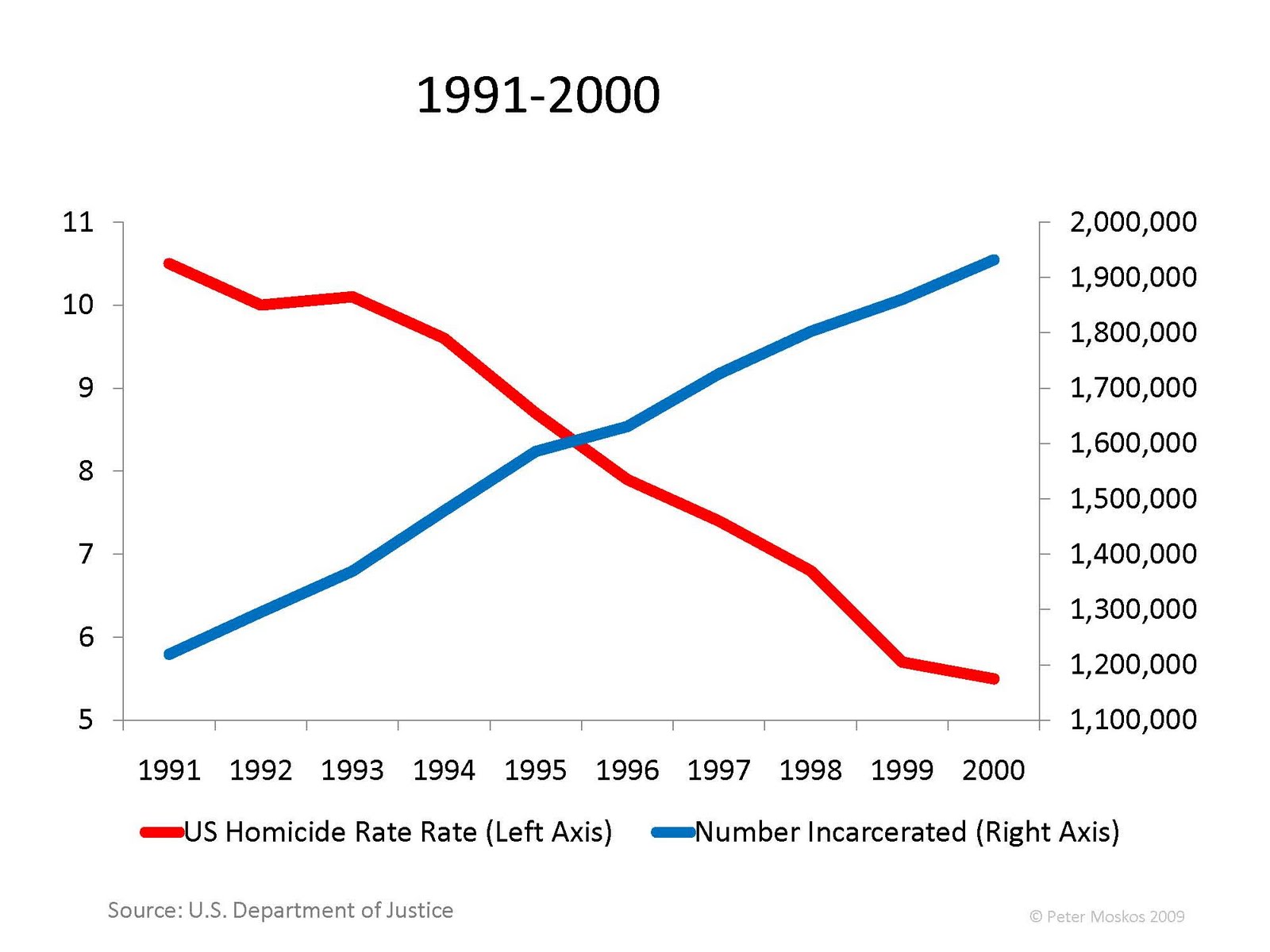
    If you look at this chart, it’s not hard to think that the great crime drop was caused by locking up all the criminals. A student brought this up in class. In the 1990s, it looks pretty convincing:

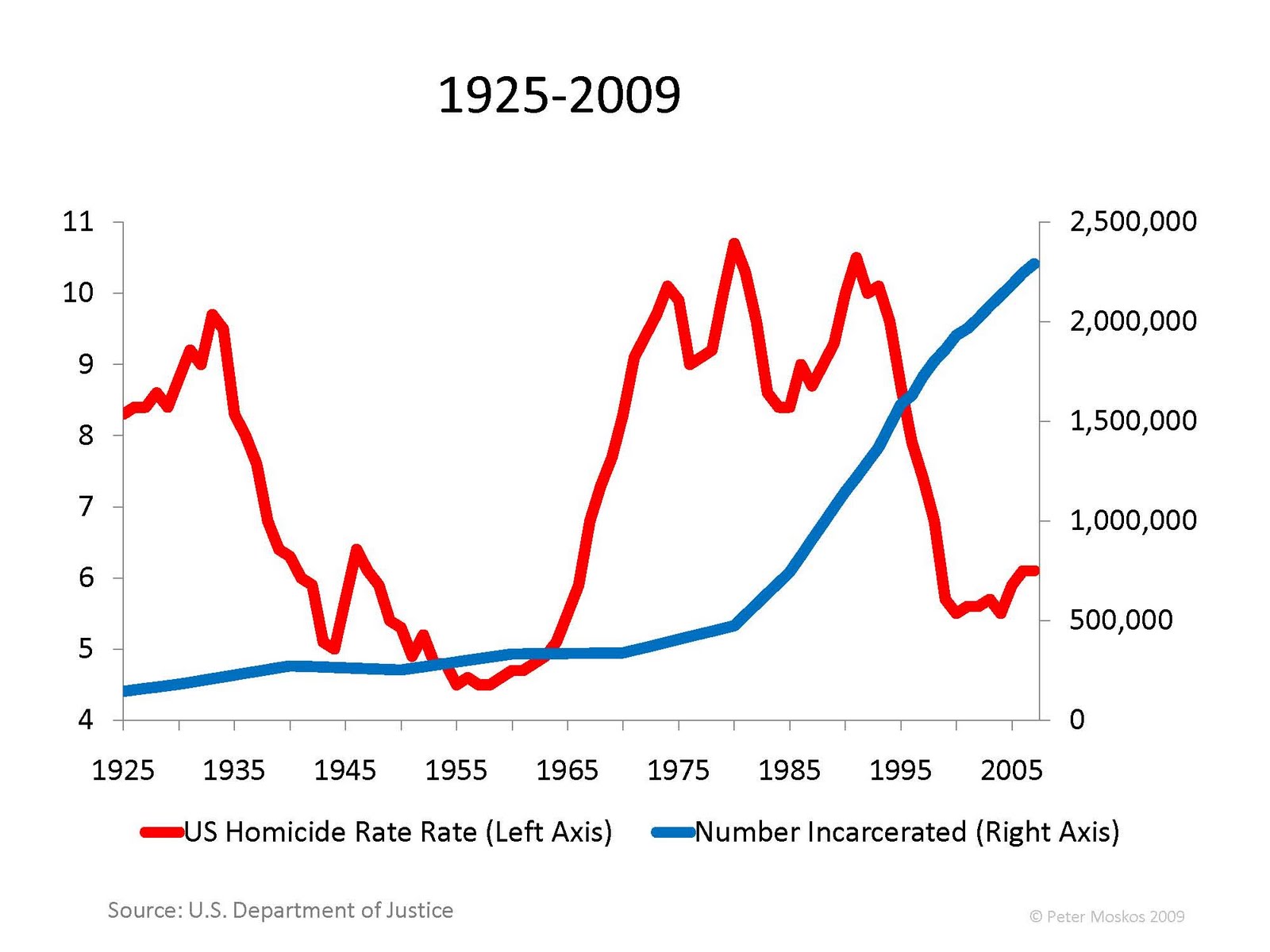
    But just looking at the 1990s misses the big picture. Here’s the same data going back to 1925. Crime went up and down and up and down, but the prison rate stayed more or less the same, and then skyrocketed after 1970.
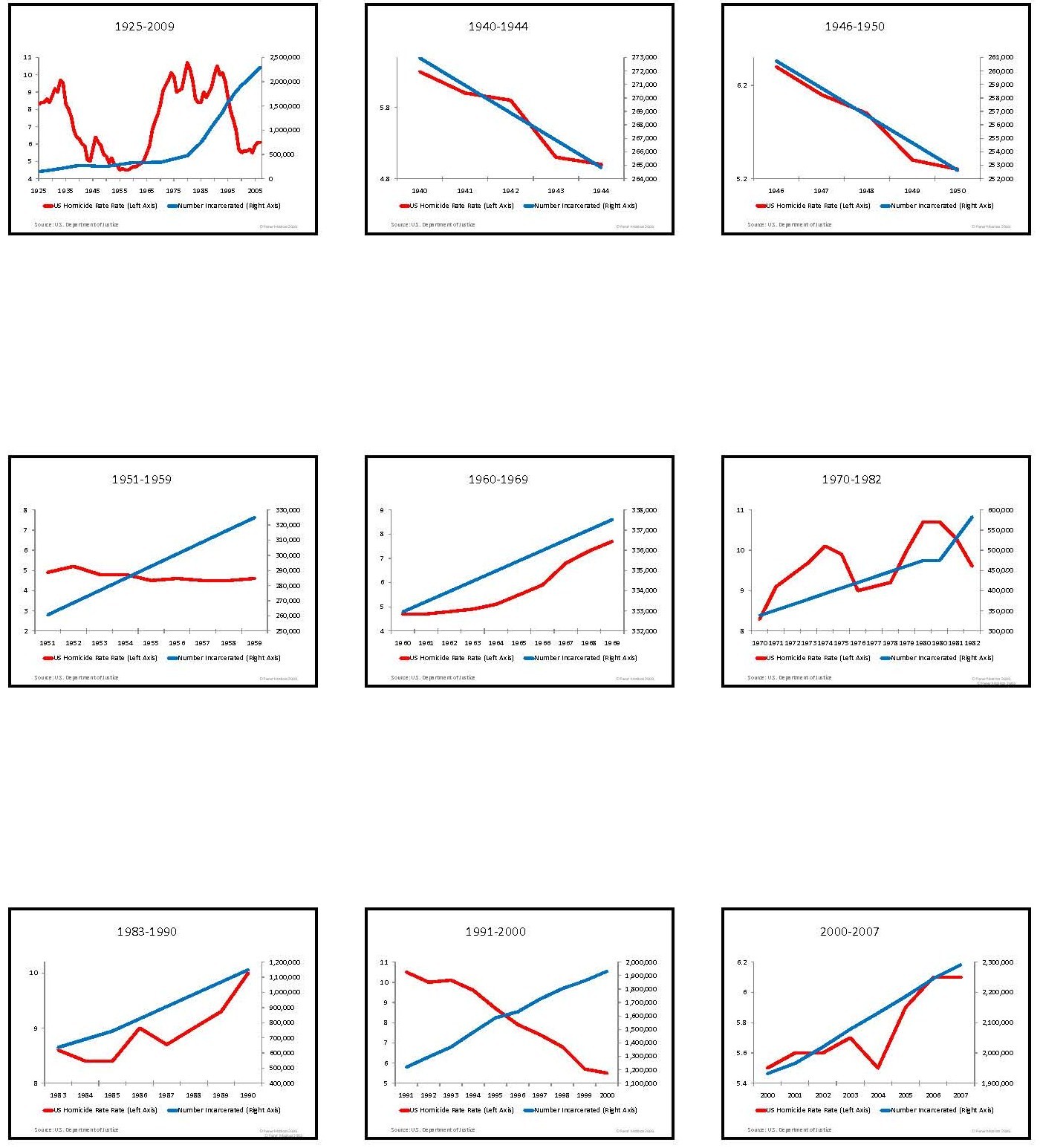
    And here’s what happens it you look at each decade separately:
    What it comes down to is this:

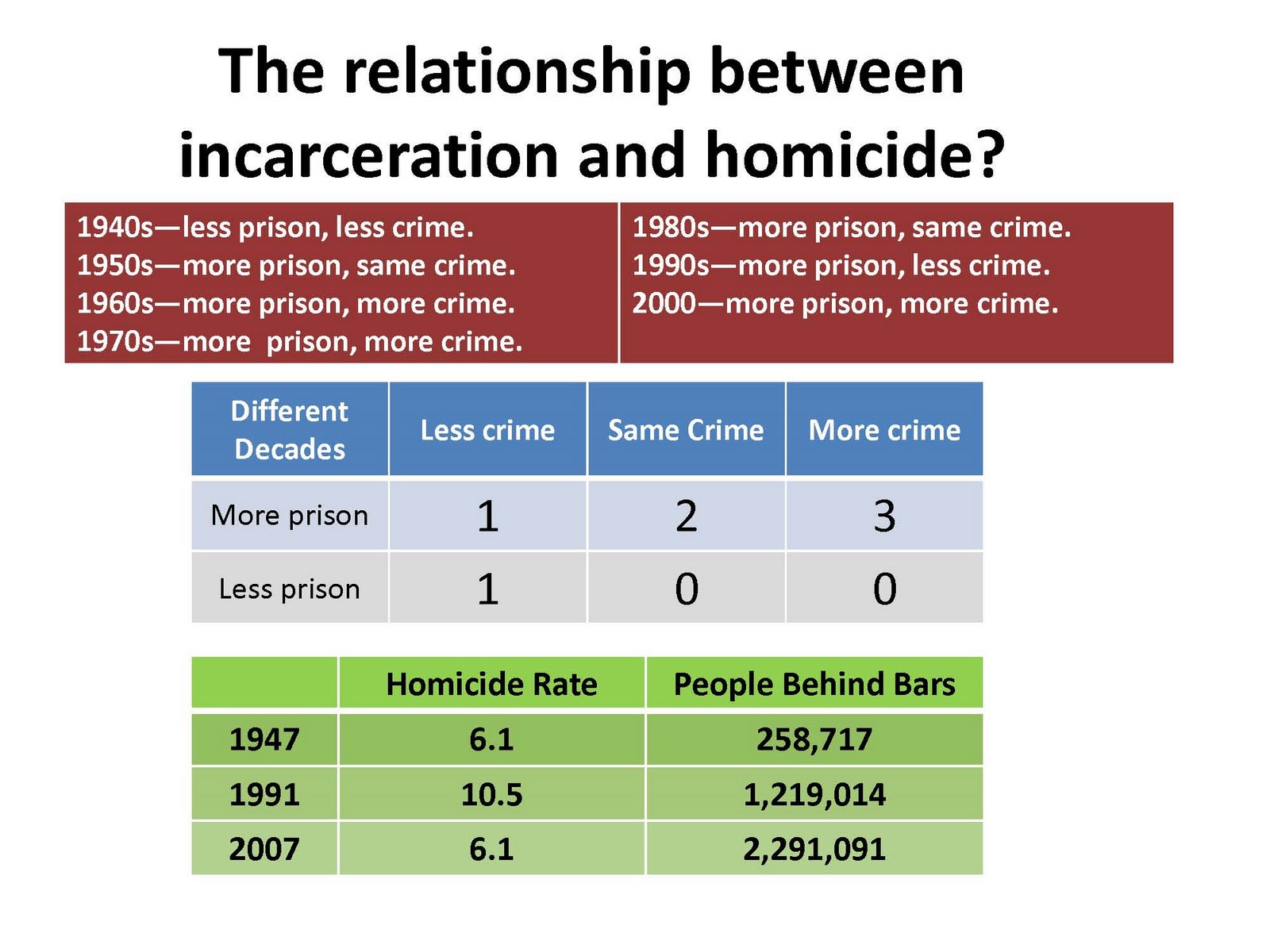
    In three decades we’ve had moreprison and moremurders. In two decades we’ve had more prison and murders were basically unchanged. In one decade we had lessprison and lessmurder. And in just one decade, the 1990s, we’ve had more prison and less murder.

    Between 1947 and 1991, the prison population increased almost 500 percent. Meanwhile the homicide rate went up by more than a third. Did locking up more people increase the homicide rate? Probably not.

    So what makes the 1990s the decade of choice that proves incarceration is the solution to crime? Was there some magic tipping point? Was there something special about the second million we incarcerated that didn’t apply to the first million? Probably not.

    I’ll put it another way, in 1947, the homicide rate was 6.1 per 100,000 and we had 259,000 people behind bars. In 2007, we had the same murder rate of 6.1 and yet 2.3 million people are behind bars. What good have we gotten from locking up an extra two million people, spending something like $50 billion per year for the privilege?

    You think there might be a better way?

  • A story of no story

    The other night I had a minor but perhaps brilliant idea. What if there were a correlation between the numberof prisons in a state and that state’s incarceration rate? Perhaps the more prisons there are, the greater the political influences that play in a state, leading to more people locked up! Prison-Industrial-Complex shit I’m talking about!

    Of course, biggerstates would have more prisons, but that’s the beauty of stats: they can take population into account and just compare the number of prisons with a state’s incarceration, holding population constant.

    So I found and put every state’s incarceration rate into an SPSS file. Then I added the state’s population. Finally I used wiki to get a decent number for the number prison institutions in each and every state.

    Then a crunched the numbers and found… uh, there’s no correlation. So I tortured the data a bit (maybe it only works for the highest and lowest levels of incarceration!). No dice. No brilliant idea. No publishable paper. Just a waste of a few hours that would have better been spent writing.

    Oh well.

  • Cost of Incarceration: NYC

    In 2008, New York’s Department of Correction’s budget was $978 million ($939 million of which is paid for city tax dollars). “In Fiscal 2007, the Department handled over 100,000 admissions, managed an average daily population of 13,987 and transported 326,735 individuals to court.” The average length of stay is 47 days.

    That’s $70,000 per inmate per year. Or $190 per person per night. I think it’s safe to say that Rikers Island is the world’s most expensive jail.

    You could say that Rikers gives you and a friend a double room for $383 night. But you don’t get to pick your friend. Meanwhile I can get a double room tonight at the Holiday Inn on 57th Street in Manhattan for $268. But the Holiday Inn doesn’t have the coveted LaGuardia view.

    You can see the DOC budget here.