Tag: police culture

  • Court Attire

    Yet another from Plantinga’s 400 Things Cops Know: Street-Smart Lessons from a Veteran Patrolman. My friend Dan gave me aline about people showing up for court “in their best sweatpants.” That always stuck with me.

    Many defendants dress casually, even for felony trials. The collared shirt is a rarity. Most wear what they might don to watch Saturday morning cartoons, like a shirt that says Lucky Charms or flip-flops and shorts. Or an oversized football jersey and their good jeans, the ones with the embroidered dragon on the rear pockets. Defendants will show up for trial on a marijuana sales case wearing a shirt with a marijuana leaf design, not on a dare, or as some kind of political statement, but because they’re so oblivious that they put the shirt on and don’t think anything of it. My partner Steve recently told me of watching a defendant stand before the judge during sentencing wearing the latest urban T-shirt that said No Remorse in bold script, a choice of apparel that probably made the man’s defense attorney, at the very least, loosen his tie.

  • On Youth

    More from Plantinga’s 400 Things Cops Know: Street-Smart Lessons from a Veteran Patrolman.

    Cynicism in law enforcement is wide-spread and to some degree, self-perpetuating. But sometimes you strive for optimism. You try to picture many of the juvenile criminals you deal with years later, as adults, having turned it around. One day you’d run into them and they’d be healthy and gainfully employed. They’d remember you and you’d remember them and you both would look back at that day in question and shake your heads knowingly at the folly of youth.

    You snap back to reality as you book the 13-year-old auto thief. There is food stuck in his hair and he smells bad. He lives with his grandma because he doesn’t know his father and his mother is in prison for the next decade. When you’re filling out your arrest paperwork and ask him how to spell his middle name, he takes a stab at it before admitting he’s not sure. You stare at him, trying to penetrate his thoughts, to mentally peel open his brain to see what’s going on in there. To see if he’s going to make it. And you don’t know. What you do know is that, for better or worse, he’s the future.

    And the future has to start somewhere.

  • Use of Force

    I’m out of the country for a week. So here’s another bit of insight (the 11th) from Adam Plantinga’s most excellent 400 Things Cops Know: Street-Smart Lessons from a Veteran Patrolman.

    The general public doesn’t always understand use of force dynamics in police work. Maybe it’s unreasonable to expect them to. Police departments do what they can to explain them, either through media channels or during periodic citizen police academies. But deep misunderstandings continue to drive a wedge between the cops and the public.

    Now, the public and media provide police oversight. That’s fine, because cops carry guns, drive large cars very fast down busy streets, and take away people’s liberty; you should have oversight. You also understand how people can criticize cops and their tactics without fully comprehending them much in the way you might heap verbal abuse on your favorite NFL team’s offense without ever having played a down of organized football. But it would be nice if the public and media sometimes gave you the benefit of the doubt. While media coverage of police brutality is commonplace, you rarely watch a news story about how officers took a violent suspect into custody using the minimum amount of force necessary even though it happens every day because, after all, what’s interesting about that?

    That being said, you will see cops who have a knack for escalating even the most benign encounter into a fist fight. Maybe they got cut from the high school football team twenty years ago and they’re still looking for payback. Or maybe they’re young and unproven and think that if they are quick to shove some people around, they won’t be perceived as weak. Whatever the case, they seem to want not just to arrest suspects but to teach them a lesson, failing to realize that there isn’t much honor in kicking a guy when he’s already under control. But these officers are in the minority, which is good, because roughing up suspects unnecessarily isn’t just wrong, it’s bad business. You can lose your job, be charged criminally, and become embroiled in a federal civil rights lawsuit. As police, you have to be better than that. And most of the time you are, respecting the law even if the criminals don’t. In the words of one Milwaukee police deputy inspector, “You have to guarantee someone his constitutional rights no matter how much of a puke he is.”

  • “It’s hard to keep caring”

    A good police perspectivefrom Lt Danie Furseth. I think his points are good… but I seriously doubt this is some contemporary perspective that wouldn’t have been valid 10, 20, 50, or 150 years ago.

    And, since I can’t say it better myself, I will quote my friend and colleague John DeCarlo:

    I have tried to share articles which describe the liberal, conservative and scholarly points of view about the current state of policing in America. Here is a piece written by a working police officer. I think it’s important to be aware of and understand this important perspective.

  • Free Doug Williams!

    The Feds are really out to get the man who tells the truth about lie detector tests, that they’re bullshit. They’ve been out to get him for a while, as I’ve previously written.

    Here’s the thing, Willam’s may or may not be guilty as charged. Honestly, he probably is. From the Journal:

    Prosecutors alleged that Mr. Williams “trained an individual posing as a federal law enforcement officer to lie and conceal involvement in criminal activity from an internal agency investigation.” He’s also accused of training another person “posing as an applicant seeking federal employment” to trick a pre-employment polygraph examination.” The Justice Department says the two individuals paid Mr. Williams for the services and were instructed by him to deny having receiving his training.

    But that is beside the point. Williams is clearly somebody the feds want to get because he is telling the truth about a messed up system. So William’s message needs to be told, and told loudly: the polygraph test is bullshit!

    It wouldn’t matter so much if the agencies that gave this test didn’t put credence in them. Yes, you can lie and pass. More troublesome is that you can tell the truth and fail. This is why such tests are not allowed in court. They are also not allowed as a condition of employment…. except by the government. Let me say this loudly: IT DOES NOT MATTER IF YOU ARE TELLING THE TRUTH. I know too many sad stories of people, students of mine, whose life dreams were shattered because they believed in the system, told the truth, and failed the test. These false positives prevented good people from getting good jobs they would be good at. The system suffers when hiring is dependent on a bad test.

    If you need to take the polygraph test, absolutely buy and read Doug William’s How to Sting the Polygraph.

  • Strike against cop cameras

    When I was cop, boy did I joke about things I wouldn’t want seen on youtube.

    It might be a tad overgenerous to say what I said were even jokes. But I laughed. I still do. When I get a message on my answering machine that says, “Pete, will you stop touching little boys and pick up the phone!” I know who it’s from. And I’m pretty sure my wife knows I’m not a pedophile. But can references to raping innocent children ever be funny? Well, I think so. And you are free to think less of me, but what I and my friends say in private really is none of your business. Besides, does anybody not say things in private that would be inappropriate in the public sphere?

    So two cops in Austin are recorded on a tape made public, while in their squad car, making tasteless comments about rape (and a few other things). Now that this video is public, you need to react accordingly. But you also need to keep things in perspective. Is what these officers said serious? No. Threatening? No. Did it affect their job performance. I doubt it. And truth be told, this is positively mild compared to things I have said. Let me confess that I too have made tasteless jokes, in private, about sex, race, crime victims, ethnic origin, religion, sexual orientation, and quite frankly every other possible taboo subject I could think of.

    Now cops, more than most people, have a obligation to refrain from bad taste in public, and especially when dealing with the public. But that’s not what happened here. When you’re riding in a car with somebody for eight hours, you get bored. You talk about a lot of things. You joke. You make tasteless jokes. Of course it depends on whom you’re riding with and the camaraderie and relationship you have with your fellow officers. Yes, I can be crude and insensitive in private and caring, compassionate, and professional in public.

    Some of this is gallows humor. And police (and paramedics and firefighters) need it because they have to deal with a lot of unpleasant stuff. But you also need to joke to bring up subjects that would be otherwise be taboo. And police joke because a lot of people you deal with — the vast majority — lie to you. Some lie to you about robbery. Some lie to you about rape. Some lie because they think it will benefit them, they want revenge, or power. Some lie because they can’t tell or don’t know the truth. And cops have to listen to all of them. So back in the car you make jokes.

    A lot of police humor is at the expense of “victims” because a lot (most?) victims aren’t actually “innocent victim.” Now in the current climate of political correctness (especially with regards to sexual assault and rape), it’s not acceptable to even bring up the phrase “innocent victims” because the alternative places some blame on the victim. But police need to make such judgements because the freedom of other people, sometimes innocent victims themselves, is at stake.

    Outside of crimes where the victim isn’t doing anything illegal and doesn’t know the person who committed the crime, there are a million shades of gray. And police need to talk about these shades. And one way to discuss nuances is by joking and making tasteless comments. In private, there’s nothing wrong with that. It’s how you learn. It’s how you cope. On the street cops need professionalism and discretion. In private, police use humor, and sometimes it’s not funny.

    Take two different rape cases. One was a nurse walking to work at Hopkins Hospital who was grabbed and raped by a stranger at knife-point. The other was a prostitute who engages in consensual sex but wasn’t paid the agreed amount. When the former happened, it was all hand on deck. A few days later the guy was caught. But for “failure to pay”? I once helped a supposed rape victim by doing little more than retriving her three jackets. It was cold outside.

    Or take a guy robbed while buying drugs. There were “real” robbery victims. You would know that when you saw a guy running barefoot wearing nothing but his tighty-whities. Now that was a robbery. And we would treat it accordingly. (Mind you, it still wasn’t “an innocent victim,” because he was still there to buy drugs… but the robbery was real.)

    But more than once I got a call for a robbery at the corner of Wolfe and Eager (then a 24/7 drug corner). On scene, the “victim,” a poor addicted white guy, would say he was minding his own business, jumped, and robbed of $20. Well, officer, what do you do?

    Generally people minding their own business don’t like being being taken for a drug dealer by some junkie too cheap to buy drugs in his own neighborhood. So this “victim” asks the first young black male he sees if he’s selling. The pissed-off non-drug dealer says, “sure” and takes his order, his $20, and continues on his merry way. The “victim” calls the police.

    I would try to keep a somewhat open mind on the off chance the “victim” was actually telling the truth. But do I start canvassing the neighborhood, stopping people who “meet the description.” Of course not. So I would conduct a brief investigation, perhaps by asking an old timer if he saw anything unusual, like an armed robbery (something beyond the usual chaos of an open-air drug market). If he nodded “no” with a look of, “you know how that white boy had it coming,” case closed. Call unfounded. Adam-No.

    And then, back in a parking lot, I would meet with a squademate and crack jokes. The guy running in his tighty-whities? “He was fast.” “Or slow.” “He had it coming… did you see what he was wearing?” “Exercise is important.” “I saw you looking at his package.”

    We would joke about anything. We needed to joke about everything. We didn’t joke because we didn’t care. We joked to stay sane. We joked to relieve the boredom. We joked to counter the cruelties of a very harsh and random world. We joked because the only real alternative would be despair. If you care too much — if you breakdown in a situation where any normal person would be unable to do anything but curl up in a fetal position and cry — you’re not a real police officer. We joked because laughing is good for the soul.

    So in this video one officer is telling another how to properly fill out a robbery report. And they they segue to insensitive comments about that robbery and then about about rape. They joke about fighting crime. They joke about ignoring crime. It was said in private, to each other. So I have no problem with it. Police should have a reasonable expectation to privacy when in private, even while on the job. And short of conspiring to commit a crime, there’s very little that should be off limits.

    Here are people who disagree with me. From Buzzfeed, the Huffington Post, and you can google a dozen others. And this news broadcastgives some good context.

    The lesson I see: police need to be more careful about the record button. And I still believe that cameras will be a net plus for police.
  • The Felony Rush

    The tenth and perhaps last in a series from Sgt. Adam Plantinga’s excellent 400 Things Cops Know: Street-Smart Lessons from a Veteran Patrolman:

    Once the fleeing vehicle has finally come to a halt, your training dictates that you then conduct a high risk stop. You park your squad car in a position of tactical advantage and order the occupants out in a systematic, cautious fashion. But cops being cops, that’s not often how it goes. Instead of the high risk stop, you get the felony rush. Or the blue swarm, or the polyester pile, all different terms to describe cops, guns drawn, who run directly at the target car, sometimes in each other’s crossfire, sometimes jumping up on the hood of the fleeing vehicle, in order to yank the occupants out through any available open window, their adrenaline so high they can’t wait, like a kid tearing open her Christmas presents on December 24th. These same cops have the tendency to fade away once the excitement is over, and only the lengthy police reports loom. Everyone likes to go to the party but no one wants to clean up.

    I might to do a few more of these. But then that’s it. There are still 390 left in the book, and I’m not going to go through all of them. So buy the damn book!

  • Paperwork

    The ninth in a series from Sgt. Adam Plantinga’s excellent 400 Things Cops Know: Street-Smart Lessons from a Veteran Patrolman:

    Most critical incidents you’re involved in take anywhere from a few seconds to a few minutes to resolve themselves. The paperwork that follows takes hours. You’ve got the incident report, the clearance report, the inventory forms, the DA sheets, the arrest report, the prisoner statement, and supplemental reports for all witness interviews. Then the reports are signed by the lieutenant, copied, stapled and routed. But not all reports are copied in the same quantities or colors. The liaison office receives an extra clearance report. The incident report requires a pink copy that stays at the district and the clearance report, which was originally green, needs white copies that are sent to the DA with the green original routed to Central Records. The arrest report needs six copies, one for the booker, one for the captain, three for the county jail, and two for the DA. Some copies are one-sided. Some are two. Some are collated. Some are stamped. You stare at the Xerox machine dully and try to remember these clerical vagaries while at the same time thinking about how Baretta never had to do any of this crap.

  • Why Hassaum McFarlan Matters (or what liberals don’t understand)

    Why Hassaum McFarlan Matters (or what liberals don’t understand)

    Imagine you’re a New York City Police Officer. You take pride in your job and serving the city. You work hard. You play by the rules. You also feel you don’t get enough respect for what you do. And that disrespect comes right from the top.

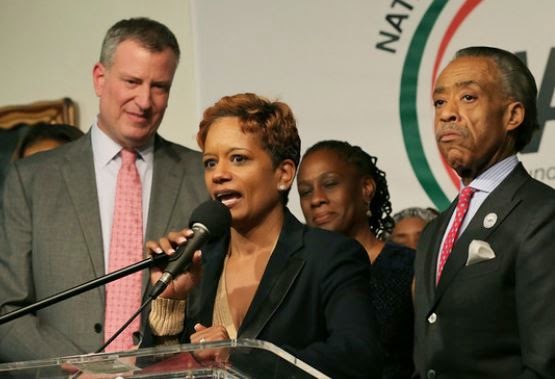
    De Blasio gets elected mayor. You believe, perhaps correctly, that the mayor neither understands nor appreciates what you do. Suddenly police bugaboo Al Sharpton becomes a trusted aide. Whatever you think of the reality of Sharpton, the symbolism of giving him a major say in police policy is painful to most police officers. The New York Timessays: “Mr. Sharpton… is now a highly influential figure at City Hall.”

    Anyway, you do like your job. You love the people you work with. But anti-police liberals — those who have no understanding of your job and seem to criticize everything you do or don’t do — piss you off.

    If you’re a cop, you’re not getting rich. You get by on $45,000 to $70,000 (perhaps $10,000 more with overtime). NYPD Captains (a rank above sergeant and lieutenant) make less than Noerdlinger. Captains can have hundreds of disgruntled officers and 100,000 concerned citizens to manage and keep satisfied. And these are people you can neither fire nor deport. On top of that, you’ve also got the top brass breathing down your neck, busting your chops at compstat. The chief of patrol makes about $200,000, I think (correct me if I’m wrong). For what it’s worth, my salary as an associate professor (10 years on the job) is about $85,000.

    And do keep in mind this is a city where apartments rent for $2,000 to $3,000 and the average (median) home sells for over $1,000,000. It’s not a cheap place to live. But this really isn’t mostly about money. It’s about job professionalism and integrity. It’s about messages from the top.

    The mayor hires Rachel Noerdlinger to serve as chief of staff to his wife, Chirlane McCray. You even noticed that one because Noerdlinger was formerly Sharpton’s spokesperson. But it became news recently when Noerdlinger became the story became of her boyfriend .

    Noerdlinger lives in Jersey (she got a waiver for that). Noerdlinger also gets paid $170,000. That would pay for two college professor, two police officers, or 1.5 sanitation workers (you can pick whichever you think is most needed).

    Here’s the first part of the problem. Noerdlinger’s live-in boyfriend, Hassaun McFarlan, was convicted of manslaughter as a teenager and does not like cops, to put it mildly. He also doesn’t seem to speak well of women, either. From the Times: “The mayor has defended Ms. Noerdlinger, saying she should not be judged by the behavior of a companion.” OK. Fair enough. Maybe we shouldn’t judge. But sometimes you need to: “two of McFarlan’s five arrests on charges ranging from driving on a suspended license to drug trafficking took place while he was dating Rachel Noerdlinger.”

    Let’s get real. This isn’t a civil service or union job. This isn’t a question of free speech. This is a question of bad judgement by a woman in a powerful discretionary patronage job. Standards should be higher, not lower. Messages from the top do matter. What if McFarlan wrote about Jews like he wrote about cops? What if McFarlan stereotyped women like he actually did stereotype, er, women? (Actually, that he’s getting a pass on that is kind of surprising). If it were almost anybody but cops complaining, Noerdlinger would be out. There were be platitudes about the tapestry of New York City. You’d hear about there being no place for hate in this beautiful diverse city. Now you may have no problem with all this being considered no big deal by the administration, but please understand why cops do.

    I would argue that a trusted aide should be trusted to have, if nothing else, good judgement, it’s not just a question of what her boyfriend said or said. It’s also that Noerdlinger herself didn’t mention her living arrangement, as required in the hiring process:

    She had failed to disclose on a background questionnaire that she lived with a boyfriend, Hassaun McFarlan, who had an extensive criminal record. False or misleading statements on such a form can result in termination or prosecution.

    …Still, it remained unclear why Ms. Noerdlinger had chosen to inform the mayor’s aides of her living arrangement, but not officials at the city’s Department of Investigation, which conducts formal reviews of high-ranking City Hall appointees.

    But apparently the administration sees no problem here Nordlinger didn’t “intend to deceive” the mayor about her domestic status. Or do honesty and ethical inquiries not apply at the top (is that a silly question to even ask)? You can be damned sure a cop in controversy would be thrown under a bus for such a violation. And perhaps rightfully so.

    Patrick Lynch, PBA president, quite rightly said:

    The standards that apply to hiring police officers should apply equally to hiring high ranking, influential staff members. If it is found that she committed a lie of omission during the investigation, then she should be fired.

    If you want to read more, you could read this and this.

  • Everywhere signs

    The eighth in a series from Sgt. Adam Plantinga’s excellent 400 Things Cops Know: Street-Smart Lessons from a Veteran Patrolman:

    Police stations are papered in signs. Some offer guidance, like the one that says: In the absence of detailed instruction, please do the right thing. Others suggest a certain approach to life like the large No Sniveling placard. There are signs for district BBQs. Someone always seems to be selling a gun or a boat. Cops advertise their side jobs out to other cops—services in home remodeling, mortgage services, and party planning. The police assembly bears a large communicable disease chart to remind you what’s out there, a chart which includes tuberculosis and antibiotic-resistant staph infections as well as more exotic maladies, like Lyme Disease, pinworms, and whooping cough. The chart kindly reminds you that Hepatitis can last up to seven days outside the body. There are so many contagious diseases that can be passed from prisoner to officer that it makes you wonder why anyone in law enforcement bothers to come into work at all.

    My favorite sign, as I’ve said before, was the one that said: “Unlike the citizens of the Eastern District, you are required to work for your government check.”