“He listens to scanners and races to locations where police are called, a source told the New York Post.”
Tag: police culture
-
The Art of Report Writing
Cops hate paperwork. Hell, everybody hates paperwork. But policing has more of it on a day-to-day basis than most occupations. And there’s an art to writing a good police report. I like to think my writing skills made me a better police officer. And it’s why as a professor I stress the importance of writing style and basic grammar.
Most police reports are basically form letters and require little or no thought or creativity: “At such and such day and time I responded to so and so location and was met by the suspect, later identified as whomever. Further investigation revealed blah-de-blah. Suspected taken into custody without incident and transported to CBIF.”
But life without personality is no fun. Take this DOA (who wasn’t, technically, deadon arrival. But it’s a pretty standard report for such an incident. Terse, to the point, and as short as possible while included all (and only) necessary details (I’ve changed names and the address):
On 19 APR 01 at 0705 hrs responded to 1581 E Lafayette for an overdose. Upon arrival Mr Jackson was being carried to an ambo, medic 10, in full cardiac arrest. Mr Jackson was brought to Hopkins and treated by Dr. Arjun Chanmugam before being pronounced dead at 0737 hrs.
Mr Jackson given medication at 1845hrs on 18 APR 01 by Ms. Ethel White.
Mr Jackson was last seen in good health by Mr Henry David at 0200 hrs. At 0700 hrs Mr David saw Mr Jackson with “his eyes rolled up” and called for a paramedic. Mr Jackson was asleep in upstairs middle bedroom. No paraphernalia was seen.
Mr Jackson on the following medication: Roxicodone, Prednisone, and Valtrax.
Hearn at M.E. notified and accepted body for autopsy. Patton #6481 at homicide notified.
That’s that. RIP, Mr. Jackson. Why did I notify homicide? He probably wasn’t murdered, but you never know; that’s not my call to make.
But what strikes me is my completely superfluous inclusion of the quote, “his eyes rolled up.” It adds nothing but is a great reason to call for an ambulance! I tried to include a good quote whenever I could–especially if the quote included naughty words, which were otherwise taboo. If “fuck you Mike bitch” was going to be keyed in a car, you could be sure it would be transcribed verbatim in my report.
When I wrote of a man throttling a woman on the ground, later I referred to this, “vehement emotional display.” In return I received this joking note: “Officer Moskos, Please stop using big words in your reports. I have a hard time understanding all of them. Thanks, OIC Woollen.” But the report was accepted.
Once I chased a suspect from an alley. He was easy to catch because his pants fell down as he was trying to get away. I described him as fleeing “in a rather ungraceful manner.” It wasn’t relevant, but why not? Why pass up a chance to make my sergeant roll his eyes or let some ASA in the bowels of CBIF smile for a moment. You gotta have fun.
But, more seriously, a well-written report can be and often is the difference between a case being dropped and the successive conviction of a dangerous criminal. If you don’t write it down, it’s like it didn’t happen. And there’s always room for a good writer’s eye. My favorite quote served such a purpose: “Squeaky beat me with a two by four, and then they came at me like locusts and beat me down.”
“They came at me like locusts and beat me down”?
Such Biblically-inspired language deserves to be inscribed. And since it added flavor to an otherwise dry description of a old man getting beat down, it helped in conviction. I wastrying to paint a story and help convict the guilty–all the while sticking to the objective tone police reports require.
Other times the night was slow and I was simply bored.
Once, on foot, I ran across a guy with a needle sticking out of his arm. He was homeless and bloody. He needed help, but none I could give him. Still, I had a job to do. I put on my latex gloves and slowly arrested him. Yuck. He was riding high. (Luckily CBIF took him.) Later I wrote in my Statement of Probable Cause:
After getting a delicious hot cup of coffee, I … could not help but notice a man, later identified as Mr. Guizotti, with a needle in his arm. Mr. Guizotti stated that he was a heroin addict and that the substance he injected himself with was, “good shit.”
All this comes to mind because Ellen Collett, who reviews police reports for the L.A.P.D., writes this fine piece in the Utne Reader, “The Art of the Police Report.” If you’re more into writing, I recommend reading the original version that appeared in The Writer’s Chronicle (but if words like “subtextual” and “syntactically” scare you, stick with the first link):
Monday through Friday, I’m enthralled by a man I’ve never met. His name is Martinez and he’s a cop with the Los Angeles Police Department.
…
Crime reports are written in neutral diction, and in the dispassionate uni-voice that’s testament to the academy’s ability to standardize writing. They feel generated rather than authored, the work of a single law enforcement consciousness rather than a specific human being.So how can I identify Martinez from a single sentence? Why do his reports make me feel pity, terror, or despair? Make me want to put a bullet in someone’s brain—preferably a wife beater’s or a pedophile’s, but occasionally my own? How does he use words on paper to hammer at my heart? Like all great cops, Sergeant Martinez is a sneaky fucker. He’s also a master of inflection and narrative voice.
…
That poster-child for cop writing, Ernest Hemingway, once observed, “Prose is architecture, not interior decoration.” A good incident report also gives us the necessary shape of the thing, but spares us the cluttering details.
…
Choose strong verbs. Beware of modifiers. Shun figurative language. Be leery of parentheticals. Avoid abstractions. Eliminate superfluous ornamentation. Omit needless words. Be concrete. Show what happened; don’t explain what it means.There was a sign in the police academy: “We’re not just report takers. We’re the police.” There is more to writing a good report than just getting down the facts. For most incidents, the responding officer isthe investigation. Nobody will even be as close to some form of objective truth. Yes, reports need to maintain a objective tone. But if there’s a guilty SOB, it’s got to be clear in the written report. You only have one chance. The report is true, but certain facts may be selectively left out if these details distract from some greater truth. For instance, in a case of child abuse where the wasfood in the kitchen, you probably wouldn’t mention that in the report (other times, less nobly, facts may be left out simply to avoid more paperwork).
Collett’s advice is good for writers and good for police officers. And allpolice officers, like it or not, are writers of stories: “Like Martinez, a good story always has an agenda. Like Martinez, a good story is a sneaky fucker.”
-
Seattle Police Union to Cops: Lay Low
Seattle Timescolumnist Danny Westneat has a worrisome article in the paper:
“You are paid to use your discretion and there are many ways to do police work. Recent events should show us that many in the city really don’t want aggressive officers who generate on-view incidents. They want officers who avoid controversy and simply respond when summoned by 911.”
…
What the union head is suggesting here is that the scrutiny of police is so severe right now, and so lopsided, that cops should mostly just respond, not initiate.
“If there’s borderline criminal or suspicious activity, I say let it go,” O’Neill said when I asked him to elaborate. “Don’t go out on a limb. It’s not worth it.”
…
Won’t crime go up?
“That might be a consequence,” O’Neill said. “But the leaders of this city need to decide how they want it around here.”
Like I said: Uh-oh.
[thanks to Sgt T]
-
Username and Password, please
I got this over the transom:
A police “accreditation manager” (whatever that means) is revising his “social networking policy” so that potential applicants, as part of their background investigation, must sign an affidavit listing any social networking sites (Facebook, Myspace, Twitter, LinkedIn) they belong to and give their passwords to these sites so the department can snoop.
Is this becoming standard? Do we approve? I’m pretty sure I don’t approve.
-
Police Officers and Free Speech
Deputy Probation Officer Joe Miller signed a letter in support of California’s Proposition 19 (marijuana legalization). A disclaimer made it clear that he did not represent the viewpoint of the Mohave County Probation Department.
Officer Miller was fired. Maybe you think a police officer should never have an opinion on anything. I can understand saying a police officer should not advocate breaking the law. But that is something else. All people, police included, should be able to express their personal opinion about public referendums without fear of retribution.
One can only wonder… actually, no: one doesn’t have to wonder at all. Nothing would would have happened to Officer Miller if he had signed a letter in support of less restrictive gun laws. Or even gay marriage, pro or con. But he thinks drugs laws should be (gasp) changed.
Whether or not you agree with Miller’s (or my) position, stand up for workers’ rights and free speech. Sign a petition in his support.
So what it is with drugs? Yes, drug use is a crime. But it’s justa crime. There are lots of crimes. Why is law enforcement so obsessed with drugs? I didn’t get it before I was a cop; I didn’t get it when I was cop; and, Heavens to Betsy, I still don’t get it!
-
“If police have to come and get you…”
“…they’re bringing an ass-kicking with them.” — Chris Rock
Here’s videoof Houston police beating a 15-year-old burglar. He was convictedback in October. But the video of the arrest was just now released.
Did he “deserve it”? I’m not going to go there. But police should take note: seven officers no longer have jobs. And for what? To give some 15-year-old a lesson? It’s not worth it.
-
1871: Two classes of police officer
This is from an 1871 newspaper article. It seems as if times never change.
The average police officer may be divided into two classes, the honest and untiring patrolman, constantly on post when duty calls, alert in performing his rounds, and courageous when confronted by sudden peril or danger, and the one who shirks his duty and skulks at every opportunity. To walk the deserted streets of a great city at the dead hour of the night, requires more courage than the policeman usually gets credit for. He must keep a sharp lookout for suspicious persons, test the fastening of every door on his route, listen for unusual noises in the houses, alleys, or yards, be ready to detect fires at the earliest possible moment, and render assistance on occasions where the lives or persons of individual are in peril.
The lazy or inefficient policeman is a most deplorable follow. He is always grumbling, now at one thing, now at another. Nothing suits him. If it rains, he is out of temper because he cannot find convenient shelters under awnings. Should it be a fine night, he is dissatisfied because there are so many people out. In warm weather he is too hot to do duty, and in Winter he finds it too cold. You always hear that his captain or the sergeants are hard upon him, and object to his loitering on post or unaccountably disappearing occasionally when in the vicinity of a dram-shop. Averse to honest labor of any kind, the lazy policeman endeavors to cheat his superiors in evading his duties, and invariably finds himself detected and dismissed. From that time forth he predicts the seedy downfall of the system, and secretly wonders how so many men continue to remain in service so long.
-
Lakewood Coffee-Shop Ambush
The good people at policeone.com have posted a, in-depth video about last year’s Lakewood Four coffee-shop ambush. The video tells the story from the perspective of the responding officers.
[I’m on vacation; life is good. While I’m gone, I’ve pre-scheduled a few posts.]
-
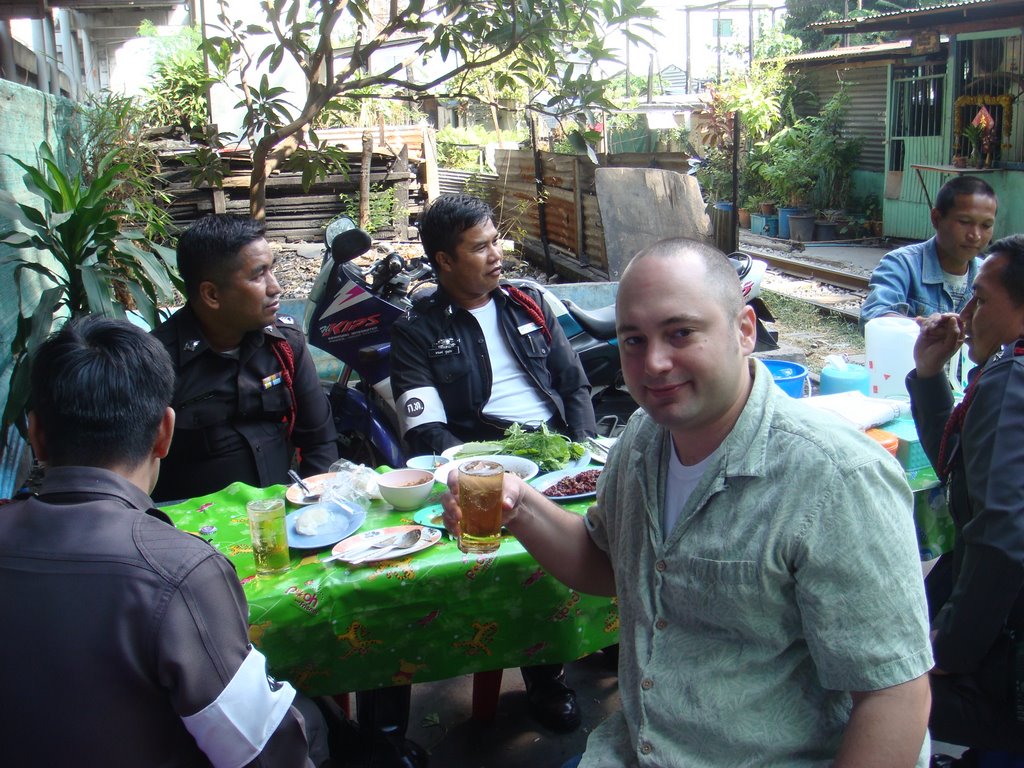
Breakfast in Bangkok
So off the main road you make a right at the train track next to the highway and walk down the tracks a short distance to the first food stand and get a papaya salad.
There’s a bunch of cops sitting at one table eating and drinking. I befriend them and ask for a picture with them. They happily agree but also hide their beer and refuse to pose. But they do poor me a beer on ice.
 They also offer us their food, which best I can tell is heavily marinated raw beef (or pork?) and some delicious greens.
  You can see some of their empties off to the side. It’s 9AM. A breakfast of champions.