Tag: police-involved shooting

  • Police use less lethal force in states with more blacks

    Police use less lethal force in states with more blacks

    Recently I came across a breathless headline in Salon: “Number of fatal shootings by police is expected to reach 1,000 for third year.” That’s an odd way to put it because A) it implies the number has been at a record high the past three years when B) this is only the third of three years the Washington Post has been counting and C) it’s not true.

    According to the Washington Post data they cite, there were 991 people shot and killed by police in 2015 and 963 in 2016. The more accurate headline, as see in the actual Washington Post is: “Number of fatal shootings by police is nearly identical to last year.” Well, that’s a bummer if one is trying to hype a crisis. Also “reach” is not synonymous with “approach.” But I’m not hear to quibble about the semantics of a few dozen deaths.

    The number of those killed by police seems to be steady at just under 1,000 per year. But given the increase in homicide, it’s actually surprising the number killed by police hasn’t increased. When violence goes down, as it did in the 1990s, police shoot fewer people. When violence goes up, as it did in the late 1980s, police shoot more people. I suspect there are two variables pulling in opposite directions. One involves more violence in general — increasing police-involved shootings — and the other involves less police engagement and fewer interactions with citizens. Less proactive policing means fewer interactions and less that can go wrong (and also more crime).

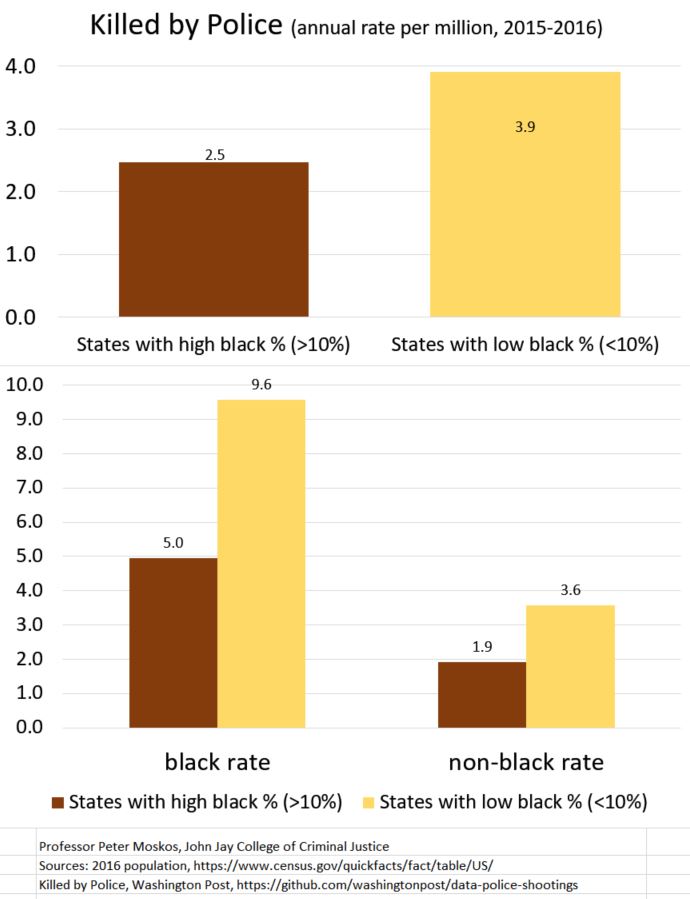
    I looked at the Washington Post dataof those shot and killed by police in 2015 and 2016 and broke it down by states with more and fewer African-Americans. States that are more than 10 percent African American include 21 states plus D.C. (198 million people, 18 percent black, 36 million blacks). There are 29 states less than 10 percent African American (126 million people, 6 percent black, 7 million blacks).

    People, all people, are 1.6 times more likely, per capita, to be shot and killed by police in states that are less than 10 percent black compared to states more than 10 percent African American. Blacks are still more likely than whites, per capita to be shot overall. But this ratio (2.6:1) doesn’t change significantly based on how black a state is.

    For both whites and blacks, the likelihood of being shot by police is greater in states with fewer blacks. And the difference is rather large. There are seven states less than two percent black. In 2015 and 2016, zero blacks were shot and killed in Maine, New Hampshire, Utah, Vermont, Wyoming, Idaho, and Montana. But if you think cops don’t shoot people in these states, you’re wrong. Compared to the four states with the highest percentage of African-American (Mississippi, Louisiana, Georgia, and Maryland are more than 30 percent black), the overall rate of police-involved killings in states with few blacks is higher. And this is despite a lower rate of overall violence.

    The implications of this are many, but for starters, if one wishes to reduce the number of people shot by police, it would make sense to focus on states that have more police-involved shootings in general. New Mexico, Alaska, Oklahoma, Wyoming, and Arizona have rates two and even three times the national average. Even though California ranks only 13 out of 51 (4.2 per million compared to 3.0 nationally), California is significant because it’s so large. In terms of reducing police-involved shootings, these are the low-hanging fruits.

    Were the states with fewer blacks able to reduce their rate of lethal force to the level of states with more blacks, there would be an 18 percent nationwide reduction in the number of those killed by police. But this would require a move away from a general focus on policing and race toward a focus on police departments that shoot a lot of people of all races (particularly hispanics, it should be noted, and not examined here). Alas, at the intersection of police, race, and ideology, I’m not holding my breath.

    And there’s a caveat: though state-level data is revealing, it’s often too general in terms of policy solutions. Intra-state differences are very large (and not examined here). Policing is local, and some local jurisdictions simply shoot a lot more peoplethan others. (That linked-to post is from two years old, but the basic points are solid).

    Here are the raw numbers. As always, click to “embiggen.” Data available on request. Corrections welcomed. Strongly encouraged, even.

    Sources: 2016 population, https://www.census.gov/quickfacts/fact/table/US/

    Killed by Police, Washington Post, https://github.com/washingtonpost/data-police-shootings

    Update July 17: Thanks to I.L., corrected and updated.

    Update: 2020 caveat.
  • Not how I was trained

    I’m curious what cops think about this police-involved shooting in Portland, Oregon:

    Hearst, a seven-year bureau member who became a police officer after graduating from Multnomah University’s bible college, said he never saw Hayes with a gun, but was trained not to wait to see one. [emphasis added]

    “Because if I let him get his hands on his gun, he will be able to pull that gun out and shoot me or my coworkers before I’m able to react to it.”

    To be clear, this was an armed robber who was shot. But he didn’t have a gun. (His replica gun was nearby.) The “trained not to wait to see one” rubs me the wrong way. Thoughts?

  • Sometimes there are good guys and bad guys

    A Baltimore police officer shot and killed an armed man who pointed a loaded gun at him.

    You’d think this would be cut and dried. But no. It’s Baltimore.

    I mean really, if any police-involved shooting is clear cut. It’s this one. Luckily for police, the cop had a body camera. Luckily it captures (barely) the key moment. Deal, a known violent offender, raises his loaded gun to shoot the cop.

    The cop, thank God, is quicker on the draw. Deal is shot and killed. And that’s where this story should end.

    But no, not in Baltimore, where officers are often criticized for doing the right thing.

    Commissioner Davis received flack at a press conference defending the cop, in part because he called Deal a “bad guy.” Why besmirch the dead? Because maybe some issues need to be presented without moral relativism. Because if you don’t point out there’s right and wrong here, people will fill in the void with an alternative facts. Also, you owe it to your officers to support them through tough times.

    [Have you killed somebody? Me, neither. But friends of mine have. And it’s not easy on them, no matter how justified and necessary the killing was. And it’s more difficult if people are saying you made a bad choice, especially when you didn’t.]

    In this case the City Papertakes aim at the cops in really one of the most idiotic police-related articles I’ve ever read. I like the City Paper. I’ve been reading it (admittedly not regularly anymore) for almost 20 years.

    According to the story, the reason you don’t know about this shooting is because “national news is at a chaotic premium right now.” Actually, no. First of all, you are reading about it cause it’s in all the papers and on the TV news.

    But what’s reckless about the City Paper story goes beyond this shooting. You may not follow this as closely as I do, but indeed, many “reformers” do not want police to be proactive at all. The story in the City Paper criticizes police for being part of the system wherein Deal ends up being shot and killed.

    Less proactive policing is the goal, the position of the DOJ report on the BPD. The DOJ asserts many things, which others may then take as Gospel because the DOJ said so. This is a real problem. The report says police shouldn’t confront/chase/arrest active violent offenders, especially if their identity is known. After all, somebody may get hurt:

    The need for the suspect’s immediate apprehension must be weighed against the risks to officers and the public caused by engaging in a foot pursuit. If officers know the identity of the suspect, his or her immediate apprehension is likely unnecessary without exigent circumstances. However, if circumstances require that the suspect be immediately apprehended, officers should contain the suspect and establish a perimeter rather than engaging in a foot pursuit, particularly if officers believe the suspect may be armed.

    Let’s talk this through.

    Man armed with an illegal gun, so you set up a “perimeter.” (Sounds cool!) How do you do that?

    What if Deal simply turns the corner and goes in a home of a friend and closes the door. (Or worse a stranger’s home.) Do you send in the militarized SWAT team? What if you didn’t see which house. Do you start banging on all the doors? That’s not really community policing. Or maybe, since you know who Deal is, you go back to the station and start filling out an arrest warrant. (Meanwhile, calls for service are backing up until the “perimeter” is called off.)

    Or what if Deal puts his gun in his waistband and runs through a vacant building into the alley. Baltimore is not like New York, where blocks are often solid with buildings and there are no alleys. But let’s say there happens to be four units at the ready (fat chance) to block off the street and sit in the rear alleys. Then what? Is a cop back there? What does she do? She was given a description of young black male, black hoodie, jeans. How does she know if it’s Deal? Does she start stopping all young black males who “match the description”? And what if Deal runs from her? Do you set up a new “perimeter”?

    And then what?

    At some point police will have to confront Deal.

    That’s why we have police. Police confront “bad guys” so we don’t have to. (Not to say Deal didn’t have any redeeming qualities, it’s just that I don’t think they’re particularly relevant in this incident.)

    Perimeter or not, assuming Deal doesn’t voluntarily put himself in handcuffs, you either chase, catch, and cuff Deal, or you police in such a manner where you do not cross his path. And if you do the latter, it would failure of the fundamental role of police in society. But when police do get the memo (or lawsuit) and police less proactively, crime goes up and people complain police aren’t doing their job. Sigh.

    I’d prefer to resolve the apprehension of an armed gunman here and now rather than have it play out for hours or days. Especially if I lived on that block. What message does it send it police let Deal walk away? Now that would be a real blow to police legitimacy.

    If there is a story here, it’s about the failure of society, and in particular Baltimore’s criminal justice system that was unwilling or unable to keep Deal off the streets. I mean, how does one even manage to get arrested and released three times in one month? Not only to you have to be a horrible criminal, you have to be kind of bad at it. Even Mosby’s often incompetent State’s Attorney’s office wanted Deal held without bail! From the Sun:

    For the third time in a month, 18-year-old Curtis Deal had been arrested on gun or drug charges. Judge Nicole Taylor wanted to be sure the young man understood what was expected if she released him to wait for trial.

    “You’re not going out at night, you’re not going to get food, you’re not going to meet your girlfriend. You’re in your house,” Taylor told him at Monday’s bail review hearing, raising her voice.

    “I’m giving you an opportunity to go to school and not be in jail pending this trial. The curfew is 1 p.m., 7 days a week.”

    Deal said he understood. Taylor wished him luck.

    The next day about 3 p.m., Deal was fatally shot by a Baltimore police detective

    It’s worth reading the whole article by Kevin Rector and Carrie Wells in the Sun. It’s a fine piece of journalism.

  • “A Bird’s Eye View of Civilians Killed by Police in 2015”

    More on the article in Criminology & Public Policy by Nix, Campbell, Byers, and Alpert. My previous post pointed out that if you use 2016 data rather than 2015 data, their conclusions would totally change.

    [Update: also see Nick Selby’s take on this. And David Klinger’s]

    How do we get data on police-involved shootings?

    Trick question. We don’t! A few departments, like the NYPD, issue great annual reports on shots fired by police. But other than that, we don’t know. We don’t know how many people cops shoot. So at best we’re left with those shot and killed by police. And that’s probably less than half of those shot by police.

    When academics call for “more study,” it’s usually a cliché. But the need here is real. We don’t know how many Americans get shot police each year? Are you effing kidding me?!

    Given that, there’s nothing wrong with using the best data you have. And I’m partial to using the Washington Post data myself. But that doesn’t mean the data are good. (By good I mean valid, in that they show what they claim to show.) (I also have a bias problem with their “ticking” counter, like last year’s shootings numbers are still going up. No, dude, every time I click on 2016 data, it’s going to go to 963. You’re not actually compiling the data on the spot.)

    1st question: Is the basic number of people shot and killing by police correct?

    Answer: Probably. It’s an unknown unknown, but we have a lot of reasons to think most killings are here.

    2nd question: Is their coding correct.

    Answer: Depends on what you want. For race, probably. For threat, probably not. The data might be “reliable” (you might get the same code if you did it again). But what does “threat” labeled “other” mean? And how is that different from “undetermined”?

    Others have pointed out to me that reporters don’t have the expertise to judge what experienced police officers are trained to see. There’s a great deal of truth to that. But more importantly, is the Post categorization valid? We don’t know.

    Say somebody gets killed on the street. How does that data get to us?

    Well, in the traditional manner — going from the street to the Uniform Crime Report (UCR) — usually somebody calls 911 cause a crime happened. Some young officer shows up and takes a report. This is a local form, for a local department, not at all coded to the standards requested by the UCR (Hispanic data is a key issue here). The cop writes a report that is collected by their sergeant toward the end of their shift. It well enough written, so it goes up to some supervisor and then to some police data consolidator and then, once a year to the FBI.

    At each stage it might get “cleaned up” a bit, as needed. And then, 9 to 21 months after the incident occurred, it gets published in the UCR index or Part I (or II) crimes. I’ve actually been able to check individual incidents I handled, later, in the UCR data. It checked out. All the facts were basically correct.

    But you only know what the UCR tells you, and it isn’t much. Nevertheless the UCR is considered the “gold standard” of crime data. But it sure ain’t perfect. And it’s particularly bad when it comes to police-involved shootings. Mostly because most departments simply do not report data on those killed by police.

    Because of that, after Michael Brown in Ferguson, the Washington Post (and to a worse extent the British Guardian) said “we’re going to start counting.” Good on them, because nobody else was. [As was pointed out to, and I should have mentioned, killedbypolice was doing it first.] They use whatever they can, which means google searches of news accounts, basically.

    So a cops (or criminal) shoots somebody. Some local reporter (most likely) with a police scanner goes to the scene and files a report. People don’t get killed by police that often. It bleeds, so it leads.

    That reporter either does or does not do a good job. They gather some of the information that seems relevant. But since they weren’t there, they don’t really know happened. It’s called an investigation. Who do you believe? The cops say the guy was armed; his family says he wasn’t. Reporters file a story and then the Washington Post has to decide if the guy was armed. Usually (for good reason) they go with the cop’s version. But what if the cop is lying? Isn’t the crux of the matter? Even if it doesn’t happen much, how would we know? Of course high-profile cases get more investigation.

    Which system is better? Neither. Both. It depends. But no existing data gather system is universal, mandatory, or really gets to the context of the incident.

    But then even more, there’s the subjective recording of data.

    Miscoding threat level

    The Washington Post labels a threat as either “attack”, “other,” or “undetermined.” That’s an odd trichotomy. Police care if a shooting is “justified” or not (aka “good” or “bad”). Courts care if it was criminals or not. The public may care if it were “necessary” or not. These are all different standards. But how can one tell 3rd-hand if a shooting was “good”?

    The article’s authors equate “other” with non-attack. This is wrong.

    Take Paul Alfred Eugene Johnson, who robbed a bank with replica guns.

    He forced the bank employees into the vault at gunpoint, told them he would kill them if they called police, and stole cash, police said shortly after the robbery.

    Surveillance images from both robberies show someone dressed in similar-looking white hooded sweatshirts and carrying guns in their left hands.

    There was a crazy chase. Johnson got out of his car and officers opened fire. I wasn’t there, but I’m willing to call this a justifiable shooting. The threat level in the data is coded as “other,” but in the journal article this gets recoded to “non-attack”? Come on, now.

    Kevin Allen charged at officers with a knife. Kaleb Alexander had a gun he wouldn’t drop. Troy Francis chased his wife and roommate with a knife, and then charged at responding officers. Hashim Abdul-Rasheed, previously not guilty by reason of insanity in an attempted murder case, tried to stab a Columbus, Ohio, police officer and was then shot and killed. Markell Atikins was wanted for the death of a 1-year-old, and then threatened officers with a knife. Tyrone Holman threatened to kill officers with a rifle and a grenade. Joseph Tassinari told an officer he was armed (he was) and then reached for his waistband. Harrison Lambert threatened his father with a knife before officers responded.

    What do all these cases have in common (along with mental illness in most of them)? They’re all categorized as “other” in the threat department. I don’t fault the Washington Post for how they categorize. They may not have proof of attack beyond and officer’s (self-justifying) account. I wish they did better, but they do what they need to do. (And nobody is doing better.) I do fault others who then group all these “others” into “non-attack” (n = 212), implying the cops did wrong.

    I’m more curious about the label of threat called by the Post: “undetermined” (n = 44). Many of the potentially worst shootings are in this category. And yet: “Cases involving an undetermined threat level were excluded from multivariate regression models.” I’m not certain why. Couldn’t you go one by one and look at them? Isn’t that what researchers do? I looked at a few.

    The Post says Robert Leon:

    exchanged gunfire with police, stole another car at gunpoint and fled. was first accused of shooting at cops and then shooting himself.

    This account seems simply to be not true. Further investigation may have revealed that Leon didn’t have a gun and died from police bullets. I wasn’t there. I don’t know. But it sure seems like an odd one to me.

    The “unarmed” issue

    If you’re looking for bad shootings, “unarmed” sure seems like a good place to start. But it’s not enough. “Unarmed” is a flag, but it is no guarantee that a suspect isn’t a lethal threat. Officers have and will be attacked and killed by “unarmed” suspects.

    Some of these cases, like white officer Stephen Rankin killing unarmed black William Chapman, resulted in the officer’s criminal conviction. The Washington Post codes Chapman as attacking the officer. The jury may not have thought so.

    The problem here, one the researchers seemed to have, is that if you look at “unarmed” suspects and those categorized as “non-attack” (the ones that people are most concerned about) you don’t have a large enough n (number of cases) to do statistical analysis.

    In 2015, you’d be down to a grand total of 50 people shot and killed by cops. It’s enough for an outrage of the week, but you can’t do much data analysis with 50 cases. And if you were to use “undermined” rather than “other” as meaning “non-attack” (I think a better but still horribly flawed categorization) you’d be down to a total of 9 cases.

  • What a difference a year makes…

    What a difference a year makes…

    There’s an article in Criminology & Public Policy by Justin Nix, Bradley Campbell, Edward Byers, and Geoffrey Alpert that has gotten some press: “A Bird’s Eye View of Civilians Killed by Police in 2015: Further Evidence of Implicit Bias”

    Although we could not determine whether officers were quicker or more likely to fire their weapon at minority suspects, we argue that if minorities were more likely to have not been attacking the police/other civilians, or [emphasis added*] more likely to have been unarmed, this would indicate the police exhibit implicit bias by falsely perceiving minorities to be a greater threat to their safety.

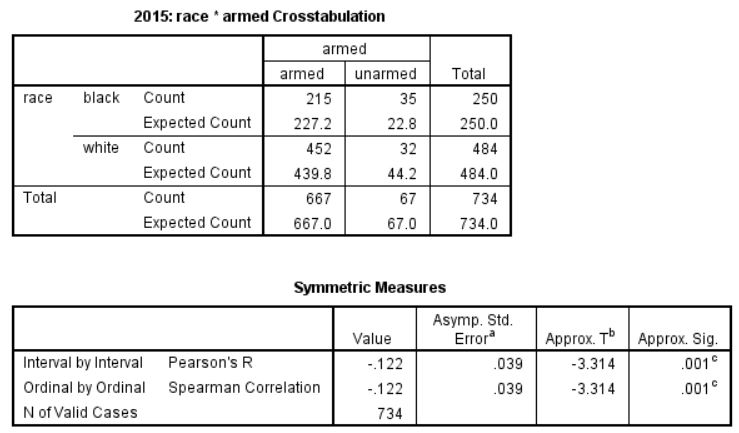
    I replicated their data and got 93 “unarmed” suspects killed in 2015. (Replicating data should be a given, but often it is not. So kudos to the authors for this.) In 2015, 38 unarmed black men and 32 unarmed whites were shot and killed by police. If the distribution were proportional to all those shot and killed, one would expect 24 blacks and 46 whites killed. This is a statistically significant difference. From this, the authors conclude “Black civilians were more than twice as likely as White civilians to have been unarmed.” Twice sounds big. The absolute number? Not so big. Still, if you’re one of the 38 unarmed black men killed, it matters.

    Here’s armed versus “unarmed” by race (for whites and blacks), for 2015 [click both to “zoom” and “refine”]:

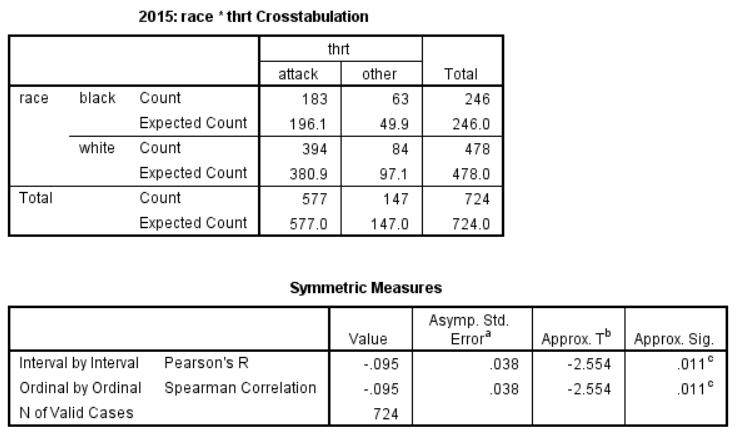
    I also looked at “threat level.” For 2015, I get what the authors get:

    You can see that for the threat = “other” (Ie: non-attack, in theory), one would “expect” to find 49.9 blacks in that square (if race wasn’t a factor). But in reality 63 blacks were killed. That’s a big and statistically significant difference.

    [I’m limiting the presentation of my analysis (as is my wont) to percentages, crosstabs, and univariate correlations. If one can’t describe statistics to a lay-person, it all becomes too abstract. And a problem with doing advanced statistics is then most people don’t understand what they mean (and that includes most academics). And so then the reader has to take the scribe at their word.]

    [Also, I have serious non-trivial issues with categorizing “other” as “non-attack,” but I’ll leave that aside, until my next post. Also, for replication purposes, I too exclude “undetermined” threat level (n = 42), but I don’t think one should. More on that in the next post.]

    Here’s where things get interesting! Unlike the authors, I can publish this in seconds and, for better and for worse, not wait for peer review (though corrections and comments are always welcome).

    So with the click of a button on SPSS (a statistics program), I can include 2016 data and even 2017 data right up to February 8 (when I downloaded the data).

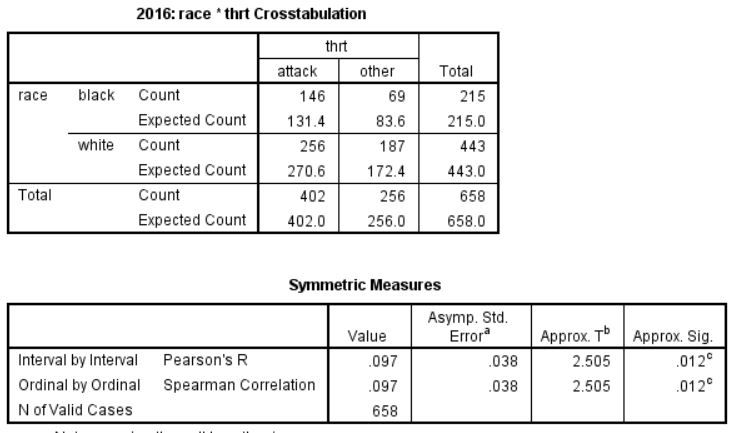
    Here’s what I get when I do their analysis on threat, but for 2016:

    Compared to 2015, in 2016 the results are reversed. This is a big deal. There are fewer blacks in the “other” threat level than one would expect. And the results are equally statistically significant.

    A similar things happens when one looks at armed and unarmed (again, I think this is too simplistic of a division, but that’s what they use).

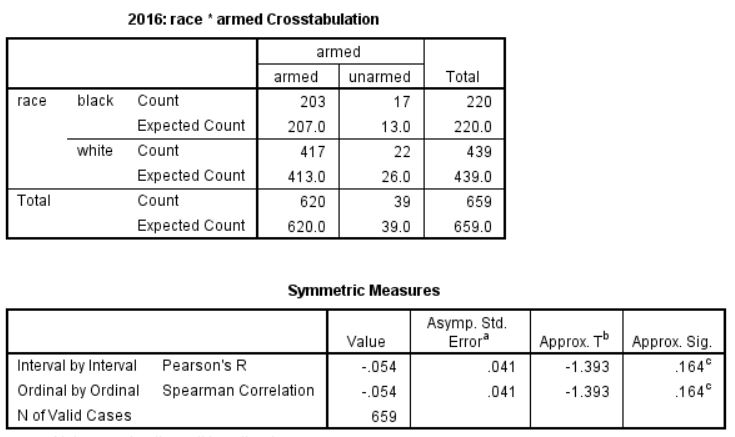
    Here’s armed versus unarmed by race, for 2016:

    While the data isn’t completely reversed, the differences in 2016 are minor enough (and the “n,” the number of cases, small enough) that the racial disparity is no longer statistically significant.

    What gives? Did the problem of racial disparity in police-involved killings disappear last year? Did it even reverse? I don’t know. But replicating the 2015 study with 2016 data would lead to a very different conclusion.

    Here are some other interesting tidbits.

    • From 2015 to 2016, total shootings deaths by police went down from 990 to 963. Given the increase in homicide, I would have expected the number of police-involves shootings to go up (they are usually correlated). I suspect that the number went down because A) given the focus on the issue of police-involved shootings, cops are less likely to pull the trigger and B) the number of discretionary interactions between cops and criminals has decreased.

    • From 2015 to 2016, killings of unarmed people dropped from 88 to 49. The drop was most pronounced among blacks (35 to 17).

    • Twenty-five percent of those killed by police are known to have pretty major mental health issues. This is a Big Red Flag. No doubt the real number is even higher (undiagnosed mental health issues among the poor, or simply a family that doesn’t want to tell a reporter about it). Implicit racial bias might (or might not) contribute to a dozen or so deaths. Mental health issues contribute to 250 a year! You want to reduce shootings? Provide mental care for people who need it.

    • Seventy-eight percent of 2015 killings (This if from Nix et al.I haven’t recoded the 2016 data) happened in the South and West (with 60 percent of the population). Again, if one wishes fewer people to be killed by police, best to focus where police kill a lot of people.

    • We really need more data, not just on police involved killings, but on all police-involved shootings. A lot of people are shot and not killed. We know next to nothing about this. And we need to know the context of these shootings. How did they start? How many are initiated by a call for service rather than a police officer’s discretion?

    • We really need to be concerned about unintended consequences of policy decision. Perhaps a laser-like focus on police shootings and police misconduct combined with lawsuits against proactive policing really have ended the racial disparity in police-involved shootings. If so, that would be great. It’s just as likely that a laser-like focus on police shootings and police misconduct combined with lawsuits against proactive policing have contributed to less proactive policing and an increase in homicide. (It’s hard to argue one without the other, though people will try. Oh, they will try.) Eighteen fewer unarmed blacks were shot and killed by police in 2016 compared to 2015. Meanwhile, 2,000 more were murdered, most of them black (using the Brennan Center’s estimate of a 13 percent increase in homicide).

    It’s not crazy to see some connection between these two variables: less proactive policing could [ie: does] mean fewer police-involved shootings and also more criminal shootings. Is this the best we can do? Is this the trade-off we want? Can one or should one talk about the value the lives in this way? I don’t know. But since more people are dying (though fewer at the hands of police) these are things we need to be talking about.

    • Also, the number of unarmed Asians killed by police since 2015: Zero (of 30 killed, total).

    [* The use of “or” is interesting. The numbers are really low. Cops just don’t shoot many unarmed unarmed attackers. You can’t really do multivariate analysis on a few dozen cases. Given the number of people killed by police, you can’t look at racial discrepancies (statistically) when the person killed is not-attacking cops and unarmed.]

    [comments are (only) available on the next, related, post.]

  • They’re just Sooner to Shoot in Oklahoma

    They’re just Sooner to Shoot in Oklahoma

    Updated: November 15, 2017

    Also see this 2020 update. And an important caveat.

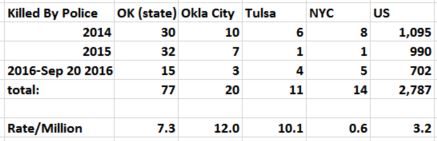
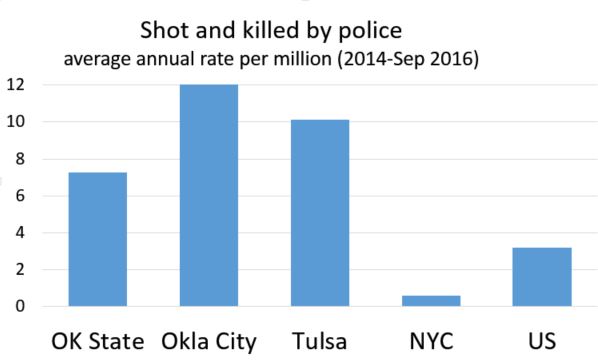
    Using data from 2014 through mid November 2017 (killedbypolice.net for 2014 and the Washington Post thereafter) Oklahoma City Police kill an average of 6.3 per year; NYPD 0.57 a year. The rate in Oklahoma City is 11 times as high. The rate per officer is 27 times higher in Oklahoma City. That means a person is Oklahoma City is 11 times more likely to be killed by police and a police officer is 27 times more likely to kill.

    Original Post:

    I’ve said for a while that when it comes to police use of lethal-force, an exclusive laser-like focus on race is misguided. It’s is a red herring. If one actually wants to reduce police-involved shootings — as opposed to simply being outraged at the latest incident — there are easier ways to do this than eliminating racism and racial disparity in America. There are low-hanging fruits to reduce the overall level at which cops shoot people.

    There will be the next police-incident worthy of outrage. We can go from incident to incident, outrage to outrage, and pretend it’s just about race. But it’s not.

    I’m not saying race doesn’t play a factor. This is American. And indeed, blacks make up a greater percent of unarmed people killed by police. The disparity could be racial bias; it could be related to violence in segregated America; it could be something else. Honestly, we’re never going to settle the debate, and I don’t know if we need to. Police misconduct doesn’t only happen to blacks. And the numbers of innocent unarmed people killed by police is simply not that large. Nor is it increasing.

    Police have shot and killed 706 people this year. Forty-one were unarmed. Fifteen of those were black. (Keep in mind “unarmed” does not mean no threat, and conversely somebody could be armed and not be an imminent threat.) I get the argument that murder is worse at the hands of the state. I even agree with it. I understand police need to be held accountable. But at some point the numbers matter, at least to put things in perspective.

    This is a country of 320 million people. There are 765,000 sworn police officers. There are 15,000 murders (and murderers). What’s an acceptable level of police-involved shooting? What’s the goal? And if you’re not happy addressing that question, or if you think the only acceptable answer is zero, than you’re not a productive part of the solution.

    Look, I know some cops do shitty things. And others make honest mistakes. But there are more cops in America than residents of Baltimore. We can and should criticize individual incidents. But we don’t harp on every crime in Baltimore — and there are a lot — to show how the whole city is filled with evil. (And I do wish we cared a bit more about victims like Michael “Chef Mike” Bates who was just shot and killed even after he complied with the three men who robbed him.)

    Does a bomb in Chelsea mean we should ban Muslims from America? (No, is the answer.) There will be the next horrific crime and the next terrorist attack just as sure as there will be the next bad police-involved shooting. Instead we’re seeing something close to a moral panic, with police as the Folk Devils, we need to reduce how often they happen.

    There are probably a few dozen bad (as in criminally bad) police-involved shootings a year. That’s a couple a month, keep in mind. And if they’re all recorded, that’s one every other week. But far more numerous are shootings which may be legally justifiable but did not have to happen. They’re justifiable but not necessary. We’re talking perhaps something in the rage of a few hundred a year. And the bulk of these happens west of the Mississippi (see a future post). The best way to reduce bad shootings is to reduce the overall level of police lethal force.

    Twenty-five percent of those who are shot and killed by police are black. Since blacks are only 13 percent of the general population, some claim this represents an “epidemic” of police violence against African Americans. But using the overall population as the denominator for interactions with police makes no sense.

    America is filled with racial disparities in poverty, violent crime, calls for police service, and those who felonious kill police officers. I mean, 96 percent of those killed by police are men, and men make up less than half the population. Is there an epidemic of misandric cops gunning for other men? I don’t think so. It’s more likely that men are more likely to pose lethal threats to police officers.

    And this brings me back to Oklahoma, where Terence Crutcher was shot and killed by a police officer even though he wasn’t an imminent threat. A while back I red-flagged Tulsa and Oklahoma because I couldn’t help but notice: they sure do seem to be a hell of a lot of police-involved shootings in Oklahoma. And now we have more data than we did a year ago.

    We’re not seeing an epidemic of police killing black people in particular in Oklahoma. The Sooner State is pretty white (72 percent, 8.6 percent Native American, and 7.4 percent black). The racial disparity in Oklahoma is pretty much in line with the rest of the nation. Since 2014, nationwide, the average annual rate of being shot and killed by police is 3.2 per million. It’s higher for blacks (6.93) and lower for whites (2.37). That’s a 3:1 ratio.

    What we see is that more white people get killed by cops in Oklahoma than all people killed by cops in majority minority New York City. Simply put, police in Oklahoma are shooting a lot of people and the NYPD isn’t. In Oklahoma, cops shoot and kill 28 people per year. In New York City, which has more than twice as many people as the entire state of Oklahoma, police kill about 5 people a year. What gives?

    People in the state of Oklahoma are 12 times as likely as New Yorkers to be killed by police.

    People in Oklahoma City are 20 times [11 times, see update, above] as likely as people in New York City to be shot and killed by police! New York City has about 2.5 times more police officers per capita. That means an officer in Oklahoma City is about 50 times more likely than an NYPD officer to shoot and kill somebody. [27 times, see update above]

    These differences are huge! Shocking! Unbelievable!

    And yet nobody seems to notice or care. [See all the states in this post.]

    I assume most of the police-involved shooting even in Oklahoma are legally justifiable. I’m not saying these cops are committing crimes, but I am saying a large percentage of these shootings aren’t necessary. They don’t need to happen. I mean, it’s likely cops in Oklahoma will always shoot more people than cops in New York City. Sometimes police have no choice but to shoot somebody. And Oklahoma isn’t New York. But it doesn’t have to be 12 or 20 times more. I can’t conceive of how a per-capita disparity this large could be justified or explained away by any variables except police training.

    So I look at the Terence Crutcher being shot, and I think: maybe that really is how police in Tulsa roll. I don’t know. And I wonder what it is about NYPD training and policy that so reduces use of lethal force. Whatever it is, and I’m sure it’s a combination of things, it shouldn’t be that hard for somebody to copy best practices. Instead of asking what individual police officers are doing wrong (though we can ask that, too), why don’t we figure out what the NYPD is doing right? We have models that work. The solution involves some combination of better hiring standards, better policy, better training, and more accountability.

    Just reducing Oklahoma’s use of lethal force to the national average would save 14 lives a year. That seems doable. And good. It’s good for the people not to get shot. And it’s good for social and racial justice. And it’s also good for police officers who get to go home without killing somebody. Cops don’t want to shoot people. You think Officer Betty Shelby wouldn’t like to go back in time and not shoot?

    And let me mention I’m only picking on Oklahoma because of the recent Tulsa shooting. Oklahoma isn’t even the worst state when it comes to high levels of police-involved shootings. Currently, in 2016, it doesn’t even crack the top five.

    [I did some brief computations on crime (some 2015 UCR data is already out!) because police violence is best predicted by public violence. In 2014 and 2015, Oklahoma has an annual murder rate of 5.4 per 100,000. This is 30 percent higher than New York City’s 4.1. Aggravated assaults and total violent crime, however, are 35 percent higher in New York City. So it seems that Oklahoma does have a violent murder problem separate from any crime problem. But nothing here would even get close to accounting for twelve- and twenty-fold differences in police use of lethal force.]

    Notes: Annual rate is based on the sum total of Jan 1, 2014 to Sep 20, 2016, multiplied by 0.367.

    2014 data: http://www.killedbypolice.net/

    2015-present: https://github.com/washingtonpost/data-police-shootings

    Oklahoma crime stats: https://www.ok.gov/osbi/documents/Crime%20in%20Oklahoma%2C%202015.pdf

    Crime stats: http://www.criminaljustice.ny.gov/crimnet/ojsa/indexcrimes/Regions.pdf

    Race data is from the Washington Post, so it starts in 2015. Annual rate is the sum from 2015 to Sep 20, 2016, multiplied by 0.58. National rates based on 318.9 million with a white population of 200 million and a black population 36 million. Feel free to double check my math. Corrections and comments always welcome.

  • “Imma start a riot like it’s Baltimore”

    Turns out the cop who once rapped “Imma start a riot like it’s Baltimore” turns out to be prophetic!

    But all joking aside, this cop who shot and killed an armed and dangerous man was from the community.

    More than 1,000 people have circulated a 2014 image, shared by the Milwaukee Police Department, identifying and lauding Officer Dominique Heaggan-Brown as the rookie cop who helped a homeless woman find a warm meal during frigid weather.

    “I was aware that he was an officer like most people,” he added. “When we did have a chance to hang out it was pure kicking it, or he would pop up at some of my shows in support sometimes.”

    Smith’s sister, Sherelle Smith, said the officer and her dead brother knew each other from their high school days.

    And then some people started listed his home address. There were death threats. Officer Heaggan-Brown — from the community he policed, doing his job, involved in a justified shooting — is now in hiding.

  • Paul O’Neal shot and killed by Chicago police

    Last week Paul O’Neal was fleeing from police in a stolen car. He crashed past one police car, and cops shot at him. He then veered head-on into another cop car, bailed, jumped over a fence (being more agile than any of the chasing cops), and was then shot at again. One (or more?) of these shots hit O’Neal in the back and killed him. O’Neal did not have a gun.

    I spent a few too many hours editing these videos down to an annotated good parts version. Here’s the timeline:

    0:00 1st police car passenger’s bodycam

    0:21 1st police car passenger’s bodycam, with comments

    1:47 1st police car driver’s bodycam

    2:01 1st police car driver’s bodycam, with comments

    2:50 rammed police car’s dashcam

    3:08 rammed police car’s dashcam, with comments

    It all does happen so fast. But it’s a bad shooting. And that’s before O’Neal is killed. The bottom line is that the first cop who shot — the passenger in the first police car struck — shot too quickly and unreasonably. His actions directly led to O’Neal’s death by creating what is known, in technical police circles, as “a complete clusterfuck.”

    This cop fucked up in so many different ways, it’s hard to count the ways. But I came up with eight, for starters:

    1) His gun is unholstered in the car (WTF?) before he even gets out.

    2) He shoots without an imminent threat to him or his partner.

    3) He shoots one-handed, while moving, without trigger control.

    4) He shoots at a moving vehicle (which goes against department policy).

    5) He came damn close to shooting his partner!

    6) Twice!!!

    7) He shoots at a fleeing felon (which goes against Tennessee v. Garner).

    8) He shoots downrange toward a light-flashing police car coming in his direction.

    And for what? A stolen car?

    And after the shootings, his most-vocalized worry was:

    Fuck, I’m going to be on the desk for 30 goddamn days now. Fucking desk duty for 30 days now. Motherfucker.

    Don’t worry. You won’t be sitting at a desk for long. You’ll be criminally charged with something, as you should be. Probably convicted, too. And I hope you’re fired for shooting at other cops. No cop will work next to this trigger-happy shooting-at-his-partners cowboy. The other officers on scene could only be so lucky if it turns out that the fatal bullet did come from his gun. See, despite having fired at at least 10 times, Officer 30-Goddamn-Days can’t be convicted of homicide because he probably never hit O’Neal! It would be fitting if they made him pay for the bullet hole in the car.

    The officer who fired the fatal shot probably shot O’Neal in the backyard, and there’s no video of this. He or she will have a reasonable defense. They had good (albeit incorrect) reasons to believe O’Neal was armed, dangerous, and shooting at cops. O’Neal was a felon who rammed a cop car head-on. The irony is that Cowboy Cop, by shooting, makes the subsequent officers’ actions more reasonable.

    This could turn out like the police-involved shooting of Amadou Diallo: a tragedy, a bad shooting, and a collective fuck-up, but still not a convictable criminal offense for cops thinking they’re under fire. “Reasonable” is the legal standard. (But it doesn’t do justice to Diallo to compare these shootings. Diallo’s death was worse because Diallo was innocent, compliant, not in a stolen car, and not fleeing from police.) This won’t be as open-and-shut obvious acquittal as, say, homicide by failure to seatbelt. But cops don’t have to be right; they have to be reasonable. And criminal cases need to be proved beyond a reasonable doubt.

    And yes, it should be said: kids, don’t steal cars!

    [I first saw the videos on Tanveer Ali’s article in DNAinfo. Unedited videos can be found at Vimeo under Log# 1081642.]

    [The one “good” shot, in my opinion, comes from the driver of the first police car. He gets out of the way of the car coming at him and takes fire (turns out from his stupid partner, but he didn’t know that). What he does know (even though it turns out to be wrong) is that a felon is shooting at cops and driving toward more police officers. You can shoot at a vehicle if you believe that vehicle to be an imminent threat is a form other than the vehicle itself. (The police passenger knew the car thief wasn’t shooting, so his shots were not good.) The police driver assumes a good shooting stance, aims, and fires once (or maybe twice), hoping to hit the driver in his back. Given what he knew right there and then, it’s a good shooting (even with the cop car downrange, but off-target). This is not the same as saying his shooting was right in hindsight. It wasn’t. But shootings can be legally justifiable even when hindsight proves them wrong.]

    Update (January 12, 2018) from the Chicago Tribune:

    Two Chicago police officers should be fired for shooting at a moving vehicle without justification during a chase and fatal police shooting in 2016, disciplinary officials ruled in a report obtained Friday by the Tribune.

    Officers Michael Coughlin Jr. and Jose Torres endangered the public and the lives of their fellow officers when they shot at 18-year-old Paul O’Neal as he tried to flee police in a stolen Jaguar convertible on a residential street in the South Shore neighborhood, according to the report by the now-defunct Independent Police Review Authority.

    The same report concluded that a third officer, Jose Diaz, who ultimately shot and killed O’Neal during an ensuing foot chase, was justified because he reasonably believed that O’Neal had a gun and had already fired shots at the police, even though O’Neal turned out to be unarmed.

    It was recommended, however, that Diaz be suspended for six months for kicking O’Neal and yelling “Bitch ass mother——, f—— shooting at us!” while the teen lay mortally wounded in a backyard.

    That same profanity-laced statement, which was captured on a police body camera, convinced investigators that Diaz “genuinely believed” at the time that O’Neal had fired at him, according to the report, obtained by the Tribune through an open records request.

    Further update, October 2018. Looks like both officers are going to be fired.

    Further more update, March 2020. They are being fired. I can’t believe it’s 4 years later.

  • Reducing police-involved shooting & “The List”

    This past week John McWhorter and I were both (separately) on Bloggingheads.tv with Glenn Loury to talk about race and all the recent shootings. McWhorter emphasized race as a factor of those shot by police and:

    challenged those who disagree to present a list of white people killed within the past few years under circumstances similar to those that so enrage us in cases such as what happened to Tamir Rice, John Crawford, Walter Scott, Sam Debose and others.

    Well I keep track of these things and through Glenn passed some names on to Professor McWhorter. I give sincere respect to Professor McWhorter for his intellectual honesty today in Time:

    The simple fact is that this list exists.

    When a black man is killed by a cop, do we grieve more because there are 46 million of us as opposed to 198 million whites? I doubt it: most Americans never hear about the white men’s deaths at all.

    Rather, we operate according to a meme under which cops casually kill black men under circumstances in which white men are apparently let off with a hand slap — and occasional cases of just that are what often get around social media, suggesting that they are the norm.

    However, at the end of the day any intelligent engagement with these issues must keep front and center that there was a Daniel Shaver for John Crawford, a Michael Parker for Walter Scott, a James Scott for Laquan McDonald. Economist Roland Fryer’s conclusions, stunning even to him, that cops use more force against black people but do not kill them more than they kill whites is perhaps less perplexing than it seems.

    Unlike McWhorter, I was not surprised by Fryer’s conclusions. Like McWhorter, “I am neither a neither Republican nor conservative.” But unlike McWhorter, I am white. (Though I have written about some of the more egregious cases, it sounds a bit funny to say, Romney like, “I have a binder full of white people!”) I don’t want to be liked and linked to by racists and the “alt-right”.

    But I’ve researched and written about race before. I said, “The idea that police don’t use lethal force in a racist way might be a tough pill for many to swallow.” But if one wishes to reduce police-involved shootings — and all of us do; cops don’t go to work hoping to shoot somebody — there are good liberal reasons to de-emphasize the significance of race in policing.

    Jonathan Ayers, Andrew Thomas, Diaz Zerifino, James Boyd, Bobby Canipe, Dylan Noble, Dillon Taylor, Michael Parker, Loren Simpson, Dion Damen, James Scott, Brandon Stanley, Daniel Shaver, and Gil Collarwere all killed by police in questionable to bad circumstances. McWhorteradded Alfred Redwineand Mary Hawkes. You can probably find others from Washington Post data. What they have in common is none were black and very few people seemed to know or care when they were killed.

    According to the Washington Post, 990 people were shot dead by police in 2015. 258 were black. More significant than racial differences — much of which can be explained by racially disproportionate levels of violence — are stunning regional differences.

    Last year in California, police shot and killed 188 people. That’s a rate of 4.8 per million. New York, Michigan, and Pennsylvania collectively have 3.4 million more people than California (and 3.85 million more African Americans). In these three states, police shot and killed (just?) 53 people. That’s a rate of 1.2 per million. That’s a big difference.

    Were police in California able to lower their rate of lethal force to the level of New York, Michigan, and Pennsylvania — and that doesn’t seem too much to ask for — 139 fewer people would be killed by police. And this is just in California! (And California isn’t even the worst state; I’m picking on California because it’s large and very much on the high end.)

    Now keep in mind most police-involved shootings are not only legally justifiable, they are necessary and good at the moment the cop pulls the trigger. But that doesn’t mean that the entire situation was inevitable. Cops don’t want to shoot people. They want to stay alive. You give cops a safe way to reduce the chance they have to pull the trigger, and they’ll certainly take it.

    I really don’t know what some departments and states are doing right and others wrong. But it’s hard for me to believe that the residents of California are so much more violent and threatening to cops than the good people of New York or Pennsylvania. I suspect lower rates of lethal force has a lot to do with recruitment, training, verbal skills, deescalation techniques, not policing alone, and more restrictive gun laws. (I do not include Tasers on this list.)

    If we could bring the national rate of people shot and killed by police (3 per million) down to the level found in, say, New York City (The big bad NYPD shoots and kills just 0.7 per million) we’d reduce the total number of people killed by police 77 percent, from 990 to 231!

    [Update: Here are more names worth considering, taken from comments to this post: David Kassick, Josh Grubb and Samantha Ramsey(examples of officer-created danger), John Winkler, Robert Saylor. Zachary Hammond. Sal Culosi. John Geer. Autumn Steele (This is rare case of an unarmed white person shot by a black officer.) Michael McCloskey.

    Also, it turns out Bobby Canipe lived. But I’m still including him because, my God.

    And it’s well worth watching Glenn Loury and John McWhorter talk about The List in a more recent Bloggingheads.tv]

  • Philando Castile

    This police-involved shooting is bad. And unlike the killing of Alton Sterlingin Louisiana, I’m willing to call this one before the polls have closed.

    This more recent shooting in Falcon Heights, Minnesota reminded me of Joseph Schultz. Schultz, you probably don’t remember because you’ve never heard of him, got shot in the face in 2003 by FBI agents who were conducting a traffic stop on the wrong car. (Schultz is white, and apparently white people don’t get bothered by being shot by police for no good reason.) I wonder how many traffic stops FBI agents have made before or since. The FBI agents got off. It was called an “unfortunate accident.” No. It was worse than that.

    Over in the twitter world — which is like the real world but somewhat more poor, nasty, brutish, and short — David Simon seems aggrieved (a burden he carries well) about my wait-for-the-facts position on Sterling in Louisiana but my willingness to rush to judgement in Castile’s death.

    I wrote:

    (Actually, I’d bet Louisiana shooting not good either, but I’m not ready to call it yet. And I’m not a betting man.)

    In a ever-so-slightly trolling manner, Simon prodded:

    You don’t need to see the beginning of the video? Or learn all the possibilities of reasonable suspicion and probable cause for car stop? Why not?

    No, I don’t. These shootings are very different. Because one involved a fighting man with an illegal gun.

    In Sterling’s death, I can imagine a scenario — one that may or may not be true but is very much possible when three people with three guns are rolling around on the ground — where the shooting was justified. What if Sterling was trying reach for a gun to kill somebody? My guess is this isn’t what happened, but I don’t know. (And neither do you.)

    But it’s not just that. Castile was a police-initiated engagement. That matters. The victim, judging from post shooting reactions, was compliant. There was no fight. It’s a car stop, which limits the possibilities of motion. That’s relevant less for the possible danger aspect than for me being willing to make some assumptions about what happened before the video. I have no idea what happened before Alton got shot and tased. I know very well how car stops work.

    And I’ll just keep mentioning this: Castile wasn’t carrying an illegal gun.

    Ah, respondedSimon (foolishly trying to find flaw in my logic):

    But video I saw was after shooting occurred. How do you ascertain all of the above other than witness credibility

    And:

    Do you have video of the run-up to and shooting of victim in Minnesota? Maybe I saw something abbreviated.

    There’s no reason to think Castile was a threat or pointed his gun at the cops. The cop, later audio indicates, told Castile to reach for something, and he did. That’s called being compliant. I am willing to give police the benefit of the doubt. But having done that, and also willing to admit I can’t honestly conceive of a way the shooting of Castile was justified (unless there’s really something big we don’t know). And it’s not the first time or even second timea compliant individual was shot by police.

    But it’s sometimes hard to explain nuance in 140 characters. So I left it at this:

    And though I generally think race is overplayed as a factor in police-involved shootings (and geographic region and act of being a lethal threat underplayed). Honestly, in this shooting, with this cop, in this locale, I don’t think there’s a chance in hell Castile would have been shot had he been white.