Tag: race

  • Killed by Police (3 of 3): Cutting the number in half

    Killed by Police (3 of 3): Cutting the number in half

    [See my previous posts 1 and 2 and about NYC.]

    It’s not unreasonable to believe — even when one knows the vast majority of police-involved shootings to be justified — that three police-involved homicides per day is perhaps two too many. Can the number of police-involved killings be reduced without placing officer’s lives in danger? Of course. We know this because some departments shoot a hell of lot more people than other departments.

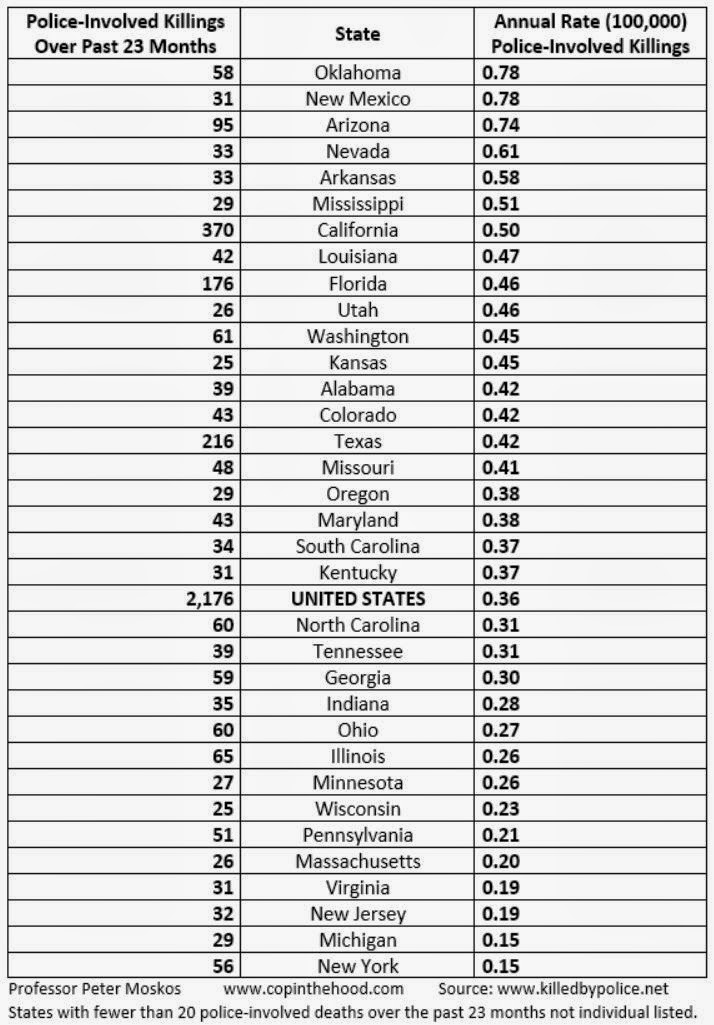
    If California could reduce their rate of police-involved shootings down to the rate that already exists in the state of New York? 135 people a year would by killed by police. And that’s just in California alone.

    Police in some states are much more likely to pull the trigger than in other states. Now this does not take crime and violence against police into account, which would in an ideal world. But the differences are still incredibly stark. And since we’re looked it states rather than cities, I mean, it’s not like cities in New York, New Jersey, and Michigan normally come to mind as epitomizing peace, love, and non-violence.

    [It’s worth warning and repeating that all this assumes the data is valid enough. I am assuming that. But I may be wrong.]

    Oklahoma has a police-involved homicide rate of 0.78. That’s higher than the overall homicide rate in Sweden. Oklahoma, New Mexico, and Arizona all have rates of police-involved killings that are twice the national average (0.36) and four to five times higher than Pennsylvania, Massachusetts, Virginia, New Jersey, Michigan, and New York.

    My guess is the differences have to do with better training, more police officers per capita, less public tolerance of police-involved killings, higher police standards and pay, and differences in police culture.

    But really, in terms of police training and standards, there’s no reason to think we couldn’t bring all states in line with the best states. And if police across the nation killed just as often as police in those least trigger-happy six states currently do? That would cut the national rate of police-involved killings by half and save 500 lives a year. This would also save 500 cops a year from having to shoot and kill somebody. Police lives matter, too.

    2020 Update. And 2020 caveat.

  • Killed by Police (2 of 3): Race

    Killed by Police (2 of 3): Race

    [See parts 1 and 3 and NYC]

    Using the data from killedbypolice.net, I looked at the race of those killed by police. Though before I give you these numbers, ask yourself this question: what percent of those whom cops kill do you think are white, black, and hispanic. Forgive the callousness, but we’re talking numbers. And this figure will get to the core of the notion that cops are “gunning for” or “hunting” black men.

    [Update: These are based on the best data from April, 2015. As of November, 2015, we have more data, but I don’t believe the conclusions have changed substantively. See also the Guardian and also, slightly better for what they exclude, the Washington Post for more up-to-date numbers on those killed by police. All three data sources are more or less in sync.]

    Given that blacks are 13 percent of the population and whites about 65 percent, what percentage would expect to see among those killed by police? Presumably police are more likely to shoot a murderer than an average Joe. So I wouldn’t think it’s reasonable to expect to find that blacks would be just 13 percent of those killed by police. What percentage would you expect to see. What percentage would mean there isn’t a problem of police shooting African Americans in particular (as opposed to police just shooting too much in general)?

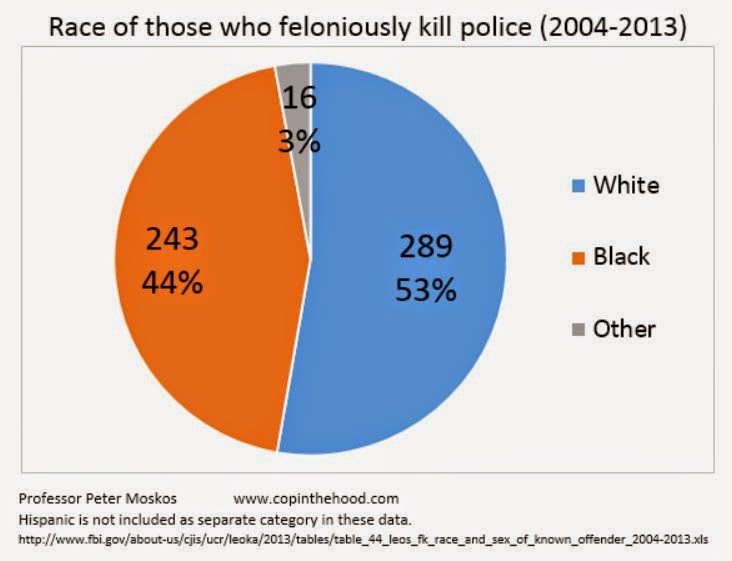
    Presumably police are (and should be) more likely to kill those who are willing or trying to kill other people. [Update: others have used arrest rates as the denominator, which seems like a good way to analyze racial disparities vis-a-vis police interactions.] Nationwide, blacks are also about 50 percent of murder victims (and thus presumably murder perpetrators, since most homicides are intra-racial). Over the past 10 years, according to FBI data that looks at those who have feloniously killed a police officer, whites are 53 percent and blacks are 44 percent.

    [For various reasons, none particularly good, FBI data seems to lumps all hispanics into the white category. The data at killedbypolice.net counts hispanics as separate. But it means that hispanics are invisible in the FBI data but counted in killedbypolice data. And I’m using both. So consider this a fair warning about comparing numbers and figures from different data sets.]

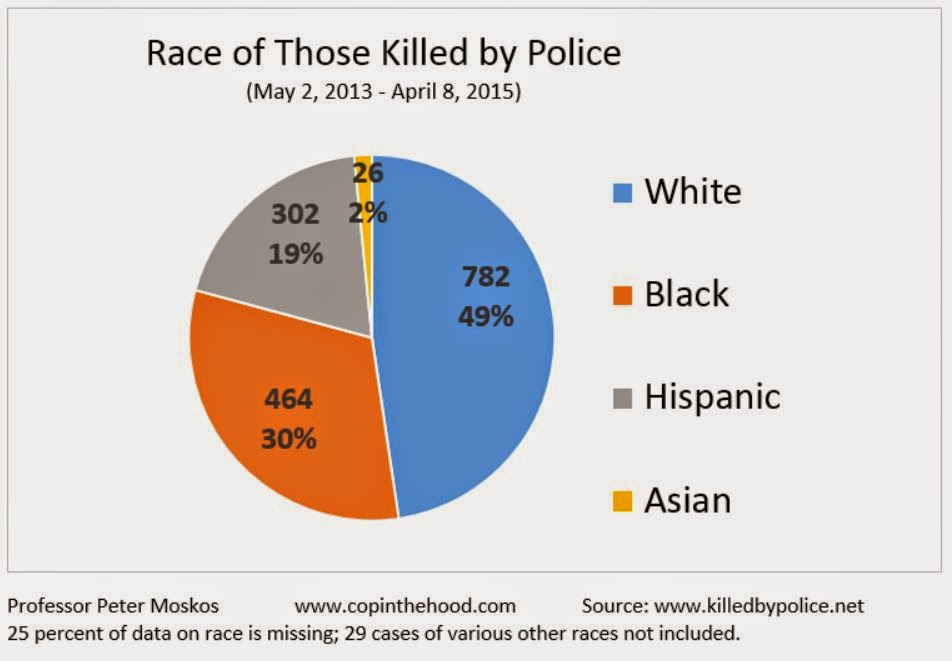
    One would hope that the racial breakdown of police-involved homicides would be not out-of-wack with the racial breakdown of those who kill police. This indeed seems to be the case: 48 percent if those killed by police are white, 30 percent are black, and 18 percent hispanic (the doesn’t-add-up-to-100-percent bit consists of Asian, Indian, Pacific Islander, and other.)

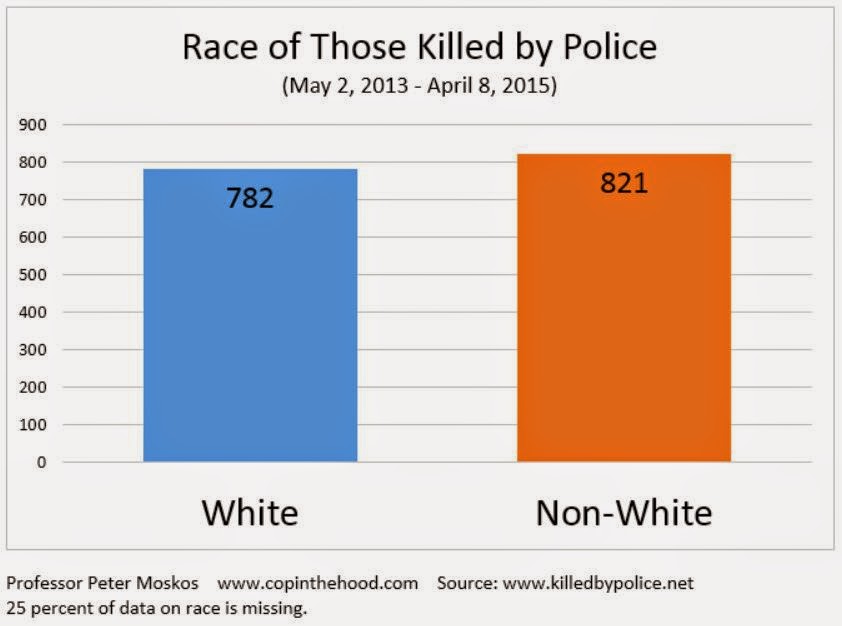
    Though if you’re so inclined, and I see so reason not to, you could spin the same data this way:

    Now the data doesn’t indicate which shootings are justified (the vast majority) and which are cold-blooded murder (not many, but some). And maybe that would vary by race. I don’t know, but I doubt it.

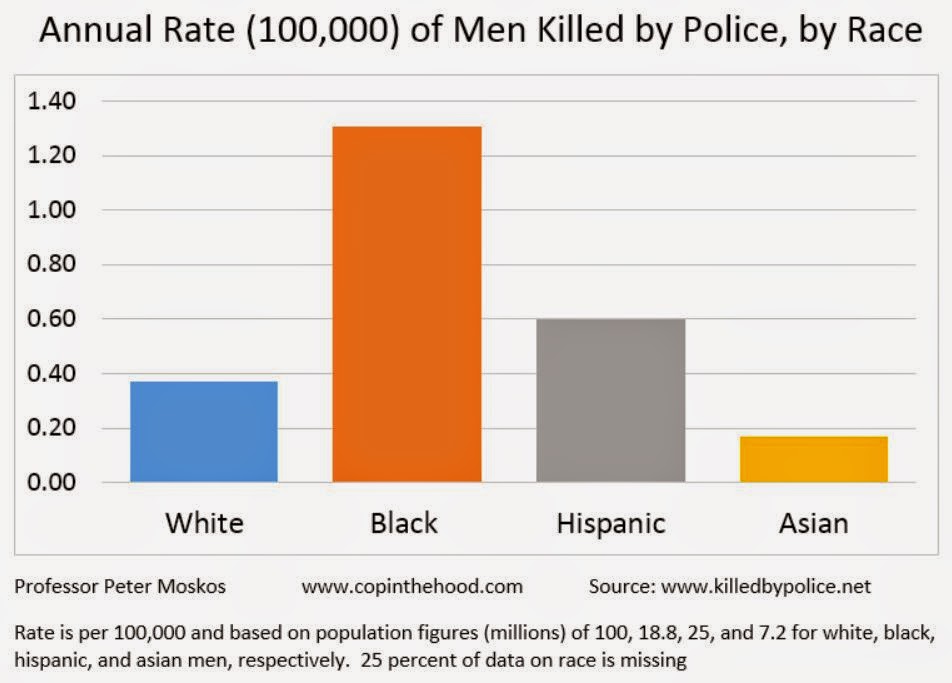
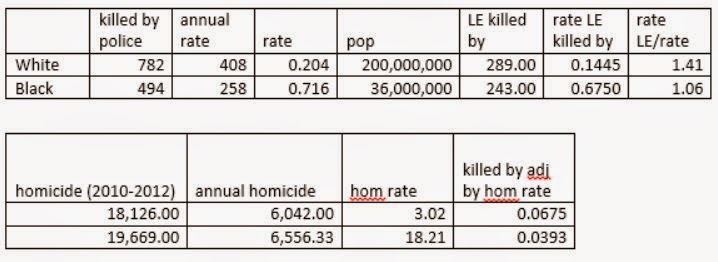
    Still, per capita, blacks are 3.5 times more likely than white men to die at the hands of police. This is now adjusted for population, and only includes men.

    Keep in mind the homicide rate for the entire country of Canada is 1.6. So a homicide rate of 1.3 for black men just killed by police (!) is very high.

    While it is a very damning figure for our country, it’s not necessarily damning for police. There is a 6:1 (per capita) black-to-white homicide rate disparity and a 4:1 black-to-white disparity (per capita) among those who felonious kill police officers. Given disparate rates of violence, it would be naive to expect equal rates among those killed by police.

    Adjusted for the homicide rate, should one choose to do that, whites are 1.7 times more likely than blacks die at the hands of police. Adjusted for the racial disparity at which police are feloniously killed, whites are 1.3 times more likely than blacks to die at the hands of police.

    Another statistic: A black man is 16 more likely to be killed by a cop than kill a cop. A white man is 20 times more likely.

    Though it goes against the all-cops-are-racist narrative, it’s not inconceivable, given an equal threat level, that a white person is actually more likely to be shot by police. I’ve gone into these reasons before, and it’s just speculation, but two I want to highlight are 1) cops in more minority cities face more political fallout when they shoot, and thus receive better training and are less inclined to shoot, and 2) since cops in more dangerous neighborhoods are more used to danger; so other things being equal (though they rarely are), police in high-crime minority areas are less afraid and thus less likely to shoot. Based on experience, I suspect that police in high-crime areas deserve more credit than they get for not shooting. Some of the bad shootings I’ve seen recently… I can’t imagine a cop in Baltimore being so damn scared for no good reason.

    So I am saying that a guy with a gun in the ghetto might actually be less likely to be shot by a cop who is more used to danger and guns. But a guy with a gun who makes a sudden movement in a neighborhood with a cop who has never faced danger in the face? Boom. [Update: it’s not like unarmed white people don’t also get killed by police.]

    All this said, one should keep all this morbidity in perspective. The odds that any given black man will shoot and kill a police officer in any given year is slim to none, about one in a million. The odds for any given white man? One in four million. The odds that a black man will be shot and killed by a police officer is about 1 in 60,000. For a white man those odds are 1 in 200,000.

    But the odds that any given police officer will have to shoot and kill somebody this year? 1 in 1,000. That is not negligible. Add when one adds in the times a cop was afraid for life and didn’t shoot? Or an officer did shoot and missed? Or shot and wounded? And then you multiply that by 20 years? Those are odds most people would not accept in a job description.

    [Go back to Part 1 or forward to Part 3.]

    #

    [My critique of ProPublica’s misleading claims. More analysis from St. Louis NPR.]

    [Corrections welcome. Please double check my work.]

    Those last figures are based very roughly on 1 million cops, 1,000 killed by police, 20 million black men, 333 killed by police, 100 million white men, 500 killed by police. For everything else, feel free to check my math and excel formulas, if you can make sense of this:

    For reference, the top-left cell is Row 13, column A. Annual rate =SUM((B14/2)*(24/23)). Rate: =SUM(C14/(E14/100000)). Rate LE killed by= =SUM(F14/(E14/100000)). Final rate: =SUM(D14/G14). Hom rate: =SUM(J14/(E14/100000)). Killed by adj by hom rate: =SUM(D14/K14).

  • “This one is different”

    An op-ed of mine to appear in Sunday’s Washington Post:

    This one is different.

    Walter Scott was killed — shot multiple times in the back — by North Charleston, S.C., police officer Michael Slager last weekend. Scott, already running away, was no threat to the officer when the first shot was fired. He was even less of a threat when Slager paused and fired the eighth and final round.

    To non-police, Scott’s death may look familiar: Not even a year after Eric Garner died during an arrest in Staten Island, N.Y., and Michael Brown died in a police shooting in Ferguson, Mo., here was another black man killed by police.

    But to law enforcement officers observing the North Charleston tragedy, the case is nothing like “another Ferguson” — and that’s where the police perspective and the civilian perspective on these events diverge.

    Click through to keep reading.

  • Well this look bad.

    Very bad. For a lot of reasons. A man is wanted for arrest for unpaid child support. A cop shoots the man while the man is running away and clearly, at that moment, is not a threat. The officer then apparently picks up and moves and drops his Taser closer to the dead body? Oh, it’s all bad.

    The North Charleston, South Carolina, police officer is being charged with murder.

    The NYT has the video.

    As if the first seven shots weren’t bad enough… the pause and the eighth shot? That last shot, as so often happens, will doom the cop. Though in this case it’s not like the first seven were justified. But even if they were, cops have to justify all their shots. And a pause indicates a reassessment of threat. And then he shot again?

  • Blacks against Black-on-Black Violence

    This isn’t really news. But some seem to think that blacks only care about black lives murder when it’s at the hands of police. (And certainly police-involved killings seems to be the only ones that get a lot of press). But when blacks do protest and act against violence in the black community, very few seem to notice.

    This happenedin Baltimore. The mayor said, “Some people have said the work we’re doing here is blaming black men. I refuse to ignore the crisis.” The sobering facts:

    This year, all but three of the city’s 44 homicide victims were black. Last year, 189 of the city’s 211 murder victims were black. And most were young. The largest group of victims — 54 — were age 25 to 29,

  • President’s Task Force on 21st Century Policing (2): The Problem with Procedural Justice

    Three years ago I wrote about the problem of “procedural justice.” If you’ve misplaced your copy of William Stuntz’s The Collapse of American Criminal Justice, just read Leon Neyfakh’s review in the Boston Globe.

    Procedural justice still matters because the Presidential Report places emphasis on it: “Police and sheriffs’ departments should adopt procedural justice as the guiding principle for internal and external policies and practices to guide their interactions with the citizens they serve.” I disagree.

    Now procedural justice seems like something that is hard to be against. But one opposite of procedural justice isn’t arbitrary justice but moral justice. If one emphases moral justice over procedural justice, you’re saying police and the criminal justice system shouldn’t just be judged on following the rules.

    Sometimes you need discretion and the ability to bend the rules — to break procedure — to do the right thing. I write about this in Cop in the Hood at the start of Chapter 6. [Long story short: Grandmother hits 17-year-old grandson she is the legal guardian of because, well, she had good reason. He calls police to report this assault. I do not arrest grandma. Instead I threaten to arrest this “kid”.] As a police officer, whenever I could, I used my discretion to value moral justice over procedural justice. (Not that I would have phrased it that way at the time. I was just “doing the right thing.”)

    Adam Gopnik of the New Yorker, a big fan of my writing, also described the issue:

    “The Collapse of American Criminal Justice,” was published, last fall, is the most forceful advocate for the view that the scandal of our prisons derives from the Enlightenment-era, “procedural” nature of American justice…. In a society where Constitution worship is still a requisite on right and left alike, Stuntz startlingly suggests that the Bill of Rights is a terrible document with which to start a justice system–much inferior to the exactly contemporary French Declaration of the Rights of Man.

    The trouble with the Bill of Rights, [Stuntz] argues, is that it emphasizes process and procedure rather than principles. The Declaration of the Rights of Man says, Be just! The Bill of Rights says, Be fair! Instead of announcing general principles–no one should be accused of something that wasn’t a crime when he did it; cruel punishments are always wrong; the goal of justice is, above all, that justice be done–[the Bill of Rights] talks procedurally. You can’t search someone without a reason; you can’t accuse him without allowing him to see the evidence; and so on. This emphasis, Stuntz thinks, has led to the current mess, where accused criminals get laboriously articulated protection against procedural errors and no protection at all against outrageous and obvious violations of simple justice. You can get off if the cops looked in the wrong car with the wrong warrant when they found your joint, but you have no recourse if owning the joint gets you locked up for life. You may be spared the death penalty if you can show a problem with your appointed defender, but it is much harder if there is merely enormous accumulated evidence that you weren’t guilty in the first place and the jury got it wrong.

    There’s also Alex Vitale’s critique of the Presidential Task Force in The Nation. Now Alex and I disagree about many police issues (such as Broken Windows), but I like people I disagree with. And he makes this point well:

    Today’s Task Force falls into this same trap…. Such procedural reforms focus on training officers to be more judicious and race-neutral in their use of force and how they interact with the public.

    Similar goals were set in the late 1960s…. Similarly, Johnson’s initial draft of the 1968 Safe Streets bill called for resources to be devoted to recruitment and training of police, modernization of equipment, better coordination between criminal-justice agencies, and innovative prevention and rehabilitation efforts, and had the support of the ACLU and other liberal reform groups…. Over the next decade, the result was a massive expansion in police hardware, SWAT teams and drug enforcement units, and almost no money towards prevention and rehabilitation.

    …Community policing also tends to turn all neighborhood problems into police problems…. The tools that police have for solving these problems, however, are generally limited to punitive enforcement actions such as arrests and ticketing.

    By conceptualizing the problem of policing as one of inadequate training and professionalization, reformers fail to directly address the ways in which the very nature of policing and the legal system served to maintain and exacerbate racial inequality. By calling for color-blind “law and order,” they in essence strengthen a system that puts people of color at a structural disadvantage.

    What is not discussed in the report is dialing back in any meaningful way the war on drugs, police militarization or the widespread use of “broken windows” policing that has led to the unnecessary criminalization of millions of mostly black and brown people. Well-trained police, following proper procedure, are still going to be engaged in the process of arresting people for mostly low-level offenses, and the burden of that will continue to fall primarily on communities of color, because that is how the system is designed to operate–not because of the bias or misunderstandings of officers. A more respectful and legally justified arrest for marijuana possession is still an arrest that could result in unemployment, loss of federal benefits and the stigma of a drug arrest.

    We cannot produce true justice by reforming police procedures. Instead, we need to call into question why we have come to rely so heavily on the police to manage social problems.

    Thinking about it another way, punishing Ferguson cops who write racist emails on the job is certainly the right thing to do, but blaming cops will do next to nothing to change an unjust system in which police officers are mere pawns.

  • DOJ: The Whole Damn System is Guilty!

    [My other posts on the DOJ reports, 1 & 3.]

    The DOJ’s report of Ferguson isn’t just about police or just about race. A large part of the report — to me the more disturbing part — is about a whole system of government using the criminal justice system as a tool to legally steal from its residents. It’s feudal, but more arbitrary. That makes it despotic. And it’s not unique to Ferguson.

    When the mafia ran a town, at least they knew they were the mob. But this is a system working under the cover of the law. But in its operation it’s nothing more than old-fashioned criminal racket.

    I don’t want to say you shouldn’t see this in a broader context of race and racism (I mean, the people getting exploited are poor and black). But one could be blind to race and still be outraged. Just don’t be not be outraged because the victims are poor and black. Presumably there are poor whites facing the same problem somewhere else in small town America. I don’t know. It’s wrong.

    Here’s how it works: the political system makes rules and tells the police to issue fines. Not for crimes, mind you, but for small stuff, traffic violations and municipal violations. The stated goalis to raise money. The court system multiplies those fines. The goal — the stated goal — is to get 30 percent of funds (the legal limit) through such skullduggery. From the DOJ report:

    It is rare for the court to sentence anyone to jail as a penalty for a violation of the municipal code; indeed, the Municipal Judge reports that he has done so only once. Rather, the court almost always imposes a monetary penalty payable to the City of Ferguson, plus court fees.

    The City Manager also requested and secured City Council approval to fund additional court positions, noting in January 2013 that “each month we are setting new all-time records in fines and forfeitures,” that this was overburdening court staff, and that the funding for the additional positions “will be more than covered by the increase in revenues.”

    In its budget for fiscal year 2013, the City budgeted for fines and fees to yield $2.11 million; the court exceeded that target as well, collecting $2.46 million. For 2014, the City budgeted for the municipal court to generate $2.63 million in revenue.

    The Finance Director wrote to Chief Jackson that “unless ticket writing ramps up significantly before the end of the year, it will be hard to significantly raise collections next year. What are your thoughts? Given that we are looking at a substantial sales tax shortfall, it’s not an insignificant issue.”

    Even as officers have answered the call for greater revenue through code enforcement, the City continues to urge the police department to bring in more money. In a March 2013 email, the Finance Director wrote: “Court fees are anticipated to rise about 7.5%. I did ask the Chief if he thought the PD could deliver 10% increase. He indicated they could try.”

    “As the RLCs [Red Light Cameras] net revenues ramp up to whatever we believe its annualized rate will be, then we can figure out how to balance the two programs to get their total revenues as close as possible to the statutory limit of 30%.”

    How do you work in such a system and maintain a clean conscious? Well…

    City officials’ application of the stereotype that African Americans lack “personal responsibility” to explain why Ferguson’s practices harm African Americans, even as these same City officials exhibit a lack of personal–and professional–responsibility in handling their own and their friends’ code violations, is further evidence of discriminatory bias on the part of decision makers central to the direction of law enforcement in Ferguson.

    In other words, if you knew the right person, your tickets and fines simply disappear. So the idea of “personal responsibility” didn’t actually extend to oneself. It was only used for other people.

    As to the police, I think the focus on racist emails sent by police is kind of a red herring. I mean they are racist. And? And — since these emails are sent on the job on their job email accounts — this racism is part of the accepted culture. OK. (This goes beyond private tasteless gallows-humor jokes about crime scenes and victims, with which I have no problem).

    Racists jokes don’t actually make the joke teller become a racist person. Racist jokes let other people know when person is racist. So I’m kind of happy to see these jokes because now I know. But it doesn’t shock me that there are racists in the police department. It would shock me if there were not. Liberals seem to revel every time a racist is outed. Conservatives love saying racism doesn’t matter. But of course there are racists and of course it matters. But here’s why I kind of shrug my shoulders when stuff like this comes out. It’s not like racists disappeared when the 13th Amendment was passed. Racist didn’t suddenly let their daughters date black men after the passage Civil Rights Act of 1964. We don’t need to solve racism to make things a hell of a lot better.

    And debating whether a joke is racist or only in bad taste is not an argument worth having. I think many of the cops are racist. But, like Jefferson’s bible, we can say the F.P.D. is seriously messed up without even talking about race.

    You might still think Obama is a Kenyan-born Muslim. You might be the most conservative Eric-Holder-hating cop. You can think every example of police action in the DOJ report is OK. You can do all that and still read this DOJ report and be outraged at the facts that not subject to ideological interpretation or “liberal bias.” (But don’t forget this is the same DOJ that did not throw Darren Wilson under the bus.)

    Ferguson uses its police department in large part as a collection agency for its municipal court. Ferguson’s municipal court issues arrest warrants at a rate that police officials have called, in internal emails, “staggering.” According to the court’s own figures, as of December 2014, over 16,000 people had outstanding arrest warrants that had been issued by the court.

    Ferguson has a population of 21,000.

    Cops understand this emphasis on fund raising:

    One officer told us that officers could spend more time engaging with community members and undertaking problem-solving projects if FPD officers were not so focused on activities that generate revenue. This officer told us, “everything’s about the courts . . . the court’s enforcement priorities are money.” Another officer told us that officers cannot “get out of the car and play basketball with the kids,” because “we’ve removed all the basketball hoops — there’s an ordinance against it.”

    There’s some irony there in moving kids from off one “court” to on to another.

    [Also, this DOJ report places strong blames on 12-hour shifts as hurting community relations. It links 12-hour shifts to lack of defined beats. I’m not certain why those would go together. This is news to me. Feel free to comment.]

    Overall the police organization comes off as pretty incompetent. Again, not hard for a former cop to imagine. But this level of institutional slackness is pretty bad:

    In Ferguson, officers will sometimes make an arrest without writing a report or even obtaining an incident number, and hundreds of reports can pile up for months without supervisors reviewing them.

    That’s messed up.

    Officers invoke the term “ped check” as though it has some unique constitutional legitimacy. It does not. Officers may not detain a person, even briefly, without articulable reasonable suspicion. To the extent that the words “ped check” suggest otherwise, the terminology alone is dangerous because it threatens to confuse officers’ understanding of the law.

    Along with issuing a “wanted” (basically issuing warrants for people without probably cause. ) I’ve never heard of a “ped check.” It’s unacceptable. As is this:

    In our conversations with FPD officers, one officer admitted that when he conducts a traffic stop, he asks for identification from all passengers as a matter of course. If any refuses, he considers that to be “furtive and aggressive” conduct and cites–and typically arrests–the person for Failure to Comply.

    And it lead to things like this:

    One woman… received two parking tickets for a single violation in 2007 that then totaled $151 plus fees. Over seven years later, she still owed Ferguson $541 — after already paying $550 in fines and fees, having multiple arrest warrants issued against her, and being arrested and jailed on several occasions. Another woman told us that when she went to court to try to pay $100 on a $600 outstanding balance, the Court Clerk refused to take the partial payment, even though the woman explained that she was a single mother and could not afford to pay more that month.

    The report concludes:

    Our investigation indicates that in Ferguson, individual officer behavior is largely driven by a police culture that focuses on revenue generation and is infected by race bias. While increased vertical and horizontal diversity, racial and otherwise, likely is necessary to change this culture, it probably cannot do so on its own.

    So these two reports tell us that Darren Wilson is innocent (and the protesters were indeed wrong at a very basic level about the facts). But one can’t in good faith say one DOJ report is spot-on and the other is terrible, biased, and based on lies. Ferguson is a seriously fucked-up place! The system is racist. Even if it’s not racist (which it is), it’s immoral and broken. And the Ferguson Police are a part of that system.

    So wouldn’t it be great if liberals could say, “Gosh, sorry. We were wrong about Michael Brown and Darren Wilson.” And then conservatives (and cops) could say, “Apology accepted. But you know what? A system of government run as extortion using police as the muscle to extort money from poor people is racist and wrong.” Oh, what a wonderful world it would be.
  • DOJ: Blaming the Cops

    [My other posts on the DOJ reports, 1 & 2.]

    I have read (most of) the incredibly damning DOJ’s report on the Ferguson P.D. I tried to read it a bit as Thomas Jefferson edited the Bible. Thomas Jefferson thought that even if Jesus isn’t the son of God, even if there are no supernatural events, there’s still something good to be learned from Jesus’s life and ethics. So Jefferson edited out all the “special” bits from the Bible. And what was left was still a good book.

    I mentally did the same with this DOJ report. I don’t think the authors “get” policing. So their criticism of specific policing incidents runs shallow at times. Others I think are wrongly interpreted. Some details are probably not true (know from their Wilson/Brown report that witnesses sometimes make shit up). But just as one can cut the miracles and supernatural out of the New Testament and believe Jesus was still a pretty cool dude, a skeptic can excise huge parts of this DOJ report and still clearly see Ferguson is a deeply — deeply — fucked-up place. And that will be the next post.

    But first, here are my quibbles:

    An officer broke up an altercation between two [girls] and sent them back to their homes. The officer ordered one to stay inside her residence and the other not to return to the first’s residence.

    That seems like good policing to me. At first he doesn’t give a ticket. He doesn’t make an arrest. But these fighting fools don’t know when to call it a night. Girl Two goes back to Girl One’s place to restart the fight. Girl One goes to the street to fight.

    Later that day, the two minors again engaged in an altercation outside the first minor’s residence. The officer arrested both for Failure to Comply with the earlier orders.

    Well now they should get locked up. Still seems like good policing. This officer chooses “Failure to Obey.” Maybe a bad choice of charges, since you can’t order somebody to stay in their house. But so what? Call it disorderly conduct or loitering or a minor assault or loitering. It doesn’t matter because these charges are going to get dropped regardless. The arrest is the punishment. But the report makes the officer’s actions seem downright sinister: “The officer’s arrest of the two minors for Failure to Comply without probable cause of all elements of the offense violated the Fourth Amendment.”

    So the cop should have charged the girls with something more serious? Or charge their mother’s with neglect? Or is the answer is to just let them fight it out until you can get them for felony assault? I don’t like this emphasis on procedural justice (also seen on the Presidential Report) as somehow more important than moral justice. The two sometimes conflict. And I’d prefer to go with what is right that the letter of the law. (Often the law demands you lock somebody up when morally it’s the wrong thing to do.)

    Later the report criticizes an officer, who, in a similar case of fighting girls, is too quick to make an arrest. Two 15-year-old girls are fighting in class. School staff separate the girls in a hallway. An officer shows up and tells the girls to walk to the principal’s office. Instead, one girl rushes the other girl, “trying to push past staff toward the other girl. The officer pushed her backward toward a row of lockers and then announced that she was under arrest for Failure to Comply.” Seems fair enough. She restarted a fight and had to be physically restrained, which is no small deal. What if she keeps charging the other girl? When is it OK to arrest somebody? The report doesn’t answer that.

    A third officer is criticized for arresting a person who, after being free to go, decides not to leave the scene of his (very minor) crime, and instead responds to the officer:

    with profanities. When the officer told him to watch his language and reminded him that he was not being arrested, the man continued using profanity and was arrested for Manner of Walking in Roadway.

    The DOJ blames the officer for “Retaliating against individuals for using language that, while disrespectful, is protected by the Constitution.”

    Say what? If I exercise discretion and don’t arrest you, and then you then thank me by getting in my face and saying, “fuck you,” of course I’m going to lock you up. Don’t believe me? Next time a cop pulls you over and gives you a warning instead of a ticket (which doesn’t happen in Ferguson) and says “drive safe and have a nice day” say “fuck you” instead of “thank you” and see what happens. Cops can legally change their mind. (The legally dubious arrest is for saying “fuck you” when you’re not committing another crime.)

    So the report blames one officer for telling fighting girls to go home, another officer for not doing so, and a third for a discretionary arrest. One might conclude that the best policing in no policing.

    The report also criticizes cops for using a statute (§ 29-19) that is “likely unconstitutionally.” Well thank you for your legal interpretation, Mr. I-haz-graduated-from-law-school. But until the courts actually say otherwise, cops can use the laws that are on the books.

    Another curious assertion in the report (citing Brown v. City of Golden Valley and Mattos v. Agarano) is the claim that police cannot use tasers against minor criminals in non-threatening non-compliance situations. I hope this is true, but I don’t think it is. I know the courts have been chipping back at wanton taser use. But is the DOJ correct here in this report? What is the law of the land on this matter?

    All that said — even if one doesn’t accept some/many/all of the criticisms of the police presented — this Ferguson report is still a shocking indictment what is business as usual (emphasis on business) in Ferguson.

  • From the [not so] sharp minds at ProPublica

    I’ve written before about their foolish and inaccurate claim that the black-to-white racial disparity among those shot by police is 21 to 1. I said, given the group they look at, the number is 9 to 1. But without any slight-of-hand or misleading highlighting of statistical outliers, the actually black-to-white racial disparity, the take-home stat, is 4 to 1.

    More than two months passed. The inaccurate 21-to-1 figure was bandied about by the NPR, the New York Times, and The Economist.

    Then, on a quiet Christmas Eve, ProPublica’s Ryan Gabrielson and Ryann Grochowski Jones posted an article to address criticism (mainly brought by me and David Klinger) of their initial study.

    I don’t want to waste much more time on this; I’ve wasted too much already (see 1, 2, 3, 4). But I do find it funny, in their piece, after many paragraphs focusing on the red herring non-issue of hispanic undercount, there it is — buried in the 11th paragraph — they kind of admit I’m right: the ratio might be 9 to 1!

    Maybe I should just stop there and say, “you’re welcome.”

    But, but, I can’t! Because then there it is — a revisionist gem — they say the actual number doesn’t really matter: “And whether 9 times as great, 17 times or 21 times, the racial disparity remains vast, and demands deeper investigation.”

    What the fuck?!

    The 21-times ratio is the only real point of your original article (which is still up and unapologetic)! And the only real point of my bitching was that 21-times is wrong. Now even 4:1 or 9:1 may be too large. And it does demand deeper investigation. So why not investigate deeper (Or at least crib from those who have)? According to ProPublica: “the data is far too limited to point to a cause for the disparity.” Actually, no. The disparity can be explained pretty well, without too much “deep” digging. What I’m about to tell isn’t the “deepest” investigation, mind you, but it’s a start. And it’s on me, guys. Gratis.

    The black to white racial disparity (all ages) of those killed by cops since 2000 (and reported to the UCR, which is big caveat) is 4 to 1. The racial disparity among those who kill cops is 5 to 1 (the rate is per capita, mind you, not the absolute number). I’d bet $20 it holds for teens, too.

    Now one could say, as does Prof. Klinger, that the data on police-involved homicides are simply too limited to make any point at all. But if one is willing to play with bad data (and I’m game, if they’re the best we got), then you can’t say your conclusion is fine but… other conclusions? …well, “the data is far too limited.”

    Finally — and it goes back to my point about outliers and cherry-picked bullshit data — ProPublica has the chutzpah to say they can’t go back further in time — thus including more data, increasing statistical validity, and decreasing the magnitude of their conclusion — because, get this: they can’t get accurate population numbers.

    So let me get this right: they’re fine using fucked-up UCR data on justified police-involved homicide, they’re fine cherry picking an outlier three-year sample with an “n” (total cases) of 62, but they wouldn’t dare look at more years because we can’t estimate the US population between 2001 and 2007? Are they on crack? Are they stupid? Or are they simply blinded by ideologically bias. I honestly do not know. But it’s a nonsensical line of statistical integrity for them to draw.

    Here is it in their words:

    Using Census 2000 and Census 2010 data for baselines assumes that the ratio of populations remain static, and that a snapshot of population rates for a subset of time can be assumed to be accurate for an entire period. We know that’s not true…. To test the critics’ argument, we calculated risk ratios for as far back as the American Community Survey data goes (2008) [ed note: the ACS actually goes back to 2005, but whatever]. From 2006 to 2008, the risk ratio was 9.1 to 1 (with a 95 percent confidence interval 6.19, 13.39).

    First of all, stop the fancy talk about “risk ratio” and “confidence interval.” You either don’t know what you’re talking about or you’re knowingly trying to mislead.

    Speaking above your reader’s head is a dirty rhetorical trick to hoodwink gentle reades into trusting your statistical acumen (which is pretty crappy). As my grand pappy used to say, “Ain’t no need to use a 25-cent word when a 5-cent one will do.” (See, now I’m usin’ the reverse rhetorical trick by affectin’ an aww-sucks-I’m-just-a-common-guy style of speech here.) For what it’s worth, my papou was an immigrant who spoke with a Greek accent.

    “Risk ratio” here means nothing more than “more likely.” “Confidence interval,” well, if you’re going to use it, explain it. Better yet, explain it accurately* or at least point out that it supports 9:1 more than 21:1.

    More to the point, it’s pointless to discuss statistical nuances of irrelevancy! Of all the problems in your analysis, you’re going to draw the line at estimating population in Census off-years? Really?! It’s like we’re sitting in your rusted jalopy and you tell me you can’t drive me home because the windshield wipers aren’t working. But you failed to mention the fact that the whole thing is up on cinder blocks!

    Of course we can estimate population figures, you fools! The US population grew 9.7% between 2000 and 2010. Talk about easy math! Go on, be bold, you dirty devil: assume a linear population growth for all categories. Divide 10% by 10. It comes out to 1% a year. I know it’s not perfect, but it’ll be close enough; trust me. (Actually population growth of 9.7% over 10-years comes out 0.925% compounded continuously.)

    Will this population estimate be perfect? No. Is it good enough? Yes. Will it tell you far more about what you claim to show? Of course. Is that why you won’t do it? Probably. Would this population estimate be the single most accurate number in your entire analysis? Abso-fucking-lutely.

  • Police killing whites and blacks

    A lot of people really believe that cops are out there gunning for blacks. People who know more about police officers find this absurd. Of course black lives do indeed matter. But other things being equal (like committing a violent crime), are cops more likely to shoot and kill blacks because they are black? That’s an empirical question worth trying to answer. And recent event and protests not withstanding, based on the data we have, the answer seems to be no.

    This is not to say there isn’t a problem with some police use of lethal (and less-lethal) force. But if you want to improve policing, you’re barking up the wrong tree if your only solution is to make cops less racist. I’ve said it before:

    Sure, race matters, but if you want to improve policing, you need to move past the idea that police only do bad things to black people. This isn’t a black and white issue. It’s a police issue.

    Here is what we know: taking population into account, if one looks at black and white men of all ages killed by police (based on very shoddy data, mind you) blacks are four times more likely than whites to be killed by police.That doesn’t sound good. But since we know police-involved homicides correlate with homicide and violence among individuals policed, what rate of racial disparity would one expect to find in police-involved homicides? Certainly not 1 to 1.

    Somebody on facebook (and no, I won’t be your “friend”) just asked me a rather basic question: “What is the racial breakdown of those who kill police?” Fair question. And you would think I would have known the answer. But I didn’t. I would assume there would be a pretty tight correlation between the race of those feloniously killing cops and the race of those shot and killed by police. Violence begets violence.

    At least one would expect that correlation if one thinks, as I do, that cops are not out there gunning for blacks. So I found that we actually do have some decent data about those who kill cops (but not so much the other way around). Based on FBI data of cop killers 289 cop killers have been white and 243 black. (If one really is looked for a group to scapegoat, 98 percent of cop killers are men.)

    [This is UCR data from 2004 to 2013. And data is those who kill cops is pretty complete. During these past 10 years, according to Officer Down, a very reliable source, there have been 520 cops shot and killed, 14 stabbed to death, and 82 killed by a vehicle (not all of the latter feloniously).]

    Adjusting for population, black men, overall, are 5 times more likely than white men to kill police officers. But to put a less ominous-sounding way, the odds that any given black man will kill a cop this year is 0.000012 percent. For white men it is 0.0000024 percent. And for women it is basically zero.

    If one takes rates of violence into account, police are not more likely to shoot and kill blacks than they are whites. Given the racial disparity found in violent crime rates (for homicide it’s 6:1, black to white) and the racial disparity among those who kill police officers (5:1, black to white), the disproportionate rate of blacks killed by police (4:1, black to white) (Ed Note: 3:1, based on 2016 Washington Post data, is a more accurate figure) seems, well, less than I would actually expect.

    If you find this difficult to believe, consider some possible reasons:

    1) Big-city police departments (cities are disproportionately minority) might be better trained and less trigger-happy.

    2) Cops in more violent neighborhoods (disproportionately minority, like where I policed in Baltimore) are less likely to over-react to real and perceived threats than are cops in less violent neighborhoods. (Even though these shootings tent to get all the press.)

    3) Police might indeed improve and become less likely to be involved in shootings, both good and bad, in response to a public outcry — and the public simply does not cry out when whites are killed by police.

    The idea that police don’t use lethal force in a racist way might be a tough pill for many to swallow. But keep in mind that the fact remains that blacks are indeed four times more likely than whites to be killed by police! Even if the cause isn’t racist cops, something is seriously wrong. So what is the solution? As I’ve said before:

    If one wishes — as one should — to reduce the racial disparity of police-involved shootings, one needs to focus on racial disparities in crime and violence in general. If one wishes — as one should — to reduce the incidences of unjustified police shootings and improper police use-of-force, one needs to improve police training and reduce police militarization.

    It’s also worth mentioning, unrelated to race, the average age of your average killer of cops is 30, which is higher than I would expect. And in case you were wondering why cops want to keep everybody in jail? Well among cop killers, 82 percent (n=565) have been previously arrested (and 63 percent convicted) of a previous crime. Twenty of those who killed police officers (3.5 percent of the total) had a previous conviction for murder. And then they got out and kept killing.

    [see follow up]