Tag: use of force

  • Police killing whites and blacks

    A lot of people really believe that cops are out there gunning for blacks. People who know more about police officers find this absurd. Of course black lives do indeed matter. But other things being equal (like committing a violent crime), are cops more likely to shoot and kill blacks because they are black? That’s an empirical question worth trying to answer. And recent event and protests not withstanding, based on the data we have, the answer seems to be no.

    This is not to say there isn’t a problem with some police use of lethal (and less-lethal) force. But if you want to improve policing, you’re barking up the wrong tree if your only solution is to make cops less racist. I’ve said it before:

    Sure, race matters, but if you want to improve policing, you need to move past the idea that police only do bad things to black people. This isn’t a black and white issue. It’s a police issue.

    Here is what we know: taking population into account, if one looks at black and white men of all ages killed by police (based on very shoddy data, mind you) blacks are four times more likely than whites to be killed by police.That doesn’t sound good. But since we know police-involved homicides correlate with homicide and violence among individuals policed, what rate of racial disparity would one expect to find in police-involved homicides? Certainly not 1 to 1.

    Somebody on facebook (and no, I won’t be your “friend”) just asked me a rather basic question: “What is the racial breakdown of those who kill police?” Fair question. And you would think I would have known the answer. But I didn’t. I would assume there would be a pretty tight correlation between the race of those feloniously killing cops and the race of those shot and killed by police. Violence begets violence.

    At least one would expect that correlation if one thinks, as I do, that cops are not out there gunning for blacks. So I found that we actually do have some decent data about those who kill cops (but not so much the other way around). Based on FBI data of cop killers 289 cop killers have been white and 243 black. (If one really is looked for a group to scapegoat, 98 percent of cop killers are men.)

    [This is UCR data from 2004 to 2013. And data is those who kill cops is pretty complete. During these past 10 years, according to Officer Down, a very reliable source, there have been 520 cops shot and killed, 14 stabbed to death, and 82 killed by a vehicle (not all of the latter feloniously).]

    Adjusting for population, black men, overall, are 5 times more likely than white men to kill police officers. But to put a less ominous-sounding way, the odds that any given black man will kill a cop this year is 0.000012 percent. For white men it is 0.0000024 percent. And for women it is basically zero.

    If one takes rates of violence into account, police are not more likely to shoot and kill blacks than they are whites. Given the racial disparity found in violent crime rates (for homicide it’s 6:1, black to white) and the racial disparity among those who kill police officers (5:1, black to white), the disproportionate rate of blacks killed by police (4:1, black to white) (Ed Note: 3:1, based on 2016 Washington Post data, is a more accurate figure) seems, well, less than I would actually expect.

    If you find this difficult to believe, consider some possible reasons:

    1) Big-city police departments (cities are disproportionately minority) might be better trained and less trigger-happy.

    2) Cops in more violent neighborhoods (disproportionately minority, like where I policed in Baltimore) are less likely to over-react to real and perceived threats than are cops in less violent neighborhoods. (Even though these shootings tent to get all the press.)

    3) Police might indeed improve and become less likely to be involved in shootings, both good and bad, in response to a public outcry — and the public simply does not cry out when whites are killed by police.

    The idea that police don’t use lethal force in a racist way might be a tough pill for many to swallow. But keep in mind that the fact remains that blacks are indeed four times more likely than whites to be killed by police! Even if the cause isn’t racist cops, something is seriously wrong. So what is the solution? As I’ve said before:

    If one wishes — as one should — to reduce the racial disparity of police-involved shootings, one needs to focus on racial disparities in crime and violence in general. If one wishes — as one should — to reduce the incidences of unjustified police shootings and improper police use-of-force, one needs to improve police training and reduce police militarization.

    It’s also worth mentioning, unrelated to race, the average age of your average killer of cops is 30, which is higher than I would expect. And in case you were wondering why cops want to keep everybody in jail? Well among cop killers, 82 percent (n=565) have been previously arrested (and 63 percent convicted) of a previous crime. Twenty of those who killed police officers (3.5 percent of the total) had a previous conviction for murder. And then they got out and kept killing.

    [see follow up]
  • How many people do police kill?

    We don’t know how many people are killed by police. That’s an outrage. But seriously, think about it: police kill more people than America executes. We spend a lot of time and money when it comes to executions. And we don’t even count those killed by police. And this isn’t even a pro- or anti-police issue. Either way we just need to know.

    Here’s somebody who is taking it on himself to keep track. It might even work. Similar methods have been used to give us idea of how many people have been killed as a result of fighting the drug war in Mexico. Another website keeps very good track of Taser-related deaths since nobody else does (about one per week, in case you were wondering. And here’s a parallel site).

  • Use of Force

    I’m out of the country for a week. So here’s another bit of insight (the 11th) from Adam Plantinga’s most excellent 400 Things Cops Know: Street-Smart Lessons from a Veteran Patrolman.

    The general public doesn’t always understand use of force dynamics in police work. Maybe it’s unreasonable to expect them to. Police departments do what they can to explain them, either through media channels or during periodic citizen police academies. But deep misunderstandings continue to drive a wedge between the cops and the public.

    Now, the public and media provide police oversight. That’s fine, because cops carry guns, drive large cars very fast down busy streets, and take away people’s liberty; you should have oversight. You also understand how people can criticize cops and their tactics without fully comprehending them much in the way you might heap verbal abuse on your favorite NFL team’s offense without ever having played a down of organized football. But it would be nice if the public and media sometimes gave you the benefit of the doubt. While media coverage of police brutality is commonplace, you rarely watch a news story about how officers took a violent suspect into custody using the minimum amount of force necessary even though it happens every day because, after all, what’s interesting about that?

    That being said, you will see cops who have a knack for escalating even the most benign encounter into a fist fight. Maybe they got cut from the high school football team twenty years ago and they’re still looking for payback. Or maybe they’re young and unproven and think that if they are quick to shove some people around, they won’t be perceived as weak. Whatever the case, they seem to want not just to arrest suspects but to teach them a lesson, failing to realize that there isn’t much honor in kicking a guy when he’s already under control. But these officers are in the minority, which is good, because roughing up suspects unnecessarily isn’t just wrong, it’s bad business. You can lose your job, be charged criminally, and become embroiled in a federal civil rights lawsuit. As police, you have to be better than that. And most of the time you are, respecting the law even if the criminals don’t. In the words of one Milwaukee police deputy inspector, “You have to guarantee someone his constitutional rights no matter how much of a puke he is.”

  • Unarmed man kills police officer

    This happened back in March, so it’s not news. But still, the number of similarities between this case and the killing of Michael Brown are interesting, especially if you are one of those who think that “unarmed” suspects cannot ever really threaten police officers to the point where lethal force might be necessary.

    Here’s gist: An unarmed man attacks Johnson City, NY, police officer Dave Smith when Officer Smith is still in his a police car. This guy, Clark, gets control of the officer’s gun and kills the cop. Then the killer gets shot six times by another cop. Then, after being shot six times by another cop, the killer fights that second cop, who shoots him two more times. Now, after being hit by eight .40-caliber rounds, the cop killer grabs the second’s cops gun, rendering it inoperable after another bullet flies into a church parking lot. Two civilians help the cop and three of them manage, with difficulty, to handcuff Clark. Clark fought and ranted all the way to the hospital.

    From the Binghamton Press & Sun-Bulletin:

    When [Officer} Smith arrived, witnesses said, Clark rushed out to the police cruiser, approaching it from behind. It was unclear who opened the door, but Clark began fighting with Smith as soon as the patrolman exited his vehicle, witnesses said.

    One witness told police Smith was still sitting in the car and just starting to get out when Clark punched him in the head. Smith tried to push the door open in an attempt to get out, and the two began to struggle.

    Within seconds, Clark was on top of Smith, holding his service weapon.

    “I saw the man practically inside the cop car driver’s door — on top of the cop,” a witness who was leaving work nearby about 7 a.m. that morning wrote in a deposition. “It looked like he was punching and swinging at the cop.”

    [Officer] Smith weighed 205 pounds and was 6 feet 2 inches tall, according to reports, while Clark weighed 225 pounds and stood 5 feet 10 inches.

    Clark fired two shots at [Officer] Smith’s head, killing him instantly.

    Once Officer Cioci could take a clear shot, he fired 10 shots at Clark, striking him six times in the torso, leg and face.

    Clark fell to the ground. Then he climbed back to his knees, ranting.

    When [Officer] Cioci approached Clark, [Clark] grabbed the officer by the leg and pulled him face-down to the pavement where the two began to wrestle.

    Clark climbed onto Cioci’s back, reaching around to his front in an attempt to grab the service weapon, police reports state. The officer pushed himself off the ground with one arm while using the other to fire at Clark, striking him a seventh and eighth time, both in the torso.

    After he was struck the eighth time, reports state, Clark inserted a finger into the trigger guard of Cioci’s weapon, sending a bullet into a nearby church parking lot but rendering the gun inoperable because his hold of the weapon interfered with the recoil action.

    “It took all three people to handcuff Clark, who was still fighting, eyes open and ranting the entire time.” [Even as he went into the ER.]

    The entire incident took place in less than five minutes, according to police reports.

    In a great understatement, Chief Zikuski added that Clark’s behavior “after being hit by eight shots from a .40-caliber weapon is also unusual.”

    Had Officer Smith managed to maintain control of his gun and had he shot and killed Clark, would the headlines have said, “Cop Kills Unarmed Man”? This is pretty similar to what happened to Darren Wilson, except, according to Wilson’s testimony, Wilson managed to retake control of his gun and shoot the suspect. Officer Smith, rest in peace, wasn’t so lucky. He was killed by an unarmed man.

  • What’s up, Riverside?

    What’s up, Riverside?

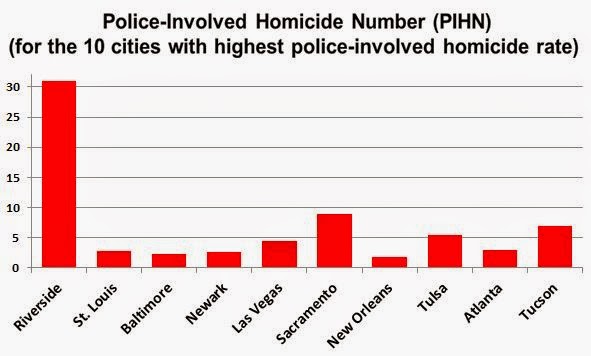
    The city of Riverside, California appears to be, by far, the city in which police are most likely to commit justifiable homicide. I listed a rough rank order of cities in my previous post. Riverside is almost 50 percent higher than the next highest cities, St. Louis and Baltimore. (Even more so if one takes into account Riverside’s population gains over the past decade.)

    Riverside police kill an average of 4.5 people a year. This is very high for a city with about 300,000 people. New York police kill about 13 people per year. But NYC has 8 million friggin’ people!

    Other cities with a lot of police-involved homicides, like St. Louis and Baltimore, have a lot of crime. Not Riverside. Over the past decade (2003-2012) there have been 14.6 homicides per year in Riverside. This is on par with about the national average of 5 per 100,000. St. Louis, by comparison, about the same size as Riverside, sees about 126 murders annually. Baltimore, twice as large, has averaged 248 murders. Baltimore and St. Louis have a lot of murders. Since there are more murderers, one would expect police to shoot more of them.

    But Riverside?

    I’ve invented an acronym called PIHN. It stands for “Police-Involved Homicide Number.” I’ve also decided it’s pronounced “pin.”

    PIHN takes a city’s violence into account and assumes a direct relationship between homicides in a city and police-involved shootings in that city. A higher PIHN means that there are more police-involved homicides for a given level of violence (presumably a poorly trained more trigger-happy police department). A low PIHN means fewer police-involved homicides (a better trained and less trigger-happy police department).

    I applied PIHN to the 10 cities with the highest rate of justifiable police-involved homicides in America and also to the 10 largest American cities. First the cities in which police kill a lot of people, per capita.

    Notice the cities ranked 2, 3, 4 (St. Louis, Baltimore, and Newark) in police-involved homicides drop way down if one takes the homicide rate into consideration.

    Here are the 10 biggest cities. New York, even with a low crime rate, has a low PIHN. Not surprising to me, because the NYPD is very restrained in shooting (despite what you may read). And there’s a general clustering between 2 and 4 for the top five.

    (Note the scale on this figure is half of the other one)

    San Diego is interesting because it doesn’t even rank in the top 25 for the overall rate of police-involved homicides. But San Diego is a safe city, overall. Given the low number of homicides in San Diego, the high number of police-involved homicides — a PIHN close to 12 — is unexpected and striking.

    Among the 20 cities I looked at, there’s a cluster of PIHNs between 2 and 3: Philadelphia, Atlanta, Chicago, St. Louis, Newark, New York, Baltimore, Dallas, and New Orleans. There’s variance, to be sure, but they’re all kind of in the same ballpark.

    And then you go west of the Mississippi and the PIHNs skyrocket, particularly in California. Tulsa’s PIHN is 5.4. Sacramento is 8.9. And Riverside, California? Riverside’s PIHN is 31.1! That’s crazy high. Here are the highest PIHNs:

    (Keep in mind this top-ten list comes only from the 20 cities I calculated, which are the 10 largest cities and the 10 cities with the highest police-involved homicide rate, based on URC data.)

    Riverside, California. What is up with Riverside?

    [You too can calculate PIHN! Divide the police-involved homicide rate or number by the average overall homicide rate or number. I used 2003-2012 homicide data from city-data). And then multiply by 100 to get a PIHN greater than 1. Or I’ll do it for you if you do some of the grunt work. Go to city-data, enter the city of your choice, scroll down to crime, add up the homicides numbers from 2003 to 2012.]

    [Data for San Antonio police-involved homicides are averaged from just the past six year, since they didn’t report to the UCR before then.]

  • On Fighting

    The third in a series from Adam Plantinga’s 400 Things Cops Know: Street-Smart Lessons from a Veteran Patrolman:

    People give off plenty of indicators that they’re looking to fight. Some precursors are obvious, like the clenched fists and the readjustment of the feet into an attack stance. Others are more subtle, like the lowering of the chin to instinctively protect their neck, or the rigid setting of the jaw or brow. Some people dry their hands on their pants to prep themselves for an assault. Many of these indicators are reflexive. People don’t even know they’re doing them. They’re tells, like poker players have. So it helps to pay attention to these signs and signals because if you see them coming from the guy you’re about to arrest, take your baton out and call for backup, because he’s not going quietly. He’s going to make you work for it.

  • The 21-Foot Myth

    It’s long been “known” among police that anybody with a knife or edged weapon within 21 feet is a lethal threat. This so-called “rule” has long been a big pet-peeve of mine.

    This anybody-within-21-feet-is-a-threat mentality does result in a lot of crazy people getting shot. And don’t get me wrong, I have no problem with police shooting and killing people coming at them with knives. But the idea that anybody within 21 feet could be carrying an edged-weapon and is thus potentially a lethal threat? Get real. Even if the “21-foot-rule” were true, what are you supposed to do with this knowledge? You’re a cop. Of course you’re going to be dealing with people at a normal talking distance of a few feet.

    The first problem with the 21-foot “rule” is that it assumes the officer doesn’t perceive a threat. The scenario starts with a holstered weapon. Well if you don’t perceive a threat that exists, that’s a separate problem. But it doesn’t mean you’re justified in keeping everybody at a 21-foot distance. The second obvious problem with the “rule” is that it assumes that the man with the blade is a trained skilled stealth ninja (or at least an academy instructor-san much better than you, young academy grasshopper trainee, at hand-to-hand combat).

    The relevant question is how close should you let a man with a knife get to you when you are in the drawn and ready position. Based on nothing but my gut experience (I’m sure somebody has better-formed answer), I would probably start shooting at about 6 feet. Maybe 10 feet if they’re advancing in more a threatening manner. But of course it all depends on the situation: what kind of person? What kind of knife? How is the person holding the blade? (Blade facing back, arm-down, fist clenched means the guy may know how to use it.)

    For small knives that don’t make particularly good weapons (like a dinner knife or something without a bolster/finger guard), I’d be more than willing to take my chances defending myself and whacking the guy with my trusty 29-inch wooden straight baton (a far better offensive and defensive weapon than the now much more common expandable metal asp). And I’d be more willing to try and disarm the guy if I could come up from behind while the person with the blade is distracted by the other six officers on scene who are drawn down on him).

    [And of course a man with a knife is exactly what the Taser is designed for, even if it is emasculatingly and shamefully used far more often for routine non-threatening non-compliance situations. Also, you should not mace a guy holding a knife, because then you have an angry blind guy with a knife.]

    Here’s the thing: most people police face with knifes are not well trained in “edged-weapon combat.” They are A) crazy or B) cutting up their loved one. Sometimes both. But police rarely if ever face a trained evil ninja out to assassinate a police officer caught unaware (honestly, there are far easier ways to assassinate a police officer, if you so choose). So basically you have this whole police paranoia based on a situation that never happens.

    I checked Officer Down and, since 2000, could find just four officers on patrol killed by an assailant with a bladed weapon: one domestic, one EP (aka: EDP or mental case), and two fatal fights after a foot pursuit. As you might guess, not one of these assailants was an a trained stealth ninja.

    Best I can ascertain, only one officer in the past 14 years (Sault Ste. Marie Detective John Weir) could have been saved, maybe, I don’t know, by keeping greater distance and being quicker to shoot. The other officers, rest in piece, died doing the job they had to do.

    So why has the 21-foot rule persisted for decades despite little basis in fact or police reality? I don’t know. I’d love to hear what you think. Could it be just another example of the conservative warrior mentality so pervasive (and usually counterproductive) in policing? Think of this: the instructor teaching hand-to-hand combat in the academy is the most aggressive threat-perceiving police officer out there perhaps (just hypothetical, er, based on my experience) having been pulled off the street and into the academy where he can’t shoot another sue-the-city person (all of them technically justified, but still…).

    So you get a perpetuating cycle where the paranoid cop too-quick to elevate a threat-level ends up teaching and scaring the next generation of police officers to adopt his code-red us-versus-them ideological world-view in which one must assume the worst about even seemingly non-threatening citizens.

    Here’s a good recent piece by Ron Martinelli which more scientifically analyzes and partially debunks the 21-foot rule, and inspired this post. If you’re still with me, it’s also worth clicking-through to the first link on this page.

    Update: Based on a useful comment to this post, I also should have included blunt weapons and not just knives. Doing so brings the total number of police officers killed in the past 15 years with any relevance to the 21-foot-rule up to three police officers. It’s also worth mentioning that I’m not looking at officers just injured. But we don’t have those figures. And one can assume some relationship between fatal and non-fatal injuries.

    So let’s put the 21-foot-rule in perspective. In this same time period since 2000, as many officers (3) have been killed by a moving trains.

    Six officers have been killed by animals: one by cow, one by spider, and one by bee; the other three from horses (interestingly, none by dog, the only animal often at the receiving end of a 21-foot mindset).

    If one were truly interested in saving police lives rather than simply building police paranoia and mistrust of the public, we should look at the 515 law enforcement officers killed traffic fatalities. How many of these would have been prevented by officers wearing seat belts? And yet the same officer who won’t wear his seatbelt because he claims it gets caught on his equipment (which, speaking from experience, is bullshit) will be quick to spout the absurdity that his life is endangered by anybody within 21 feet, in optimal conditions.

    Also, it’s come to my attention that the 21-foot-rule has now been upped to 30 feet.

  • “Unarmed” man not shot by police

    One of the things that keeps coming out of the Ferguson shooting is that Michael Brown was “unarmed.” As if “unarmed” people cannot be a threat to cop.

    That’s bullshit.

    Now I’m not talking about whether Michael Brown was or was not a threat. I do not know. But the fact that he was “unarmed” does not mean he wasn’t a threat.

    This is a video (from 5 months ago) of an “unarmed” man on the whom I think the police officer should have shot. But the cop didn’t. I guess the officer didn’t feel his life was in danger. Kudos to him. Seriously. But I think his life was in imminent danger. And I think I would have shot the guy.

    Just based on the description of the video (and the fact that the train isn’t leaving and a police officer is involved), let’s assume guy threatened to shoot subway passengers. A cop responded. The guy attacks the cop. That’s where the video starts.

    The cop tries to retreat. Then the cop maces him at 0:15. There’s a nice deflection at 0:17. (Shazam! Jujitsu shit.) The asp comes out at 0:21. [Wack.] Little if any effect. The guy keeps coming at the police officer. Notice how few seconds have passed.

    The grappling continues. The guy keeps coming. What would you do?

    Now when you can use lethal force is not cut and dried. It’s up to the police officer. And I can’t read this police officer’s mind. But he didn’t use lethal force. That was the choice he made. Maybe he never felt his life was in danger.

    But I’m telling you I think I would shot guy point-blank at 0:45.

    Would this have been a “good” (ie: justified) shooting. Abso-fucking-lootly.

    I’ve been in fights. And I haven’t shot anybody. For whatever reason (backup, for instance) I never felt my life was in danger. I won’t say this cop should have shot the guy. He felt he didn’t need to. And he turned out to be right. But had he shot him, I would defend that shooting (as would the law).

    But what if there’s no video? What if the cop does shoot? What if, as would happen, some “eyewitness” on the subway says “the guy had his hands in the air [which, actually, he kind of did]. And he was surrendering when the cops shot him for no reason!” Then what do you assume?

    Because when cops hear of a cop shooting an “armed person,” they assume something like this happened. Cop know, based on everything they have done and seen, that police do not shoot people for no reason. Cops think: there but for the grace of God, go I.

    Also note there is a train of people, not one of whom helps the cop. (Or you could say it’s good nobody helped the other guy, who was asking for help).

    So this subway cop showed amazing (and perhaps even unwise) restraint in use of force. But yes, in hindsight, it’s clearly better that nobody got shot.

    So did this officer receive any kudos for his bravery or his restraint? I don’t know. Should he? Yes. Did he? I doubt it.

  • How to arrest a very large man who doesn’t want to go

    Telling officers what not to do doesn’t tell them what they should do. And it’s never going to look pretty. That doesn’t make it wrong.

    Here’s my op-ed in today’s New York Daily News:

    If you’re a cop, how do you cuff a 6-foot-tall, 350-pound man who doesn’t want to go to jail?

    Most arrests happen without a problem. Police order a guy to put his hands behind his back. The cuffs click or zip, and that’s that. But sometimes people make it clear that they don’t want to go. Then what?

    Read the whole thing here.

  • The chokehold that wasn’t?

    Not surprisingly, the preliminary autopsy report in the death of Eric Garner shows, showsthat the “deadly encounter Thursday did not damage his windpipe or neck bones.”

    Why is the not surprising? Because I’m still not convinced there was any chokehold at all. It certainly did not happen when Mr. Garner was taken down. There may have been a chokehold later, but as I have said, and without 100 percent certainly, I don’t think there was. But seeing how Garner apparently didn’t suffer any damage from a chokehold, can we at least stop saying a chokehold killed him?

    The Daily News, which has been the most harsh of all the NYC newspapers, has repeated mentioned “chokehold” as a matter of fact, even though it may not be. “Chokehold” is mentioned around eight times in a webpagethat ends with, “Sources told the Daily News that a preliminary report found no signs of neck trauma, such as a crushed windpipe.”

    There’s something very strange about people who are screaming about “police killing a man with an illegal chokehold” who then don’t care that there perhaps there wasn’t a chokehold. Don’t facts matter? Of course it doesn’t help that Commissioner Bratton himself has called it a chokehold, which seems to sort of settle the matter, at least in the media.

    Of course Garner is dead, so it’s fair to ask, “does it matter?” Well, yes. It does. Because (as I’ve said before) there’s a big difference between police killing a man and having a man die of a heart attack in the course of resisting arrest. It matters because the former is a crime and the latter is a tragedy. The guy seems to have died from physical exertion while resisting arrest. Is that the fault of police?

    Meanwhile a police officer has been tried in the court of public opinion and found guilty. He very well may be tried in a criminal court — and then there will be further shock and uproar when he is acquitted.

    Except for some of the more extreme cops, who believe everybody resisting police should die, most decent people can agree that something went wrong. A man shouldn’t be dead after a minor police encounter over a non-violent crime. That should be a starting point for discussion. But if you start by saying police killed a man — even if it’s not true — it’s hard to have any sort of reasonable or productive discussion.

    This ideological anti-police bias is a left-wing lie similar to the right-wing lies I prefer to write about. It’s like Larmondo “Flair” Allen, the drug dealer who, according to a right-wing email being sent around, was receiving $13,500 a month in welfare before he was murdered. “An outrage!” people scream while blaming Obama (“Flair” died in 2004). When I corrected this fact — the real figure would have been more like $550 a month — most people who so outraged by the $13,500 figure didn’t seem to give a damn that it wasn’t true. They want to be outraged! Facts be damned! “Well,” they say, “maybe those numbers are wrong, but that doesn’t change my opinion.” Well… then you’re a fool. If your opinion is based on beliefs that are not true, shouldn’t you perhaps change your opinion? Or at least get your facts right?

    Maybe in my next post I’ll try and break down the Garner encounter situation and point out various points where something could have been done differently. Choices, had they been taken, where Mr. Garner wouldn’t end up dead. Certainly things went wrong; a man is dead. But that doesn’t mean the officers on scene killed a man.

    [Update: I defer to the medical examiner, who says otherwise.]