Tag: war on drugs

  • Legal Robbery

    Meanwhile, civil forfeiture continues. You know, where government agents just come and take your money. Why? Because they can.

    Charles Clarke was questioned because the U.S. Airlines ticketing agent told police that his checked luggage had a strong odor of marijuana. When his money was confiscated, Clarke had no guns, drugs, or any contraband on him or in his luggage.

    According to the affidavit, this is what gives probably cause to steal $11,000 from a citizen:

    Travel on a recently purchased one-way ticket;

    inability to provide documentation for source of currency;

    strong oder of marijuana on checked luggage;

    positive hit by drug dog.

    Eleven law enforcement agencies want a cut of his money:

    in Charles Clarke’s case, agencies stand to receive payouts even though they had nothing to do with the seizure. “Law enforcement agencies are just scrambling to get a cut of the money and it has nothing to do with legitimate law enforcement incentives,” said Clarke’s attorney Darpana Sheth. “It’s more about policing for profit.” The small amounts that most agencies requested — just a few hundred dollars — represent what Sheth calls the “pettiness” of much of civil asset forfeiture. “It’s really just the money, its not anything else that’s driving the request,” she said.

    According to the Federal Aviation Administration, passenger departures at CVG [the airport] have dropped by about 75 percent since 2005, from a high of roughly 11 million down to fewer than 3 million in 2013. Over the same time, the total amount of cash seized at the airport has increased more than sixteen-fold, from $147,000 to $3 million in 2012. So in stepping up their seizure efforts, authorities at the airport are squeezing more cash out of fewer passengers.

    So Clarke has to hire a lawyer to prove the innocence of his money. The case is titled: “United States of America v. $11,000 in United States Currency and Charles L. Clarke, II.” I doubt he’s going to win.

  • The Futility of the War on Drugs

    Given the recent discussion started by Michael Wood, Jr. this last excerpt from Cop in the Hood couldn’t come at a better time:

    It may seem incongruous for police officers to see the futility of drug enforcement and simultaneously promote increased drug enforcement. But for many, the drug war is a moral issue and retreat would “send the wrong message”:

    “It’s a crusade for me. My brother and a cousin died from heroin overdoses. I know that on some level it’s a choice they made. But there was also a dealer pushing it on them. I want to go out and get these drug dealers.”

    Another officer was more explicit: “You’ve got to see it [drugs] as evil. What do you think? It’s good? When we’re out there, risking our lives, we’re on the side of good. Drugs are evil. It’s either that or seeing half the people in the Eastern [District] as being evil. I like to think that I’m helping good people fight evil. That’s what I’d like to think.”

    The attitudes of police and criminal are largely controlled by a desire to protect their turf while avoiding unnecessary interactions. On each call for service, drug dealers generally do not wish to provoke the police and most police officers are not looking for adventure. At night, curfew violations can be enforced on minors. Open containers can be cited. People can be arrested for some minor charge. But arrests take officers off the street and leave the drug corner largely unpoliced while the prisoner is booked. Nothing police officers do will disrupt the drug trade longer than it takes drug dealers to walk around the block and recongregate. One officer expressed this dilemma well: “We can’t do anything. Drugs were here before I was born and they’re going to be here after I die. All they pay us to do is herd junkies.”

  • Things Police Do

    Things Police Do

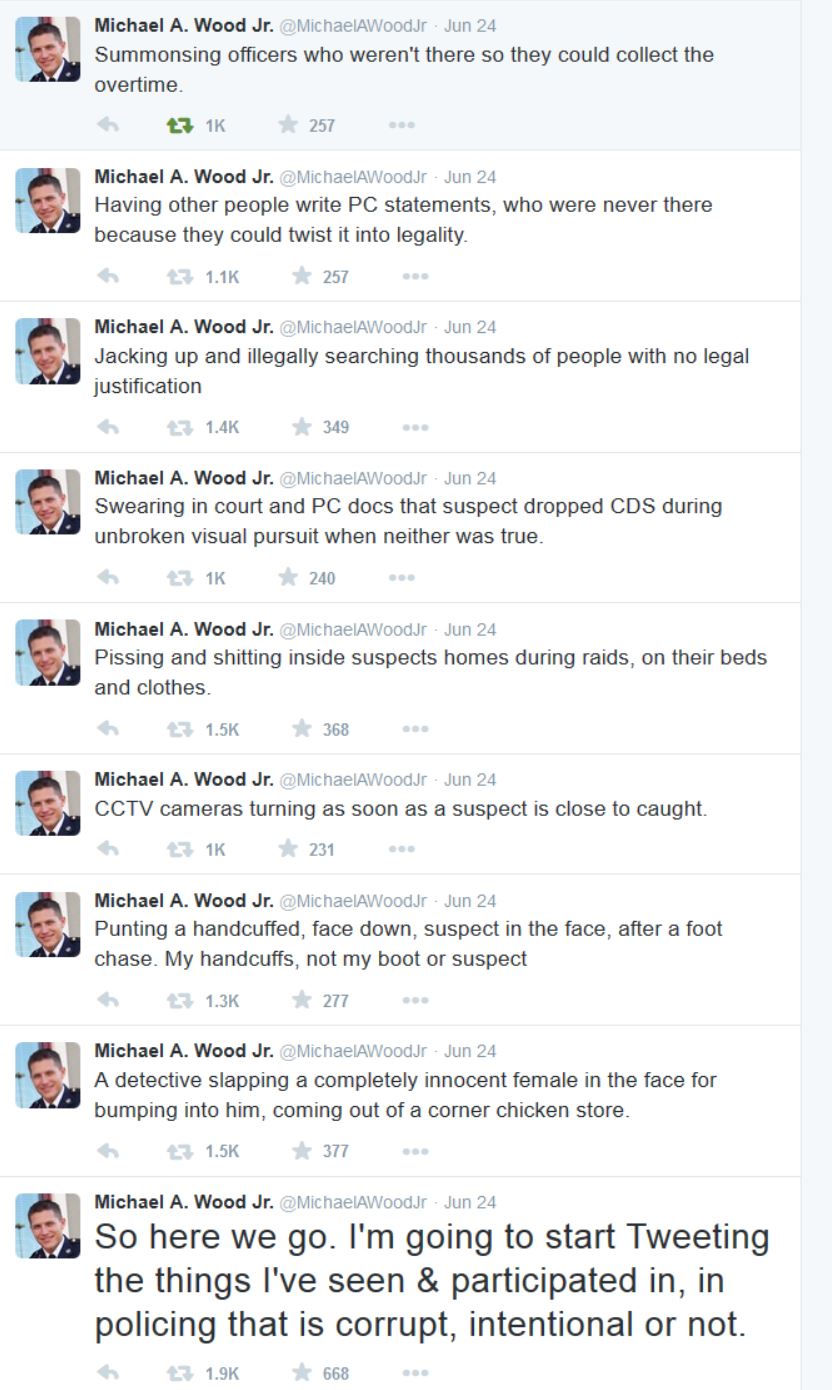
    Michael Wood Jr. has made some waves by tweeting about things he saw as a Baltimore cop.

    [To get up to speed, single best thing to read now is the Balko interview.]

    Honestly, I don’t doubt what Wood says. I am curious if all the bad he saw came from his time in narcotics. And for better or for worse, he wasn’t in narcotics long. I don’t think he made an arrest since 2009. There has been lots of time to bring up these issues. Lots of time to go to IAD. In fact, he still could. But anyway…

    I never worked a specialized unit. I didn’t want to. I didn’t like they way the worked. (I also wasn’t there long enough anyway to get out of patrol.) I saw the drug squads tear up homes during raids. (I was sometimes the lone “uniform” out back.) It was immoral and ugly. Worst of all, it was legal.

    End the drug war and 80 percent of police problems vanish.

    But I’m curious, if Wood was a sergeant, did this stuff happen under his command? Because then it’s also on him. But all in all, I have no reason not to take him at his word:

    I will admit to some self interest in coming forward. I’d like to part of the solution. I woke up to this, and I think I can be a bridge. I speak the language cops speak. If there’s some task force or policing reform committee I can serve on, I’d love to do that.

    Other than that, I think we just need more conversation.

    Unlike Wood, I never had a “come to Jesus” moment working as a cop. The world — and policing — is filled with a lot of gray. I already knew the war on drugs was doomed. (What I learned as a cop on the front line was how that failure worked out on the front line.) I suppose I went in a bit more world weary and cynical than the average cop. I was older (29) than the average rookie. I lived in the city. I did not have a military us versus them attitude. I was college educated. Well traveled. I spent a lot of time with the police in Amsterdam (on and off from 1996 to 1999). So I had a certain perspective as to what I was seeing and doing on the job. I was not completely unfamiliar with the ghetto, black people, or urban life in general. I was not afraid.

    I am afraid that lost in the sensationalism of a cop “telling all” will be the subtlety and nuance of what Wood is saying. It would be unfortunate were this just filed away as ammo in the “cops are bad” camp. I know — as I presume Wood does — too many cops who do care, do have empathy, and do work very hard to help people. I also know a lot of cops who maybe stopped caring, but still do a good job. And, sure I’m all for societal justice, but lofty ideals don’t tell police what to do in neighborhoods with these kinds of problems!

    In a very long radio interview Wood mentions something which deserves highlighting:

    This job is largely impossible.

    The expectation of the modern police officer is that they should be a medic. They need to be MapQuest. They need to be a jujitsu expert. They need to be a handgun superstar who can shoot somebody in the knee…. They need to be a psychiatrist. They need to understand mental illness. They need to be able drive effectively. They need to do all of this while making $45,000, having minimal training, and no education.

    Wood makes the point that there’s too much injustice in our society. He’s right. And he’s right that they’re linked to race and class. He’s right that the rules are different if you grow up in the ghetto. He’s right that the war on drugs is a failure. And he’s right that too many cops come from completely different backgrounds without any empathy or understanding of the area or the people in the area they police. He’s right that what we’re doing isn’t working. He’s right that police can do better.

    Here’s an interview of Wood by Radley Balko in the Washington Post:

    What we’re doing to people to fight the drug war is insane. And the cops who do narcotics work — who really want to and enjoy the drug stuff — they’re just the worst. It’s completely dehumanizing. It strips you of your empathy.

    I found his take on veterans as cops (he is one) interesting:

    But when it comes to former military joining law enforcement, I’m in the camp that says they’re going to be better when it comes to shootings and using force. Bad police shootings are almost always the result of a cop being afraid…. The military strips you of fear. Here’s the thing: There’s nothing brave or heroic about shooting Tamir Rice the second you pull up to the scene. You know what is heroic? Approaching the young kid with the gun. Putting yourself at risk by waiting a few seconds to be sure that the kid really is a threat, that the gun is a real gun. The hero is the cop who hesitates to pull the trigger.

    That’s where I think a military background can help. Very few of these bad shootings were by cops with a military background. There may have been a few, but I can’t think of one.

    I’ve often said it would be nice if we could talk about some of the important issues before somebody dies. Maybe Wood is giving us that opportunity.

    [Though he’s wrong about the baton.]
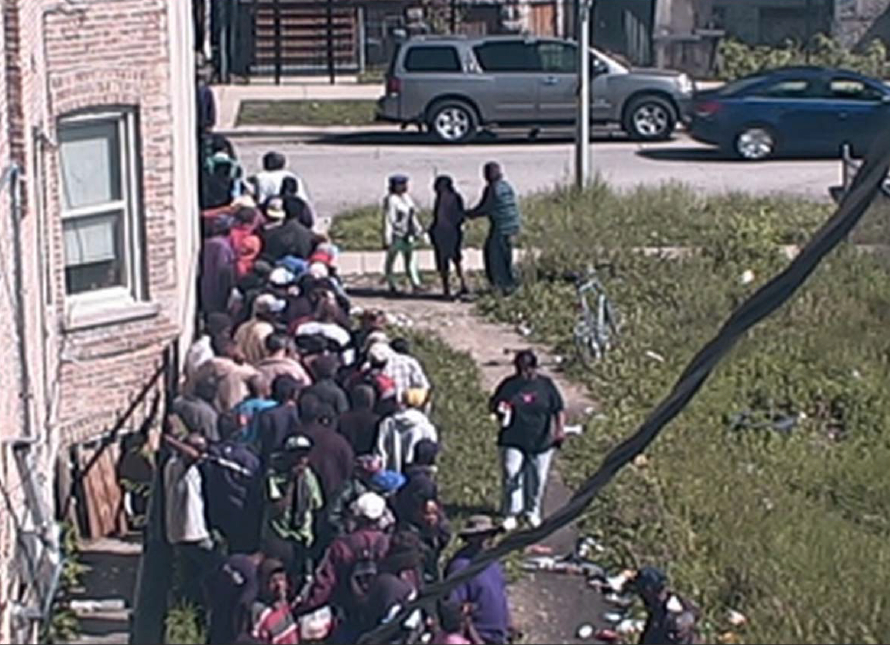
  • Customers line up for heroin in Chicago

    Customers line up for heroin in Chicago

    So what do you want cops to do about this?

    From the Chicago Sun-Times. The 3700 block of W. Grenshaw. 3711 W. Grenshaw, to be exact, according to my google streetview snooping skills. It’s not even a horrible looking block, to be honest. I mean, it’s not the best looking block. But there are a bunch of well-kept homes. It’s a short walk to the L. Two of Chicago’s largest parks are within walking distance. You can get a great building with a few units for under $120,000. But, of course, that’s not the point. Because of course none of that matter with scenes like pictured above.

    I’m certain the neighbors called police. So what should cops do? Short of legalize and regulate distribution, this is what I have never heard a good answer to.

    Decriminalizing small-scale heroin possession isn’t the answer. Because then police have no legal authority over everybody lined up to buy drugs. And police do need to “do something.”

    In this case, there was an investigation, the Feds were involved, a big raid, and dozens of people were arrested. That’s all well and good. And it cost hundreds of thousands of dollars in law enforcement and court costs. It will cost millions of dollars in prison time.

    And for what? So now somebody else is selling. At a different house. Now what? Wash, rinse, and repeat isn’t good enough.

    [Two miles from this house is this block]

  • On arresting drug offenders

    From Cop in the Hood:

    Because of these problems and the “victimless” nature of drug crimes, most drug arrests are at the initiative of police officers. On one occasion, while driving slowly through a busy drug market early one morning, I saw dozens of African American addicts milling about while a smaller group of young men and boys were waiting to sell. Another officer in our squad had just arrested a drug addict for loitering. I asked my partner, “What’s the point of arresting people for walking down the street?” He replied: “Because everybody walking down the street is a criminal. In Canton or Greektown [middle- class neighborhoods] people are actually going somewhere. How many people here aren’t dirty? [‘None.’] It’s drugs. . . . If all we can do is lock ’em up for loitering, so be it.”

    I don’t think that’s the answer. But… I’m not certain what is the answer. Certainly junkies are a quality-of-life issue. The best we could do is regulate the drug trade. The worst we could do is decriminalize low-level drug offenses. The latter solves neither quality-of-life issues nor the violence around public drug dealing.

  • Baltmore’s so-called gang problem

    From Cop in the Hood:

    In cities like Chicago and Los Angeles, gangs control the drug dealing. Because of that, some assume that drug violence is intrinsically linked to gangs. But East Coast cities have a different history. Large-scale gangs, such as the Bloods and Crips, are growing but still comparatively small. Gangs in Baltimore tend to be smaller and less organized, sometimes just a group sitting on a corner. Any group selling drugs can be called a gang, but the distinction between a gang and a group of friends is often based more on race, class, and police labeling than anything else. The disorganization of Baltimore’s crime networks may contribute to Baltimore’s violence. Conceivably, organized large gangs could reduce violence by deterring competition and would-be stickup kids.

    While drug-dealing organizations exist, they tend to restrict themselves to wholesale operations without conspicuous gang names, clothes, or colors. In Baltimore, wholesalers–often SUV-driving Dominicans and Jamaicans with New York or Pennsylvania tags–will sell their product to various midlevel dealers once or twice a week. The midlevel dealers will re-up the corner dealers’ stash as needed. Street-level dealers in Baltimore control smaller areas, perhaps three or four corners in close proximity. As a uniformed patrol officer, my focus was exclusively on the low-level street dealer. Going up the drug ladder requires lengthy investigations, undercover police, snitches, and confidential informants. A patrol officer’s job is to answer 911 calls for service.

    Has any of this changed?

  • “Police earn court overtime pay while residents get rap sheets. It’s a horrible equilibrium, and police are the fulcrum”

    I hear a lot of people with very strong opinions try and tell me and others about a place they’ve never been and a job they’ve never worked. I wrote about police the drug corner, places like where Freddie Gray was arrested and died in police custody. The next few posts will be exerts from the chapter in Cop in the Hood called “The Corner: Life on the Streets.” It starts with this quote from a Baltimore City police officer:

    It’s a different culture. You know, what is normal for us–like going to work, getting married–they don’t understand that. Drugs are normal. Mommy did it. Daddy did it, not that he’s around. But if people want to take drugs, there’s nothing we can do. All we can do is lock them up. But even that is normal.

    On “clearing the corner”:

    [It’s] what separates those who have policed from those who haven’t. Some officers want to be feared; others, respected; still others, simply obeyed. An officer explained: “You don’t have to [hit anybody]. Show up to them. Tell them to leave the corner, and then take a walk. Come back, and if they’re still there, don’t ask questions, just call for additional units and a wagon. You can always lock them up for something. You just have to know your laws. There’s loitering, obstruction of a sidewalk, loitering in front of the liquor store, disruptive behavior.” Police assume that if the suspects are dirty, they will walk away rather than risk being stopped and frisked. You can always lock them up for something, but when a police officer pulls up on a known drug corner, legal options are limited.

    If a shop is run efficiently, the boss, himself working for or with a midlevel dealer, should be able to sit and observe the operation. By not handling drugs or money, he faces little risk of arrest from uniformed patrol officers. The boss may be sitting on a stoop of a nearby vacant and boarded-up building posted with a “no loitering” sign. Because of the sign, he could be arrested for the very minor charge of loitering, the catch-all arrest charge. But how often can that be done? Repeated arrests for loitering, especially if no drugs are found, could easily result in a complaint about police racism and harassment to Internal Affairs.

    Don’t worry. It gets better.

  • Race, drugs, arrests, and hospital admissions

    Race, drugs, arrests, and hospital admissions

    I recently got some interesting data over the email transom.

    Here’s the thing: It’s largely assumed that white and black illegal drug use is about the same. And that’s based on legit sources. The kind of drug people take varies by race. For instance crack is still disproportionately black. Meth and LSD still mostly white. Generally.

    But those who point to the racism of the drug war, myself included, start with the assumption that illegal drug use overall is not disproportionately black. Quick random links: 1, 2, 3, and 4. I did find one opposing view (but even that only questions a 20 percent difference).

    Now the link between drugs and violence is disproportionately black thanks to the prohibition and the nature of illegal drug distribution. Public drug dealing equals violence. Buying from friends and family and coworkers? Much more copacetic.

    Blacks are 32 percent of those arrested for drugs, which is roughly twice what would expect to find based on the number of blacks in America.

    But the nature of drug dealing (and police presence and reaction to violence rates) does explain some of the disproportionate arrest and incarceration rate. You don’t get arrested for drugs unless A) police find them. And that sometimes often relates to B) people complain about it. (Street corner drug dealing in particular.)

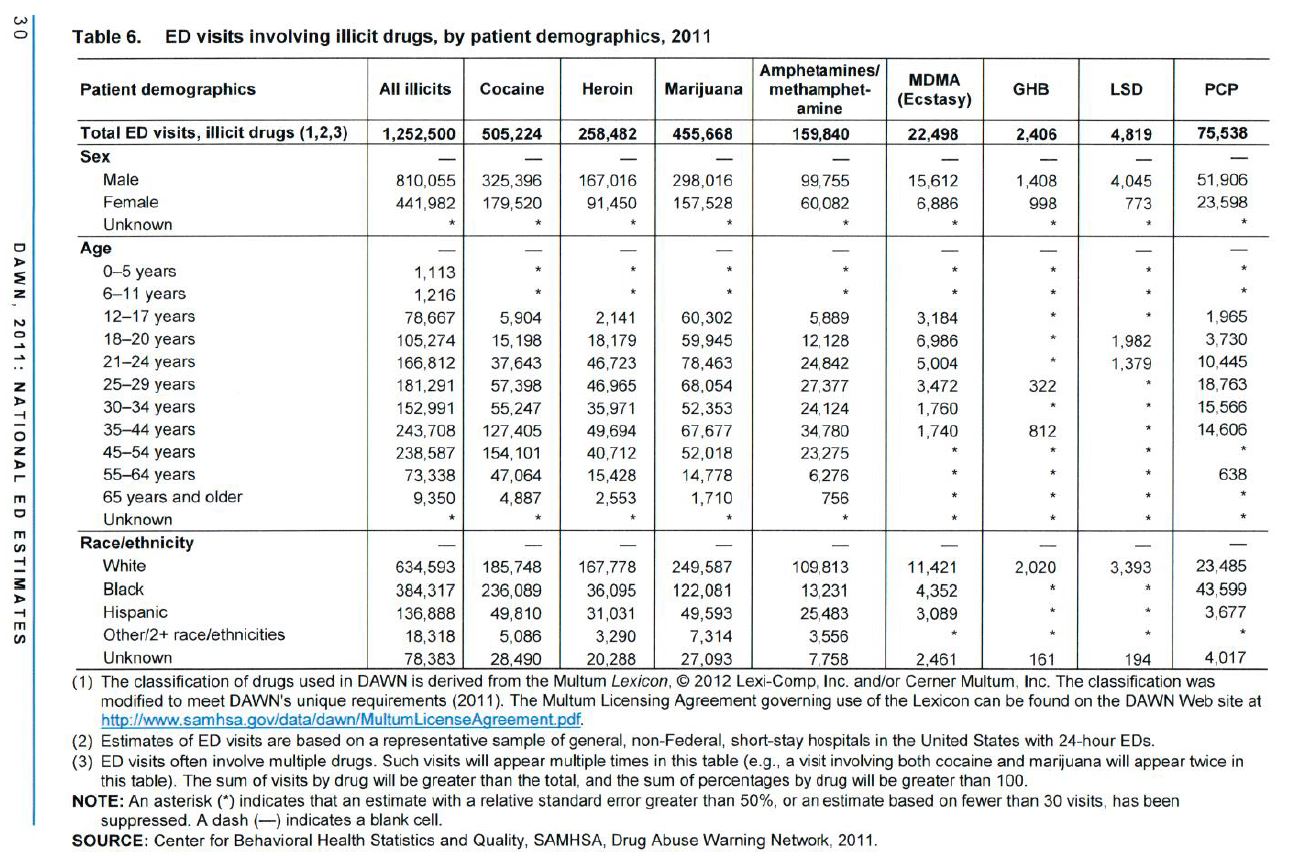
    So explain this: Why are blacks roughly one-third of those admitted to the ED (formerly known as the ER) for illicit drugs? This is rate 2.5 times greater than one would expect, based on 13 percent of Americans being black.

    click to embiggen.

    Leaving out when race in unknown, 60 percent of PCP patients going in to the ED are black, 50 percent of cocaine admittances, 15 percent for heroin, 28 percent marijuana, 9 percent meth, and less 1 percent for GHB and LSD. All in all it’s 33 percent. The ED admissions percentage, by race, is the exact same as the percentage of those arrested for drugs.

    What gives? Perhaps the hospital data is bad. But I’m more likely to suspect that surveys on illegal drugs use are bad. Are blacks are 2.5 times more likely to buy bad drugs? Are blacks are 2.5 times more likely to go to the hospital if they have a bad trip? Maybe. I don’t know.

    I can’t figure out how to reconcile these hospital admissions data with the long-established belief that illegal drug use rates are consistent across race. Any ideas?

    [Update: A lot of people have good ideas. But I think it comes down to the fact that blacks are twice as likely (per capita) to go the ED (and there are a bunch of reasons for that). That could explain away 80% of the 2.5X disparity right there. The rest could be measurement error or anything. That’s close enough for me. I consider that a good honest answer to a good honest question.]

  • “Daily Measurables”

    My long-standing question related to Freddie Gray — no doubt tops on everyone’s list — has always been, “Why the hell were officers doing much of anything at 8:45 on a Sunday morning?!” The Baltimore Sun reports:

    About three weeks before Freddie Gray was chased … the office of prosecutor Marilyn Mosby asked police to target the intersection with “enhanced” drug enforcement efforts.

    “It must be understood that Mrs. Mosby was directing these officers to one of the highest crime intersections in Baltimore City and asking them to make arrests, conduct surveillance, and stop crime,” the defense attorneys wrote. “Now, the State is apparently making the unimaginable argument that the police officers are not allowed to use handcuffs to protect their safety and prevent flight in an investigatory detention where the suspect fled in a high crime area and actually had a weapon on him.”

    [Western District commander Maj.] Robinson told [Lt.] Rice and the other officers to begin a “daily narcotics initiative” focused on North Avenue and Mount Street, according to the email, and said he would be collecting “daily measurables” from them on their progress.

    “This is effective immediately,” Robinson wrote, noting that the officers should use cameras, informants and other covert policing tactics to get the job done.

    “They want increased productivity, whether it be car stops, field interviews, arrests — that’s what they mean by measurables,”

    Butler said that he has never seen such orders come from the state’s attorney’s office but that they come at the request of politicians and community leaders all the time.

    “Once you’re given an order, you have to carry it out. It’s just that simple,” he said.

    Defense attorneys want Mosby removed from the case because of her involvement in the police initiative.

  • “Cop of the Year”?

    I was recently asked for comments about a “Cop of the Year.” It doesn’t matter which. I didn’t know the cop, so I didn’t say much. I have no clue what he did (or didn’t) do. But I am suspicious of “cops of the year.” Are my suspicions justified? I’ll presume there are lots of nice “cops of the year” out there. Wonderful cops of the year. But I don’t remember meeting one. Of course a good cop would be modest about such an award and wouldn’t wear it on his sleeve.

    So maybe I’m just barking up the wrong tree. But it sure does seem like a disproportionate number of arrested cops have been a “cop of the year” at some point. (Of course if I’m looking for something like this, and I am, then I’m susceptible to “confirmation bias.”)

    I do worry that the same factors that make a cop “cop of the year” — aggression, a lot of arrests, a focus on results, seeing your job as a crusade against evil, seeing no gray in the world — these are exactly the same factors that get you in trouble in the long run.

    Quite simply, it’s nearly impossible to consistently make 10 times as many arrests as other cops. Seems to me that being a “super cop” is more a red flag than a cause for celebration.

    Also, I never wanted to work with an over-driven I’m-going-to-save-the-world let’s-lock-up-all-the-bad-guys adrenaline-loving supermen. I mean, why is somebody getting into a signal-13s when you’re off duty? And when that happens, why would that person end up on my post saying, “you never saw me.” I never wanted to see him because trouble was always finding him. Maybe he was just a better cop than me. Either way, I stayed clear.

    [I just googled the guy I’m thinking of, because I assumed he didn’t retire as a cop. And he didn’t. Though he does seem to have a better job. So for all I know he mellowed and learned and took a wise career move. Maybe. But to see him described in one article as a “by the book” cop? Ha.]

    Anyway, this all came to mind because another “cop of the year” was just sentenced to 10 years for drug charges. So I googled “‘Cop of the year’ sentenced” and came up with a bunch pretty quickly. Coincidence? I don’t know. But they were all described as having at one been recognized as a “cop of the year”:

    Philip LeRoy, Queens. Drugs. The most recent.

    Noe Juarez in Houston. Cocaine trafficker for Los Zetas.

    Drew Peterson, Illinois. Domestic murder.

    Ron Coleman, Houston, Drugs.

    Jonathan Bleiweiss, Florida. Forced sex with male illegal immigrants.

    Jerome Finnigan of Illinois. Armed robbery (and racist bad taste).

    David Britto, Boynton Beach, Florida. Drugs.

    James Joseph Krey, Florida (again). Domestic-related.

    Michael Grennier, South Plainfield, NJ. Child porn.

    Michael Froggatt. Gold Coast, Australia. Drunk Driving.

    Matthew Anselmo. Omaha Nebraska. Mail fraud & money-laundering.

    Pace yourself, I say. You got years on the force to do good. And you don’t want to get burnt out of banged by the department because you took the job too seriously.