Tag: NYPD

  • Why did New Yorkers stop shooting each other?

    In New York City not only has the number of homicides being going down, but the percentage of homicides committed with a gun has been decreasing.

    Put another way, there were about 309 people shot and killed in 2011 in NYC (for UCR reasons we’re talking incidents, so this is a bit of an undercount). In 2013: 188. That’s a huge decrease. (2014 saw 184.)

    If you look at all other city homicides (ie: non-gun), they’re down a little. But the decrease in NYC is all about fewer people shot. Did New Yorkers get together in 2011 and decide to stop shooting each other? I missed that meeting. Was it because of Occupy? Or because Occupy was broken up? Did anti-police protests somehow reduce gun violence? I doubt it. But something happened, and I don’t know what it is.

    Oddly, the NYPD didn’t take credit for this crime drop because it coincided with anti-police protests and the end of stop and frisk. Cops and Kelly and those on the right were certain — hoping even — that crime was going to skyrocket. They’ve been saying that since at least 2012. Well, it’s 2016.

    Here is some UCR homicide data from 2014 (if you hold your breath for 2015, you’ll turn blue and pass out):

    New York City: 56 percent of homicides are by gun, 26 percent by knife (“or cutting instrument”). Nationwide is 68% gun, 13% knife.

    A few other cities:

    Baltimore: 75% gun, 18% knife.

    Chicago: 87% gun, 7%knife.

    Los Angeles: 73% gun, 13% knife.

    Here’s the percentage of NYC homicides that were gun-related at various years (UCR data):

    1990: 74% of homicides by gun

    1997: 61%

    1998: 60%

    1999: 59%

    2000: 66%

    2002: 61%

    2005: 61%

    2009: 63%

    2010: 61%

    2011: 61%

    2012: 57%

    2013: 59%

    2014: 56%

    So maybe that’s not the issue. Honestly? A five-percent decrease since 1997 ain’t such a big deal. But my gut tells me a 5-percent slow but steady drop since 2011 does mean something.

    Of course it *is* related to gun control. But as any 2nd-Amendment-loving Trump-loving patriot will tell you (often in all caps) “CHICAGO HAS GUN CONTROL!!!!” And Chicago, if this is too subtle for you, has a lot of killings.

    So maybe, at least this is what I think, gun control isn’t about gun laws as much as actual prosecution and deterrence. New York is the only city where people believe — mostly correctly I might add — that illegal gun possession will bring you real time.

    What if it were that simple?

  • Al Baker is one smart, journalist

    I always like Al Baker’s stories. He seems to get it. And I don’t think he’s Greek. But I do think his father was a cop. Maybe that matters. Or maybe he’s just smart and works hard. Anyway, I’m happy to see him writing about police issues again. I trust that when I read his stories, I’m going to learn something.

    On stop and frisk in the NYPD. As to the picture… why is that cop car on the sidewalk? It’s just a Broken Window pet peeve of mine.

    Since Mayor de Blasio took office in New York, the number of recorded street stops has continued to decline, to about 24,000 last year from 45,787 in 2014…. Those tallies represent a small fraction of the stop-and-frisk activity logged during the administration of Mayor Michael R. Bloomberg, a political independent, when recorded stops reached a height of 685,000 in 2011, and fell to about 192,000 in 2013, which was Mr. Bloomberg’s last year in office.

    To ask cops to fill out a lengthy form and have another officer, the sergeant, review the form? It’s too much to ask. Not when stops are discretionary. (There’s also something rude about asking all this information from a person who just wants to go about his business, but nobody ever raises that point.) But if the goal is to end stops and all discretionary policing, well, this is one step to that goal.

    All that said, keep in mind murders are down 38 percent this year! That stat doesn’t mean much in mid-February, of course. But were shootings up, I’m sure you’d be hearing from the usual suspects saying the sky is falling… and it’s Obama’s fault… and don’t black lives matter?

    Anyway, I still have to read the whole report. Summaries and thoughts from those who have are more than welcome.

    [Kind of sort of related, how much does the “independent monitor,” Arnold & Porter LLP, get for writing this report? And does anybody know if anybody knows if consent decrees have any impact on crime? Something seems awfully fishy — not about this report in particular, I have great respect for Anthony Braga — but for the whole advice and consult and decree concept in general. Is there a ready list of police departments that have been under consent decrees and for which years?]

  • The right not to get shot

    The right not to get shot

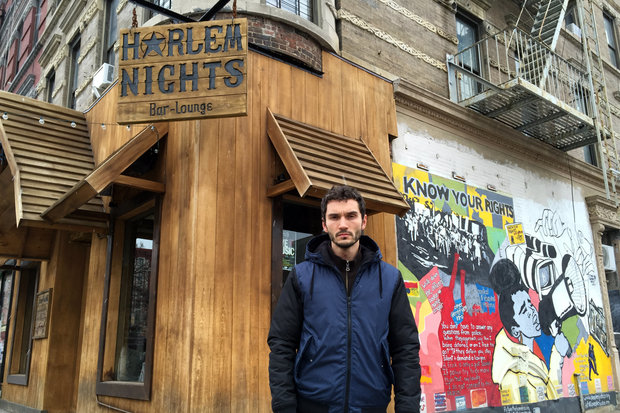
    There’s something ironic here, this Harlem bar owner discussing the fatal shooting in his bar and the need the need to buy a metal detector and hire a third security guard in order to pat-down customers so nobody gets shot:

    He called the extra security measures, “horrible” and “insane” but unfortunately necessary to keep everyone safe.

    Hoping there isn’t retaliation, he’s standing in front of a “know your rights” mural that urges people to observe and record — but not cooperate with — police.

    (FYI, from google street view, the mural predates the bar.)

  • NYPD Officer Liang found guilty

    Do I think Peter Liang wanted to kill Akai Gurley? No. Do I think Liang messed up so bad that he should be found criminally guilty of manslaughter and official misconduct for failing to help Mr. Gurley as he lay dying in a public housing stairwell?

    Yeah.

    But, as a side note, Liang is right about this:

    He felt unqualified to perform CPR, as is required of an officer under such circumstances, because he received poor training at the Police Academy.

    And I certainly don’t think he (or anybody) should be given a long sentence without mens rea.

  • Sergeant in Eric Garner death charged departmentally

    I don’t know if this is good or bad, but why does it take years? That’s what’s so f*cked up about police discipline. And these charges were placed only, 18 months later, to beat the statute of limitations. The story in the Times.

  • “Stop question and frisk” is dead

    “Stop question and frisk” is dead

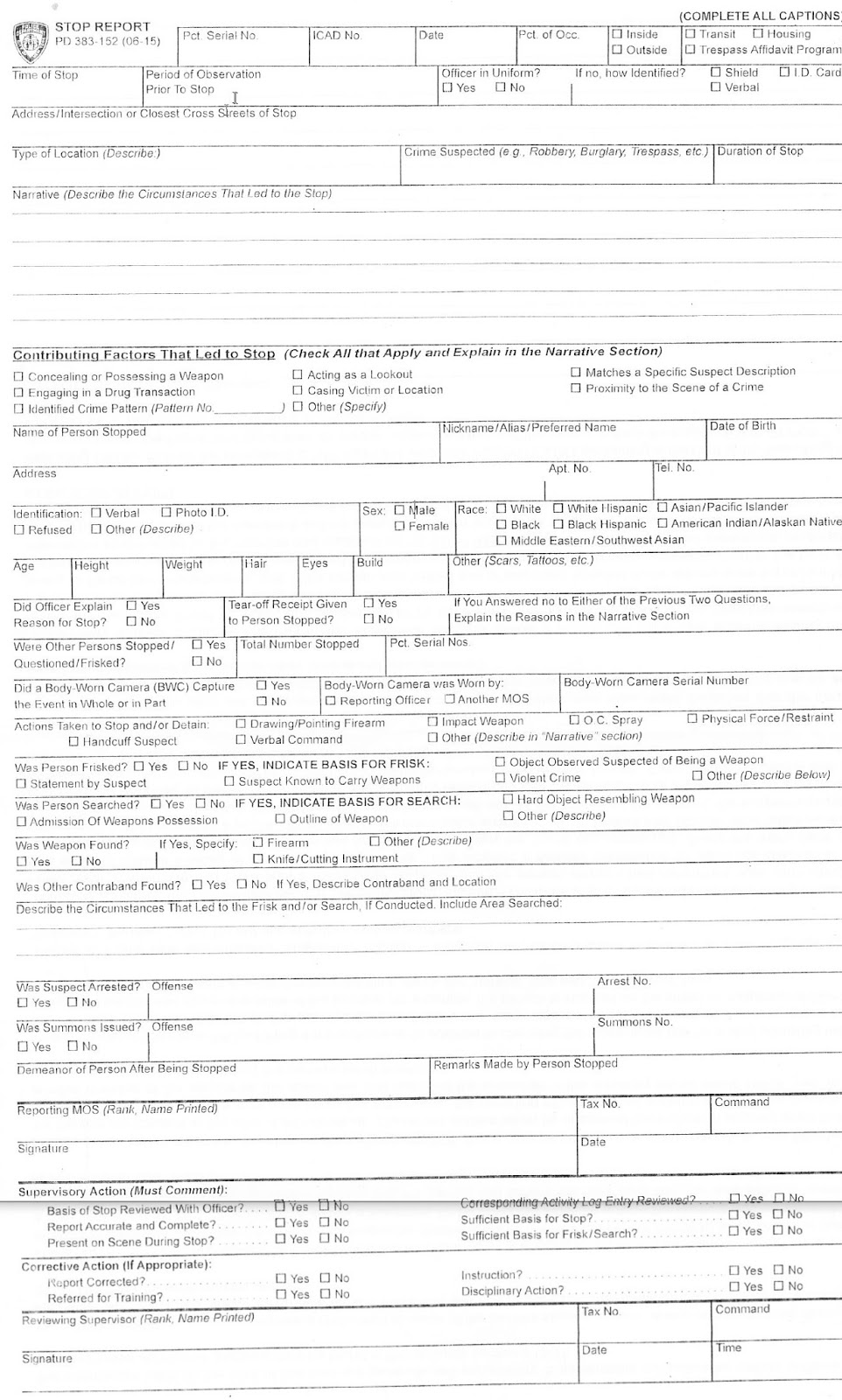
    Welcome the NYPD’s “PD 382-152” (06-15), née UF-250, AKA Stop Report, just FYI:

    This new “UF-250” replaces the old “UF-250” from 2002 that made an unconstitutional mockery of reasonable suspicion as laid out in Terry v. Ohio. (Also FYI, the original form actually called a UF-250 is long dead; long live the UF-250!)

    If the goal is fewer stops, add paperwork to each and every stop. Two things will be accomplished:

    A) There will be fewer stops.

    B) More stops will go unrecorded. (Who the hell has time or desire to fill out a form every time and tell a sergeant every time you stop somebody?)

    And what’s clever, is that in the supervisory action (must comment), you can’t just swipe down the “yes” column. It throws a “no” in there just to slow you down.

    More importantly, and correctly, there’s an actual “narrative” section. Yes, police officers will actually have to “articulate” their “reasonable suspicion” rather than checking a box saying “furtive movement.”

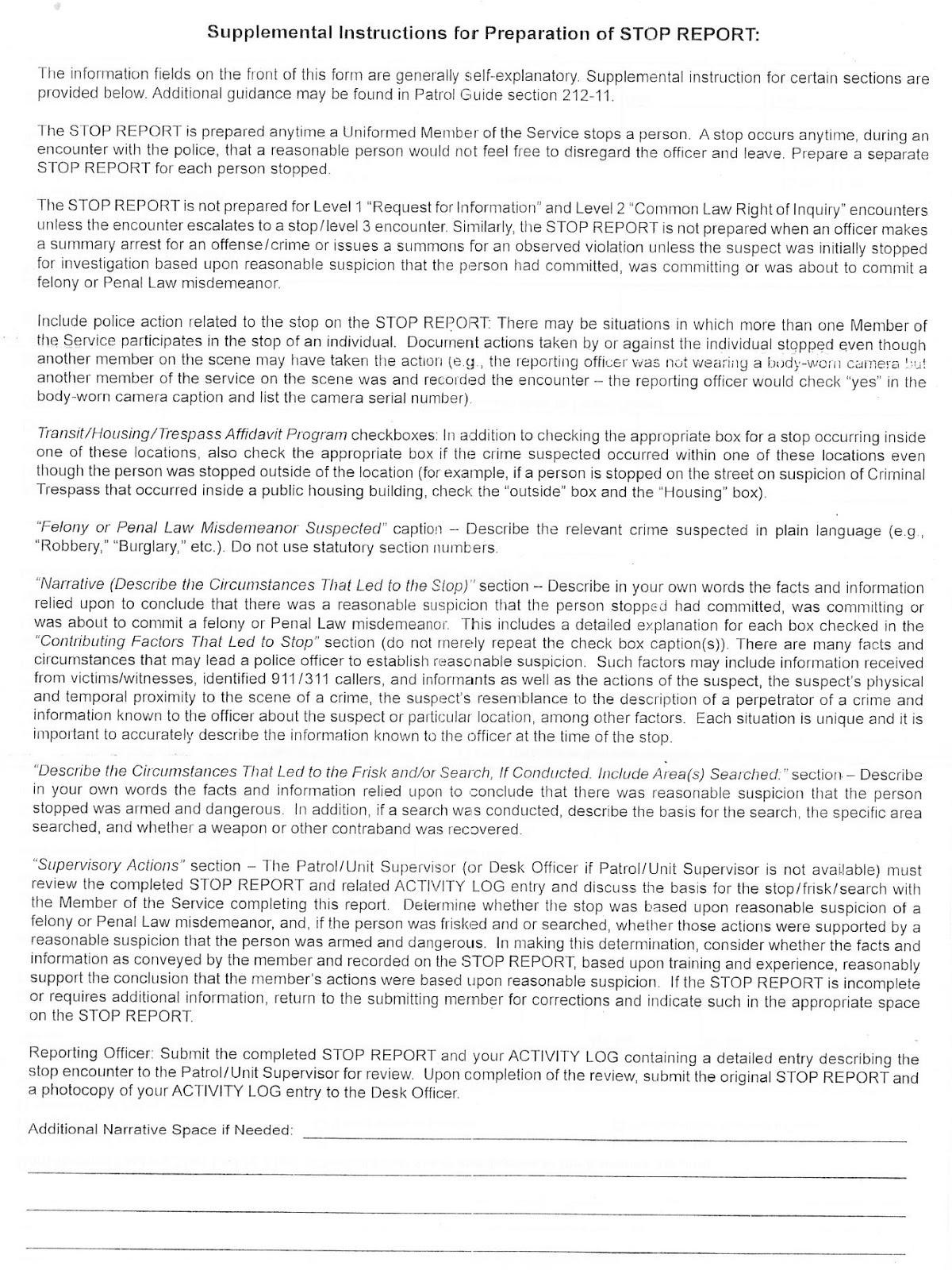
    And the back:

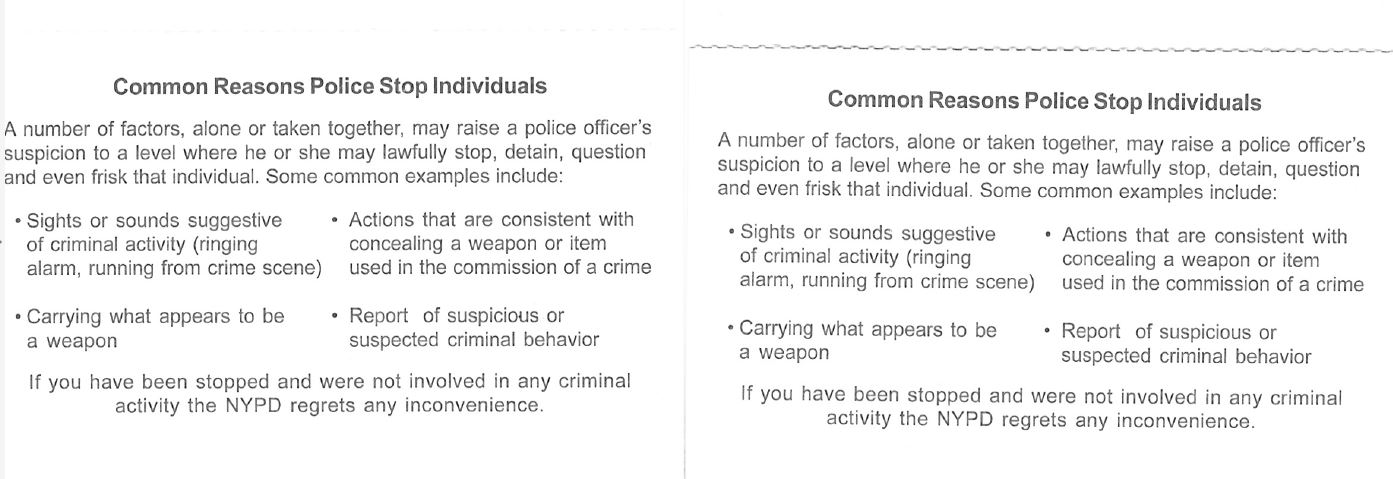
    And then you’re supposed to give the person this card (fat chance):

    Years or weeks from now, when past years’ “stop question and frisk” controversy is but a footnote to NYPD history, this form will still exist. And then, every time an officer doesn’t fill one out — because, for instance, there’s work to be done or there won’t be any forms available — he or she will be in violation of the patrol guide.

    Business as usual will adopt to get things done in a organization designed to be dysfunctional. Because we don’t really want an officer spending 5-15 minutes filling out a form and debriefing a sergeant every time they briefly stop somebody or pat a criminal down to make sure they’re not armed. (Can you “frisk” a person without “stopping” them? I don’t think so.) And then one day further in the future an officer will get in trouble for not following the absurd rules.

    Footnote from 2000: “Completion of the UF-250 form has been required since 1986. In 1997, however, Commissioner Safir declared filing the UF-250’s “a priority” that should be “rigorously enforced.” As a result, filings by the SCU, to cite one example, rose from 140 in 1996 to 18,000 in 1997.

  • Bratton calls out Kelly for calling out Bratton! It’s an NYPD smackdown!

    Bratton calls out Kelly for calling out Bratton! It’s an NYPD smackdown!

    This Kelly vs Bratton feud has been simmering in the backgroundfor a little while.

    But then when Kelly accusedBratton of cooking the books(something Kelly should be familiar with, since book-cooking constantly flared up during his reign)? Well, I’ll just sit back and enjoy the fight.

    And here’s an insiders’ tip: the good money is on Bratton.

    The NYPD took Kelly seriously enough to release an official rebuttal. And hell, Kelly is the former NYPD commissioner. He should be taken seriously.

    Now I will admit my initial thought on Kelly’s accusations: it sure is odd this year that shootings are down and homicides are up. How does that happen? What are the odds? So could Kelly be on to something?!

    Turns out: No.

    In the far corner, the former champion, the man who must be in charge, Raymond Kelly. He’s the consummate micro manager, the marine, and the man would wouldn’t let cops administer a heroin antidote (not on his watch). Kelly completely closed the department to outside researchers, transparency be damned! But he kept crime down and avoided a big scandal. (Stop, question, and frisk was not a scandal so much as a strategy.)

    I don’t think Kelly did a bad job. Not at all. But I was happy to see him go. At some level I just don’t like him. Substantively his conservative micromanaging was insane. Everything transfer and shift of manpower had to go through him. His emphasis on stats led to a lot of problems.

    The fact that below I use week-old data copied from a PDF file is entirely Kelly’s fault. And the fact that he could be so closed, on idiotic principle, even with Mike “open data” Bloomberg as mayor? It was all amazing. Kelly ran the department like nobody has ever been allowed to run that department. For 12 years, he was the boss.

    Murders did drop from a low 587 to an amazingly low 334. The last two years of his reign saw a 35 percent reduction in killings(!). And nobody took credit for it. Kelly didn’t want to take credit for a crime drop at the exact moment it was coinciding with a massive drop in stops, since each and every one of those stops, so he said, was absolutely necessary to prevent a rise in homicides. And Kelly’s opponents sure didn’t want to give the big bad NYPD credit for anything at all. So we had the largest drop in homicides since the mid 1990s… and nobody noticed.

    Kelly ran the NYPD, something Bloomberg didn’t want to do. But Bratton is doing what De Blasio can’t do. De Blasio needs Bratton a lot more than Bloomberg needed Kelly, and also much more than Bratton needs de Blasio.

    So in this corner, the current champion, William Bratton. He’s a bit more polished, a bit more educated, some might even say… smarter. Bratton is also conservative, mind you, but in a more intellectual way. Bratton understands the politics of policing. Bratton is also more open to transparency and sharing data. The fact that the same limited NYPD Compstat data is available in 2015 in spreadsheet form? Well, that’s progress, I guess. (But there’s no reason he couldn’t have (Now can we please get open crime data like this.)

    I like Bratton because of his track record, his intelligence, and his support and understanding of Broken Windows policing. Also Bratton, unlike Kelly, understands why, other things being equal, it’s better if people don’t hate the police. Kelly really didn’t give a shit what people thought. He knew he was doing a good job. That was enough.

    I’ll give Kelly the benefit of the doubt and not doubt his motives. Kelly probably really believes what he’s saying. Unlike some former commissioners, at least Kelly is nota crook. Now that he’s not in charge, he knows things must be going to hell. Besides, people are constantly telling him things are going to hell.

    Kelly always surrounded himself with yes-men. He wasn’t a micromanager because he trusted others. And now you’ve got a bunch of old friends who remain loyal to him. Cops hate de Blasio and everything happening right now (the latter is a constant, by the way, no matter what is happening). And maybe there was actually a case of a shooting that was downgraded. It happens. So these old buddies get together with Kelly and, over a soda water, tell him all the bad that is happening. Kelly believes it to be God’s truth, since it’s coming from his people. His loyal people.

    So why did Kelly do this? Probably not just to sell books. Though maybe Kelly found out he enjoys talking to the press. Those with big egos tend to like seeing themselves on the tee-vee.

    But back to the issue at hand. How do you tell if shooting victims aren’t been counted?

    I thought I would look for smoke in the ratio of homicide to shooting victims. But to find out which of the NYC homicide victims were shot, you have to go the UCR data (the FBI’s Uniform Crime Report). So I did that. After a fun couple of hours on SPSS, I got the answer. For the past 15 years, about 60 percent of homicide victims are shot. It hasn’t changed much. No smoking gun.

    Between 1999 and 2013 (but excluding 2006 and 2008, for UCR data quality reasons. And keep in mind, if you run the numbers, the UCR undercounts homicides by about 5 percent because it looks at incidents. Like everybody else, I ignored this and assumed a constant error rate) approximately 60 percent of homicide victims were shot. But I already told you that. But it’s worth pointing out that this number remains pretty consistent over these years, which I was not expecting. And over these years, it turns out the odds of dying if you’re shot in NYC is about 15 percent (which is substantially lower than I thought it was. Much lower).

    In other words, in 2013 there were 334 people killed in NYC, about 195 of those were shot (188 incidents recorded by the UCR plus a few multiple homicides). There were 1,300 shooting victims, according to the NYPD, people with gunshot wounds.

    Now we, the UCR, doesn’t yet have gunshot deaths from 2014, much less 2015. (Though I’m sure the NYPD does, now about that openness…)

    We do have shooting victims and total homicides recording by the NYPD (the former is surprisingly difficult to tease from the UCR, which is yet another UCR problem).

    If the number of shooting victims were being artificially reduced, one would expect the ratio of shooting victims to total homicides to be way down this year. And it is. But just a bit: to 3.9:1 from 4.2:1 in 2014. But it turns out that 2014 is the odd year, not this year. 4.2 is the highest that ratio has ever been. It was 3.9 also in 2012 and 2013. The average over the past 15 years in 3.4. The ratio is steadily increasing, probably due to better medical care. Maybe hospital closings affect this rate. Or maybe it’s just statistical variance (AKA: bad luck). But no, the numbers don’t look funny this year.

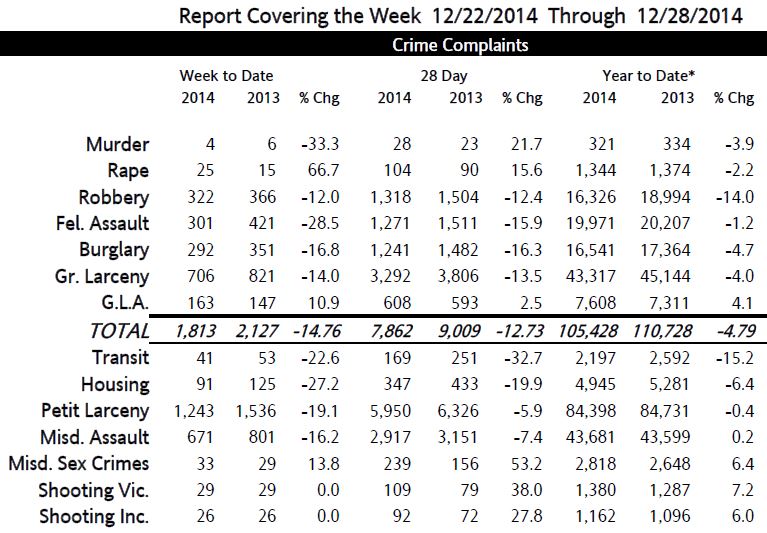
    Anybody still with me? One quick double-check: last year (2014) compared to the previous year (2013) the number of shootings should be down and homicides up (the opposite of this year). And yes, indeed, that is the case.

    Look at the “year to date” columns for the two years and the rows “homicide” and “shooting vic.”


    I’m betting on Bratton.

    Update: Gothamist jumps into the ring with a folding chair! And Bratton hits againin the Daily News. And the Inspector General, that’s the new oversight department under the Department of Investigations that is still in search of institutional meaning, stays mum.)
  • “Fruit and other food in season… seems to have been completely overlooked”!

    “Fruit and other food in season… seems to have been completely overlooked”!

    The good ol’ days…

    I love spending time in John Jay College’s great Lloyd Sealy Library browsing NYPD annual police reports from 100 years ago. Even older ones are available to the public online.

    In 1912 the total force was 10,371 plus 268 civilian.

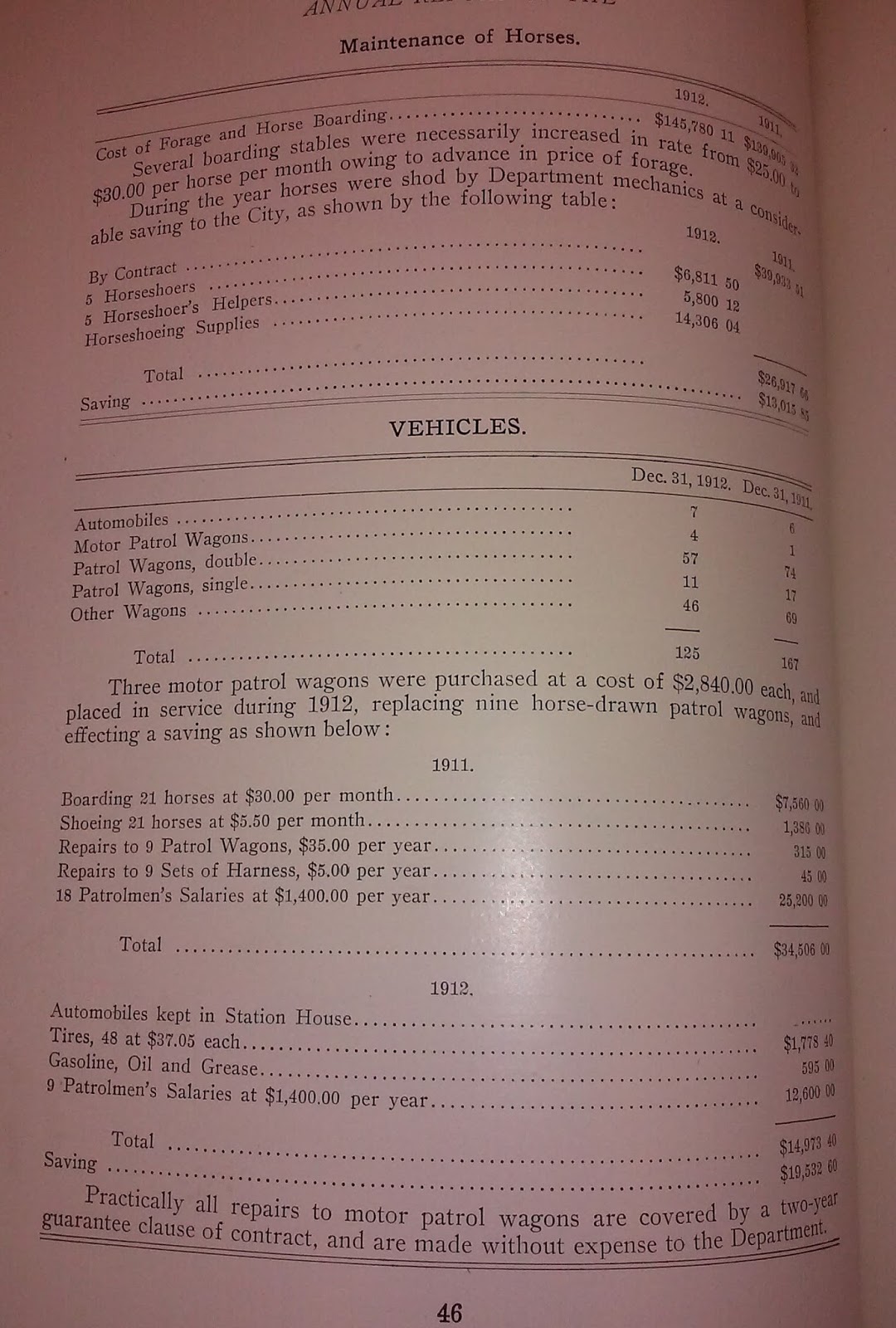
    Three motor patrol wagons were installed during the year 1912 [making 4]. It is proposed to immediately purchase ten additional wagons of the same type. Each of these vehicles replaces three horse-drawn wagons. The savings in salaries of the drivers alone pay for the original cost of the vehicle [$2,840] in about six months.

    There were the 25 motorcycles, 55 bicycles, and 679 horses (139 patrol wagon, 483 saddle service).

    Crime and arrests: 300 homicides, 107,227 misdemeanor arrests (60,493 for intoxication and/or disorderly conduct), and 18,780 felony arrests (242 for cocaine, 2 for opium).

    Pay was to be not less than $1,000 for a patrolmen. Pension was requested to be 2% per year after 25 years of service.

    In 1919 NYC had 5.6 million people and 10,000 cops, the ratio of which was considered a big low compared to other cities.

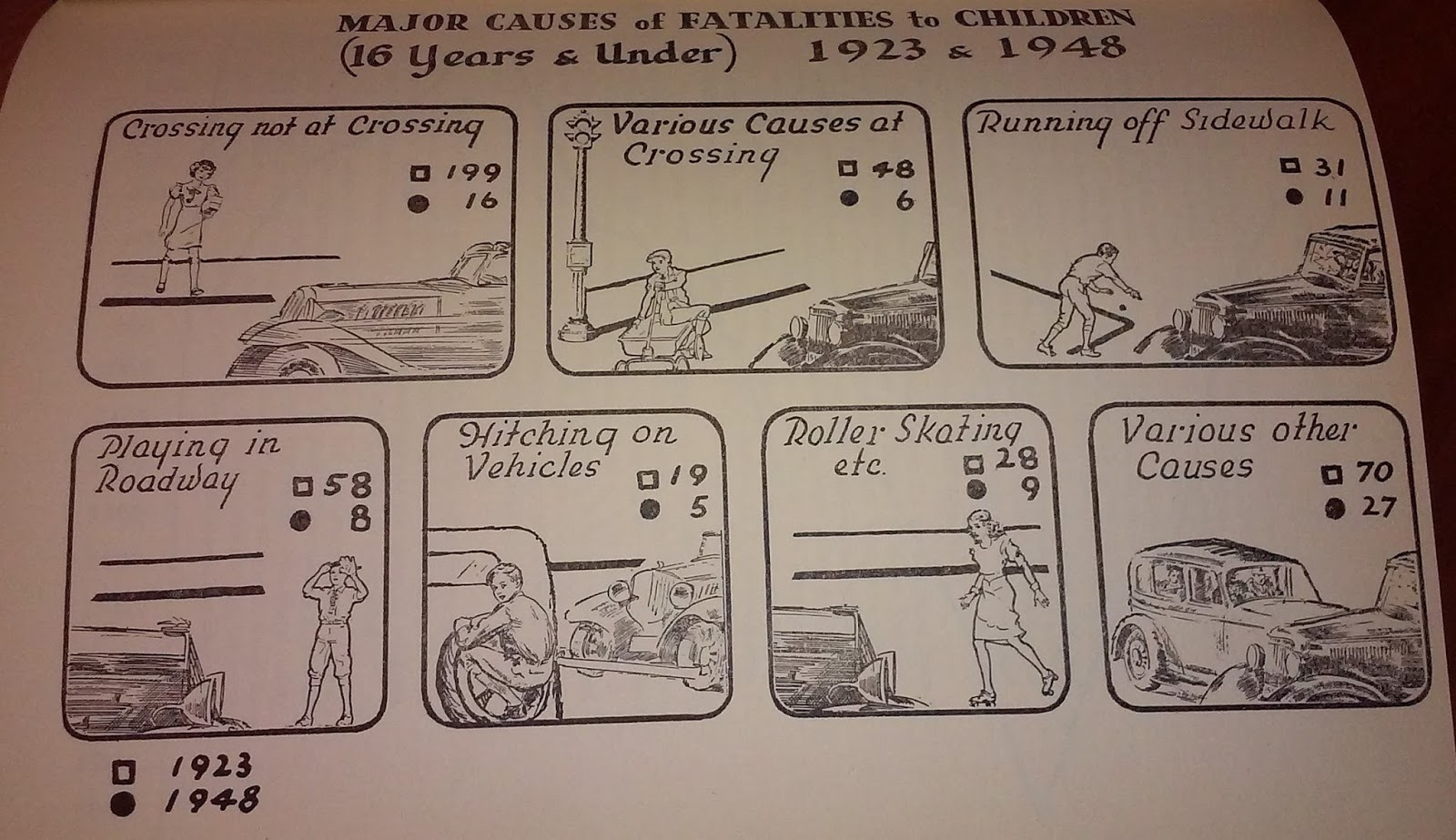
    In 1925, 453 children 16 and under were killed by cars and trolleys. That’s a lot! By 1948 this number was brought down to 82. In 2015 there were 250 people of all ages killed by traffic. I guess the 1920s was the first time in human history when kids weren’t supposed to play in the streets.

    I love the category of “roller skating, etc.”

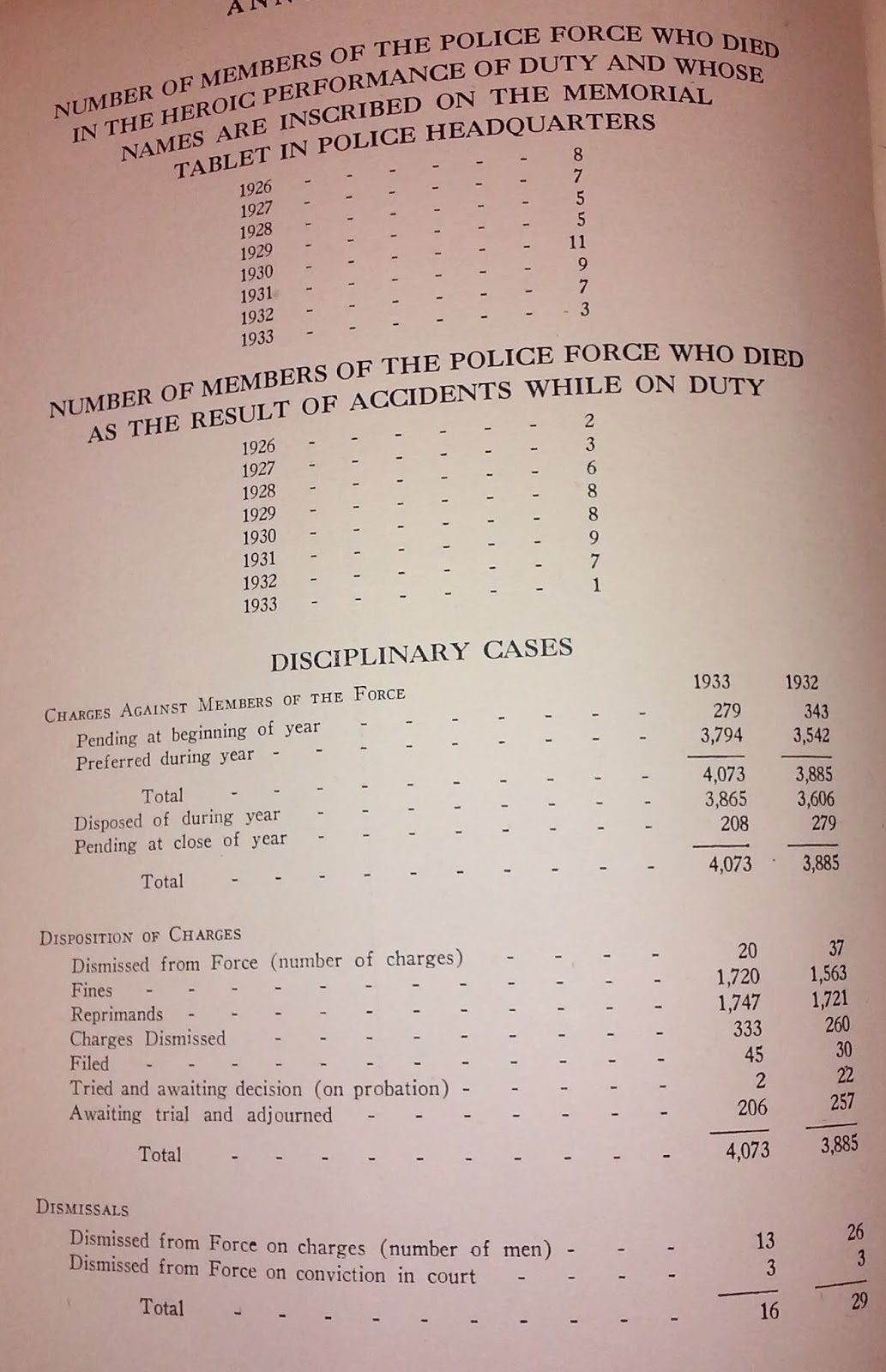
    From 1926 to 1933, an average of 7 officer a year “died in the heroic performance of duty.” An additional 5.5 died “as the result of accidents while on duty.” There were just under 19,000 uniformed personnel.

    In 1933, at the end of prohibition, there were 431 murders: 6 homicides from bootleggers’ dispute (down from 16 in 1932), 3 narcotic disputes, 3 slot machine disputes, and 2 prostitution disputes. 997 traffic fatalities. Total arrests 460,484.

    There were 12 motorcycles with side cars, armored. 64 2-passenger radio equipped coupes were purchased. There were 240 2 passengers, radio equipped “runabouts.” 123 had no radio. Keep in mind there were one-way radios! “Standard equipment, seven tube super-heterodyne radio receivers have been installed in four hundred Department automobiles.” Radio Motor patrol made 2,162 arrests.

    Under the great Mayor LaGuardia, police re-entered the social welfare game:

    The Unemployment Relief Bureau was established to function in connection with the work of obtaining aid and relief for the unemployed.

    Members of the Force were assigned to investigate applications for the relief cases of distress, visit owners of property whose tenants were in arrears in payment of rent with a view of obtaining monetary relief from the Mayor’s Official Committee.

    Food checks were issued to families requiring assistance.

    The nature of relief rendered through the Mayor’s Official Committee was as follows:

    A) monetary assistance

    B) distribution of food tickets

    C) Distribution of fuel

    D) distribution of clothing

    E) Securing positions for unemployed

    F) cases referred to other agencies.

    1,780,600 lbs of coal distributed. 16,334 articles of clothing, 220,000 food tickets (redeemed at authorized stores) worth $684,814, $70,799 in cash.

    31,094 (!) pistol licenses were issued (bringing in $286.50). 74 tear gas permits (?!) issued along with 418 religious permits (30 were disapproved). Other permits that the Pistol License Bureau could issue were: “auctioneers, bail bond agents, candidates for admission to the Bar, Hotel runners’ license, loud speaker permits, masque ball permits, massage operators, massage institute license, miscellaneous investigations, piston license, religious permits, tear gas permits, various investigations for the Department of License.”

    By 1939 homicides in the city dropped to 291 (78 shooting, 96 cutting, 85 assault). There were still 326 motorcycles and 375 horses in service.

    In 1948 there were 315 murders. 93 were shootings and 59 were categorized as “marital or passion.”

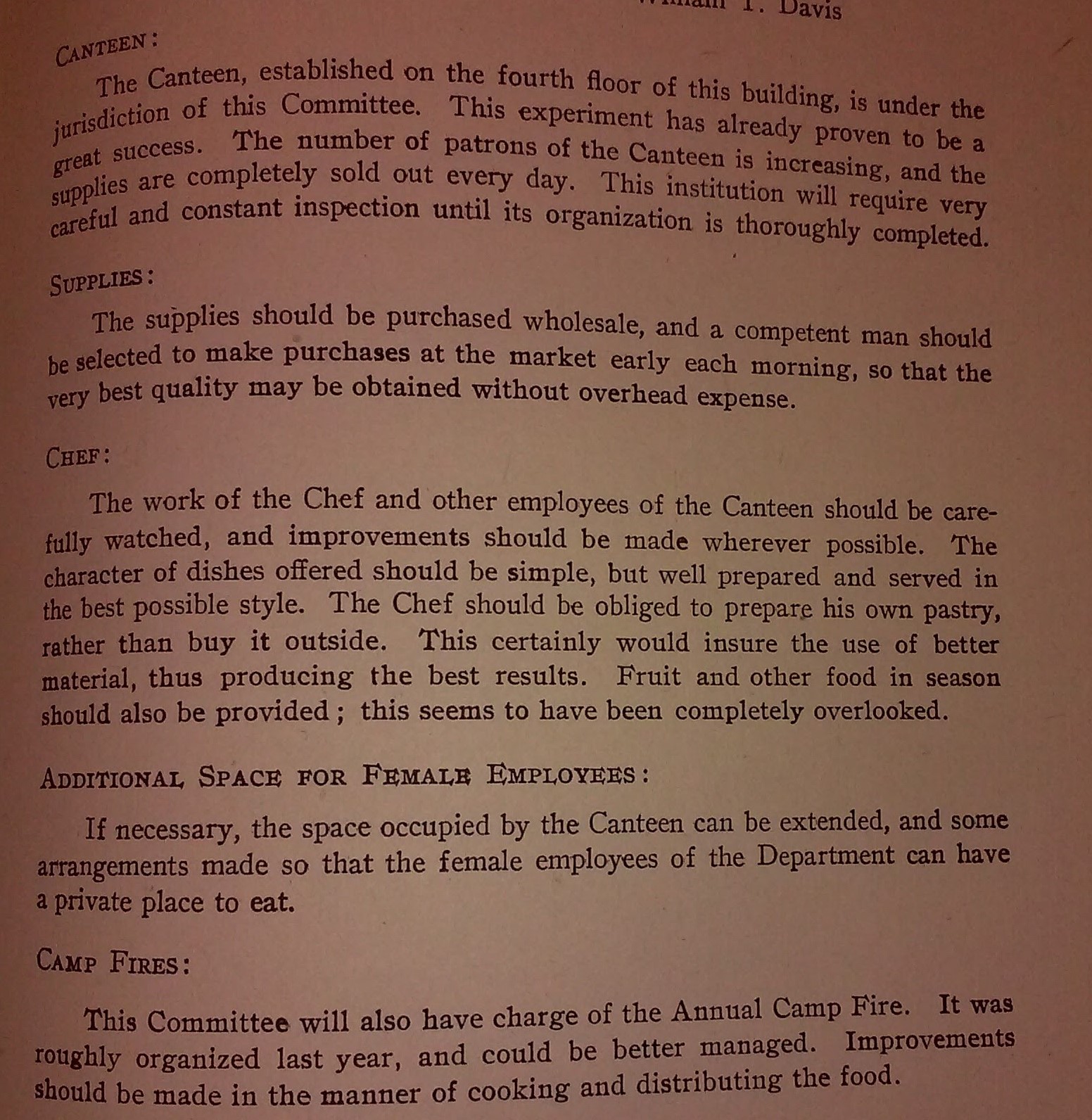
    My favorite part goes comes from the 1913 report and the complaint about the lack of “fruit and other food in season” at the canteen, something “that seems to have been completely overlooked”! Well, I say, the Chef does need to up his game!

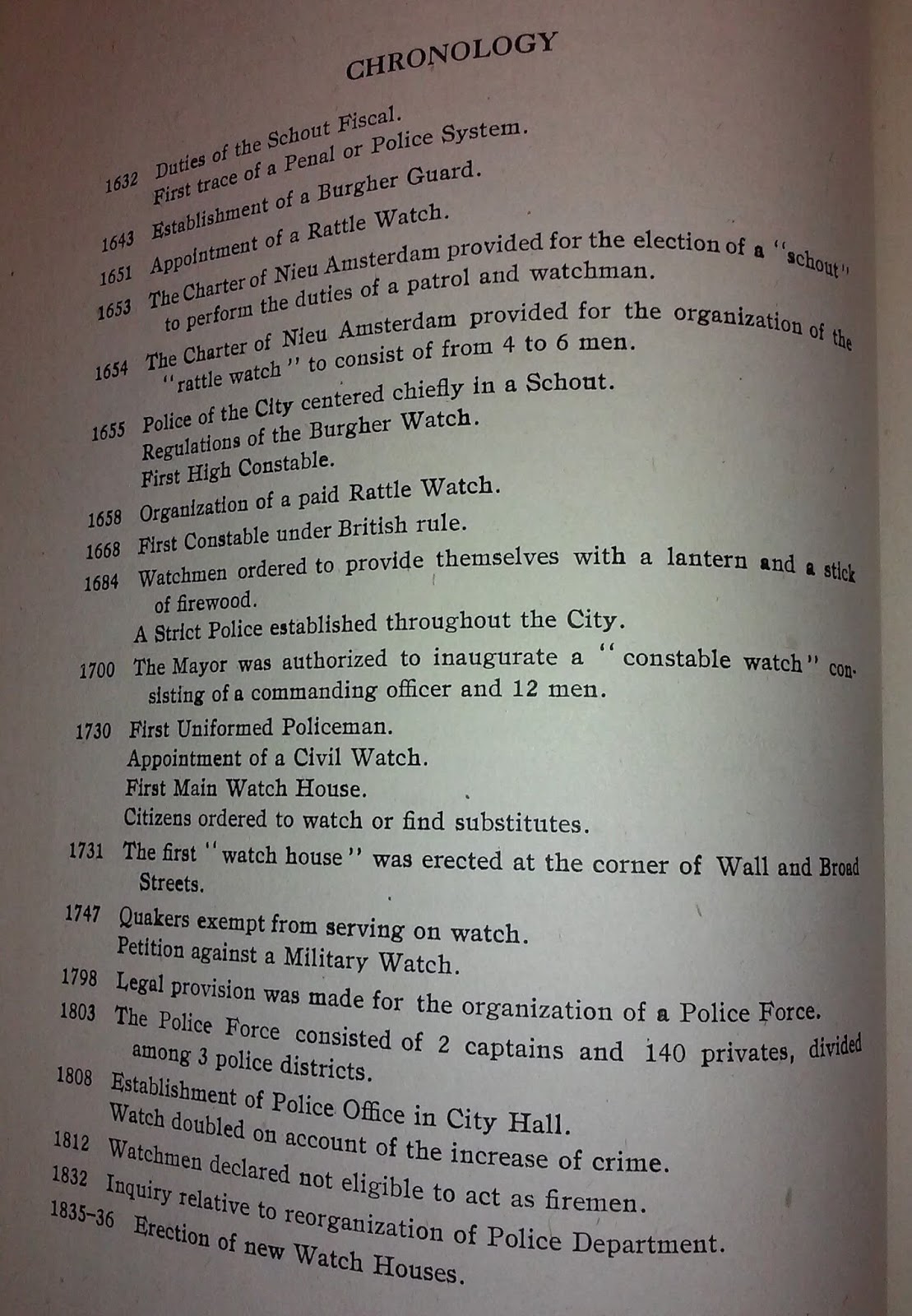
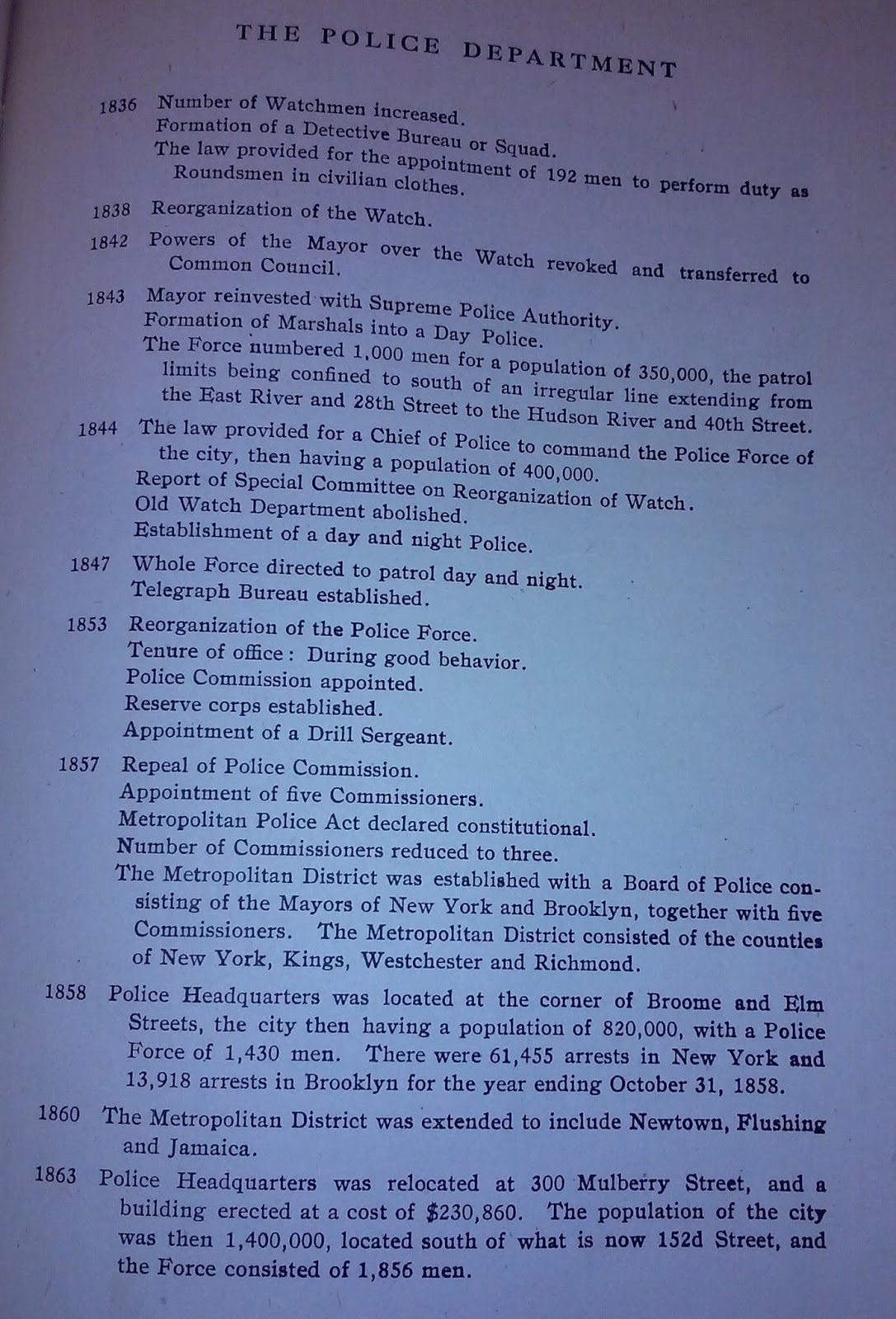
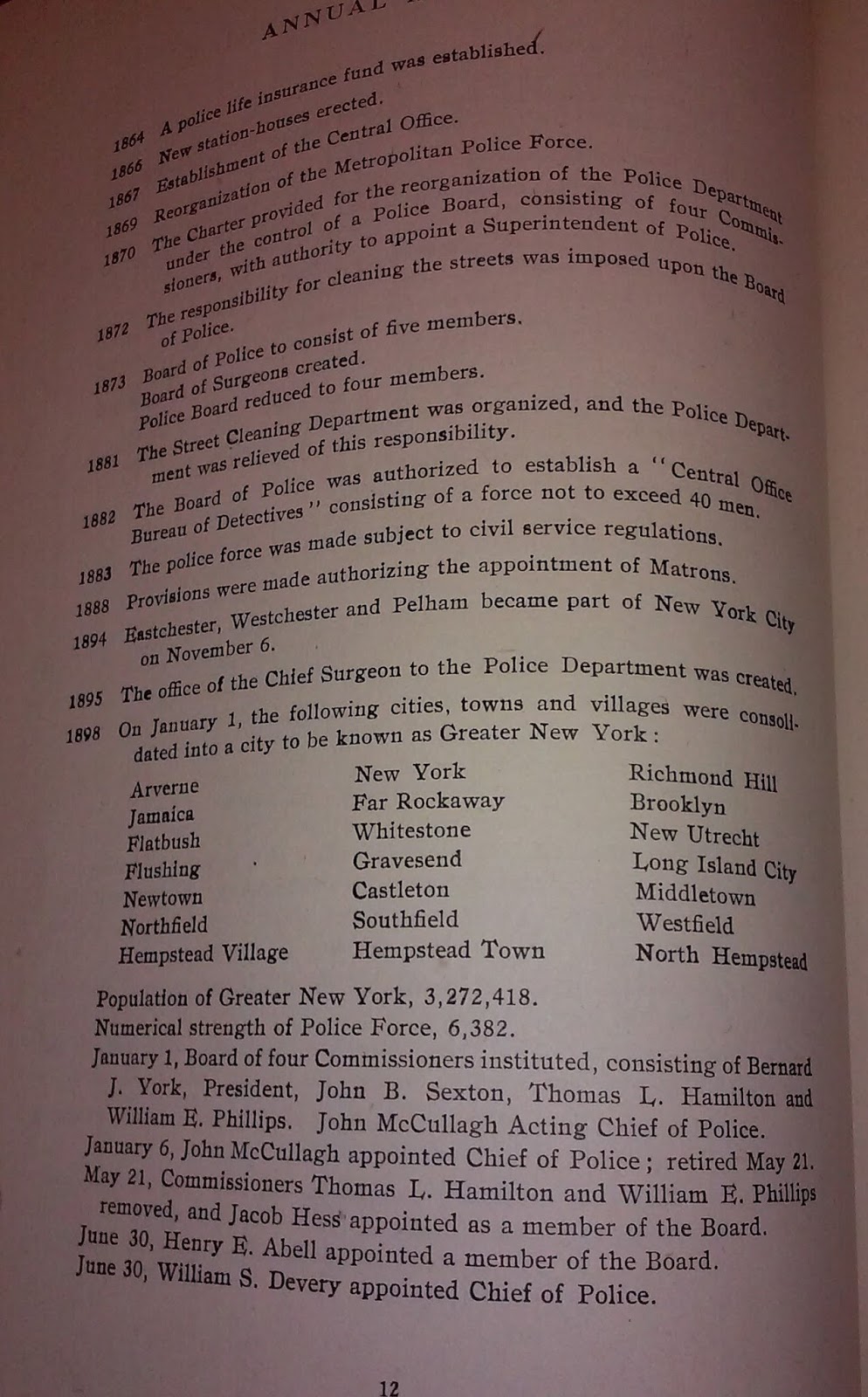
    And here’s the official chronology of the NYPD, up to 1900:


  • 2015 NYPD firearms discharge report

    2015 NYPD firearms discharge report

    From the NYPD firearms discharge report for 2014:

    In adversarial conflict, 58 NYPD officers fired 201 rounds in 35 incidents.

    In total, 104 NYPD officers fired 282 rounds shot in 79 incidents.

    18 incidents involving animal attack.

    There were 4 suicides.

    In adversarial conflict:

    41% of officers fired one round. No officer had to reload.

    52% of those shootings were in Brooklyn.

    14 suspects shot and injured.

    8 shot and killed.

    1 suspect was “unarmed.”

    4.9 million “radio assignments involving weapons.”

    4,779 gun arrests.

    1,172 criminal shooting incidents.

    2 officers injured.

    2 officers killed.

    To put the NYPD in perspective, according to the data from the Guardian’s The Counted, 7 people have been killed in New York this year (2015). Compare that some other cities:

    Miami and Indianapolis: 8 each.

    Dallas and Oklahoma City: 7 each.

    San Jose, San Francisco, Austin, Las Vegas (NV): 6 each.

    Bakersfield, CA: 5.

    Collectively those cities have fewer people than New York City. And those other cities have seen 53 people killed by police this year.

    For the NYPD:

  • Schoolcraft gets $600K

    Adrian Schoolcraft wanted money and he got it, according to the Post.

    Schoolcraft wasn’t the first to point out that the NYPD was under intense (and illegal) quota pressure. He’s just, as I wrote.

    The only one, in my humble opinion, who has tried to martyr himself and turn number fudging into a tidy personal $50 million profit. He and his father have tried twice before to sue police departments for money. Maybe the third time is the charm.

    It was.

    Here’s what I’ve written about this, in chronological order.

    May 6, 2010. The NYPD Tapes

    May 19, 2010. School[craft] Readings

    August 13, 2010. Like Father Like Son?

    March 10, 2012. No New News

    June 25, 2010. Schoolcraft Tapes

    August 10, 2010. Schoolcraft sues NYPD for $50 Million

    November 10, 2010. NYPD Quotas (and Schoolcraft)

    October 16, 2015. “Adrian Schoolcraft is no Frank Serpico”