Tag: use of force

  • “Number Two” at the range

    “Number Two” at the range

    Two days ago in the Bronx, an NYPD sergeant shot and killed Deborah Danner, a 66-year-old with schizophrenia armed with a baseball bat. Deborah Danner’s death is a tragedy. It is a failure of the system. But almost immediately, the officer who shot was stripped of his badge and gun and denounced by the mayor and police commissioner. DeBlasio — who according to the Times, “struggled to answer basic questions about the shooting” — felt he knew enough to throw the cop under the bus:

    The shooting of Deborah Danner was tragic, and it is unacceptable. It should never have happened. It is quite clear our officers are supposed to use deadly force only when faced with a dire situation. And it’s very hard for any of us to see that that standard was met here.

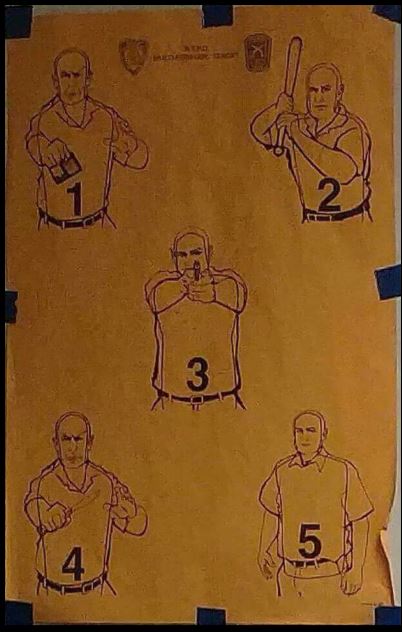
    Really? At NYPD target practice, there’s a simple shoot/don’t-shoot scenario. (This is something we did not have in Baltimore, which might help explain the NYPD’s overall extremely low rate of using lethal force.)

    The guy with a bat is known as “Number Two.” When you hear, “Number Two,” you’re supposed to see the guy with a bat and shoot Mr. Number Two. (Also Three and Four, but not Numbers One or Five.)

    I am not saying this was a good shooting. I am saying that if we don’t want cops to shoot people with baseball bats, why do we train cops to do just that?

    The mayor continued:

    There was certainly a protocol that called for deferring to the Emergency Service Unit (ESU). That was not followed. There was obviously the option of using a taser. That was not employed. We will fully investigate this situation and we will cooperate fully with any prosecutorial agencies. We need to know why this officer did follow his training and did not follow those protocols.

    [The New York State attorney general said he would not investigatethe shooting.]

    Protocol, so I hear, does say that officers confronted with an emotionally disturbed armed person (apparently initially naked and armed with scissors) should back off, close the door, and call for ESU and wait.

    I’m not convinced the department really wants this to happen all the time. This protocol, let’s call it Plan B, would tie up a few officers for a few hours in what would then be a barricade situation. It would also draw on the military-like resources of ESU.

    Plan A is for two cops to simply handle the inncident quickly and professionally, and get back in service to handle the next call. When violating “protocol” is routine, even encouraged, it’s not fair to only crack the whip when things go bad.

    But one thing about these events is they can change police culture quite quickly. ESU is now going to have a lot more work, for better or for worse. But wouldn’t be ironic if ESU responded to every call, especially in light of demands to de-militarize the police? And then what happens when ESU kills somebody? Then we blame ESU?

    Then who do we call? The really issue is that police shouldn’t be responding to this type of call at all.

    Here’s Alex Vitale (whom I’m actually agreeing with!) in the Gotham Gazette:

    The fact that police had to even be dispatched in the first place is a sign that something went wrong.

    Health officials knew about this woman’s condition…. Why was she returned to her apartment without adequate ongoing supervision or care?

    Yet thousands of profoundly disabled people continue to roam the streets and subways or idle away at home with little or no support, leaving police to deal with the crises that inevitably result.

    The mayor was wrong when he said that current training is adequate and this was just the mistake of a single officer. Ultimately, police are the wrong people to be responding to a person experiencing a mental health crisis.

  • “Chicago cop murders unarmed man after fender bender”

    That’s the headline that wasn’t.

    Instead we have this headline: “Officer Didn’t Shoot Attacker Because She Feared Backlash.”

    A 43-year-old female 17-year-veteran suffered this:

    The man had punched her and “repeatedly smashed her face into the pavement” until she was knocked out, police said. She suffered head trauma and multiple cuts to her face and head.

    When you’re a cop losing a fight and a man is bashing your head on the ground trying to kill you, it’s OK to shoot the guy. Can we agree on that?

    Fran Spielman in the Sun-Times:

    A “simple traffic accident” that turned ugly.

    “A subject who was under the influence of PCP attacked a female officer. Viciously pounded her head into the street as her partner was trying to get him off of her. This attack went on for several minutes,” [Chicago Police Supt.] Johnson told the assembled dignitaries.

    “As I was at the hospital last night visiting with her, she looked at me and said she thought she was gonna die. And she knew that she should shoot this guy. But, she chose not to because she didn’t want her family or the department to have to go through the scrutiny the next day on national news.”

    The superintendent said he plans to turn that around by “encouraging” his officers and assuring them he has their backs.

    “But, at the same time, we know we have to change this national narrative that the cops are the bad guys. The cops are actually the good guys trying to do a difficult job,” Johnson said.

    It took many cops to arrest this guy. And three of those cops were hurt. The female officer is still hospitalized.

    Tribune Columnist (and fellow Greek American) John Kass:

    She’s alive, but what if she had pulled her gun and used it?

    We’d be going through the old rituals we know by heart, angry activists, the dead re-created as the victim of state-sponsored racism, politicians cowering and turning their backs on her, the entire urban political liturgy we’ve seen so many times.

    Cops are getting in trouble for shooting armed suspects. You think she’s get a pass for killing an unarmed black man? (I’m not 100 percent certain the man is black, but the neighborhood is.)

    “She murdered an innocent unarmed man!” “They should have helped him after his accident.” “How could one man be a threat to multiple officers?” “They didn’t have to kill him!” And indeed, they didn’t. He was taken alive.

    Of course the guy who beat the cop is a violent felon. But who would hold that against him after being victimized by police? I’m sure there’s a nice picture of him and relatives willing to say how “he was turning his life around” and would “never hit a woman.” Who would believe Chicago cops?

    So this officer was willing to let herself be beat to unconsciousness in order to save her family and the department from the now inevitable “scrutiny” had she decided to use lethal force.

    So what should have she done? Honestly, I don’t know. I’m not convinced she made the wrong choice. The reality today is there would be hell to pay if she shot the guy. Her job and family might be ruined. There would be protests. Threats. She could lose her job or face criminal prosecution. She might have to move and take her family into hiding. She made her choice. But that is a choice no cop should ever have to make, especially at the moment when your face is smashed on concrete again and again and the world fades into darkness around you.

  • “Why’d you have to shoot that criminal with a gun?”

    So much of the body-cam debate, releasing or not releasing videos, comes down not to police behavior but to this:

    I know, as a lifelong police officer, that I see people on the worst day of their lives. People shouldn’t feel like when the police come to your house that what’s happened to you is going to be splashed all over the Internet.

    But it will.

    I’ve long advocated punting the releasing of video and privacy issue to the ACLU. If police take the lead on this, no matter what they choose, they will be faulted. There needs to be a policy based on something other than public outrage. And generally I’m all for erroring on the side of transparency. And that’s probably the way it has to be as long as people are willing to say people are holding books when they’re holding guns.

    As my colleague says:

    “What you’re seeing is basically a policy of appeasement,” said Jon Shane, a professor at the John Jay School of Criminal Justice in New York City and a former police captain in Newark, N.J.

    Shane said state legislatures should decide the rules for making recordings public. In California, lawmakers have repeatedly failed to draw up statewide policies on the issue.

    There’s also this factor:

    Beck acknowledged the anger surrounding the weekend’s shootings and said he believed some of the reaction has been compounded by other police killings around the country.

    “We have all seen police-involved shootings that defy justification in other municipalities. I have seen them where I am at a loss to understand why,” he said. “I think that affects what happens on the streets of Los Angeles.”

    This concerns the shooting of Carnell Snell Jr. in Los Angeles.

  • Dejuan Yourse Arrest

    For the life of me, I can’t figure what Yourse is going to be charged with. Even with the game rigged in cops’ favor, I don’t see a crime. Yourse is under arrest after 9:10 when the officer doesn’t take kindly to Yourse invited his friends over. I can understand why the officer doesn’t want a posse of friends showing up at the scene, but what’s the crime? This was in Greensboro, NC.

    I’d be curious to see how he’d be able to articulate reasonable suspicion at 8:13. I’m not saying he couldn’t; it’s a low standard. But I’d like to see how. That’s when things go South. Before that moment, everybody is playing along and sticking to the script. Poking a guy rarely serves any tactical benefit. Alternative if you don’t want him to leave? Hold your palm out. If you’re going to make physical contact, let the suspect initiate it. Also then you’re in a better position to push back or grab.

    After that, it becomes your standard shit show of trying to get a guy’s hands behind his back. First he is resisting arrest. But then even when he isn’t, it would seem like that because he’s so built that his arms don’t physically move in a way that can be cuffed (without double cuffs). Anyway, resisting arrest is a charge, but first you actually to be arrested for a crime before you can be charged with resisting. The standard catch-alls — loitering, failure to obey, disorderly — none of those even seem to apply here.

    Anyway, word on the street (ie: a journalist told me) is that the officers resigned. I’m not going to defend how the male officer handled this. He sure could have benefited from de-escalation or common sense. I mean, as long as he doesn’t come back wanted, I’m pretty convinced he’s not breaking into the house. Too bad she wasn’t handling this with him running the warrant check. But why in the world would she resign? Unless the lied on her report or something.

    Also, once again, you have cops serving as force multipliers, forced into a situation by a call from an ignorant and/or racist citizen. That happens a lot. But it may not be the case here.

    My wife just told me that Yourse actually was wanted on some warrant, but the cops didn’t know that yet when the arrested Yourse. According an attorney for the Greensboro Police Association:

    Once Mr. Yourse was taken into custody, the officers were able to continue attempting to verify his identity. Upon doing so, it was learned that Mr. Yourse had two active warrants for his arrest, along with two additional orders for his arrest [?]. Additionally, they discovered that Mr. Yourse had been charged twice in the past for breaking into his mother’s house, 2 Mistywood Ct.

  • State Variance in Police Use of Lethal Force

    State Variance in Police Use of Lethal Force

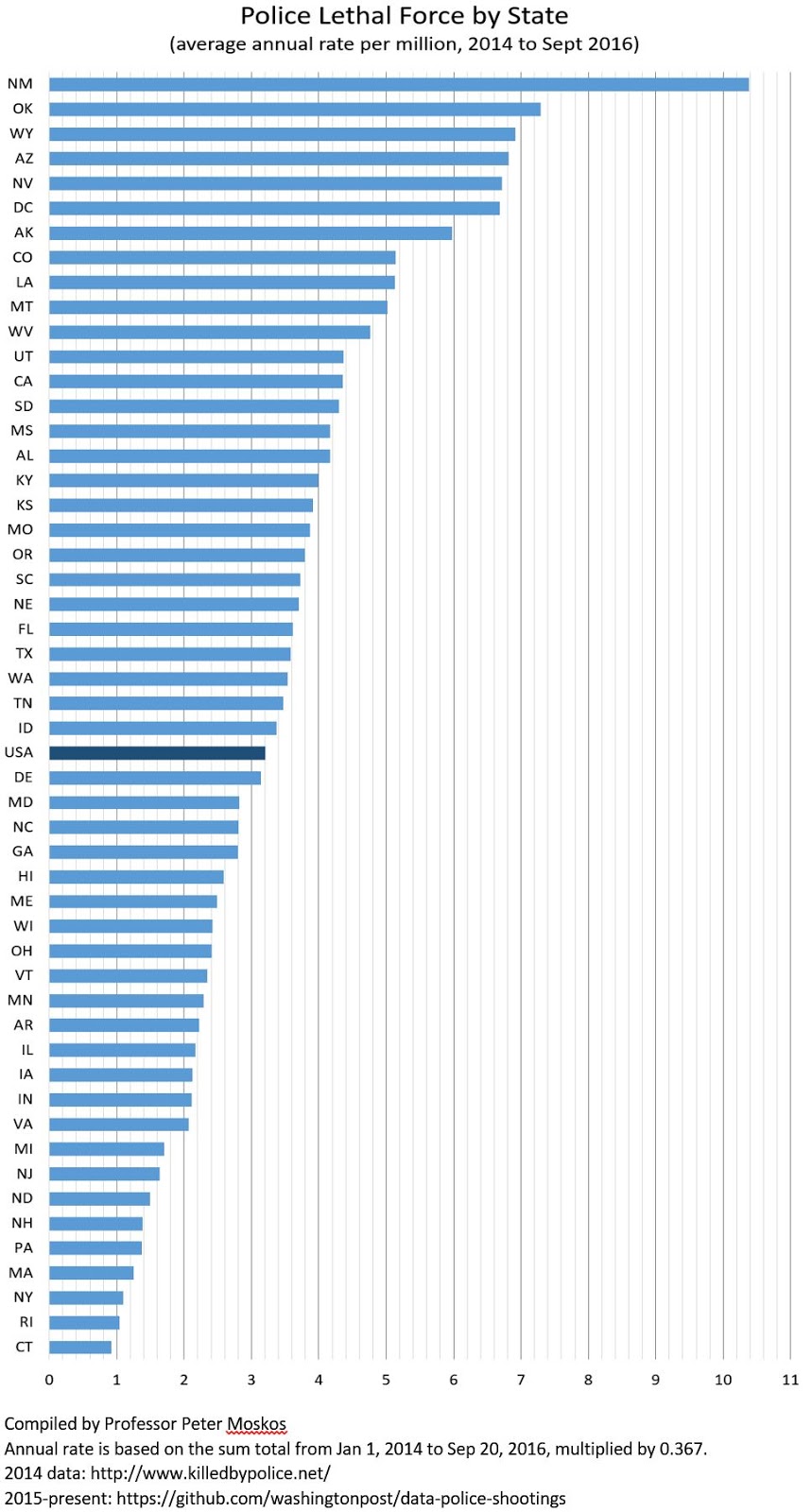
    If we want to reduce police-involved shootings— and we do — why not focus on states where cops shoot the most and learn from states where cops shoot the least? These differences are huge. What is New Mexico doing wrong? What is New York doing right? The top twenty states (ignoring D.C.) are all west of the Mississippi. Arkansas is also noteworthy. I would expect it to be toward the top, but its rate of 2.2 is below the national average.

    Take this chart with a grain of salt.

    [See 2020 caveat.]

    The data are uncorrected and I can’t promise it’s error free. And the absolute number (n) for many states is low (18 have n < 20, for instance), so the data for a lot of these states are statistically dodgy. But the greater regional trends are pretty pronounced.

    Here are the raw numbers, sorted small to large: RhodeIsland 3, NorthDakota 3, Vermont 4, NewHampshire 5, Delaware 8, Connecticut 9, Maine 9, Hawaii 10, SouthDakota 10, Wyoming 11, Alaska 12, DistrictofColumbia 12, Montana 14, Idaho 15, Iowa 18, Arkansas 18, Nebraska 19, Massachusetts 23, WestVirginia 24, Kansas 31, Minnesota 34, Mississippi 34, Utah 35, Indiana 38, Wisconsin 38, NewJersey 40, Oregon 41, Michigan 46, Maryland 46, Virginia 47, Pennsylvania 48, Kentucky 48, SouthCarolina 49, Nevada 52, Alabama 55, NewYork 59, NewMexico 59, Tennessee 62, Missouri 64, Louisiana 65, Washington 68, Colorado 75, Illinois 76, Ohio 76, NorthCarolina 76, Georgia 77, Oklahoma 77, Arizona 125, Florida 196, Texas 263, California 460, USA 2787

  • Trends in NYPD police-involved shootings

    Trends in NYPD police-involved shootings

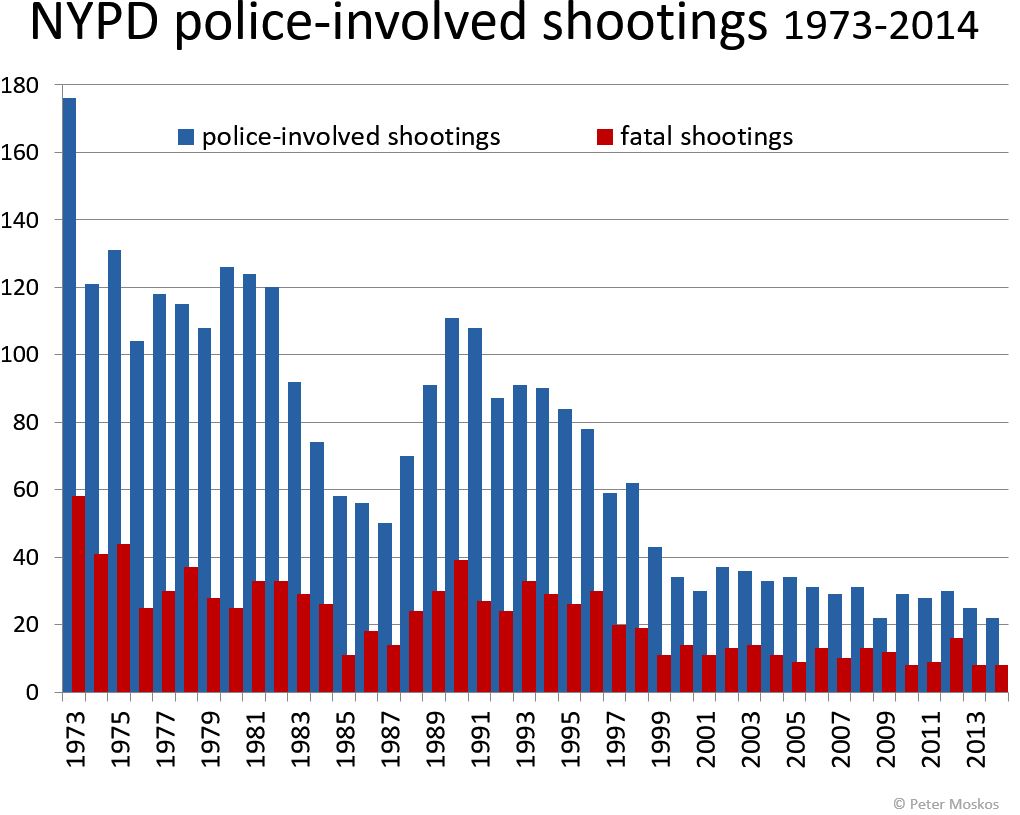
    In relation to my previous post, it’s not like the NYPD didn’t used to shoot a lot of people.

    There are two trends going on here. Police-involved shootings always reflect homicide numbers. (Cops are more likely to shoot a murder with a gun.) So there’s a spike in 1990 the then a big drop after that, which reflects crime in NYC. But even taking that into account, there’s a long-term downward trend. I have no idea what the long-terms trends in Oklahoma have been.

    Source: NYPD

  • They’re just Sooner to Shoot in Oklahoma

    They’re just Sooner to Shoot in Oklahoma

    Updated: November 15, 2017

    Also see this 2020 update. And an important caveat.

    Using data from 2014 through mid November 2017 (killedbypolice.net for 2014 and the Washington Post thereafter) Oklahoma City Police kill an average of 6.3 per year; NYPD 0.57 a year. The rate in Oklahoma City is 11 times as high. The rate per officer is 27 times higher in Oklahoma City. That means a person is Oklahoma City is 11 times more likely to be killed by police and a police officer is 27 times more likely to kill.

    Original Post:

    I’ve said for a while that when it comes to police use of lethal-force, an exclusive laser-like focus on race is misguided. It’s is a red herring. If one actually wants to reduce police-involved shootings — as opposed to simply being outraged at the latest incident — there are easier ways to do this than eliminating racism and racial disparity in America. There are low-hanging fruits to reduce the overall level at which cops shoot people.

    There will be the next police-incident worthy of outrage. We can go from incident to incident, outrage to outrage, and pretend it’s just about race. But it’s not.

    I’m not saying race doesn’t play a factor. This is American. And indeed, blacks make up a greater percent of unarmed people killed by police. The disparity could be racial bias; it could be related to violence in segregated America; it could be something else. Honestly, we’re never going to settle the debate, and I don’t know if we need to. Police misconduct doesn’t only happen to blacks. And the numbers of innocent unarmed people killed by police is simply not that large. Nor is it increasing.

    Police have shot and killed 706 people this year. Forty-one were unarmed. Fifteen of those were black. (Keep in mind “unarmed” does not mean no threat, and conversely somebody could be armed and not be an imminent threat.) I get the argument that murder is worse at the hands of the state. I even agree with it. I understand police need to be held accountable. But at some point the numbers matter, at least to put things in perspective.

    This is a country of 320 million people. There are 765,000 sworn police officers. There are 15,000 murders (and murderers). What’s an acceptable level of police-involved shooting? What’s the goal? And if you’re not happy addressing that question, or if you think the only acceptable answer is zero, than you’re not a productive part of the solution.

    Look, I know some cops do shitty things. And others make honest mistakes. But there are more cops in America than residents of Baltimore. We can and should criticize individual incidents. But we don’t harp on every crime in Baltimore — and there are a lot — to show how the whole city is filled with evil. (And I do wish we cared a bit more about victims like Michael “Chef Mike” Bates who was just shot and killed even after he complied with the three men who robbed him.)

    Does a bomb in Chelsea mean we should ban Muslims from America? (No, is the answer.) There will be the next horrific crime and the next terrorist attack just as sure as there will be the next bad police-involved shooting. Instead we’re seeing something close to a moral panic, with police as the Folk Devils, we need to reduce how often they happen.

    There are probably a few dozen bad (as in criminally bad) police-involved shootings a year. That’s a couple a month, keep in mind. And if they’re all recorded, that’s one every other week. But far more numerous are shootings which may be legally justifiable but did not have to happen. They’re justifiable but not necessary. We’re talking perhaps something in the rage of a few hundred a year. And the bulk of these happens west of the Mississippi (see a future post). The best way to reduce bad shootings is to reduce the overall level of police lethal force.

    Twenty-five percent of those who are shot and killed by police are black. Since blacks are only 13 percent of the general population, some claim this represents an “epidemic” of police violence against African Americans. But using the overall population as the denominator for interactions with police makes no sense.

    America is filled with racial disparities in poverty, violent crime, calls for police service, and those who felonious kill police officers. I mean, 96 percent of those killed by police are men, and men make up less than half the population. Is there an epidemic of misandric cops gunning for other men? I don’t think so. It’s more likely that men are more likely to pose lethal threats to police officers.

    And this brings me back to Oklahoma, where Terence Crutcher was shot and killed by a police officer even though he wasn’t an imminent threat. A while back I red-flagged Tulsa and Oklahoma because I couldn’t help but notice: they sure do seem to be a hell of a lot of police-involved shootings in Oklahoma. And now we have more data than we did a year ago.

    We’re not seeing an epidemic of police killing black people in particular in Oklahoma. The Sooner State is pretty white (72 percent, 8.6 percent Native American, and 7.4 percent black). The racial disparity in Oklahoma is pretty much in line with the rest of the nation. Since 2014, nationwide, the average annual rate of being shot and killed by police is 3.2 per million. It’s higher for blacks (6.93) and lower for whites (2.37). That’s a 3:1 ratio.

    What we see is that more white people get killed by cops in Oklahoma than all people killed by cops in majority minority New York City. Simply put, police in Oklahoma are shooting a lot of people and the NYPD isn’t. In Oklahoma, cops shoot and kill 28 people per year. In New York City, which has more than twice as many people as the entire state of Oklahoma, police kill about 5 people a year. What gives?

    People in the state of Oklahoma are 12 times as likely as New Yorkers to be killed by police.

    People in Oklahoma City are 20 times [11 times, see update, above] as likely as people in New York City to be shot and killed by police! New York City has about 2.5 times more police officers per capita. That means an officer in Oklahoma City is about 50 times more likely than an NYPD officer to shoot and kill somebody. [27 times, see update above]
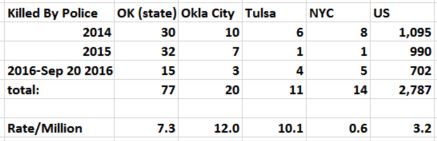
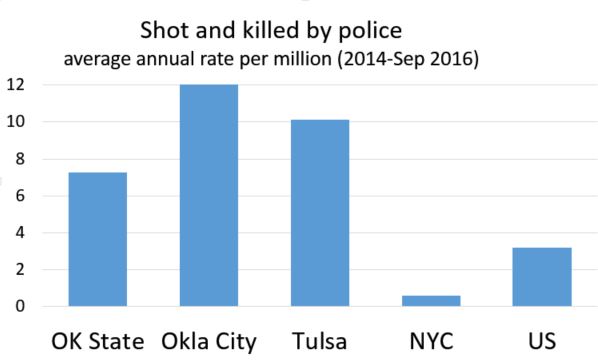
    These differences are huge! Shocking! Unbelievable!

    And yet nobody seems to notice or care. [See all the states in this post.]

    I assume most of the police-involved shooting even in Oklahoma are legally justifiable. I’m not saying these cops are committing crimes, but I am saying a large percentage of these shootings aren’t necessary. They don’t need to happen. I mean, it’s likely cops in Oklahoma will always shoot more people than cops in New York City. Sometimes police have no choice but to shoot somebody. And Oklahoma isn’t New York. But it doesn’t have to be 12 or 20 times more. I can’t conceive of how a per-capita disparity this large could be justified or explained away by any variables except police training.

    So I look at the Terence Crutcher being shot, and I think: maybe that really is how police in Tulsa roll. I don’t know. And I wonder what it is about NYPD training and policy that so reduces use of lethal force. Whatever it is, and I’m sure it’s a combination of things, it shouldn’t be that hard for somebody to copy best practices. Instead of asking what individual police officers are doing wrong (though we can ask that, too), why don’t we figure out what the NYPD is doing right? We have models that work. The solution involves some combination of better hiring standards, better policy, better training, and more accountability.

    Just reducing Oklahoma’s use of lethal force to the national average would save 14 lives a year. That seems doable. And good. It’s good for the people not to get shot. And it’s good for social and racial justice. And it’s also good for police officers who get to go home without killing somebody. Cops don’t want to shoot people. You think Officer Betty Shelby wouldn’t like to go back in time and not shoot?

    And let me mention I’m only picking on Oklahoma because of the recent Tulsa shooting. Oklahoma isn’t even the worst state when it comes to high levels of police-involved shootings. Currently, in 2016, it doesn’t even crack the top five.

    [I did some brief computations on crime (some 2015 UCR data is already out!) because police violence is best predicted by public violence. In 2014 and 2015, Oklahoma has an annual murder rate of 5.4 per 100,000. This is 30 percent higher than New York City’s 4.1. Aggravated assaults and total violent crime, however, are 35 percent higher in New York City. So it seems that Oklahoma does have a violent murder problem separate from any crime problem. But nothing here would even get close to accounting for twelve- and twenty-fold differences in police use of lethal force.]

    Notes: Annual rate is based on the sum total of Jan 1, 2014 to Sep 20, 2016, multiplied by 0.367.

    2014 data: http://www.killedbypolice.net/

    2015-present: https://github.com/washingtonpost/data-police-shootings

    Oklahoma crime stats: https://www.ok.gov/osbi/documents/Crime%20in%20Oklahoma%2C%202015.pdf

    Crime stats: http://www.criminaljustice.ny.gov/crimnet/ojsa/indexcrimes/Regions.pdf

    Race data is from the Washington Post, so it starts in 2015. Annual rate is the sum from 2015 to Sep 20, 2016, multiplied by 0.58. National rates based on 318.9 million with a white population of 200 million and a black population 36 million. Feel free to double check my math. Corrections and comments always welcome.
  • Baton Question

    Baton Question

    (Nothing to to with the DOJ’s BPD report, just FYI)

    I received a call from a deputy down in Louisiana.

    He asked if I knew of any study looking at the effectiveness of various forms of baton. I do not. Does you? Leave a comment or, should you be deterred by that process, send me and email (my email address is toward the top of this page.)

    Does anybody know of anything that compares the old-fashion straight wooden baton versus the asp versus the PR-24? (Extra credit if it includes the espantoon.)

    I think the expandable baton took over much of policing because of little more than bad supervision (“I don’t carry my baton,” said too many cops), marketing, and a general cop of toys.

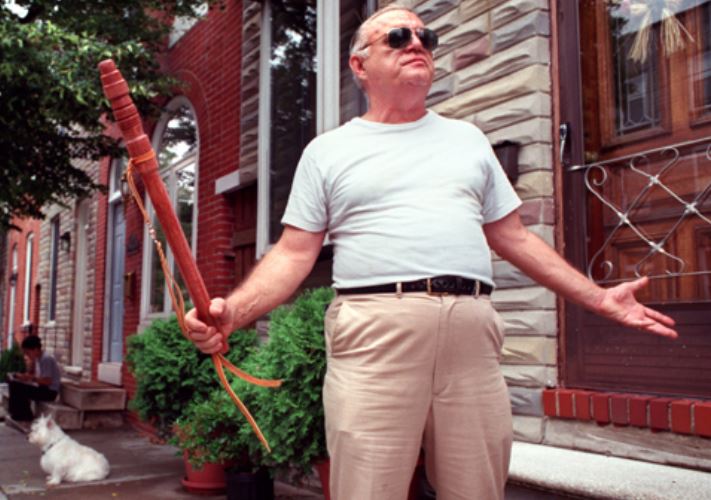
    No baton was better than a Joe “Nightstick Joe” Hlafka espantoon.

    I really wish I had one. One of my great regrets is not using an espantoon. I wasn’t good enough at using one.

  • Shooting at a moving vehicle

    Great (and thus rare) legal discussion by Whet Moser in Chicago Magazine: “Why It’s Legal for Police to Shoot at Someone During a Car Chase: CPD officers who shot at Paul O’Neal may have violated procedure, but Supreme Court decisions set a high barrier for legal liability”:

    Perhaps the law could evolve. Police departments are trying to limit high-speed chases, but right now the Supreme Court precedent is pretty clear. That alone doesn’t eliminate the possibility that, as Moskos suggests, that criminal charges could be filed. But as Steve Bogira pointed out after another shooting—in which an officer shot 16 times into the wrong car, nearly killing one of its occupants, leading to IPRA’s first recommendation that an officer be fired—criminal charges are incredibly rare. The case law surrounding deadly force and car chases would seem to make the possibility in this case rarer still.

  • “Unarmed” man shoots and kills store worker

    “Unarmed” man shoots and kills store worker

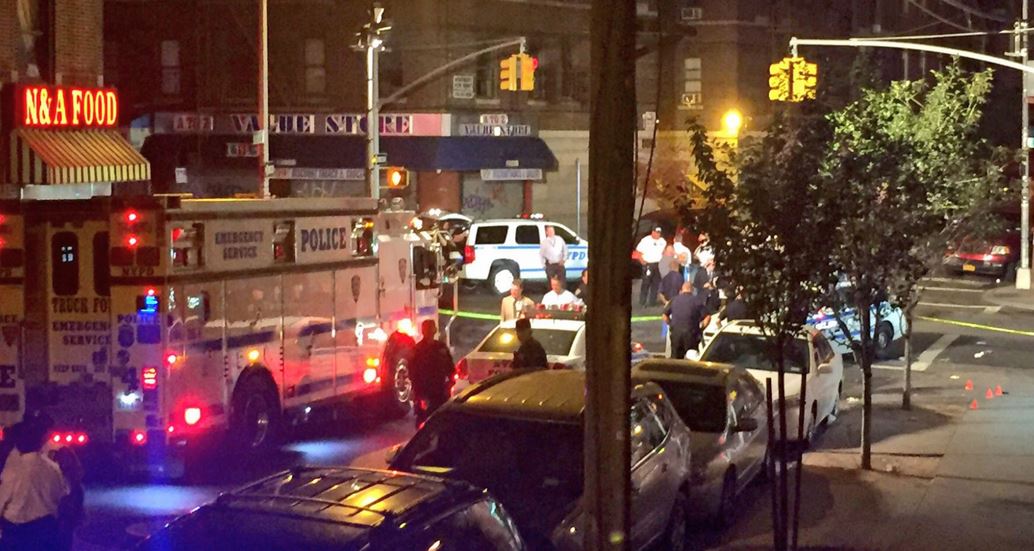
    Did you see the headline in today’s New York Counterfactual?: “NYPD Kills Unarmed Man in Bronx”:

    Protests erupted after police killed a hispanic man in a Bronx bodega. Efraim Guzman, 30, was unarmed when he was shot and killed by police. One round entering Guzman’s back.

    Police allege Guzman was engaged in a dispute at a store at 230 East 198th Street around 1 a.m. and was shot when he attempted to reach for an officer’s gun. Witnesses say the man was surrendering and surrounded by three officers when he was shot and killed in a Bronx bodega.

    Liam Murphy, the family’s lawyer, said, “A simple store dispute is no reason to kill a man. This is the kind of broken windows policing that is so lethal to young men of color.” Murphy also criticized police for confiscated the in-store video of the shooting and called the release of Guzman’s criminal record “a disgraceful attempt by police to justify this unlawful execution.”

    A store worker, 49-year-old Wally Camara, said that Guzman was being disruptive, but added, “police didn’t need to shoot him. I wish they could have resolved this some other way.”

    Pedro Moscoso, a friend of Guzman, said, “Effi was a good man, like a brother to me. He was turning his life around. He was there for you. I’ll miss his cooking. When he made mofongo, he would make extra, enough for anybody to just drop by.”

    Bronx District Attorney Darcel D. Clark said her office was investigating the shooting, and criminal charges against police could be pending. The officer who shot Guzman, a three-year veteran who has not been identifed, has been placed on administrative desk duty.

    Last year police nationwide shot and killed 18 unarmed hispanic men, according to data compiled by the Washington Post. Unarmed hispanic man are twice as likely to be killed by police as unarmed white men.

    Of course this isn’t what happened. Guzman did take a cop’s gun. And despite then being shot and wounded by police, he managed to squeeze off 15 rounds. One of those killed Wally Camara, a longtime worker at the store and immigrant from Africa.

    One of the officerslooked like he was trying to protect the civilian,” Nikunen told reporters. “He was shielding and trying to push him away as Mr. Guzman was firing shots in the store.”

    Investigators believe the victim was caught in the crossfire and not the intended target.

    Had police shot Guzman before he killed Camara, Guzman would have been another “unarmed” man of color killed by police; people would be angry. Instead Camara is another black men killed in the Bronx; people don’t care.

    So what should cops have done? Consider this, kind of like the that philosophical dilemma where a streetcar is barreling towards three men and you’re at switch-track and can flip the switch so only one man dies.

    You’re a cop. There’s a chaotic scene. Your partner is wrestling with a man. The man is reaching for your partner’s gun. At least that is what you think. Do you shoot him?

    If you do shoot, you will have killed an unarmed man of color and have to face the consequences: there will be protests; you will be on desk duty; you might face criminal trial for murder and lose your pay and your family’s health insurance. But thanks to your action, an innocent black man would still be alive.

    If you don’t shoot, a man will take your partner’s gun and kill an innocent black man. But you’ll be OK, more or less: there will be no protests; you’ll face to independent investigation; your life and job won’t be terribly disrupted.

    What would you do? Given this choice, what cop in his right mind would shoot the unarmed criminal and save a life? You’d have to be a martyr to make the morally correct choice.

    But in hindsight, knowing what we now know, of course the cops should have shot and killed Guzman before he got control of the cop’s gun. Had police had been quicker to shoot and kill Guzman, Camara would still be alive. Though we wouldn’t know that. But had this happened, would you be willing to defend the officer’s decision to shoot as correct? Or “justified.” Or at the very least “reasonable?” Unless you’re a cop, my guess is probably not.

    Guzman was a threat before he got shot, when he was still unarmed. Any time a man is trying to take a cop’s gun, cops are in a no-win pickle, since they’re fighting with an “unarmed man.” But being willing to kill a killer before he kills is not a flaw of policing; it’s a feature. By the time it was 100 percent clear Guzman was a lethal threat, it was too late. He got off fifteen rounds. Anybody on the block could have been shot and killed, but the fates picked Camara.

    The problem, the logical fallacy even, is you never know for sure what will happen. Cops sure don’t. And they have to make split-second decisions. But when a man is fighting for control of your gun, he needs to be shot. Sooner rather than later. But that is not the lesson of Ferguson. Cops are fully aware of the potential consequences of even good shootings. Some people call this “progress.” I doubt it’s any consolation to Camara’s family and friends.